


Numbers 13:24
Bible text: King James Version (1769 Blayney text) · Public domain
Bible text: Berean Standard Bible · Public domain
Bible text: American Standard Version (1901) · Public domain
Bible text: World English Bible, Messianic edition · Public domain
Bible text: Geneva Bible (1599) · Public domain
Bible text: Young's Literal Translation · Public domain
- לַמָּקוֹםla·ma·Kom<to> the placeH4725Prep-l ¦ N-msNoun Singular Masculine Absoluteלַ<to> theמָּקוֹםplace
- הַהוּאha·Hu'<the> thatH1931Art ¦ Pro-3msPronoun Personal 3rd Singular Masculineהַ<the>הוּאthat
- קָרָאka·Ra'someone calledH7121V-Qal-Perf-3msVerb Qal Perfect 3rd Singular Masculine
- נַחַלNa·chal[the] wadi ofH5158N-properNoun Proper Location
- אֶשְׁכּוֹל'esh·KolEshcolH812N-properNoun Proper Location
- עַל'alonH5921PrepPreposition
- אֹדוֹת'o·Dot[the] causes ofH182N-fpcNoun Plural Feminine Construct
- הָאֶשְׁכּוֹלha·'esh·Kolthe clusterH811Art ¦ N-msNoun Singular Masculine Absoluteהָtheאֶשְׁכּוֹלcluster
- אֲשֶׁר'a·SherwhichH834RelParticle Relative
- כָּרְתוּka·re·Tuthey cut downH3772V-Qal-Perf-3cpVerb Qal Perfect 3rd Plural common gender
- מִשָּׁםmi·Shamfrom thereH8033Prep-m ¦ AdvAdverbמִfromשָּׁםthere
- בְּנֵיbe·Nei[the] people ofH1121N-mpcNoun Plural Masculine Construct
- יִשְׂרָאֵלYis·ra·'ElIsraelH3478N-properNoun Proper Location
English is a literal word-by-word gloss of the Hebrew, not the KJV's wording. Why?
This is the original text the KJV's translators worked from — each Hebrew word with its own literal English meaning in this verse, prepared by scholars at Tyndale House, Cambridge. The KJV translates whole sentences, not word by word, so its wording differs: one Hebrew word can become several English words, and the KJV may choose “the LORD” where the gloss reads “Yahweh”. Both are faithful — they answer different questions. For the KJV's own rendering, switch to the KJV text.
Details
See on the biblical-era maps
Study this verse
Public-domain commentary
Matthew Henry
From his Commentary on the Whole Bible. Henry comments on passages, not single verses — this entry covers Numbers 13:21–25.
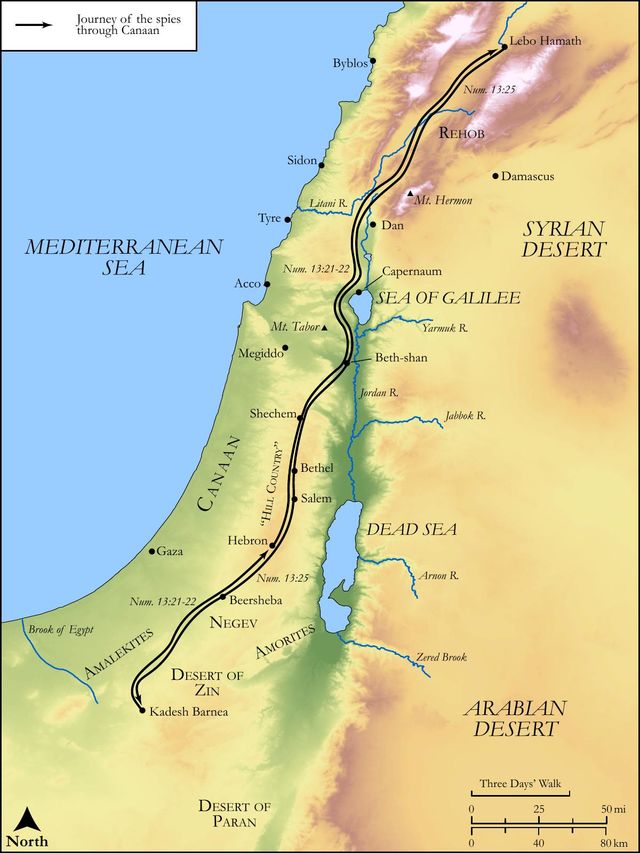
We have here a short account of the survey which the spies made of the promised land. 1. They went quite through it, from Zin in the south, to Rehob, near Hamath, in the north, Num 13:21. See Num 34:3, Num 34:8. It is probable that they did not go altogether in a body, lest they should be suspected and taken up, which there would be the more danger of if the Canaanites knew (and one would think they could not but know) how near the Israelites were to them; but they divided themselves into several companies, and so passed unsuspected, as way-faring men. 2. They took particular notice of Hebron (Num 13:22), probably because near there was the field of Machpelah, where the patriarchs were buried (Gen 23:2), whose dead bodies did, as it were, keep possession of that land for their posterity. To this sepulchre they made a particular visit, and found the adjoining city in the possession of the sons of Anak, who are here named. In that place where they expected the greatest encouragements they met with the greatest discouragements. Where the bodies of their ancestors kept possession for them the giants kept possession against them. They ascended by the south, and came to Hebron, that is, "Caleb," say the Jews, "in particular," for to his being there we find express reference, Jos 14:9, Jos 14:12, Jos 14:13. But that others of the spies were there too appears by their description of the Anakim, v. 33. 3. They brought a bunch of grapes with them, and some other of the fruits of the land, as a proof of the extraordinary goodness of the country. Probably they furnished themselves with these fruits when they were leaving the country and returning. The cluster of grapes was so large and so heavy that they hung it upon a bar, and carried it between two of them, Num 13:23, Num 13:24. The place whence they took it was, from this circumstance, called the valley of the cluster, that famous cluster which was to Israel both the earnest and the specimen of all the fruits of Canaan. Such are the present comforts which we have in communion with God, foretastes of the fulness of joy we expect in the heavenly Canaan. We may see by them what heaven is.
Historical interpretation
Historical reception
1 surviving comment on this verse from the historical church.
Later on, a sacred vine put forth a cluster of grapes that was prophetic. To those who had been led by the Educator to a place of rest after their wanderings it was a sign, for the great cluster of grapes is the Word crushed on our account. The Word desired that the “blood of the grape” be mixed with water as a symbol that his own blood is an integral element in salvation.
Continue studying Numbers 13:24 across the web’s major study libraries — every link below opens this exact verse, chapter, or book on the destination site.
Read & Compare
 BibleGatewayThis verse in more than 200 translations and 70 languages.
 Bible.comThe YouVersion reader — hundreds of translations, reading plans, and highlights.
 ESV.orgCrossway's official English Standard Version reader.
 NET BibleThe NET translation with 60,000+ translators' notes on every rendering decision.
 STEP BibleTyndale House's free study tool — original text, vocabulary, and scholarly resources.
 BibliaLogos Bible Software's free web reader.
 USCCBThe New American Bible (Revised Edition) with the U.S. bishops' study notes.
Commentaries
 BibleHub CommentariesDozens of classic commentaries on this verse, gathered on one page.
 StudyLightMore than 100 commentary sets — the largest collection on the web.
 BibleRefPlain-English commentary on what this verse means, verse by verse.
 Enduring WordDavid Guzik's free commentary on this chapter, widely used by Bible teachers.
 Bible Study ToolsVerse commentary alongside Greek and Hebrew study aids.
Original Language & Research
- BibleHub InterlinearThe verse word by word — original language, transliteration, and English.
- BibleHub LexiconEvery word's original-language definition and Strong's entry.
 Blue Letter BibleDeep-study tools — Strong's numbers, concordance, and word studies.
 SefariaThe Hebrew text with Rashi and centuries of Jewish commentary.
Sermons, Hymns & Audio


TrulyRandomVerse is not affiliated with these sites and doesn’t control their content. They’re linked because they’re genuinely useful.
Summary
Numbers 13:24 serves as a geographical marker within the pivotal narrative of the Israelite spies' reconnaissance mission into Canaan. This verse specifically names "the brook Eshcol," commemorating the extraordinary discovery of a massive cluster of grapes by the returning scouts. It underscores the remarkable fertility and abundance of the land God had promised to His people, providing tangible evidence of its richness and serving as a powerful testament to divine provision.
Context
ShowHideLiterary Context
Numbers 13:24 is situated within the broader narrative of the twelve spies' mission, detailed in Numbers 13. Moses, at the Lord's command, sends one leader from each tribe to explore Canaan, assess its inhabitants, and determine its agricultural potential. The spies spend forty days surveying the land, and their return marks a critical juncture in Israel's wilderness journey. The preceding verse, Numbers 13:23, explicitly describes the cutting down of the immense cluster of grapes, along with pomegranates and figs, requiring two men to carry it. This verse then provides the etymology for the place name, solidifying the event's significance and the land's perceived abundance in the collective memory of Israel. The subsequent verses detail the spies' report, which, despite the evidence of abundance, leads to a crisis of faith among the Israelites, culminating in their forty years of wandering in the wilderness.
Historical & Cultural Context
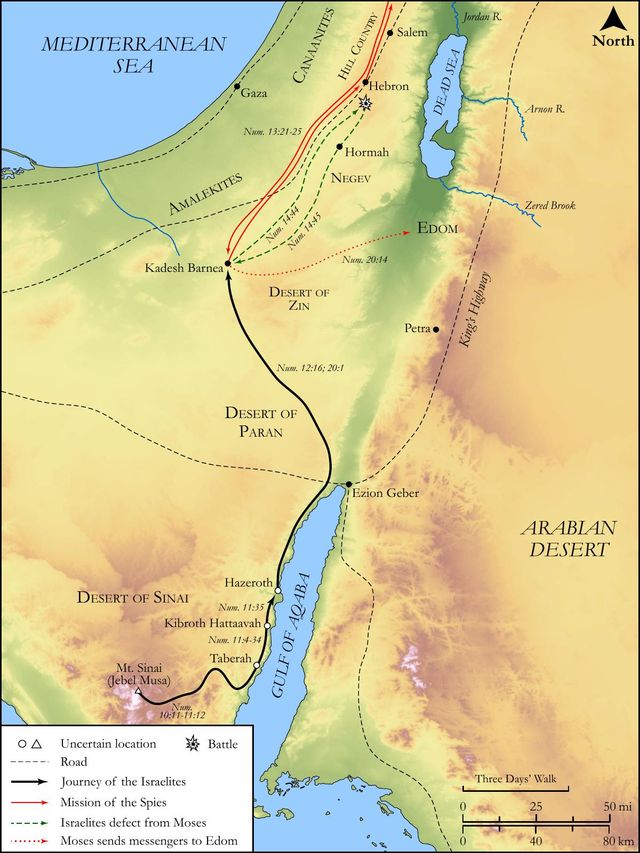
The setting for this event is the wilderness of Paran, specifically Kadesh-Barnea, which served as the Israelites' base camp before their intended entry into Canaan. The act of sending spies was a common military and strategic practice among the nations, designed to gather intelligence before an invasion or settlement. The description of Canaan as a "land flowing with milk and honey" (Exodus 3:8) was a well-understood idiom signifying extraordinary fertility and prosperity, a stark contrast to the arid wilderness through which Israel had been journeying. Grapes, pomegranates, and figs were staple crops of the region, symbolizing agricultural wealth. The size of the grape cluster, requiring two men to carry it on a pole, was not merely a detail but a hyperbolic or highly emphasized description intended to convey an almost unbelievable level of fertility, far surpassing what the Israelites would have encountered in Egypt or the wilderness. This visual evidence was meant to confirm God's promises and encourage the people to trust in His ability to deliver.
Key Themes
ShowHideThis verse, and the broader narrative of the spies, contributes to several overarching themes within the book of Numbers and the Pentateuch. Firstly, it powerfully illustrates The Abundance and Faithfulness of God's Promises. The colossal cluster of grapes serves as undeniable, tangible proof that the promised land was indeed as bountiful as God had declared, a land of extraordinary produce, not a barren wasteland. This directly fulfills the divine promise of a "good and spacious land" (Exodus 3:8). Secondly, it highlights the theme of Evidence for Faith vs. Fear. The fruit from Eshcol was intended to inspire confidence and trust in God's power to grant them victory and possession of the land, despite the presence of formidable inhabitants like the Anakim. However, as the narrative unfolds in Numbers 14, the majority of the spies, and consequently the people, succumbed to fear rather than embracing the faith that the evidence of God's provision should have fostered. Lastly, the naming of the place "Eshcol" underscores the Significance of Memory and Memorials. The place itself becomes a permanent memorial, a reminder of both God's incredible provision and, ironically, the people's failure to believe in the face of such clear evidence.
Exposition and Analysis
ShowHideKey Word Analysis
ShowHideAs the name of the valley (H812), "Eshcol" is directly linked to the Hebrew word for "cluster." This etymological connection, explicitly stated in the verse, signifies the profound impact of the extraordinary discovery. The place was named not merely for where grapes were found, but because it was so defined by this singular, remarkable cluster, serving as a perpetual mnemonic for the event and the land's fertility.
This term (H811) refers to the physical bunch of grapes. Its usage here, especially in light of the preceding verse's description of its immense size, emphasizes the unparalleled richness of the land. It serves as crucial evidence for conveying the abundant nature of Canaan, affirming the divine promise of a land overflowing with produce beyond ordinary experience.
The verb "cut down" (H3772) describes the action taken by the Israelite spies. While literally meaning to sever, its use here highlights the active engagement of the spies in retrieving the evidence of the land's bounty. This act of cutting and carrying signifies the tangible nature of their discovery, making the fruit a concrete testament to God's provision and the land's potential.
Verse Breakdown
ShowHide"The place was called the brook Eshcol"
This clause identifies a specific geographical feature, a "brook" or wadi (a valley or ravine, often dry except in the rainy season), which was given the name "Eshcol." The naming of a place after a significant event or characteristic was a common practice in ancient Israel, serving as a historical marker and a mnemonic device. It implies that this location became renowned specifically because of what occurred there, embedding the event into the very geography of the land.
"because of the cluster of grapes which the children of Israel cut down from thence"
This explanatory clause provides the precise reason for the naming of the brook. It directly links the place's identity to the extraordinary agricultural yield discovered by the Israelite spies. The "cluster of grapes" (mentioned as so large in the preceding verse, Numbers 13:23, that it required two men to carry) was the defining feature. This detail reinforces the theme of the land's incredible fertility and God's abundant provision, making the place a living testimony to the promises of the covenant.
Literary Devices
ShowHideNumbers 13:24 employs several literary devices to enhance its impact. Toponymy is central, as the verse explicitly explains the naming of a place ("Eshcol") based on a significant event (the finding of the "cluster" of grapes). This device anchors the narrative in a specific, memorable location, making the story more concrete and vivid. The extraordinary size of the grape cluster, though mentioned in the preceding verse, is the implicit reason for the naming here, serving as a form of Hyperbole or Exaggeration to emphasize the land's incredible fertility. While not directly stated as exaggeration, the sheer scale of the cluster functions to impress upon the reader the unparalleled abundance of Canaan. Furthermore, the "cluster of grapes" itself functions as Symbolism. It is not merely fruit; it symbolizes the richness, blessing, and divine favor associated with the Promised Land, serving as a tangible representation of God's covenant faithfulness and the fulfillment of His promises. The naming of the place after the object found there can also be seen as a form of Metonymy, where the part (the cluster) stands for the whole experience of abundance and the promise of the land.
Theological and Thematic Connections
ShowHideNumbers 13:24 stands as a powerful testament to God's unfailing faithfulness and the tangible reality of His promises. The immense cluster of grapes from Eshcol was not just a natural phenomenon but a divine sign, confirming that the land God promised was indeed a land of overflowing abundance, far exceeding the expectations of a people who had known only the stark wilderness. This provision was meant to build their faith, demonstrating that God's capabilities matched His declarations. However, the subsequent narrative reveals the tragic human response of fear and unbelief, highlighting the constant tension between God's perfect provision and humanity's wavering trust. The memory of Eshcol, therefore, serves as a perpetual reminder of both God's extravagant goodness and the profound cost of doubt.
Reflection and Application
ShowHideNumbers 13:24 offers a profound lesson for believers today. Just as God provided tangible evidence of His promises to Israel through the fruit of Eshcol, He continues to provide "fruit" in our lives that testifies to His goodness, faithfulness, and abundant provision. This verse challenges us to cultivate a vision of faith that sees beyond immediate obstacles and focuses on the reality of God's promises, even when faced with daunting "giants" in our own lives. It encourages us to remember God's past faithfulness and to trust that His plans for us are for "hope and a future" (Jeremiah 29:11), and that His provision is always more than sufficient. We are called to be like Caleb and Joshua, who saw the fruit and believed in God's power to overcome the challenges, rather than succumbing to the fear and doubt that led to forty years of wandering.
Questions for Reflection
ShowHideFAQ
ShowHideWhat is the significance of the name "Eshcol"?
ShowHideThe name "Eshcol" (אֶשְׁכֹּל) is Hebrew for "cluster," specifically referring to a cluster of grapes. Numbers 13:24 explicitly states that the place was named "because of the cluster of grapes" that the Israelite spies cut down from there. This name serves as a perpetual memorial to the extraordinary fertility and abundance of the land of Canaan, providing tangible evidence of God's promise of a "land flowing with milk and honey" (Exodus 3:8). It highlights the overwhelming nature of the land's produce, which was so impressive it required two men to carry a single cluster (Numbers 13:23).
Why was it important for the spies to bring back fruit from the land?
ShowHideThe primary reason for bringing back fruit, especially such an impressive cluster, was to provide concrete, undeniable proof of the land's fertility and the truthfulness of God's promises. Moses had instructed the spies to "bring back some of the fruit of the land" (Numbers 13:20). This physical evidence was intended to inspire faith and confidence in the Israelite people, assuring them that the land was indeed a good land, worthy of fighting for and settling. It was a visual aid to counteract any potential doubt or fear, though tragically, the majority of the people focused on the strength of the inhabitants rather than the land's bounty.
Christ-Centered Fulfillment
ShowHideWhile Numbers 13:24 describes the tangible fruit of a promised earthly land, it powerfully foreshadows the spiritual abundance found in Christ, the ultimate fulfillment of God's promises. Just as the cluster from Eshcol testified to the richness of Canaan, Jesus Christ is the living proof of God's boundless grace and the spiritual "fruit" of salvation. He is the true vine (John 15:1), and those who abide in Him bear much fruit—the fruit of the Spirit, which includes love, joy, peace, patience, kindness, goodness, faithfulness, gentleness, and self-control (Galatians 5:22-23). The earthly land of milk and honey, with its overflowing produce, points to the spiritual inheritance and the abundant life that believers receive through Christ (John 10:10). The failure of Israel to enter the land due to unbelief, despite the evidence of Eshcol, serves as a stark warning against spiritual apathy, urging us to enter God's rest by faith in Jesus (Hebrews 4:1-11). Ultimately, the physical abundance of Eshcol finds its spiritual and eternal reality in the person and work of Christ, who provides an inheritance far richer and more enduring than any earthly land (Ephesians 1:3-14).