


Numbers 13:25
Bible text: King James Version (1769 Blayney text) · Public domain
Bible text: Berean Standard Bible · Public domain
Bible text: American Standard Version (1901) · Public domain
Bible text: World English Bible, Messianic edition · Public domain
Bible text: Geneva Bible (1599) · Public domain
Bible text: Young's Literal Translation · Public domain
- וַיָּשֻׁבוּvai·ya·Shu·vuand they returnedH7725Conj-w ¦ V-Qal-ConsecImperf-3mpVerb Qal Consecutive Imperfect 3rd Plural Masculineוַandיָּשֻׁבוּthey returned
- מִתּוּרmi·Turfrom spying outH8446Prep-m ¦ V-Qal-InfVerb Qal Infinitive Constructמִfromתּוּרspying out
- הָאָרֶץha·'A·retzthe landH776Art ¦ N-fsNoun Singular Feminine Absoluteהָtheאָרֶץland
- מִקֵּץmi·Ketzfrom [the] end ofH7093Prep-m ¦ N-mscNoun Singular Masculine Constructמִfromקֵּץ[the] end of
- אַרְבָּעִים'ar·ba·'ImfortyH705Adj-mpAdjective Numerical Plural Masculine Absolute
- יוֹםYomday[s]H3117N-msNoun Singular Masculine Absolute
English is a literal word-by-word gloss of the Hebrew, not the KJV's wording. Why?
This is the original text the KJV's translators worked from — each Hebrew word with its own literal English meaning in this verse, prepared by scholars at Tyndale House, Cambridge. The KJV translates whole sentences, not word by word, so its wording differs: one Hebrew word can become several English words, and the KJV may choose “the LORD” where the gloss reads “Yahweh”. Both are faithful — they answer different questions. For the KJV's own rendering, switch to the KJV text.
Details
See on the biblical-era maps
Study this verse
Public-domain commentary
Matthew Henry
From his Commentary on the Whole Bible. Henry comments on passages, not single verses — this entry covers Numbers 13:21–25.
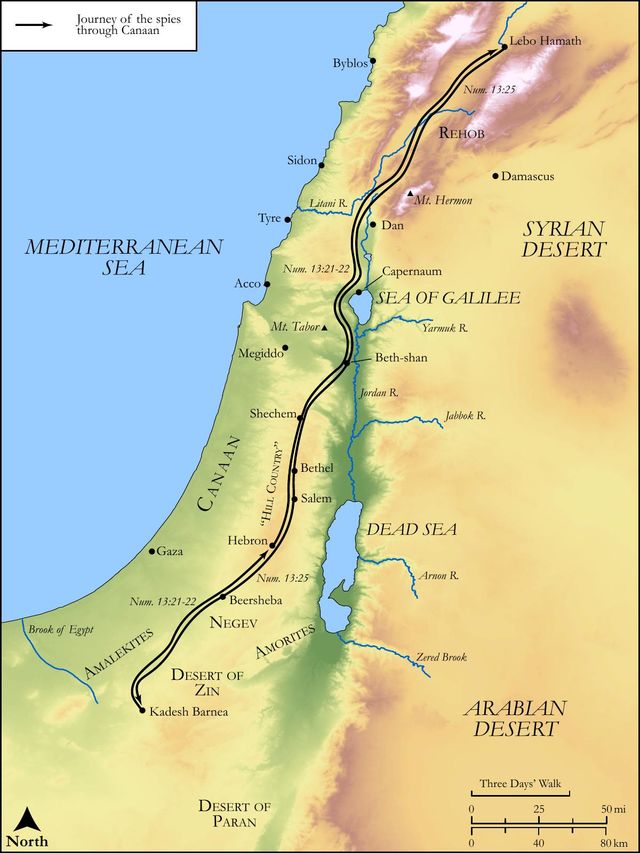
We have here a short account of the survey which the spies made of the promised land. 1. They went quite through it, from Zin in the south, to Rehob, near Hamath, in the north, Num 13:21. See Num 34:3, Num 34:8. It is probable that they did not go altogether in a body, lest they should be suspected and taken up, which there would be the more danger of if the Canaanites knew (and one would think they could not but know) how near the Israelites were to them; but they divided themselves into several companies, and so passed unsuspected, as way-faring men. 2. They took particular notice of Hebron (Num 13:22), probably because near there was the field of Machpelah, where the patriarchs were buried (Gen 23:2), whose dead bodies did, as it were, keep possession of that land for their posterity. To this sepulchre they made a particular visit, and found the adjoining city in the possession of the sons of Anak, who are here named. In that place where they expected the greatest encouragements they met with the greatest discouragements. Where the bodies of their ancestors kept possession for them the giants kept possession against them. They ascended by the south, and came to Hebron, that is, "Caleb," say the Jews, "in particular," for to his being there we find express reference, Jos 14:9, Jos 14:12, Jos 14:13. But that others of the spies were there too appears by their description of the Anakim, v. 33. 3. They brought a bunch of grapes with them, and some other of the fruits of the land, as a proof of the extraordinary goodness of the country. Probably they furnished themselves with these fruits when they were leaving the country and returning. The cluster of grapes was so large and so heavy that they hung it upon a bar, and carried it between two of them, Num 13:23, Num 13:24. The place whence they took it was, from this circumstance, called the valley of the cluster, that famous cluster which was to Israel both the earnest and the specimen of all the fruits of Canaan. Such are the present comforts which we have in communion with God, foretastes of the fulness of joy we expect in the heavenly Canaan. We may see by them what heaven is.
Continue studying Numbers 13:25 across the web’s major study libraries — every link below opens this exact verse, chapter, or book on the destination site.
Read & Compare
 BibleGatewayThis verse in more than 200 translations and 70 languages.
 Bible.comThe YouVersion reader — hundreds of translations, reading plans, and highlights.
 ESV.orgCrossway's official English Standard Version reader.
 NET BibleThe NET translation with 60,000+ translators' notes on every rendering decision.
 STEP BibleTyndale House's free study tool — original text, vocabulary, and scholarly resources.
 BibliaLogos Bible Software's free web reader.
 USCCBThe New American Bible (Revised Edition) with the U.S. bishops' study notes.
Commentaries
 BibleHub CommentariesDozens of classic commentaries on this verse, gathered on one page.
 StudyLightMore than 100 commentary sets — the largest collection on the web.
 BibleRefPlain-English commentary on what this verse means, verse by verse.
 Enduring WordDavid Guzik's free commentary on this chapter, widely used by Bible teachers.
 Bible Study ToolsVerse commentary alongside Greek and Hebrew study aids.
Original Language & Research
- BibleHub InterlinearThe verse word by word — original language, transliteration, and English.
- BibleHub LexiconEvery word's original-language definition and Strong's entry.
 Blue Letter BibleDeep-study tools — Strong's numbers, concordance, and word studies.
 SefariaThe Hebrew text with Rashi and centuries of Jewish commentary.
Sermons, Hymns & Audio


TrulyRandomVerse is not affiliated with these sites and doesn’t control their content. They’re linked because they’re genuinely useful.
Summary
Numbers 13:25 marks the pivotal conclusion of the twelve Israelite spies' forty-day reconnaissance mission into the land of Canaan. Their return to the wilderness encampment, bearing both the tangible evidence of the land's extraordinary bounty and the daunting reports of its formidable inhabitants, sets the stage for a profound crisis of faith. This moment directly precipitates the nation's critical decision regarding God's promise to give them the land, ultimately determining the destiny of an entire generation and shaping the course of Israel's wilderness journey.
Context
ShowHideLiterary Context
This verse serves as a crucial narrative hinge within the book of Numbers, specifically within the dramatic account of the spying mission in Numbers 13. It immediately follows God's directive to Moses to send out the spies (Numbers 13:1-2), the careful selection of one leader from each tribe for this task (Numbers 13:3-16), and Moses' detailed instructions concerning their exploration of the land's topography, inhabitants, and agricultural potential (Numbers 13:17-20). The completion of their forty-day journey, as stated in Numbers 13:25, directly precedes the delivery of their contrasting reports to the congregation (Numbers 13:26-33), which then tragically escalates into the people's rebellion and God's subsequent judgment in the following chapter (Numbers 14). Thus, this verse is the precise moment that shifts the narrative from preparation and execution to the critical phase of reporting, decision, and consequence.
Historical & Cultural Context
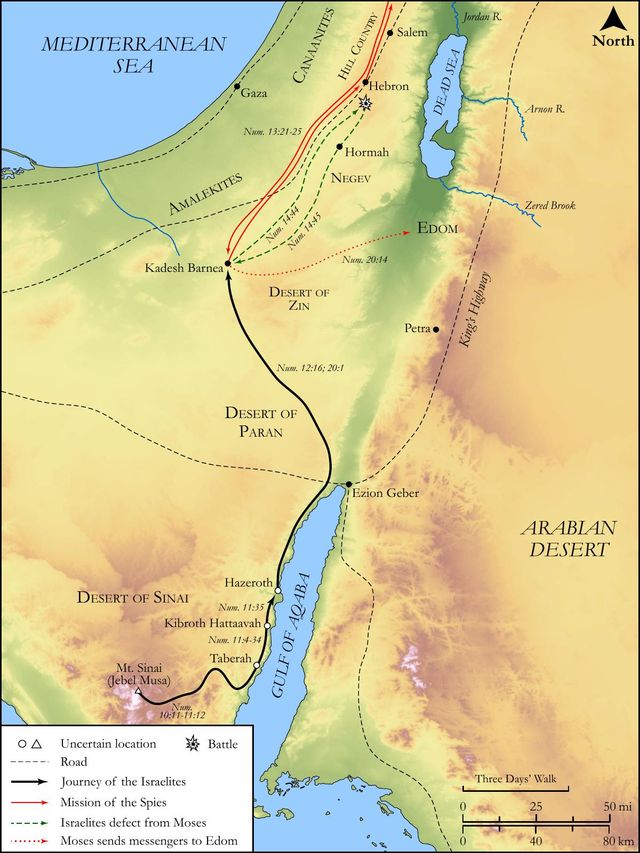
At this juncture, the Israelites were encamped at Kadesh-barnea in the wilderness of Paran, poised at the southern border of the Promised Land. The practice of dispatching scouts or spies prior to military campaigns was a well-established and essential strategic maneuver among the nations of that day. Such missions aimed to gather vital intelligence regarding enemy strength, terrain, water sources, and available resources. While God had unequivocally promised the land to Israel, this reconnaissance mission was intended to provide the people with tangible evidence of Canaan's fertility and to assess the practical challenges of conquest, thereby bolstering their faith and preparing them for the impending invasion. The spies' extensive journey would have taken them through diverse ecological zones, from the arid Negeb in the south to the fertile valleys and hills of the Hebron region, requiring them to observe fortified cities and the various formidable ethnic groups, such as the Anakim, who were known for their imposing stature and military prowess.
Key Themes
ShowHideThe return of the spies in Numbers 13:25 encapsulates several profound themes central to the book of Numbers and the broader Pentateuch. Foremost is the theme of Divine Promise versus Human Faith. Although God had guaranteed the land, the information gathered by the spies, while factually accurate, would be interpreted through the lens of either unwavering faith in God's omnipotence or debilitating fear of human obstacles. The specified "forty days" carries the significant biblical theme of Testing and Preparation, a recurring motif symbolizing a period of trial, discernment, or divine judgment before a major event or revelation. This period was a test not of God's ability, but of Israel's willingness to trust Him. Furthermore, the verse underscores the theme of Leadership and Accountability, as the twelve tribal leaders, entrusted with this crucial mission, would find their reports profoundly impacting the entire community's destiny. This pivotal moment also powerfully anticipates the theme of Consequences of Disobedience, as the people's faithless response to the spies' report would lead to severe repercussions, including the forty years of wilderness wandering—a direct consequence of their unbelief.
Exposition and Analysis
ShowHideKey Word Analysis
ShowHideThis primitive root signifies a turning back, a reversal of direction, or a coming home. In the context of Numbers 13:25, it marks the completion of the spies' outward journey and their re-entry into the Israelite camp. The act of "returning" here is not merely geographical; it carries the weight of expectation, signaling that the information-gathering phase is complete and the crucial time for decision and action has arrived. This verb brings the narrative focus back to the waiting congregation and the impending report that will set the immediate course for their future.
This primitive root means to meander about, explore, investigate, or spy out. It implies a thorough, deliberate, and comprehensive examination rather than a casual glance. The use of tûwr emphasizes the meticulous and exhaustive nature of the spies' mission, which was to gain detailed intelligence about the land's inhabitants, its agricultural potential, and its strategic features. The spies were not mere sightseers but agents on a vital reconnaissance mission, meticulously "searching" every aspect as commanded by Moses in Numbers 13:17-20. The thoroughness implied by tûwr underscores the factual reliability of the data they collected, even if their interpretation of it would later prove to be faithless.
The phrase "forty days" combines the numerical adjective "forty" (ʼarbâʻîym) with the noun "day" (yôwm), which can denote a literal day or a defined period of time. The number "forty" is highly symbolic and significant throughout biblical literature, frequently denoting a period of testing, purification, preparation, or judgment. Here, it represents the precise duration of the spies' mission, suggesting a comprehensive and arduous undertaking that allowed for a thorough exploration of the vast and diverse land of Canaan. This temporal marker emphasizes the deliberate nature of the mission and powerfully foreshadows the equally significant forty years of wilderness wandering that would result from the people's unbelief, where each day of spying would correspond to a year of punishment (Numbers 14:34).
Verse Breakdown
ShowHide"And they returned"
This opening phrase immediately signals the completion of the spies' mission and their re-entry into the Israelite camp. The "they" refers collectively to the twelve men, one from each of the Israelite tribes, who had been specifically chosen and dispatched by Moses. Their return signifies the end of the information-gathering phase and the imminent beginning of the crucial reporting and decision-making phase for the entire nation. It carries an air of profound anticipation, as the people eagerly await the discoveries made by their representatives.
"from searching of the land"
This clause precisely defines the purpose and nature of their extensive journey. They were not merely traveling through the territory but actively "searching" or "spying out" the land of Canaan, fulfilling the specific mandate given by God through Moses. This phrase highlights the investigative, intelligence-gathering, and exploratory aspect of their mission, which involved a comprehensive assessment of the land's fertility, the strength and disposition of its inhabitants, and the nature of their fortifications. It underscores that the report they were about to deliver would be based on direct, firsthand observation and thorough reconnaissance.
"after forty days"
This temporal marker precisely quantifies the duration of their mission. The "forty days" is a significant period, indicating a comprehensive and arduous exploration. Beyond its literal meaning, this duration carries profound symbolic weight within biblical narratives, often signifying a period of intense effort, observation, personal testing, or divine preparation. The precise completion of this defined period brings the narrative to a critical juncture, where the meticulously collected information must now be presented, interpreted, and acted upon by the entire congregation, setting the stage for their immediate future.
Literary Devices
ShowHideNumbers 13:25, despite its brevity, functions as a potent Narrative Bridge, seamlessly connecting the initial command and execution of the spying mission (detailed in the preceding verses) with the crucial reports and subsequent crisis of faith that unfold immediately afterward. It marks a decisive turning point, signaling the transition from preparation and exploration to reporting, decision, and ultimately, consequence. The explicit mention of "forty days" serves as powerful Symbolism, drawing upon a recurring biblical motif that signifies periods of testing, purification, or divine judgment. This specific duration not only underscores the thoroughness of the spies' mission but also acts as a profound Foreshadowing of the forty years of wilderness wandering that would be imposed as divine judgment upon the disbelieving generation, directly linking each day of spying to a year of punishment (Numbers 14:34). The verse also demonstrates remarkable Conciseness, delivering a significant narrative development with a few impactful words, thereby allowing the dramatic weight of the impending events and the gravity of the people's impending decision to build with palpable tension.
Theological and Thematic Connections
ShowHideThe return of the spies after forty days is far more than a simple logistical update; it represents a pivotal theological moment where divine promise intersects with human responsibility, choice, and the profound implications of faith or unbelief. God had already sovereignly declared His intention to give Israel the land, yet He permitted this reconnaissance, allowing His people to engage with the tangible realities of the task ahead. This period of "searching" became a crucial test, not of God's ability to fulfill His word, but of Israel's willingness to trust Him. The factual report they brought back, laden with both bounty and formidable challenges, would expose the spiritual condition of the people, revealing whether they would courageously trust God's omnipotence to overcome formidable giants and fortified cities, or tragically succumb to fear and debilitating doubt. This incident profoundly illustrates the enduring biblical principle that while God's promises are steadfast and unwavering, their realization often requires a courageous, faith-filled, and obedient response from His people, even when confronted with seemingly insurmountable obstacles.
Reflection and Application
ShowHideNumbers 13:25, though a concise statement of fact, serves as a profound and enduring reminder that moments of information gathering often precede critical junctures of decision and faith. The spies returned with the unvarnished facts about the land and its inhabitants, but it was the interpretation of those facts—whether through the lens of fear-driven doubt or faith-filled trust—that ultimately determined Israel's destiny. In our own lives, we frequently encounter "forty-day" periods of observation, research, waiting, or discernment before making significant choices or embarking on new endeavors. This verse challenges us to deeply consider how we process information, especially when it presents daunting obstacles, seemingly insurmountable challenges, or calls for a step into the unknown. Do we allow the "giants" in our path—our fears, insecurities, or the perceived strength of our adversaries—to overshadow God's unwavering promises and His limitless power? True, biblical faith is not the absence of fear, but rather the courageous decision to act in obedience to God's revealed word and character, despite the presence of fear. The tragic consequences of Israel's unbelief—forty years of wandering in the wilderness—stand as a solemn and potent warning, urging us to root our responses to life's challenges in unwavering trust in God's faithfulness, rather than succumbing to the paralyzing grip of doubt. This verse calls us to move beyond mere factual assessment to a faith-filled appropriation of God's sovereign plan and purpose for our lives, embracing the challenges as opportunities to witness His power.
Questions for Reflection
ShowHideFAQ
ShowHideWhy was the duration exactly "forty days," and what is its significance?
ShowHideThe "forty days" was the precise period allotted for the spies' reconnaissance mission, suggesting a thorough and comprehensive exploration of the vast and diverse land of Canaan. Beyond its practical duration, the number forty carries significant symbolic weight throughout the Bible, often representing a period of testing, purification, preparation, or judgment. For example, Noah's flood lasted forty days and forty nights, Moses spent forty days and forty nights on Mount Sinai receiving the Law, and Jesus was tempted in the wilderness for forty days before beginning His public ministry. In the specific context of Numbers 13, the forty days of spying directly foreshadowed the forty years of wilderness wandering that would be imposed on the Israelites as a divine judgment for their unbelief, with each day of spying corresponding to a year of punishment for their rebellion against God's command to enter the land (Numbers 14:34). Thus, the forty days highlight both the thoroughness of the mission and the impending, crucial test of faith for the entire nation.
Christ-Centered Fulfillment
ShowHideNumbers 13:25, marking the return of the spies to the very edge of the Promised Land, finds its profound Christ-centered fulfillment in the person and redemptive work of Jesus Christ. The original spies were sent to assess a physical land and its inhabitants, a mission that tragically exposed the people's lack of faith and ultimately led to their exclusion from the promised rest. In stark contrast, Jesus Christ is the ultimate and faithful "spy" or messenger sent from God, not merely to assess a physical territory, but to enter into the very "land" of fallen humanity, taking on flesh to fully understand our condition and redeem us from within (John 1:14). He is the true and faithful Joshua, the One who perfectly fulfills the role of leading God's people into their eternal and spiritual rest, a rest not found in a geographical territory but in salvation and intimate communion with God Himself (Hebrews 4:8-10). While the spies brought back a report that instilled paralyzing fear and doubt, Jesus brings the glorious good news of the Kingdom, having already overcome every "giant" of sin, death, and the power of the enemy through His perfect life, atoning death on the cross, and victorious resurrection (Colossians 2:15). His own forty days in the wilderness before His public ministry, unlike the spies' forty days, demonstrated His perfect obedience and triumph over temptation, thereby qualifying Him to lead us into the spiritual inheritance that the first generation of Israelites forfeited due to their unbelief (Matthew 4:1-11). He is the Lamb of God who takes away the sin of the world, making entry into God's holy presence and eternal rest possible for all who believe in Him (John 1:29).