


Numbers 13:23
Bible text: King James Version (1769 Blayney text) · Public domain
Bible text: King James Version with Strong's numbers · Public domain
Bible text: Berean Standard Bible · Public domain
Bible text: American Standard Version (1901) · Public domain
Bible text: World English Bible, Messianic edition · Public domain
Bible text: Geneva Bible (1599) · Public domain
Bible text: Young's Literal Translation · Public domain
- וַיָּבֹאוּvai·ya·Vo·'uand they cameH935Conj-w ¦ V-Qal-ConsecImperf-3mpVerb Qal Consecutive Imperfect 3rd Plural Masculineוַandיָּבֹאוּthey came
- עַד'adtoH5704PrepPreposition
- נַחַלNa·chal[the] wadi ofH5158N-properNoun Proper Location
- אֶשְׁכֹּל'esh·KolEshcolH812N-properNoun Proper Location
- וַיִּכְרְתוּvai·yikh·re·Tuand they cut downH3772Conj-w ¦ V-Qal-ConsecImperf-3mpVerb Qal Consecutive Imperfect 3rd Plural Masculineוַandיִּכְרְתוּthey cut down
- מִשָּׁםmi·Shamfrom thereH8033Prep-m ¦ AdvAdverbמִfromשָּׁםthere
- זְמוֹרָהze·mo·Raha branchH2156N-fsNoun Singular Feminine Absolute
- וְאֶשְׁכּוֹלve·'esh·Koland a cluster ofH811Conj-w ¦ N-mscNoun Singular Masculine Constructוְandאֶשְׁכּוֹלa cluster of
- עֲנָבִים'a·na·VimgrapesH6025N-mpNoun Plural Masculine Absolute
- אֶחָד'e·ChadoneH259Adj-fsAdjective Numerical Singular Feminine Absolute
- וַיִּשָּׂאֻהוּvai·yi·sa·'U·huand they carried itH5375Conj-w ¦ V-Qal-ConsecImperf-3mp ¦ 3msVerb Qal Consecutive Imperfect 3rd Plural Masculineוַandיִּשָּׂאֻthey carriedהוּit
- בַמּוֹטva·Moton the poleH4132Prep-b ¦ N-msNoun Singular Masculine Absoluteבַon theמּוֹטpole
- בִּשְׁנָיִםbish·Na·yim<in> twoH8147Prep-b ¦ Adj-cdAdjective Numerical Dual common gender Absoluteבִּ<in>שְׁנָיִםtwo
- וּמִןu·minand some ofH4480Conj-w ¦ PrepPrepositionוּandמִןsome of
- הָרִמֹּנִיםha·ri·mo·Nimthe pomegranatesH7416Art ¦ N-mpNoun Plural Masculine Absoluteהָtheרִמֹּנִיםpomegranates
- וּמִןu·minand some ofH4480Conj-w ¦ PrepPrepositionוּandמִןsome of
- הַתְּאֵנִיםha·te·'e·Nimthe figsH8384Art ¦ N-mpNoun Plural Masculine Absoluteהַtheתְּאֵנִיםfigs
English is a literal word-by-word gloss of the Hebrew, not the KJV's wording. Why?
This is the original text the KJV's translators worked from — each Hebrew word with its own literal English meaning in this verse, prepared by scholars at Tyndale House, Cambridge. The KJV translates whole sentences, not word by word, so its wording differs: one Hebrew word can become several English words, and the KJV may choose “the LORD” where the gloss reads “Yahweh”. Both are faithful — they answer different questions. For the KJV's own rendering, switch to the KJV text.
Details
See on the biblical-era maps
Study this verse
Public-domain commentary
Matthew Henry
From his Commentary on the Whole Bible. Henry comments on passages, not single verses — this entry covers Numbers 13:21–25.
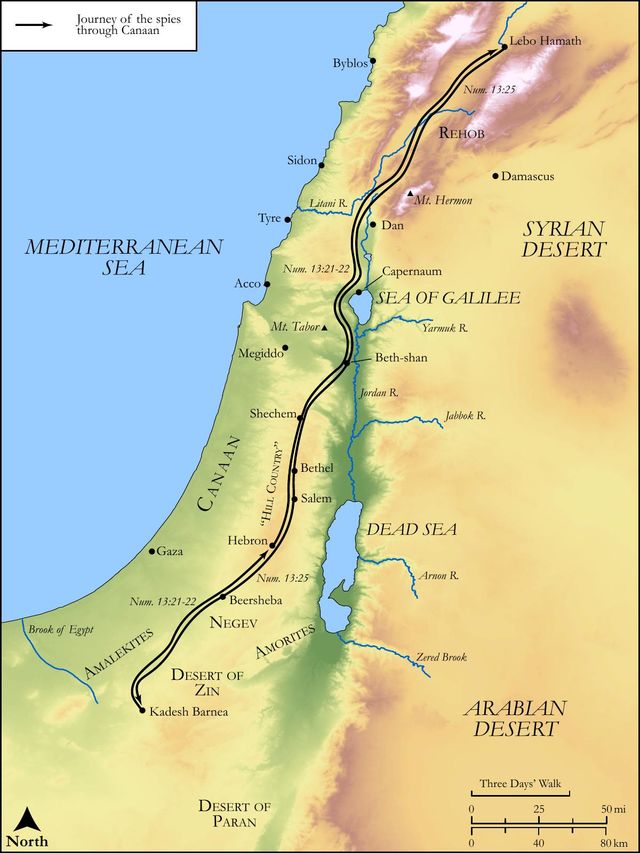
We have here a short account of the survey which the spies made of the promised land. 1. They went quite through it, from Zin in the south, to Rehob, near Hamath, in the north, Num 13:21. See Num 34:3, Num 34:8. It is probable that they did not go altogether in a body, lest they should be suspected and taken up, which there would be the more danger of if the Canaanites knew (and one would think they could not but know) how near the Israelites were to them; but they divided themselves into several companies, and so passed unsuspected, as way-faring men. 2. They took particular notice of Hebron (Num 13:22), probably because near there was the field of Machpelah, where the patriarchs were buried (Gen 23:2), whose dead bodies did, as it were, keep possession of that land for their posterity. To this sepulchre they made a particular visit, and found the adjoining city in the possession of the sons of Anak, who are here named. In that place where they expected the greatest encouragements they met with the greatest discouragements. Where the bodies of their ancestors kept possession for them the giants kept possession against them. They ascended by the south, and came to Hebron, that is, "Caleb," say the Jews, "in particular," for to his being there we find express reference, Jos 14:9, Jos 14:12, Jos 14:13. But that others of the spies were there too appears by their description of the Anakim, v. 33. 3. They brought a bunch of grapes with them, and some other of the fruits of the land, as a proof of the extraordinary goodness of the country. Probably they furnished themselves with these fruits when they were leaving the country and returning. The cluster of grapes was so large and so heavy that they hung it upon a bar, and carried it between two of them, Num 13:23, Num 13:24. The place whence they took it was, from this circumstance, called the valley of the cluster, that famous cluster which was to Israel both the earnest and the specimen of all the fruits of Canaan. Such are the present comforts which we have in communion with God, foretastes of the fulness of joy we expect in the heavenly Canaan. We may see by them what heaven is.
Continue studying Numbers 13:23 across the web’s major study libraries — every link below opens this exact verse, chapter, or book on the destination site.
Read & Compare
 BibleGatewayThis verse in more than 200 translations and 70 languages.
 Bible.comThe YouVersion reader — hundreds of translations, reading plans, and highlights.
 ESV.orgCrossway's official English Standard Version reader.
 NET BibleThe NET translation with 60,000+ translators' notes on every rendering decision.
 STEP BibleTyndale House's free study tool — original text, vocabulary, and scholarly resources.
 BibliaLogos Bible Software's free web reader.
 USCCBThe New American Bible (Revised Edition) with the U.S. bishops' study notes.
Commentaries
 BibleHub CommentariesDozens of classic commentaries on this verse, gathered on one page.
 StudyLightMore than 100 commentary sets — the largest collection on the web.
 BibleRefPlain-English commentary on what this verse means, verse by verse.
 Enduring WordDavid Guzik's free commentary on this chapter, widely used by Bible teachers.
 Bible Study ToolsVerse commentary alongside Greek and Hebrew study aids.
Original Language & Research
- BibleHub InterlinearThe verse word by word — original language, transliteration, and English.
- BibleHub LexiconEvery word's original-language definition and Strong's entry.
 Blue Letter BibleDeep-study tools — Strong's numbers, concordance, and word studies.
 SefariaThe Hebrew text with Rashi and centuries of Jewish commentary.
Sermons, Hymns & Audio


TrulyRandomVerse is not affiliated with these sites and doesn’t control their content. They’re linked because they’re genuinely useful.
Summary
Numbers 13:23 vividly portrays the extraordinary fertility of the Promised Land, serving as tangible evidence of God's lavish provision for His people. This verse details the return of the Israelite spies from Canaan, specifically highlighting their discovery at the brook of Eshcol: a single, immense cluster of grapes so heavy it required two men to carry it on a staff, alongside samples of pomegranates and figs. This physical demonstration of Canaan's abundance was intended to confirm God's covenant promises and inspire faith in the congregation, setting the stage for a pivotal moment in Israel's wilderness journey.
Context
ShowHideLiterary Context
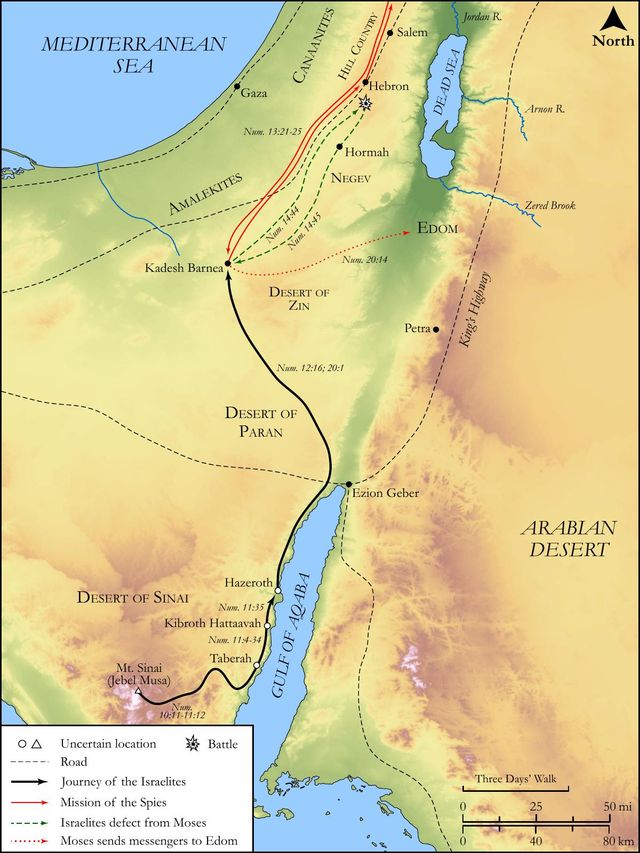
Numbers 13:23 is situated at a critical juncture in Israel's wilderness journey, following their departure from Mount Sinai and arrival at Kadesh-barnea. The preceding verses in Numbers 13 recount Moses's decision, at God's command, to dispatch twelve leaders—one from each tribe—to scout the land of Canaan. Their mission, outlined in Numbers 13:1-20, was comprehensive: to assess the land's agricultural potential, the strength and number of its inhabitants, and the fortifications of its cities. After forty days, the spies returned to the Israelite camp, bringing with them both a verbal report and the compelling physical evidence described in this verse, setting the stage for the pivotal decision that would determine the nation's immediate future.
Historical & Cultural Context
Fertile land was of immense value, as agricultural productivity was directly tied to survival and prosperity. The concept of a "land flowing with milk and honey" (Exodus 3:8) was not merely poetic but signified unparalleled abundance and blessing. Grapes, pomegranates, and figs were staple crops, highly prized for their nutritional value, sweetness, and symbolism of prosperity and well-being. The very act of carrying such a massive cluster of grapes on a staff by two men would have been a dramatic and unforgettable spectacle, designed to impress upon the entire Israelite community the unparalleled richness of the land God was giving them, contrasting sharply with the barrenness of the wilderness they had endured.
Key Themes
ShowHideThis verse powerfully underscores the central theme of God's faithfulness to His covenant promises. The extraordinary fruitfulness of Canaan, exemplified by the colossal grape cluster and other fruits, served as undeniable proof that God's word was true, even before Israel had fully entered their inheritance. It highlights the theme of divine provision and abundance, demonstrating that God's blessings far exceed human expectation. Furthermore, the tangible evidence brought back by the spies introduces the theme of faith versus sight, as this proof was intended to inspire confidence, yet it ultimately became a point of contention when contrasted with the intimidating report of the land's inhabitants in Numbers 13:28-33. The scene at Eshcol was meant to be a foundation for faith, a "firstfruits" of the promised blessing.
Exposition and Analysis
ShowHideKey Word Analysis
ShowHideThis place name, derived from the same root as the Hebrew word for "cluster" (H811, ʼeshkôwl), is remarkably fitting given the discovery made there. As a valley in Palestine, its very name foreshadowed the immense "cluster" of grapes found, highlighting a divine orchestration that emphasized the significance of the find as a representative sample of Canaan's bounty. It underscores the idea that God led them precisely to a place that would visually confirm His promise of a fruitful land.
The term "grape" (H6025, ʻênâb) refers to the fruit of the vine, a primary agricultural product in ancient Israel, symbolizing fertility, joy, and prosperity. The description of "one cluster of grapes" so large it required two men to carry it on a staff is a powerful visual hyperbole, accentuating the unparalleled abundance of the land. This was not merely a good harvest; it was an extraordinary, almost miraculous, display of the land's inherent richness, directly fulfilling the promise of a land "flowing with milk and honey."
The detail that the cluster was carried "between two upon a staff" (H4132, môwṭ) is crucial. The term "staff" here implies a pole used for carrying, and its use signifies the immense size and weight of the grape cluster, making it impossible for a single individual to carry with ease. This practical detail transforms the fruit from a mere sample into a dramatic, undeniable testament to the land's fertility, designed to impress and convince the entire congregation of Israel.
Verse Breakdown
ShowHide"And they came unto the brook of Eshcol,"
The spies' arrival at this specific location, whose name itself means "cluster," suggests a divinely guided discovery. The "brook" (נַחַל, nachal, H5158) implies a wadi or seasonal stream, indicating a fertile valley or ravine, ideal for viticulture. This setting underscores the natural abundance of the region, a stark contrast to the barren wilderness.
"and cut down from thence a branch with one cluster of grapes,"
This action signifies the deliberate collection of evidence. The verb "cut down" (כָּרַת, kârath, H3772) indicates a decisive act of severing, emphasizing the intentionality of gathering this proof. The emphasis on "one cluster" (אֶשְׁכּוֹל, ʼeshkôwl, H811) highlights its extraordinary size, making it a singular, impressive specimen rather than a collection of many small ones. This was not just a sample; it was a statement about the land's capacity for unparalleled produce.
"and they bare it between two upon a staff;"
This is the most striking detail, visually communicating the immense scale of the grapes. The verb "bare" (נָשָׂא, nâsâʼ, H5375) means to lift or carry. The necessity of two men (שְׁנַיִם, shᵉnayim, H8147) to carry a single cluster on a staff transforms it into a public spectacle, an undeniable and memorable demonstration of the land's incredible fertility, intended to instill confidence and awe in the Israelite community.
"and [they brought] of the pomegranates, and of the figs."
The inclusion of pomegranates (רִמּוֹן, rimmôwn, H7416) and figs (תְּאֵנָה, tᵉʼên, H8384) further reinforces the theme of abundance. These fruits were also highly valued in Israel, symbolizing prosperity and blessing. Their presence alongside the colossal grapes provides a comprehensive picture of Canaan's agricultural richness, demonstrating that the land was indeed a place of extraordinary provision, fulfilling the promise of a land "flowing with milk and honey."
Literary Devices
ShowHideNumbers 13:23 employs several potent literary devices to convey its message. The most prominent is Symbolism, where the grapes, pomegranates, and figs are not merely fruits but powerful symbols of the Promised Land's extraordinary fertility and God's abundant provision. The sheer size of the grape cluster, requiring two men to carry it, borders on Hyperbole, emphasizing the land's incredible bounty beyond normal expectations and creating a vivid, unforgettable image. This dramatic presentation also functions as Vivid Imagery, painting a clear and striking picture in the reader's mind of the spies' discovery. Furthermore, the "branch with one cluster of grapes" can be seen as a form of Synecdoche, where a part (the fruit) represents the whole (the entire land's fertility), serving as a tangible "firstfruits" of the inheritance awaiting Israel. The very name of the place, Eshcol ("cluster"), adds an element of Irony or divine synchronicity, as the place itself declares what will be found there.
Theological and Thematic Connections
ShowHideNumbers 13:23 stands as a powerful testament to God's unwavering faithfulness to His covenant promises. The lavish abundance displayed in the fruits from Eshcol was not merely a pleasant discovery but a divine confirmation of the land described as "flowing with milk and honey" since the time of Abraham. This tangible evidence was intended to bolster the faith of a generation prone to grumbling and doubt, demonstrating that God's word was true and His provision boundless. It highlights the tension between God's clear demonstration of His goodness and humanity's struggle to trust Him fully, especially when faced with perceived obstacles. The fruit was a "good report," a foretaste of the blessings that awaited a faithful people, serving as a powerful visual aid to encourage obedience and trust in divine power over human limitations.
Reflection and Application
ShowHideNumbers 13:23 offers profound lessons for contemporary believers. Just as the Israelites received a tangible "firstfruits" of the Promised Land, so too does God often provide us with glimpses of His faithfulness and the abundance of His promises in our own lives. These "Eshcol moments"—whether a specific answered prayer, a season of unexpected provision, a profound spiritual insight, or a clear demonstration of His grace—are meant to strengthen our faith and encourage us to press forward, even when challenges seem insurmountable. This verse challenges us to cultivate a spirit of gratitude and to remember God's past faithfulness when doubt creeps in. Are we, like the ten fearful spies, allowing the "giants" in our lives to overshadow the undeniable evidence of God's goodness, or are we, like Caleb and Joshua, holding fast to the "good report" of His promises, knowing that His power is greater than any obstacle? Our response to God's demonstrated faithfulness determines whether we enter into the fullness of His blessings and experience the abundant life He intends for us.
Questions for Reflection
ShowHideFAQ
ShowHideWhy did the spies bring back such large fruit, specifically grapes, pomegranates, and figs?
ShowHideThe primary reason was to provide undeniable, tangible proof of the land's extraordinary fertility and abundance, directly confirming God's promise that Canaan was "a land flowing with milk and honey" (Exodus 3:8). The sheer size of the grape cluster, requiring two men to carry it, was a dramatic visual aid intended to impress upon the entire Israelite congregation the unparalleled richness of their promised inheritance. Grapes, pomegranates, and figs were chosen because they were highly valued, staple crops in the land of Canaan, symbolizing prosperity and blessing, thus serving as perfect representatives of the land's incredible agricultural potential. This physical evidence was crucial for building faith and confidence in God's ability to deliver on His word, serving as a powerful counter-argument to any potential doubt or fear.
Christ-Centered Fulfillment
ShowHideNumbers 13:23, with its vivid depiction of the land's overflowing abundance, finds its ultimate and profound fulfillment in Jesus Christ. While the physical fruits from Eshcol represented the earthly inheritance God promised Israel, Christ embodies the spiritual and eternal inheritance offered to all believers. He is the true "firstfruits" (1 Corinthians 15:20) of God's new creation, the guarantee of a greater, imperishable reality. Just as the grapes symbolized life and joy, Jesus declared Himself to be the "true vine" (John 15:1), from whom all spiritual fruitfulness flows, enabling believers to bear much fruit for God's glory (John 15:5). The abundance of Canaan, though impressive, was but a shadow of the immeasurable spiritual blessings we receive in Christ—the forgiveness of sins, eternal life, the indwelling Holy Spirit, and access to God's presence (Ephesians 1:3). The "good report" that Caleb and Joshua brought back, rooted in faith in God's power despite the giants, foreshadows the gospel message: a report of God's redemptive work through Christ, enabling us to enter a spiritual "rest" and inherit a kingdom that cannot be shaken (Hebrews 4:9-10). Thus, the lavish fruit of Eshcol points beyond itself to the infinitely greater, life-giving fruit of salvation and abundant life found only in Jesus.