


Numbers 13:22
Bible text: King James Version (1769 Blayney text) · Public domain
Bible text: King James Version with Strong's numbers · Public domain
Bible text: Berean Standard Bible · Public domain
Bible text: American Standard Version (1901) · Public domain
Bible text: World English Bible, Messianic edition · Public domain
Bible text: Geneva Bible (1599) · Public domain
Bible text: Young's Literal Translation · Public domain
- וַיַּעֲלוּvai·ya·'a·Luand they went upH5927Conj-w ¦ V-Qal-ConsecImperf-3mpVerb Qal Consecutive Imperfect 3rd Plural Masculineוַandיַּעֲלוּthey went up
- בַנֶּגֶבva·ne·Gevin the NegevH5045Prep-b ¦ N-properNoun Proper Locationבַin theנֶּגֶבNegev
- וַיָּבֹאvai·ya·Vo'and he cameH935Conj-w ¦ V-Qal-ConsecImperf-3msVerb Qal Consecutive Imperfect 3rd Singular Masculineוַandיָּבֹאhe came
- עַד'adtoH5704PrepPreposition
- חֶבְרוֹןchev·rOnHebronH2275N-properNoun Proper Location
- וְשָׁםve·Shamand [were] thereH8033Conj-w ¦ AdvAdverbוְandשָׁם[were] there
- אֲחִימַן'a·chi·ManAhimanH289N-proper-mNoun Proper Masculine
- שֵׁשַׁיshe·ShaiSheshaiH8344N-proper-mNoun Proper Masculine
- וְתַלְמַיve·tal·Maiand TalmaiH8526Conj-w ¦ N-proper-mNoun Proper MasculineוְandתַלְמַיTalmai
- יְלִידֵיye·li·Deithose born ofH3211N-mpcNoun Plural Masculine Construct
- הָעֲנָקha·'a·Nak<the> AnakH6061Art ¦ N-msNoun Gentilic Singular Masculine Absoluteהָ<the>עֲנָקAnak
- וְחֶבְרוֹןve·chev·Ronand HebronH2275Conj-w ¦ N-properNoun Proper LocationוְandחֶבְרוֹןHebron
- שֶׁבַעShe·va'sevenH7651Adj-csAdjective Numerical Singular common gender Absolute
- שָׁנִיםsha·NimyearsH8141N-mpNoun Plural Masculine Absolute
- נִבְנְתָהniv·ne·Tahit was builtH1129V-Niphal-Perf-3fsVerb Niphal Perfect 3rd Singular Feminine
- לִפְנֵיlif·Nei<to> beforeH6440Prep-l ¦ N-mpcNoun Plural Masculine Constructלִ<to>פְנֵיbefore
- צֹעַןTzo·'anZoanH6814N-properNoun Proper Location
- מִצְרָיִםmitz·Ra·yimEgyptH4714N-properNoun Proper Location
English is a literal word-by-word gloss of the Hebrew, not the KJV's wording. Why?
This is the original text the KJV's translators worked from — each Hebrew word with its own literal English meaning in this verse, prepared by scholars at Tyndale House, Cambridge. The KJV translates whole sentences, not word by word, so its wording differs: one Hebrew word can become several English words, and the KJV may choose “the LORD” where the gloss reads “Yahweh”. Both are faithful — they answer different questions. For the KJV's own rendering, switch to the KJV text.
Details
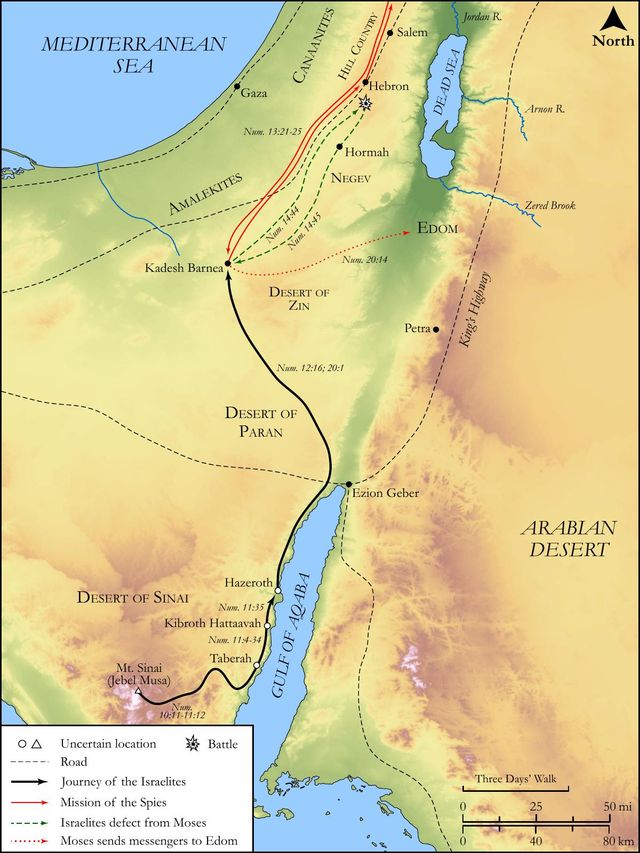
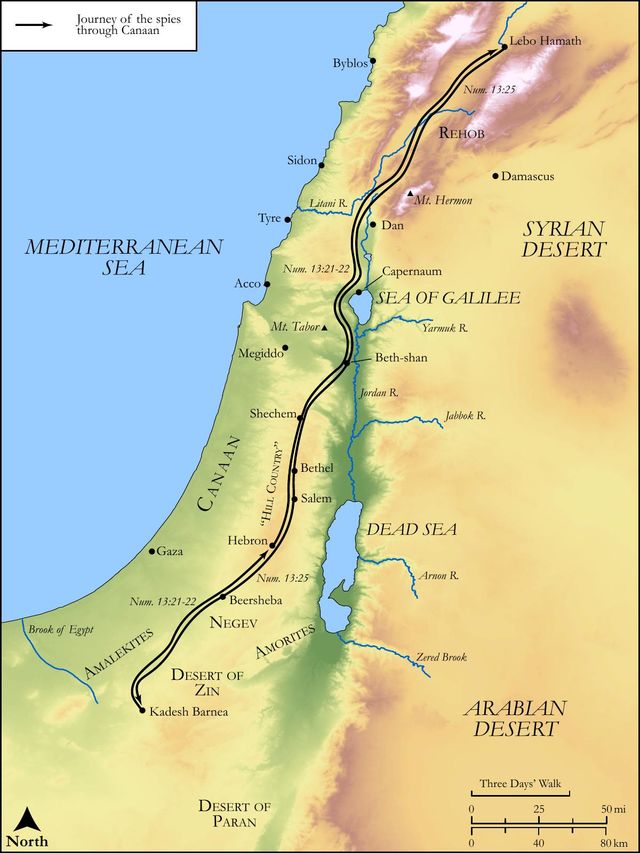
See on the biblical-era maps
Study this verse
Public-domain commentary
Matthew Henry
From his Commentary on the Whole Bible. Henry comments on passages, not single verses — this entry covers Numbers 13:21–25.
We have here a short account of the survey which the spies made of the promised land. 1. They went quite through it, from Zin in the south, to Rehob, near Hamath, in the north, Num 13:21. See Num 34:3, Num 34:8. It is probable that they did not go altogether in a body, lest they should be suspected and taken up, which there would be the more danger of if the Canaanites knew (and one would think they could not but know) how near the Israelites were to them; but they divided themselves into several companies, and so passed unsuspected, as way-faring men. 2. They took particular notice of Hebron (Num 13:22), probably because near there was the field of Machpelah, where the patriarchs were buried (Gen 23:2), whose dead bodies did, as it were, keep possession of that land for their posterity. To this sepulchre they made a particular visit, and found the adjoining city in the possession of the sons of Anak, who are here named. In that place where they expected the greatest encouragements they met with the greatest discouragements. Where the bodies of their ancestors kept possession for them the giants kept possession against them. They ascended by the south, and came to Hebron, that is, "Caleb," say the Jews, "in particular," for to his being there we find express reference, Jos 14:9, Jos 14:12, Jos 14:13. But that others of the spies were there too appears by their description of the Anakim, v. 33. 3. They brought a bunch of grapes with them, and some other of the fruits of the land, as a proof of the extraordinary goodness of the country. Probably they furnished themselves with these fruits when they were leaving the country and returning. The cluster of grapes was so large and so heavy that they hung it upon a bar, and carried it between two of them, Num 13:23, Num 13:24. The place whence they took it was, from this circumstance, called the valley of the cluster, that famous cluster which was to Israel both the earnest and the specimen of all the fruits of Canaan. Such are the present comforts which we have in communion with God, foretastes of the fulness of joy we expect in the heavenly Canaan. We may see by them what heaven is.
Continue studying Numbers 13:22 across the web’s major study libraries — every link below opens this exact verse, chapter, or book on the destination site.
Read & Compare
 BibleGatewayThis verse in more than 200 translations and 70 languages.
 Bible.comThe YouVersion reader — hundreds of translations, reading plans, and highlights.
 ESV.orgCrossway's official English Standard Version reader.
 NET BibleThe NET translation with 60,000+ translators' notes on every rendering decision.
 STEP BibleTyndale House's free study tool — original text, vocabulary, and scholarly resources.
 BibliaLogos Bible Software's free web reader.
 USCCBThe New American Bible (Revised Edition) with the U.S. bishops' study notes.
Commentaries
 BibleHub CommentariesDozens of classic commentaries on this verse, gathered on one page.
 StudyLightMore than 100 commentary sets — the largest collection on the web.
 BibleRefPlain-English commentary on what this verse means, verse by verse.
 Enduring WordDavid Guzik's free commentary on this chapter, widely used by Bible teachers.
 Bible Study ToolsVerse commentary alongside Greek and Hebrew study aids.
Original Language & Research
- BibleHub InterlinearThe verse word by word — original language, transliteration, and English.
- BibleHub LexiconEvery word's original-language definition and Strong's entry.
 Blue Letter BibleDeep-study tools — Strong's numbers, concordance, and word studies.
 SefariaThe Hebrew text with Rashi and centuries of Jewish commentary.
Sermons, Hymns & Audio


TrulyRandomVerse is not affiliated with these sites and doesn’t control their content. They’re linked because they’re genuinely useful.
Summary
Numbers 13:22 records a crucial detail from the reconnaissance mission of the Israelite spies into Canaan, specifically their arrival at the ancient city of Hebron. This verse not only identifies the formidable "children of Anak"—a people noted for their immense stature—as inhabitants of Hebron but also provides a unique chronological marker, stating that Hebron was founded seven years prior to Zoan in Egypt. This information was vital for the spies' assessment of the land and its inhabitants, profoundly influencing their subsequent report and setting the stage for Israel's significant crisis of faith regarding the conquest of the Promised Land.
Context
ShowHideLiterary Context
Numbers 13:22 is embedded within the narrative of Moses dispatching twelve leaders, one from each tribe, to scout the land of Canaan, a command directly given by the Lord as detailed in Numbers 13:1-2. The spies' comprehensive mission, outlined in Numbers 13:17-25, required them to evaluate the land's agricultural potential, the strength of its inhabitants, and the defensibility of their cities. The arrival at Hebron, a major city in the southern highlands of Canaan, represents a significant geographical milestone in their journey. The intelligence gathered here, particularly concerning the formidable Anakim, directly informs the fearful report delivered by ten of the spies upon their return to Kadesh-barnea, as recounted in Numbers 13:26-33. This report ultimately triggered Israel's rebellion and resulted in their forty-year period of wandering in the wilderness.
Historical & Cultural Context
At the time of this mission, the Israelites were positioned at Kadesh-barnea, on the southern frontier of Canaan, poised for entry into the land promised by God. The practice of sending spies was a standard military and strategic maneuver among the nations, employed to gather critical intelligence before an invasion or major campaign. Hebron, known historically as Kirjath-arba (Genesis 23:2), was an exceptionally ancient and profoundly significant city, holding deep patriarchal connections as the burial site for Abraham, Isaac, and Jacob. The mention of the Anakim, a people widely recognized for their imposing stature and strength, would have immediately signaled an immense challenge to any invading force. The comparison of Hebron's venerable age to that of Zoan (Tanis), a prominent capital city in the Nile Delta of Egypt, further emphasizes Hebron's immense antiquity and established importance, providing a readily understandable benchmark for the Israelite audience, who were intimately familiar with Egyptian history and geography.
Key Themes
ShowHideThis verse significantly contributes to several overarching themes within the book of Numbers and the broader Pentateuch. Firstly, it underscores the formidable nature of the land's inhabitants, specifically the Anakim, who were perceived as "giants" and became a primary source of fear and doubt for the Israelites, as vividly portrayed in Numbers 13:33. This directly challenges Israel's faith and obedience to God's promise to grant them the land, irrespective of the obstacles. Secondly, the historical detail regarding Hebron's age highlights the deep-rooted presence of the Canaanite peoples, emphasizing that the conquest would not be a simple task but a profound act of divine displacement. This detail also subtly reinforces the theme of God's faithfulness to His covenant promises, given Hebron's intimate connection to Abraham's covenant in Genesis 13:14-18. The encounter with the Anakim serves as a crucial test of Israel's resolve, revealing their recurring tendency to rely on what they see rather than on divine assurance, a motif that recurs throughout their wilderness journey.
Exposition and Analysis
ShowHideKey Word Analysis
ShowHideThis term refers to the progenitor of a pre-Israelite people group, the Anakim (the plural form), renowned for their extraordinary height and strength. They are frequently described as "giants" in biblical texts (e.g., Deuteronomy 2:10-11). Their established presence in Hebron, a strategically important city, immediately conveyed the formidable nature of the inhabitants the Israelites would face. The spies' report heavily emphasized the Anakim, portraying them as insurmountable obstacles, which directly contributed to the people's despair and subsequent rebellion.
This primitive root signifies the act of construction, both literally and figuratively. In Numbers 13:22, it refers to the founding or establishment of the city of Hebron. The use of this word in the parenthetical note emphasizes the ancient and established nature of Hebron, indicating that it was not a recent settlement but a city with a long, deep history. This detail underscores the entrenched presence of its inhabitants, including the Anakim, making the task of conquest appear even more daunting.
Also known as Tanis, Zoan was a major ancient city located in the northeastern Nile Delta, serving as a capital during various periods of Egyptian history, notably during the Hyksos and Ramesside dynasties. Its mention here as a chronological benchmark ("Hebron was built seven years before Zoan in Egypt") serves to highlight Hebron's extreme antiquity and established importance. For the Israelite audience, who had recently departed Egypt, Zoan would have been a familiar and significant reference point, thus emphasizing Hebron's venerable age and the deep-rooted nature of its Canaanite inhabitants.
Verse Breakdown
ShowHide"And they ascended by the south, and came unto Hebron;"
This phrase meticulously details the spies' geographical progression. "Ascended" accurately reflects the topographical reality of moving from the lower, arid southern desert region (the Negeb) northward into the higher elevation of the Judean hills, where Hebron is situated. Their arrival at Hebron signifies a deep penetration into the heart of the Promised Land, reaching a city of immense historical and strategic importance, a key objective of their reconnaissance.
"where Ahiman, Sheshai, and Talmai, the children of Anak, [were]."
This clause delivers critical and alarming intelligence. Ahiman, Sheshai, and Talmai are specifically named as prominent individuals among the Anakim residing in Hebron. The explicit mention of "the children of Anak" immediately evokes images of powerful, giant-like warriors, confirming the formidable nature of the land's inhabitants and validating the fears that would soon grip the Israelite camp. This specific detail would become a central and persuasive point in the negative report delivered by the ten spies.
"(Now Hebron was built seven years before Zoan in Egypt.)"
This parenthetical note, though seemingly an aside, serves a crucial historical and rhetorical purpose. It underscores Hebron's ancient origins and deep-rooted establishment. By comparing its founding to Zoan, a well-known and ancient Egyptian capital, the text emphasizes Hebron's venerable age and, by extension, the long-standing, entrenched presence of its inhabitants, including the Anakim. This detail adds significant weight and credibility to the spies' findings, suggesting that the people they encountered were not recent, easily dislodged settlers but a powerful, ancient population.
Literary Devices
ShowHideNumbers 13:22 masterfully employs several literary devices to convey its message. The most prominent is Juxtaposition, as the verse immediately places the formidable presence of the Anakim alongside a historical note emphasizing Hebron's extreme antiquity. This contrast vividly highlights the deep-rooted and powerful nature of the obstacles Israel faced, making the challenge seem even more daunting and deeply entrenched. This detailed description of the Anakim also functions as Foreshadowing, subtly hinting at the pervasive fear and profound lack of faith that will soon paralyze the Israelite nation, ultimately leading to their rebellion and subsequent divine judgment. The Anakim themselves serve as a powerful Symbolism, representing the seemingly insurmountable obstacles, both physical and psychological, that stand between God's people and the fulfillment of His divine promises. Their imposing physical stature symbolizes the spiritual and psychological "giants" that challenge faith, testing whether God's people will trust in His omnipotence or succumb to human fear and doubt.
Theological and Thematic Connections
ShowHideNumbers 13:22 profoundly illustrates the inherent tension between God's unwavering covenant promises and humanity's often wavering faith. The formidable presence of the Anakim in Hebron represents the "giants"—the seemingly insurmountable obstacles, challenges, and entrenched evils—that frequently stand in the way of God's people inheriting His blessings and fulfilling His purposes. The theological implication is clear: God's promises are not contingent on the absence of difficulties, but rather demand a robust faith that trusts in His sovereign power to overcome any adversary, no matter how formidable or deeply rooted. This verse sets the stage for Israel's catastrophic failure to trust God, leading to a generation's wilderness wandering, yet it also subtly foreshadows the eventual triumph through faith, exemplified by Caleb's unwavering determination to conquer Hebron. It serves as a powerful reminder that while divine promises often involve human struggle and perseverance, the ultimate victory is always God's.
Reflection and Application
ShowHideNumbers 13:22 serves as a timeless and poignant reminder that the journey toward receiving God's promises is seldom without formidable challenges. The "giants" encountered by the spies in Hebron—the Anakim—represent the overwhelming obstacles, paralyzing fears, and deeply entrenched problems that can stand between us and God's intended blessings. This verse compels us to honestly examine our own responses when confronted with seemingly insurmountable difficulties in our lives. Do we, like the ten fearful spies, allow the sheer size or perceived strength of our adversaries to dictate our faith, leading us to paralysis and doubt? Or do we, like the courageous Caleb and Joshua, fix our gaze steadfastly on the faithfulness and omnipotence of God, trusting implicitly that He is infinitely greater than any "giant" we may face? True faith is not the absence of fear, but rather the courageous decision to move forward in obedience despite it, resting in the profound assurance that God has already promised the victory. Our spiritual journey often requires us to "ascend by the south" into territories that appear hostile and overwhelming, but God's sovereign presence guarantees our ultimate inheritance and triumph.
Questions for Reflection
ShowHideFAQ
ShowHideWho were the Anakim, and why were they so significant to the spies' report?
ShowHideThe Anakim were a group of people known for their immense stature and strength, often described as "giants" in biblical texts (e.g., Deuteronomy 9:2). Their presence in Hebron and other parts of Canaan was profoundly significant because they represented a formidable military and psychological challenge to the Israelites. The spies' report heavily emphasized the Anakim, portraying them as insurmountable obstacles that made the Israelites feel like "grasshoppers" in comparison (Numbers 13:33). This fearful description directly contributed to the people's pervasive lack of faith and their subsequent rebellion against God's explicit command to enter and conquer the land.
Why does the verse include the detail that "Hebron was built seven years before Zoan in Egypt"?
ShowHideThis seemingly parenthetical note serves a crucial historical and rhetorical purpose: to emphasize Hebron's extreme antiquity and established importance. Zoan (Tanis) was a well-known and ancient capital city in Egypt, a civilization with which the Israelites were intimately familiar. By stating that Hebron predated Zoan by seven years, the text highlights that Hebron was not a newly settled outpost but a venerable, deeply entrenched city with a long and significant history. This detail underscored the formidable and long-standing presence of its inhabitants, including the Anakim, making the challenge of conquest appear even more daunting and lending substantial credibility to the spies' findings about the strength and rootedness of the Canaanite presence. It grounds the narrative in Egypt's own history, providing a recognizable benchmark for its original audience.
Christ-Centered Fulfillment
ShowHideNumbers 13:22, with its vivid depiction of formidable "giants" inhabiting the Promised Land, finds its ultimate and profound fulfillment in the person and redemptive work of Jesus Christ. The Anakim represented the seemingly insurmountable obstacles to Israel's physical inheritance; similarly, sin, death, and the pervasive power of evil are the spiritual "giants" that inherently prevent humanity from inheriting eternal life and enjoying unbroken fellowship with God. Just as the Israelites were called to trust God for victory over their physical adversaries, believers today are called to trust Christ for decisive victory over spiritual ones. Jesus, the true and greater Joshua, did not merely scout the land; He courageously entered into our fallen world, confronted the spiritual powers of darkness head-on, and decisively conquered them through His sacrificial death on the cross (Colossians 2:15). Through His glorious resurrection, He triumphed over death itself, the ultimate "giant" (1 Corinthians 15:54-57). Our inheritance in Christ is not a physical land but a spiritual kingdom and eternal life, secured not by our strength, courage, or ability to overcome, but solely by His perfect and finished work (Ephesians 1:3-14). He is the one who empowers and enables us to overcome the "giants" of fear, doubt, and sin in our lives, leading us into the true rest and eternal inheritance found only in Him (Hebrews 4:9-10).