


Numbers 34:8
Bible text: King James Version (1769 Blayney text) · Public domain
Bible text: Berean Standard Bible · Public domain
Bible text: American Standard Version (1901) · Public domain
Bible text: World English Bible, Messianic edition · Public domain
Bible text: Geneva Bible (1599) · Public domain
Bible text: Young's Literal Translation · Public domain
- מֵהֹרme·Horfrom HorH2023Prep-m ¦ N-properNoun Proper LocationמֵfromהֹרHor
- הָהָרha·Harthe mountainH2022Art ¦ N-msNoun Singular Masculine Absoluteהָtheהָרmountain
- תְּתָאוּte·ta·'Uyou will mark outH8376V-Piel-Imperf-2mpVerb Piel Imperfect 2nd Plural Masculine
- לְבֹאle·Vo'LeboH935V-Qal-InfVerb Qal Infinitive Construct
- חֲמָתcha·MatHamathH2574N-properNoun Proper Location
- וְהָיוּve·ha·Yuand they will beH1961Conj-w ¦ V-Qal-ConsecPerf-3cpVerb Qal Consecutive Perfect 3rd Plural common genderוְandהָיוּthey will be
- תּוֹצְאֹתtotz·'Ot[the] extremities ofH8444N-fpcNoun Plural Feminine Construct
- הַגְּבֻלha·ge·Vulthe borderH1366Art ¦ N-msNoun Singular Masculine Absoluteהַtheגְּבֻלborder
- צְדָדָהtze·Da·dahZedad towardsH6657N-proper ¦ SfxNoun Proper LocationצְדָדָZedadהtowards
English is a literal word-by-word gloss of the Hebrew, not the KJV's wording. Why?
This is the original text the KJV's translators worked from — each Hebrew word with its own literal English meaning in this verse, prepared by scholars at Tyndale House, Cambridge. The KJV translates whole sentences, not word by word, so its wording differs: one Hebrew word can become several English words, and the KJV may choose “the LORD” where the gloss reads “Yahweh”. Both are faithful — they answer different questions. For the KJV's own rendering, switch to the KJV text.
Details
See on the biblical-era map
Study this verse
Continue studying Numbers 34:8 across the web’s major study libraries — every link below opens this exact verse, chapter, or book on the destination site.
Read & Compare
 BibleGatewayThis verse in more than 200 translations and 70 languages.
 Bible.comThe YouVersion reader — hundreds of translations, reading plans, and highlights.
 ESV.orgCrossway's official English Standard Version reader.
 NET BibleThe NET translation with 60,000+ translators' notes on every rendering decision.
 STEP BibleTyndale House's free study tool — original text, vocabulary, and scholarly resources.
 BibliaLogos Bible Software's free web reader.
 USCCBThe New American Bible (Revised Edition) with the U.S. bishops' study notes.
Commentaries
 BibleHub CommentariesDozens of classic commentaries on this verse, gathered on one page.
 StudyLightMore than 100 commentary sets — the largest collection on the web.
 BibleRefPlain-English commentary on what this verse means, verse by verse.
 Enduring WordDavid Guzik's free commentary on this chapter, widely used by Bible teachers.
 Bible Study ToolsVerse commentary alongside Greek and Hebrew study aids.
Original Language & Research
- BibleHub InterlinearThe verse word by word — original language, transliteration, and English.
- BibleHub LexiconEvery word's original-language definition and Strong's entry.
 Blue Letter BibleDeep-study tools — Strong's numbers, concordance, and word studies.
 SefariaThe Hebrew text with Rashi and centuries of Jewish commentary.
Sermons, Hymns & Audio


TrulyRandomVerse is not affiliated with these sites and doesn’t control their content. They’re linked because they’re genuinely useful.
Summary
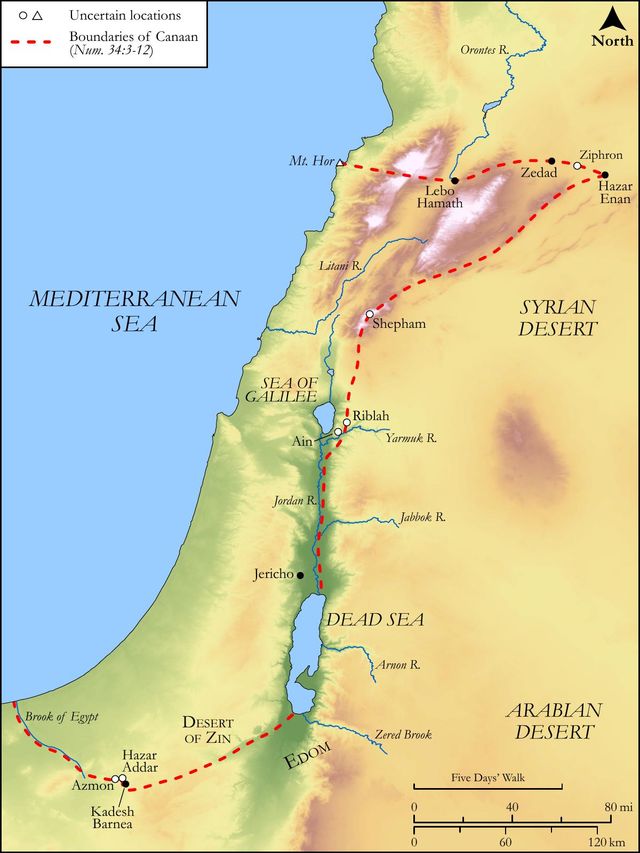
Numbers 34:8 meticulously delineates a crucial segment of the northern boundary of the promised land of Canaan, specifying Mount Hor as the starting point, extending to the strategic entrance of Hamath, and then eastward to Zedad. This verse is an integral part of God's precise instructions for the territorial division among the Israelite tribes, powerfully underscoring divine sovereignty over their inheritance and emphasizing the profound importance of clearly defined geographical parameters for the nascent nation.
Context
ShowHideLiterary Context
This verse is embedded within Numbers 34:1-12, a comprehensive and divinely mandated description of the boundaries of the land of Canaan that Israel was destined to inherit. This detailed geographical blueprint immediately follows God's explicit command in Numbers 33:50-56 for the Israelites to dispossess the current inhabitants and settle the land. The meticulous specifications here serve as the authoritative guide for the subsequent division of the land, which would later be implemented under Joshua's leadership, as comprehensively recorded in Joshua 13-19. Placed after decades of wilderness wanderings, failures, and preparations, these precise boundary instructions stand as a tangible and powerful expression of God's unwavering faithfulness to His covenant promises, finally bringing His people to the brink of their long-awaited inheritance.
Historical & Cultural Context
The historical setting is the plains of Moab, where the new generation of Israelites stands poised to enter Canaan after forty years of wilderness wandering. This land was promised to their patriarchs, Abraham, Isaac, and Jacob, as recorded in Genesis 15:18-21. In Israel, clearly defined land ownership and national borders were paramount for establishing identity, ensuring security, and maintaining economic stability. God's direct involvement in delineating these boundaries underscored His unique relationship with Israel, positioning Himself as their sovereign King and ultimate Provider. Mount Hor, specifically mentioned, is a significant landmark, notably the place where Aaron, the high priest, died and was buried, as recounted in Numbers 20:22-29. "The entrance of Hamath" (Levo Hamath) refers to a well-known strategic pass or region in Syria, commonly understood as the ideal northern extent of Israelite territory, frequently serving as a key geographical and political marker in Israel's later history. Zedad was another specific northern location, further solidifying the precise trajectory of this divinely ordained border.
Key Themes
ShowHideNumbers 34:8 contributes profoundly to several overarching themes within the book of Numbers and the broader Pentateuch. Firstly, it powerfully highlights Divine Sovereignty and Faithfulness, demonstrating God's meticulous care and unwavering commitment in fulfilling His covenant promises regarding the land, initially articulated in Genesis 12:7. Secondly, the detailed boundaries underscore the theme of Inheritance and Possession, emphasizing that the land is not merely conquered but divinely apportioned to each tribe, thereby establishing their unique identity and responsibilities within the nascent nation. Thirdly, the specificity of the borders reinforces the importance of Order and Boundaries, both physical and spiritual, for God's people. This divine blueprint for the land reflects God's profound desire for an ordered society, distinct from the surrounding nations, living securely within the parameters He Himself established. Finally, it serves as a crucial foundational element for the Fulfillment of Prophecy, as these precise instructions lay the groundwork for the narratives in the book of Joshua, where these exact boundaries are actualized and possessed.
Exposition and Analysis
ShowHideKey Word Analysis
ShowHideThis verb (H8376, תָּוָה) signifies "to mark off," "to designate," or "to draw a line." It implies a clear, visible, and intentional demarcation, not a suggestion. In this context, it conveys a divine act of precisely defining the extent of the promised inheritance, leaving no ambiguity about the boundaries. It is an authoritative command to establish a fixed and unchangeable border, reflecting God's deliberate and sovereign will.
This noun (H1366, גְּבֻל) refers to a "boundary," "limit," or "territory enclosed." Derived from a root meaning "to twist" (like a cord used for measuring), it emphasizes the physical demarcation line as well as the land contained within it. Its repeated use in this passage underscores the concrete, tangible nature of the inheritance and the critical importance of clearly defined territorial limits for the stability and identity of the Israelite nation.
This noun (H8444, תּוֹצָאָה) refers to "exit," "boundary," or "outgoings." Used in the plural, it denotes the precise course or trajectory of a boundary line as it extends from a given point. In Numbers 34:8, "the goings forth of the border" meticulously describes the eastward extension of the northern boundary from the entrance of Hamath to Zedad, highlighting the exactness and comprehensive nature of God's geographical instructions.
Verse Breakdown
ShowHide"From mount Hor ye shall point out [your border]"
This initial clause establishes the precise starting point and the divine imperative. Mount Hor, a geographically significant landmark known to the Israelites (and where Aaron died), serves as a tangible reference. The verb "point out" (H8376, tâʼâh) conveys the authoritative, deliberate, and precise nature of God's instruction to delineate the boundary. The implied phrase "[your border]" emphasizes that this is the specific, divinely allotted territory for the tribes of Israel.
"unto the entrance of Hamath;"
This phrase specifies the northernmost extent of the border. From Mount Hor, the boundary line is to be drawn northward to this well-known strategic geographical and political marker. The "entrance of Hamath" (H935, bôwʼ H2574, Chămâth) refers to a pass or region leading into the city-state of Hamath in Syria. Its inclusion here indicates a substantial stretch of territory, reaching deep into what is modern-day Syria, thereby highlighting the expansive nature of the land God intended for His people.
"and the goings forth of the border shall be to Zedad:"
This concluding clause further refines the northern boundary, indicating its eastward trajectory from the "entrance of Hamath" to Zedad. "Goings forth" (H8444, tôwtsâʼâh) signifies the precise course or outcome of the border line. Zedad (H6657, Tsᵉdâd), another specific location north of Damascus, confirms the exact path the boundary was to take, emphasizing the meticulous detail of God's geographical instructions and leaving no doubt about the divinely ordained limits.
Literary Devices
ShowHideThe primary literary device evident in Numbers 34:8, and indeed throughout the entire passage of Numbers 34:1-12, is Precision and Meticulous Detailing. The naming of specific, identifiable geographical landmarks such as Mount Hor, the Entrance of Hamath, and Zedad demonstrates an extraordinary level of exactitude. This is not a vague promise of an undefined territory but a divinely engineered blueprint for a precise and measurable land. This Divine Mandate for geographical boundaries serves to powerfully underscore God's absolute sovereignty over the land and His unwavering faithfulness in fulfilling His covenant promises to Israel. The very act of "pointing out" or "marking" the border can also be understood as a form of Symbolism, representing God's active, personal involvement in establishing Israel's national identity, security, and distinctiveness, setting them apart as a unique nation with a divinely defined inheritance.
Theological and Thematic Connections
ShowHideNumbers 34:8, with its precise geographical instructions, stands as a profound testament to God's unwavering faithfulness and the tangible reality of His covenant promises. The land was far more than mere real estate; it was the physical manifestation of God's solemn commitment to Abraham, Isaac, and Jacob, designed to provide a secure and permanent dwelling place for His chosen people. This divine detailing of boundaries underscores God's meticulous care for His people's well-being, their national identity, and their security. It highlights that God's promises are not abstract hopes but concrete realities, meticulously designed to be fulfilled in specific times and places. Furthermore, it establishes a foundational precedent for the importance of order, property, and defined limits within God's kingdom, reflecting His very character as a God of perfect order, not chaos.
Reflection and Application
ShowHideWhile Numbers 34:8 describes a physical border for ancient Israel, its underlying principles offer profound spiritual lessons for believers today. Just as God meticulously delineated a physical inheritance for His people, He also provides clear guidance and a spiritual inheritance for us, secured in Christ. This passage powerfully reminds us that God is a God of faithfulness and precision; His promises are not vague aspirations but definite realities that He will bring to pass in His perfect timing and manner. We are called to cultivate a deep trust in His meticulous care for our lives, knowing that He has a perfect plan and purpose for each of us, even when we cannot fully discern the "borders" of His divine design. This passage encourages us to live intentionally within the "boundaries" of His revealed will, finding ultimate security, identity, and flourishing in Christ, who is our supreme and eternal inheritance. God's divine attention to such minute detail should inspire us to live lives marked by purpose and intentionality, recognizing that our individual journeys are integral parts of a larger, divinely orchestrated plan.
Questions for Reflection
ShowHideFAQ
ShowHideWhy was God so specific about the land boundaries?
ShowHideGod's profound specificity about the land boundaries in Numbers 34:8 and the surrounding verses was absolutely crucial for several interconnected reasons. Firstly, it powerfully underscored His sovereignty over the land and His unwavering faithfulness in fulfilling the covenant promises made to Abraham, Isaac, and Jacob, as detailed in Genesis 12:7. The land was not merely a possession but a tangible, physical sign of His covenant relationship with Israel. Secondly, these precise boundaries provided a clear, divinely mandated inheritance for each of the Israelite tribes, which was essential for preventing future disputes, establishing their national identity, and ensuring their economic and social stability. Among the nations, clearly defined borders were fundamental for a nation's security, legal standing, and internal cohesion. Thirdly, this level of detail served as a practical and authoritative blueprint for the actual division and settlement of the land, as later meticulously executed under Joshua's leadership in the book of Joshua, particularly in Joshua 14:1-5. Ultimately, this divine attention to detail demonstrated God's active, personal, and meticulous involvement in the affairs of His people, guiding them with precision into their promised future.
Christ-Centered Fulfillment
ShowHideWhile Numbers 34:8 meticulously describes the physical boundaries of an earthly land inheritance for ancient Israel, its deeper theological resonance finds its ultimate and glorious fulfillment in Jesus Christ. The earthly inheritance of Canaan, though profoundly significant for its time, was always a type and shadow, pointing forward to a greater, spiritual, and eternal inheritance. In Christ, believers receive an imperishable, heavenly inheritance that transcends all geographical and temporal limits, as wonderfully articulated in Ephesians 1:11. Just as God precisely "pointed out" the borders for Israel's earthly possession, Christ, as our ultimate High Priest and King, secures our spiritual and eternal inheritance through His perfect, once-for-all sacrifice and triumphant resurrection, becoming the mediator of a new covenant with an eternal inheritance, as revealed in Hebrews 9:15. The "Promised Land" of Canaan, with its defined boundaries, foreshadows the boundless spiritual reality of being "in Christ," where believers are already blessed with "every spiritual blessing in the heavenly places" (Ephesians 1:3). Our true citizenship, our ultimate homeland, is not an earthly territory but is firmly established in heaven (Philippians 3:20), and our inheritance is described as imperishable, undefiled, and unfading, kept securely in heaven for us by God's power (1 Peter 1:3-5). Thus, the meticulous precision of Numbers 34:8 powerfully points to the absolute certainty, the immeasurable richness, and the eternal security of the spiritual inheritance secured for us by Jesus Christ, the one who truly defines the glorious boundaries of God's eternal kingdom.