


Numbers 34:7
Bible text: King James Version (1769 Blayney text) · Public domain
Bible text: Berean Standard Bible · Public domain
Bible text: American Standard Version (1901) · Public domain
Bible text: World English Bible, Messianic edition · Public domain
Bible text: Geneva Bible (1599) · Public domain
Bible text: Young's Literal Translation · Public domain
- וְזֶהve·zehand thisH2088Conj-w ¦ PrtParticle Demonstrativeוְandזֶהthis
- יִהְיֶהyih·Yehit will beH1961V-Qal-Imperf-3msVerb Qal Imperfect 3rd Singular Masculine
- לָכֶםla·Khemof youPrep-l ¦ 2mpSuffix Personal 2nd Plural Masculineלָofכֶםyou
- גְּבוּלge·Vulborder ofH1366N-mscNoun Singular Masculine Construct
- צָפוֹןtza·Fon[the] northH6828N-fsNoun Singular Feminine Absolute
- מִןminfromH4480PrepPreposition
- הַיָּםhai·Yamthe seaH3220Art ¦ N-msNoun Singular Masculine Absoluteהַtheיָּםsea
- הַגָּדֹלha·ga·Dol<the> greatH1419Art ¦ Adj-msAdjective Singular Masculine Absoluteהַ<the>גָּדֹלgreat
- תְּתָאוּte·ta·'Uyou will mark outH8376V-Piel-Imperf-2mpVerb Piel Imperfect 2nd Plural Masculine
- לָכֶםla·Khemfor <the> yourselvesPrep-l ¦ 2mpSuffix Personal 2nd Plural Masculineלָfor <the>כֶםyourselves
- הֹרhorHorH2023N-properNoun Proper Location
- הָהָרha·Harthe mountainH2022Art ¦ N-msNoun Singular Masculine Absoluteהָtheהָרmountain
English is a literal word-by-word gloss of the Hebrew, not the KJV's wording. Why?
This is the original text the KJV's translators worked from — each Hebrew word with its own literal English meaning in this verse, prepared by scholars at Tyndale House, Cambridge. The KJV translates whole sentences, not word by word, so its wording differs: one Hebrew word can become several English words, and the KJV may choose “the LORD” where the gloss reads “Yahweh”. Both are faithful — they answer different questions. For the KJV's own rendering, switch to the KJV text.
Details
See on the biblical-era map
Study this verse
Historical interpretation
Historical reception
1 surviving comment on this verse from the historical church.
The most high mountain: Libanus.
Continue studying Numbers 34:7 across the web’s major study libraries — every link below opens this exact verse, chapter, or book on the destination site.
Read & Compare
 BibleGatewayThis verse in more than 200 translations and 70 languages.
 Bible.comThe YouVersion reader — hundreds of translations, reading plans, and highlights.
 ESV.orgCrossway's official English Standard Version reader.
 NET BibleThe NET translation with 60,000+ translators' notes on every rendering decision.
 STEP BibleTyndale House's free study tool — original text, vocabulary, and scholarly resources.
 BibliaLogos Bible Software's free web reader.
 USCCBThe New American Bible (Revised Edition) with the U.S. bishops' study notes.
Commentaries
 BibleHub CommentariesDozens of classic commentaries on this verse, gathered on one page.
 StudyLightMore than 100 commentary sets — the largest collection on the web.
 BibleRefPlain-English commentary on what this verse means, verse by verse.
 Enduring WordDavid Guzik's free commentary on this chapter, widely used by Bible teachers.
 Bible Study ToolsVerse commentary alongside Greek and Hebrew study aids.
Original Language & Research
- BibleHub InterlinearThe verse word by word — original language, transliteration, and English.
- BibleHub LexiconEvery word's original-language definition and Strong's entry.
 Blue Letter BibleDeep-study tools — Strong's numbers, concordance, and word studies.
 SefariaThe Hebrew text with Rashi and centuries of Jewish commentary.
Sermons, Hymns & Audio


TrulyRandomVerse is not affiliated with these sites and doesn’t control their content. They’re linked because they’re genuinely useful.
Summary
Numbers 34:7 meticulously outlines a crucial segment of the northern boundary for the promised land of Canaan, declaring, "And this shall be your north border: from the great sea ye shall point out for you mount Hor." This verse is an integral part of God's precise instructions to Moses, detailing the divinely appointed geographical limits for the inheritance of the twelve tribes of Israel, thereby emphasizing divine faithfulness in covenant fulfillment and the establishment of a secure, distinct national territory.
Context
ShowHideLiterary Context
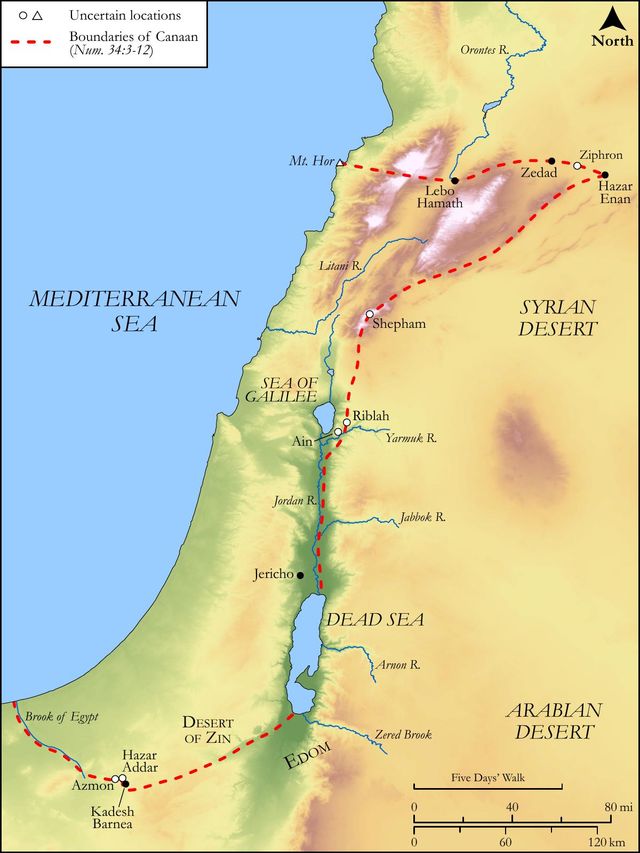
Numbers chapter 34 provides a comprehensive, divinely revealed blueprint for the geographical boundaries of the land of Canaan, which the new generation of Israelites was preparing to inherit. This detailed chapter follows the census that confirmed the people ready for entry and precedes the instructions for the equitable distribution of the land among the tribes. The meticulous description of the borders, systematically moving from south to north, and west to east, underscores God's direct and sovereign involvement in shaping Israel's national identity and securing their future dwelling. Verse 7 specifically defines a pivotal portion of the northern boundary, anchoring it to the natural western limit of the Mediterranean Sea and extending it eastward to a significant, identifiable landmark, Mount Hor, thereby providing clear and unambiguous markers for the tribal allotments and preventing future disputes.
Historical & Cultural Context
At this juncture in the narrative, the Israelites are encamped on the plains of Moab, poised to enter the promised land after four decades of wilderness wandering. The comprehensive land demarcation defines national and tribal territories, yet here it is uniquely presented as an explicit divine decree rather than a human negotiation or conquest. In this agrarian society, land was foundational to identity, security, and economic prosperity. Establishing clear, divinely sanctioned boundaries was paramount to prevent internal conflicts among the tribes and external disputes with neighboring peoples. These instructions also served as a tangible manifestation of God's unwavering faithfulness to the covenant promises made to Abraham, Isaac, and Jacob, assuring their descendants a specific, defined land. The designation of the "Great Sea" (Mediterranean) and "Mount Hor" as boundary markers highlights the ancient reliance on prominent natural features for unambiguous geographical definition.
Key Themes
ShowHideThe meticulous outlining of the borders in Numbers 34, including the specific detail in Numbers 34:7, contributes significantly to several overarching themes within the book of Numbers and the broader Pentateuch. Firstly, it powerfully demonstrates Divine Precision and Order. God's exactness in defining every segment of the border underscores His sovereign control and the deliberate nature of His plans, leaving nothing to chance regarding His people's inheritance. Secondly, it is a profound illustration of the Fulfillment of Promise. This detailed mapping is a tangible step towards the realization of the covenant God made with Abraham, Isaac, and Jacob concerning their descendants inheriting a specific land, as seen in passages like Genesis 15:18. It highlights God's unwavering faithfulness across generations. Lastly, the establishment of clear geographical boundaries signifies a Secured Inheritance for Israel. By providing a distinct and divinely appointed territory, God ensured their identity as a nation and laid the groundwork for their future stability, preventing future disputes over land ownership and providing a secure place for them to live out their covenant relationship with Him, as also promised in Deuteronomy 1:7.
Exposition and Analysis
ShowHideKey Word Analysis
ShowHideFrom the root meaning "hidden" or "dark," this term refers to the northern quarter, often associated with mystery or the unknown in ancient thought. In this context, it precisely designates the geographical direction of the border being described, indicating the northernmost extent of the promised land. Its usage here is purely directional, specifying the side of the territory being delineated.
This word denotes a large body of water, specifically the Mediterranean Sea when used with the article, as implied in "the great sea." The root suggests a "roaring" sound, indicative of crashing waves. As a boundary marker, the "great sea" (Mediterranean) served as an unmistakable, vast, and natural western limit, providing a clear and permanent starting point for the northern border's eastward trajectory.
A primitive root meaning "to mark off" or "designate." This verb implies a deliberate, active, and precise act of demarcation. It suggests the process of surveying, drawing a line, or identifying a specific direction or point. While God issues the command, the Israelites, through their appointed leaders, would be responsible for recognizing and establishing these divinely appointed markers, underscoring the intentionality and clarity behind the boundary setting.
Verse Breakdown
ShowHide"And this shall be your north border:"
This opening declaration immediately establishes the subject of the verse as a specific segment of Israel's northern boundary. The possessive "your" highlights the direct and personal allocation of this territory to the Israelite nation, underscoring God's specific provision for His people. It functions as a definitive statement of divine decree, leaving no ambiguity about the intended recipient and purpose of the upcoming geographical details.
"from the great sea"
This phrase specifies the precise starting point of this particular section of the northern border. The "great sea," universally understood as the Mediterranean Sea, serves as a natural, unmistakable, and vast western boundary. Its inclusion grounds the divine instruction in tangible, recognizable geography, providing a clear and universally acknowledged reference point for the commencement of the northern demarcation.
"ye shall point out for you mount Hor:"
This final clause directs the Israelites to identify and mark Mount Hor as the next significant point on their northern border. The verb "point out" (Hebrew, tâʼâh) implies a deliberate act of surveying or identifying, suggesting that while God provides the blueprint, human agency is involved in recognizing and establishing these divine markers. "Mount Hor" serves as a crucial landmark, extending the boundary line eastward from the Mediterranean, thereby completing this segment of the northern border's definition with a clear and unambiguous geological feature.
Literary Devices
ShowHideNumbers 34:7, within the broader context of the chapter, primarily employs Geographical Realism and Precision. The text meticulously names specific, identifiable landmarks like the "great sea" and "Mount Hor," grounding the divine instructions in the tangible world. This realism serves to authenticate the divine promise of land, making it concrete and actionable for the Israelites. The Precision of the language, using directional terms ("north border," "from") and specific, identifiable points, underscores God's meticulous planning and orderly nature. There is also an inherent element of Divine Fiat, where God's word directly establishes reality ("this shall be your north border"), demonstrating His sovereign authority over the land and its allocation to His chosen people. The repetition of boundary descriptions throughout the chapter, of which this verse is a part, also functions as a form of Emphasis, reinforcing the importance, permanence, and divine sanction of these divinely appointed borders.
Theological and Thematic Connections
ShowHideNumbers 34:7, as an integral part of God's detailed boundary instructions, profoundly illustrates the meticulous nature of divine providence and unwavering faithfulness. It reveals a God who is not vague in His promises but precise in their fulfillment, demonstrating His deep commitment to establishing His people in a secure and clearly defined inheritance. This physical demarcation of land reflects a deeper theological truth: God's desire for order, clarity, and security in the lives of His people, both nationally and individually. The boundaries were not arbitrary but divinely appointed, ensuring Israel's distinct identity and providing a tangible space for their covenant relationship with Yahweh to flourish. This passage reminds us that God's plans are detailed, purposeful, and ultimately designed for the flourishing and security of those He calls His own, providing a stable foundation for their existence and worship.
Reflection and Application
ShowHideThe divine precision in outlining Israel's northern border in Numbers 34:7 offers a powerful spiritual lesson: God is meticulously faithful in every detail of His promises. Just as He provided a specific, defined physical inheritance for Israel, He also provides a spiritual inheritance and a clear path for believers today. This passage invites us to trust in God's detailed plan for our lives, knowing that His boundaries are not restrictive but protective, designed for our flourishing and security. It encourages us to seek His guidance for our own "territory"—our callings, relationships, and responsibilities—and to live within the "borders" of His righteous commands, finding freedom and purpose there. We are reminded that God's provision is comprehensive, extending beyond the general promise to the specific, tangible details that ensure our well-being and the fulfillment of His purposes through us, fostering a deep sense of security and belonging in His divine order.
Questions for Reflection
ShowHideFAQ
ShowHideIs the Mount Hor mentioned in Numbers 34:7 the same as the Mount Hor where Aaron died in Numbers 20?
ShowHideNo, it is generally understood by biblical scholars that the Mount Hor mentioned in Numbers 34:7 as part of Israel's northern border is a different peak from the Mount Hor where Aaron, Moses' brother, died and was buried, as recorded in Numbers 20:28 and Numbers 33:38. The Mount Hor of Aaron's death is located in Edom, near the southern border of the promised land, likely Jabal Harun near Petra in modern-day Jordan. The Mount Hor of the northern border, however, is believed to be a prominent peak much further north, possibly in the Lebanon mountain range (e.g., Jabal Akkar or a peak in the Anti-Lebanon range), serving as a distinct landmark for the northernmost extent of the divinely appointed territory. The biblical text uses the same name for different locations, requiring careful contextual understanding based on geographical and narrative clues.
Why is God so specific and detailed about the geographical borders of the land?
ShowHideGod's extreme specificity regarding the land's borders in Numbers 34 and particularly in Numbers 34:7 serves several crucial purposes. Firstly, it underscores divine precision and order in His plans. God is not vague; His promises are concrete and meticulously detailed. Secondly, it is a tangible demonstration of the fulfillment of His covenant promises to Abraham, Isaac, and Jacob, that their descendants would inherit a specific land (e.g., Genesis 15:18). Thirdly, these clear boundaries provided security and identity for the nascent nation of Israel, preventing internal disputes among tribes and defining their distinct territory from surrounding nations. It established a secure place where they could live out their covenant relationship with God without ambiguity regarding their inheritance. Finally, it highlights God's sovereignty over the land and its allocation, emphasizing that Israel's possession was a divine gift, not a human conquest or earned right.
Christ-Centered Fulfillment
ShowHideWhile Numbers 34:7 describes the physical boundaries of a literal land inheritance, it finds its ultimate spiritual fulfillment in Christ. The meticulously defined borders of Canaan foreshadow the secure and boundless spiritual inheritance believers receive in Christ, an inheritance that is "imperishable, undefiled, and unfading, kept in heaven for you" (1 Peter 1:4). Just as Mount Hor marked a definitive point for Israel's physical territory, Christ is the definitive landmark and boundary of our spiritual reality. He is the "way, the truth, and the life" (John 14:6), defining the parameters of our relationship with God and the scope of our eternal dwelling. The promise of a secure land in the Old Testament points to the "better country" (Hebrews 11:16) and the eternal city whose builder and maker is God (Hebrews 11:10) that we inherit through faith in Jesus. In Christ, our "territory" is not bound by physical geography but by the Spirit, encompassing all the spiritual blessings in the heavenly places (Ephesians 1:3) and a secure dwelling in God's very presence, made possible by His atoning work. He is the ultimate fulfillment of God's promise of rest and inheritance for His people, providing a spiritual home that transcends earthly limitations and is eternally secured by His finished work on the cross.