


Numbers 34:9
Bible text: King James Version (1769 Blayney text) · Public domain
Bible text: Berean Standard Bible · Public domain
Bible text: American Standard Version (1901) · Public domain
Bible text: World English Bible, Messianic edition · Public domain
Bible text: Geneva Bible (1599) · Public domain
Bible text: Young's Literal Translation · Public domain
- וְיָצָאve·ya·Tza'and it will go outH3318Conj-w ¦ V-Qal-ConsecPerf-3msVerb Qal Consecutive Perfect 3rd Singular Masculineוְandיָצָאit will go out
- הַגְּבֻלha·ge·Vulthe borderH1366Art ¦ N-msNoun Singular Masculine Absoluteהַtheגְּבֻלborder
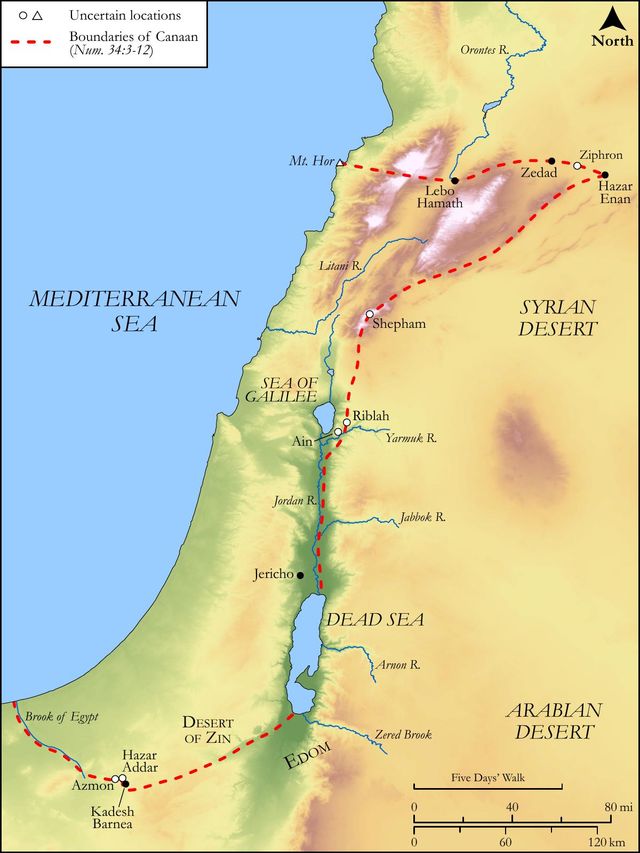
- זִפְרֹנָהzif·Ro·nahZiphron towardsH2202N-proper ¦ SfxNoun Proper LocationזִפְרֹנָZiphronהtowards
- וְהָיוּve·ha·Yuand they will beH1961Conj-w ¦ V-Qal-ConsecPerf-3cpVerb Qal Consecutive Perfect 3rd Plural common genderוְandהָיוּthey will be
- תוֹצְאֹתָיוtotz·'o·Tavits extremitiesH8444N-fpc ¦ 3msNoun Plural Feminine Constructתוֹצְאֹתָיextremitiesוits
- חֲצַרcha·TzarHazarH2704N-properNoun Proper Location
- עֵינָן'ei·NanEnanH2704N-properNoun Proper Location
- זֶהzehthisH2088PrtParticle Demonstrative
- יִהְיֶהyih·Yehit will beH1961V-Qal-Imperf-3msVerb Qal Imperfect 3rd Singular Masculine
- לָכֶםla·Khemof youPrep-l ¦ 2mpSuffix Personal 2nd Plural Masculineלָofכֶםyou
- גְּבוּלge·Vulborder ofH1366N-mscNoun Singular Masculine Construct
- צָפוֹןtza·Fon[the] northH6828N-fsNoun Singular Feminine Absolute
English is a literal word-by-word gloss of the Hebrew, not the KJV's wording. Why?
This is the original text the KJV's translators worked from — each Hebrew word with its own literal English meaning in this verse, prepared by scholars at Tyndale House, Cambridge. The KJV translates whole sentences, not word by word, so its wording differs: one Hebrew word can become several English words, and the KJV may choose “the LORD” where the gloss reads “Yahweh”. Both are faithful — they answer different questions. For the KJV's own rendering, switch to the KJV text.
Details
See on the biblical-era map
Study this verse
Continue studying Numbers 34:9 across the web’s major study libraries — every link below opens this exact verse, chapter, or book on the destination site.
Read & Compare
 BibleGatewayThis verse in more than 200 translations and 70 languages.
 Bible.comThe YouVersion reader — hundreds of translations, reading plans, and highlights.
 ESV.orgCrossway's official English Standard Version reader.
 NET BibleThe NET translation with 60,000+ translators' notes on every rendering decision.
 STEP BibleTyndale House's free study tool — original text, vocabulary, and scholarly resources.
 BibliaLogos Bible Software's free web reader.
 USCCBThe New American Bible (Revised Edition) with the U.S. bishops' study notes.
Commentaries
 BibleHub CommentariesDozens of classic commentaries on this verse, gathered on one page.
 StudyLightMore than 100 commentary sets — the largest collection on the web.
 BibleRefPlain-English commentary on what this verse means, verse by verse.
 Enduring WordDavid Guzik's free commentary on this chapter, widely used by Bible teachers.
 Bible Study ToolsVerse commentary alongside Greek and Hebrew study aids.
Original Language & Research
- BibleHub InterlinearThe verse word by word — original language, transliteration, and English.
- BibleHub LexiconEvery word's original-language definition and Strong's entry.
 Blue Letter BibleDeep-study tools — Strong's numbers, concordance, and word studies.
 SefariaThe Hebrew text with Rashi and centuries of Jewish commentary.
Sermons, Hymns & Audio


TrulyRandomVerse is not affiliated with these sites and doesn’t control their content. They’re linked because they’re genuinely useful.
Summary
Numbers 34:9 meticulously defines a segment of the northern border of the land of Canaan, specifying Ziphron and Hazarenan as key geographical markers. This verse is an integral part of God's comprehensive blueprint for Israel's inheritance, powerfully underscoring His unwavering faithfulness in fulfilling His ancient covenantal promises to Abraham, Isaac, and Jacob. It highlights the concrete, intentional, and divinely ordained nature of God's provision, ensuring a precisely delineated territory for His chosen people and affirming the certainty of His commitments.
Context
ShowHideLiterary Context
Numbers 34:9 is situated within a highly detailed and prescriptive section of the book of Numbers (chapters 33-36) that meticulously outlines the precise geographical boundaries and the divinely ordained method of division for the land of Canaan. This land was God's promised inheritance to the Israelites. Following the Lord's explicit command in Numbers 33:50-56 to dispossess the existing inhabitants and divide the land by lot, chapter 34 functions as the "legal deed" or authoritative blueprint for this sacred inheritance. Verse 9 specifically contributes to the meticulous description of the northern frontier, demonstrating the divine precision and absolute authority behind Israel's future possession of the land. This detailed mapping serves as a foundational legal and theological document, setting the stage for the subsequent conquest and settlement narratives comprehensively detailed in the book of Joshua.
Historical & Cultural Context
At the time these instructions were given, the Israelites were encamped on the plains of Moab, poised on the brink of entering the Promised Land after forty arduous years of wilderness wandering. The meticulous delineation of national and tribal boundaries was of paramount importance in Israel. Land ownership and clearly defined territorial claims were fundamental pillars of national identity, economic stability, and the prevention of inter-tribal or inter-national conflicts. Such detailed geographical descriptions served as authoritative legal documents, designed to prevent future disputes and unequivocally affirm the divine grant of the land. The specific locations mentioned, Ziphron and Hazarenan, likely refer to points at the northernmost extent of the ideal "promised land" as envisioned by God, potentially extending into what is modern-day Syria, thereby indicating the full, expansive scope of God's intended inheritance, even if Israel's historical occupation sometimes fell short of these maximal boundaries.
Key Themes
ShowHideThis verse, along with the entire chapter, powerfully reinforces several core theological themes central to the Pentateuch. Firstly, it underscores Divine Provision and Faithfulness, demonstrating God's unwavering and active commitment to His covenant with Abraham, Isaac, and Jacob, particularly concerning the land promised to their descendants (as seen in Genesis 12:7 and Genesis 15:18). The precise mapping highlights that God's promises are concrete, tangible, and not vague abstractions. Secondly, it emphasizes Order and Specificity in God's divine plans; there is no ambiguity regarding the precise extent of the land He has appointed. This meticulous detail reflects God's sovereign control, meticulous planning, and His desire for clarity for His people. Lastly, the concept of Inheritance and Possession is central, as the land is presented not merely as a territory to be conquered, but as a direct, unmerited gift from God to His chosen people, to be possessed, settled, and stewarded. The command to divide the land by lot in Numbers 33:54 further solidifies this idea of a divinely allotted and secured territory.
Exposition and Analysis
ShowHideKey Word Analysis
ShowHideFrom the root meaning "to bound" or "to twist a cord," this term (H1366) properly refers to a cord used for measurement, and by extension, a boundary line or the territory enclosed by such a line. In a legal and theological sense, it signifies a fixed, defined limit, often marked by natural features or man-made markers. Its usage here emphasizes the non-negotiable and precise nature of the land's extent as ordained by God, affirming Israel's legitimate and divinely established claim to this specific region.
This primitive root (H3318) means "to go out" or "to proceed." In the context of a border, it signifies the continuous progression or extension of the boundary line. It emphasizes the active movement and trajectory of the border as it extends towards a specific point, indicating that the line is not static but is being meticulously traced and defined from one point to the next.
This noun (H8444), typically used in the plural collective, denotes "exits," "extremities," or "terminal points." It refers to the definitive conclusion or furthest reach of a boundary line. In Numbers 34:9, it highlights that Hazarenan marks the precise conclusion or final extension of this segment of the northern border, leaving no room for ambiguity regarding the line's ultimate termination.
Verse Breakdown
ShowHide"And the border shall go on to Ziphron"
This initial clause describes the continuous progression and specific direction of the northern boundary line. "Ziphron" is named as a significant landmark or a key geographical point that the border reaches as it extends. This indicates a precise geographical trajectory, moving towards a recognizable location in the northern region, serving as a crucial reference point for the meticulous delineation of the territory.
"and the goings out of it shall be at Hazarenan"
This part of the verse specifies the ultimate, definitive termination point of this particular segment of the border. "Hazarenan" functions as the extremity or final limit, marking where the northern line concludes or exits the defined territory. This reinforces the meticulousness of the divine mapping, ensuring absolute clarity regarding the full extent and precise end point of the inheritance.
"this shall be your north border"
This concluding declarative statement serves as a clear, authoritative, and unequivocal affirmation. It formally designates the described line, extending to and terminating at the specified points, as the official and divinely appointed northern boundary for the tribes of Israel. This declaration leaves no doubt about the legitimacy, certainty, and divine origin of this territorial claim.
Literary Devices
ShowHideThe language of Numbers 34:9, and indeed the entire chapter, is characterized by Geographical Enumeration, meticulously listing specific place names to define precise boundaries. This technique, coupled with the Repetition of key terms such as "border" (gᵉbûwl) and "goings out" (tôwtsâʼâh) throughout the chapter, serves to reinforce the meticulousness, certainty, and divine authority of the decree. The text also employs Legal Language and a highly Precise Diction, mirroring the style of ancient land deeds or cadastral surveys. This precision underscores the divine authority behind the allocation of the land and ensures that there is no ambiguity regarding the exact extent of Israel's inheritance. The very act of such detailed mapping functions as a literary device to convey God's absolute control, His unwavering faithfulness, and the tangible, concrete nature of His covenantal promises.
Theological and Thematic Connections
ShowHideNumbers 34:9, with its precise delineation of physical boundaries, serves as a powerful testament to God's faithfulness and the concrete nature of His covenant promises. Just as God meticulously defined the borders of the earthly inheritance for Israel, He operates with precision and certainty in all His dealings, both physical and spiritual. This concept of divinely appointed boundaries extends beyond mere geography, speaking to the order, security, and blessing found within the parameters God sets for His people. The physical land of promise, with its clearly marked borders, foreshadows a greater, spiritual inheritance, emphasizing that God has a secure and specific "territory" for each of His children, marked by His grace, provision, and eternal purpose. His promises are not vague hopes but definite realities.
Reflection and Application
ShowHideThe meticulous detail of Numbers 34:9, defining ancient geographical borders, offers profound spiritual insights for believers today. It reminds us that our God is a God of precision, order, and unwavering faithfulness. Just as He meticulously fulfilled His promises to Israel regarding their physical land, we can trust in His perfect provision and the absolute certainty of His Word concerning our lives. This passage encourages us to recognize that God sets "borders" not to restrict us, but to guide us into paths of peace, security, and abundant blessing. Understanding and respecting these divine "borders" – whether they are moral principles, spiritual disciplines, or the specific callings He places on our lives – leads to true flourishing and freedom. Furthermore, the concept of a divinely allotted inheritance points us directly to our spiritual inheritance in Christ, a secure and eternal reality that far surpasses any earthly territory. We are called to live faithfully within the "borders" of His grace and truth, trusting that His plans for us are as concrete and certain as the ancient boundaries of Canaan.
Questions for Reflection
ShowHideFAQ
ShowHideWhy is such a detailed geographical description included in the Bible?
ShowHideThe inclusion of such meticulous geographical details in Numbers 34:9 and the surrounding verses serves several crucial purposes. Firstly, it provides a legal and historical validation of God's promise to Israel regarding the land of Canaan, demonstrating that His covenantal commitments are concrete and specific, not vague or symbolic. This detailed blueprint served as the definitive title deed for Israel's inheritance. Secondly, it underscores God's divine order and precision; He is not a God of chaos but of meticulous planning, leaving no ambiguity about the exact extent of the territory He appointed for His people. Thirdly, these details were essential for practical reasons, guiding the tribes in their settlement and preventing future territorial disputes among them, fostering unity and peace. Lastly, it serves as an enduring historical record, allowing future generations to understand the scope of the land God intended for His people, even if their actual occupation varied throughout history. The mention of specific places like Ziphron and Hazarenan anchors the divine promise in real-world geography, affirming the tangible nature of God's interaction with humanity and the historical veracity of His Word.
Christ-Centered Fulfillment
ShowHideWhile Numbers 34:9 meticulously delineates the physical borders of an earthly inheritance, it powerfully foreshadows the spiritual and eternal inheritance found supremely in Jesus Christ. The promised land of Canaan, with its divinely appointed boundaries, serves as a profound type of the ultimate "rest" and "inheritance" that believers receive through saving faith in Christ. Just as the Israelites were given a defined territory to possess, so too are believers granted "every spiritual blessing in the heavenly places in Christ" (Ephesians 1:3). The physical "goings out" of the border, marking the furthest extent of the earthly promise, point to the expansive, boundless nature of the new covenant, where the Kingdom of God is not confined by geographical limits but by the pervasive reign of Christ in the hearts of His people and throughout the world. Jesus Himself is our ultimate "promised land," our true rest and secure inheritance, as He provides the perfect peace and eternal security that the land of Canaan could only symbolize (Hebrews 4:9-10). Through His atoning work on the cross, we are "made alive together with Christ" and have been granted an "inheritance among those who are sanctified" (Colossians 1:12). The meticulous precision of the ancient borders finds its ultimate fulfillment in the perfect and complete provision of salvation and eternal life offered through the Lamb of God, who takes away the sin of the world!, leading us to the new heavens and new earth, our eternal and boundless home (Revelation 21:1-4).