


Numbers 34:10
Bible text: King James Version (1769 Blayney text) · Public domain
Bible text: Berean Standard Bible · Public domain
Bible text: American Standard Version (1901) · Public domain
Bible text: World English Bible, Messianic edition · Public domain
Bible text: Geneva Bible (1599) · Public domain
Bible text: Young's Literal Translation · Public domain
- וְהִתְאַוִּיתֶםve·hit·'a·vi·Temand you will markH184Conj-w ¦ V-Hiphil-ConsecPerf-2mpVerb Hiphil Consecutive Perfect 2nd Plural Masculineוְandהִתְאַוִּיתֶםyou will mark
- לָכֶםla·Khemfor <the> yourselvesPrep-l ¦ 2mpSuffix Personal 2nd Plural Masculineלָfor <the>כֶםyourselves
- לִגְבוּלlig·Vulfor [the] border ofH1366Prep-l ¦ N-mscNoun Singular Masculine Constructלִforגְבוּל[the] border of
- קֵדְמָהKe·de·maheast -wardH6924N-ms ¦ SfxNoun Singular Masculine Absoluteקֵדְמָeastה-ward
- מֵחֲצַרme·cha·Tzarfrom HazarH2704Prep-m ¦ N-properNoun Proper LocationמֵfromחֲצַרHazar
- עֵינָן'ei·NanEnanH2704N-properNoun Proper Location
- שְׁפָמָהshe·Fa·mahShepham towardsH8221N-proper ¦ SfxNoun Proper LocationשְׁפָמָShephamהtowards
English is a literal word-by-word gloss of the Hebrew, not the KJV's wording. Why?
This is the original text the KJV's translators worked from — each Hebrew word with its own literal English meaning in this verse, prepared by scholars at Tyndale House, Cambridge. The KJV translates whole sentences, not word by word, so its wording differs: one Hebrew word can become several English words, and the KJV may choose “the LORD” where the gloss reads “Yahweh”. Both are faithful — they answer different questions. For the KJV's own rendering, switch to the KJV text.
Details
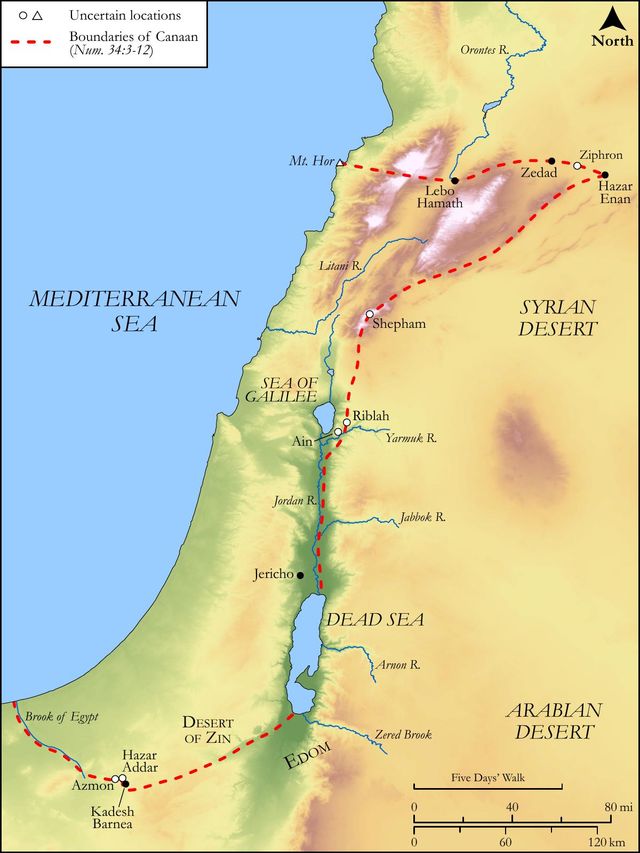
See on the biblical-era map
Study this verse
Continue studying Numbers 34:10 across the web’s major study libraries — every link below opens this exact verse, chapter, or book on the destination site.
Read & Compare
 BibleGatewayThis verse in more than 200 translations and 70 languages.
 Bible.comThe YouVersion reader — hundreds of translations, reading plans, and highlights.
 ESV.orgCrossway's official English Standard Version reader.
 NET BibleThe NET translation with 60,000+ translators' notes on every rendering decision.
 STEP BibleTyndale House's free study tool — original text, vocabulary, and scholarly resources.
 BibliaLogos Bible Software's free web reader.
 USCCBThe New American Bible (Revised Edition) with the U.S. bishops' study notes.
Commentaries
 BibleHub CommentariesDozens of classic commentaries on this verse, gathered on one page.
 StudyLightMore than 100 commentary sets — the largest collection on the web.
 BibleRefPlain-English commentary on what this verse means, verse by verse.
 Enduring WordDavid Guzik's free commentary on this chapter, widely used by Bible teachers.
 Bible Study ToolsVerse commentary alongside Greek and Hebrew study aids.
Original Language & Research
- BibleHub InterlinearThe verse word by word — original language, transliteration, and English.
- BibleHub LexiconEvery word's original-language definition and Strong's entry.
 Blue Letter BibleDeep-study tools — Strong's numbers, concordance, and word studies.
 SefariaThe Hebrew text with Rashi and centuries of Jewish commentary.
Sermons, Hymns & Audio


TrulyRandomVerse is not affiliated with these sites and doesn’t control their content. They’re linked because they’re genuinely useful.
Summary
Numbers 34:10 provides a precise geographical marker for a segment of the eastern boundary of the Promised Land, illustrating God's meticulous instructions for the division and settlement of Canaan. This verse underscores the divine faithfulness in fulfilling ancient covenant promises to Abraham regarding a defined inheritance for His people, emphasizing the importance of clear, unambiguous borders for the nascent nation of Israel as a testament to God's orderly provision and sovereign allocation.
Context
ShowHideLiterary Context
Numbers 34:10 is situated within a crucial section of the Book of Numbers, specifically chapters 33-36, which provides the final divine instructions before Israel's entry into the Promised Land. Following the census in Numbers 26, which determined the population for land distribution, and the laws regarding inheritance for daughters in Numbers 27, this chapter, Numbers 34, specifically outlines the precise geographical boundaries of the land west of the Jordan River that was to be divided among the nine and a half tribes. Verses 1-9 define the southern and western borders, and Numbers 34:10-12 then focuses on the eastern perimeter, moving from north to south. This meticulous delineation emphasizes the legal and administrative preparations for settlement, ensuring that the land, a key component of God's covenant, was clearly defined and distributed.
Historical & Cultural Context
The setting for Numbers 34 is the plains of Moab, on the eastern side of the Jordan River, just before Israel's entry into Canaan after forty years of wilderness wandering. For Israel, land ownership and clear boundaries were paramount, signifying identity, security, and economic stability. The covenant with Abraham had already named the land from the river of Egypt to the river Euphrates, and God's precise demarcation of the land here gives that promise its exact bounds, demonstrating His sovereign authority over the earth and His meticulous care for His people. The Israelites, having been nomadic for generations, were about to transition into an agrarian, settled society, making the clear definition of their inherited territory not just a legal necessity but a foundational element for their national identity and future prosperity, directly tied to the promises made to their patriarchs, particularly in Genesis 15:18-21.
Key Themes
ShowHideThis verse, within its broader context, contributes to several significant themes. First is the Divine Provision and Inheritance: The detailed description of the borders highlights God's active and specific role in providing a tangible, physical inheritance for His people, fulfilling His promises. It is not a vague promise but a clearly defined territory, demonstrating God's generosity and faithfulness. Second, the theme of Order and Specificity is prominent; God's instructions are remarkably precise, leaving no ambiguity about the extent of the land. This meticulousness reflects divine order, foresight, and wisdom in managing His people's future and avoiding future conflicts over land claims. Third, it powerfully underscores the Fulfillment of Promise: The very act of defining these borders signifies the imminent culmination of the covenant God made centuries earlier with Abraham, Isaac, and Jacob. It assures Israel that their long journey and trials are indeed leading to the promised rest and possession, echoing the divine commitment seen in passages like Genesis 12:7.
Exposition and Analysis
ShowHideKey Word Analysis
ShowHideThis primitive root means "to extend or mark out." In the context of Numbers 34:10, it signifies a precise, deliberate action of defining limits. It implies the authoritative act of surveying and establishing clear, unalterable borders. The use of this word emphasizes that the boundaries are not arbitrary or subject to human negotiation, but are divinely appointed and precisely specified, conveying a sense of divine intentionality and meticulousness in the allocation of the inheritance.
This term, derived from a root meaning "to twist" (like a cord), properly refers to "a boundary" and by extension "the territory inclosed." In this verse, "your east border" refers to the precise geographical limit of the Promised Land on its eastern side. The use of this word highlights the tangible and defined nature of the inheritance God was providing, emphasizing the fixed and non-negotiable nature of the divinely ordained territory. It signifies a clear demarcation that prevents disputes and establishes ownership.
This place name literally means "village of springs." As a geographical marker, its inclusion indicates a prominent and recognizable location, likely characterized by significant water sources, which would have made it an unmistakable landmark on Israel's northern frontier. Its function here is to serve as the northern starting point for the eastern boundary, ensuring that the boundary could be clearly identified and followed, underscoring the divine precision in defining the extent of the promised inheritance.
Verse Breakdown
ShowHide"And ye shall point out your east border"
This opening clause functions as a direct divine command, indicating that the Israelites (or their appointed leaders) are responsible for physically marking or recognizing the boundary that God has already determined. The phrase "your east border" specifies the particular side of the land being addressed, following the previous delineation of the southern and western boundaries. The verb "point out" implies a clear, deliberate act of identification and establishment, underscoring the importance of these divinely ordained limits. This is not a suggestion but a mandate for the precise demarcation of their inheritance.
"from Hazarenan to Shepham"
This phrase provides the specific geographical markers for the segment of the eastern border. "From Hazarenan" indicates the northern starting point of this particular section of the eastern boundary, while "to Shepham" indicates the southern ending point of this segment, establishing a clear line of demarcation between these two points. Together, these place names provide concrete, identifiable references for the boundary, ensuring that the extent of the land was unambiguously defined. This precision was crucial for preventing disputes among the tribes and with neighboring peoples, reflecting God's orderly provision and foresight.
Literary Devices
ShowHideThe primary literary device evident in Numbers 34:10, and throughout the detailed boundary descriptions in this chapter, is Precision and Specificity. The text employs a highly detailed, almost legalistic, form of geographical description, meticulously naming specific landmarks and directions to eliminate any ambiguity about the exact extent of the land. This meticulousness serves to underscore the divine authority and the binding nature of the land allocation. Another significant device is Repetition, as the formulaic "and ye shall point out" or similar phrases are used for each border segment, reinforcing the systematic and comprehensive nature of the divine command and the importance of these boundaries. The use of specific, identifiable place names like Hazarenan and Shepham also exemplifies Topographical Realism, grounding the divine promise in concrete, verifiable locations. This makes the inheritance tangible and underscores the literal fulfillment of God's word. The overall tone is distinctly Didactic and Prescriptive, emphasizing divine instruction and command, thereby reinforcing the absolute will of God for the land's division and Israel's settlement.
Theological and Thematic Connections
ShowHideNumbers 34:10, with its precise geographical details, profoundly illustrates God's unwavering faithfulness and meticulous care for His covenant people. It demonstrates that God's promises are not vague or ethereal, but concrete and specific, culminating in a tangible inheritance. This detailed mapping of the land underscores the divine commitment to fulfilling the Abrahamic covenant, which promised a specific territory to Abraham's descendants. The emphasis on clear boundaries reflects God's desire for order, peace, and security for His people, preventing internal disputes and external encroachments. It teaches that God is sovereign over all the earth, and He precisely allocates portions according to His divine plan, ensuring His people's well-being and their ability to live according to His laws within their designated space, thereby establishing their national identity and purpose.
Reflection and Application
ShowHideNumbers 34:10, though detailing ancient geographical boundaries, offers timeless and profound insights for contemporary believers. It serves as a powerful reminder of God's unwavering faithfulness to His promises. Just as He meticulously defined and secured a physical inheritance for Israel, He has provided and secured a spiritual inheritance for us in Christ, a reality far grander, more enduring, and eternally significant. This passage encourages us to trust in God's precise and purposeful plan for our lives, even when the "borders" of our circumstances may seem unclear or challenging. His divine order ensures that every detail, every boundary, and every provision is ultimately for our good and His glory. We are called to live within the boundaries He sets—whether ethical, spiritual, or relational—recognizing that these limits are not restrictive but are divinely designed for our flourishing, protection, and sanctification. Understanding God's meticulousness in providing for Israel should deepen our confidence in His sovereign provision for us, knowing that He is a God of order who unfailingly brings His promises to fruition.
Questions for Reflection
ShowHideFAQ
ShowHideWhy did God provide such detailed geographical boundaries for the land?
ShowHideGod provided such meticulous details for several crucial reasons, reflecting His divine character and purposes for Israel. Firstly, it underscored His faithfulness in fulfilling His ancient covenant promises to Abraham, Isaac, and Jacob, which explicitly included a specific land inheritance, as seen in passages like Genesis 12:7. The precision demonstrated that this was a concrete, tangible gift, not a vague concept. Secondly, it established order and prevented disputes among the twelve tribes regarding their respective territories, and with neighboring nations. Clear boundaries were essential for national identity, security, and the administration of justice within the nascent nation. Thirdly, it emphasized God's sovereignty over all the earth, demonstrating His right and power to allocate land as He willed, reinforcing His ultimate authority. Finally, these boundaries were also designed to protect Israel's distinct identity as God's chosen people, setting them apart geographically from pagan influences and enabling them to live in obedience to His laws within their designated sphere, fostering their unique covenant relationship with Him.
Christ-Centered Fulfillment
ShowHideNumbers 34:10, with its emphasis on a divinely appointed and meticulously defined earthly inheritance, finds its ultimate and glorious fulfillment in Jesus Christ. While ancient Israel received a physical land as a temporary dwelling, believers in Christ receive an eternal, spiritual inheritance that transcends all geographical and temporal limits. Jesus Himself is the true "boundary marker" and guarantor of this new covenant, through whom all of God's promises, including the promise of an inheritance, are definitively "Yes" and "Amen" (2 Corinthians 1:20). The earthly rest and security found in the Promised Land served as a powerful foreshadowing of the true rest and eternal security believers find in Christ, who is our ultimate dwelling place and the very substance of our inheritance (Hebrews 4:9-10). Just as God precisely delineated the land for Israel, Christ has secured for us a "heavenly inheritance that is imperishable, undefiled, and unfading, kept in heaven for you" (1 Peter 1:4). The meticulousness of the old covenant's land distribution thus points to the even greater precision, certainty, and spiritual richness of the new covenant's blessings, all centered and secured in the person and redemptive work of Jesus, who brings us into the very presence of God, our true and everlasting "Promised Land" (Ephesians 1:11).