


Numbers 34:11
Bible text: King James Version (1769 Blayney text) · Public domain
Bible text: King James Version with Strong's numbers · Public domain
Bible text: Berean Standard Bible · Public domain
Bible text: American Standard Version (1901) · Public domain
Bible text: World English Bible, Messianic edition · Public domain
Bible text: Geneva Bible (1599) · Public domain
Bible text: Young's Literal Translation · Public domain
- וְיָרַדve·ya·Radand it will go downH3381Conj-w ¦ V-Qal-ConsecPerf-3msVerb Qal Consecutive Perfect 3rd Singular Masculineוְandיָרַדit will go down
- הַגְּבֻלha·ge·Vulthe borderH1366Art ¦ N-msNoun Singular Masculine Absoluteהַtheגְּבֻלborder
- מִשְּׁפָםmi·she·Famfrom ShephamH8221Prep-m ¦ N-properNoun Proper LocationמִfromשְּׁפָםShepham
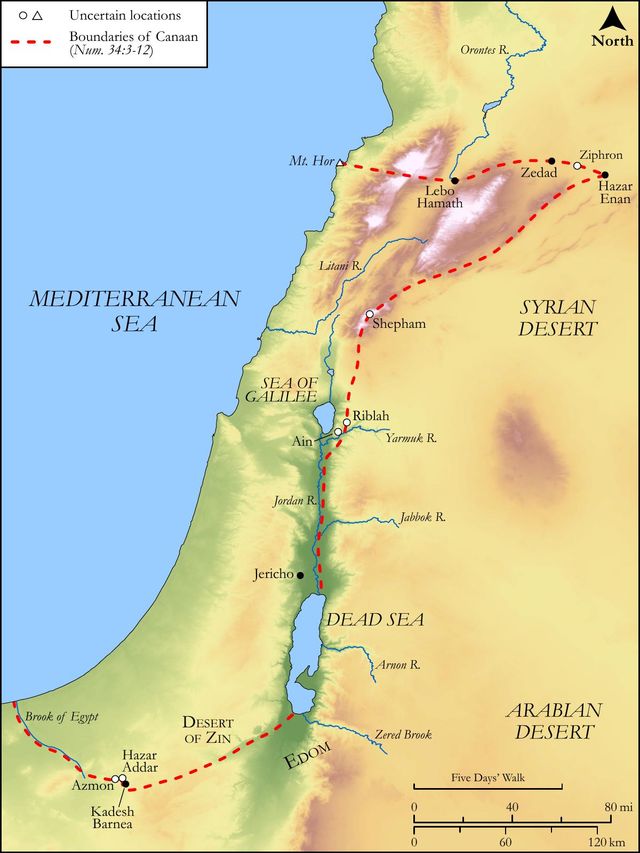
- הָרִבְלָהha·riv·Lah<the> RiblahH7247Art ¦ N-properNoun Proper Locationהָ<the>רִבְלָהRiblah
- מִקֶּדֶםmi·Ke·demfrom [the] eastH6924Prep-m ¦ N-mscNoun Singular Masculine Constructמִfromקֶּדֶם[the] east
- לָעָיִןla·'A·yinof <the> AinH5871Prep-l ¦ N-properNoun Proper Locationלָof <the>עָיִןAin
- וְיָרַדve·ya·Radand it will go downH3381Conj-w ¦ V-Qal-ConsecPerf-3msVerb Qal Consecutive Perfect 3rd Singular Masculineוְandיָרַדit will go down
- הַגְּבוּלha·ge·Vulthe borderH1366Art ¦ N-msNoun Singular Masculine Absoluteהַtheגְּבוּלborder
- וּמָחָהu·ma·Chahand it will reachH4229Conj-w ¦ V-Qal-ConsecPerf-3msVerb Qal Consecutive Perfect 3rd Singular Masculineוּandמָחָהit will reach
- עַל'altoH5921PrepPreposition
- כֶּתֶףKe·tef[the] shoulder ofH3802N-fscNoun Singular Feminine Construct
- יָםyom[the] sea ofH3220N-mscNoun Singular Masculine Construct
- כִּנֶּרֶתki·Ne·retKinnerethH3672N-properNoun Proper Location
- קֵדְמָהKe·de·maheast -wardH6924N-ms ¦ SfxNoun Singular Masculine Absoluteקֵדְמָeastה-ward
English is a literal word-by-word gloss of the Hebrew, not the KJV's wording. Why?
This is the original text the KJV's translators worked from — each Hebrew word with its own literal English meaning in this verse, prepared by scholars at Tyndale House, Cambridge. The KJV translates whole sentences, not word by word, so its wording differs: one Hebrew word can become several English words, and the KJV may choose “the LORD” where the gloss reads “Yahweh”. Both are faithful — they answer different questions. For the KJV's own rendering, switch to the KJV text.
Details
See on the biblical-era map
Study this verse
Historical interpretation
Historical reception
1 surviving comment on this verse from the historical church.
Sea of Cenereth: This is the sea of Galilee, illustrated by the miracles of our Lord.
Continue studying Numbers 34:11 across the web’s major study libraries — every link below opens this exact verse, chapter, or book on the destination site.
Read & Compare
 BibleGatewayThis verse in more than 200 translations and 70 languages.
 Bible.comThe YouVersion reader — hundreds of translations, reading plans, and highlights.
 ESV.orgCrossway's official English Standard Version reader.
 NET BibleThe NET translation with 60,000+ translators' notes on every rendering decision.
 STEP BibleTyndale House's free study tool — original text, vocabulary, and scholarly resources.
 BibliaLogos Bible Software's free web reader.
 USCCBThe New American Bible (Revised Edition) with the U.S. bishops' study notes.
Commentaries
 BibleHub CommentariesDozens of classic commentaries on this verse, gathered on one page.
 StudyLightMore than 100 commentary sets — the largest collection on the web.
 BibleRefPlain-English commentary on what this verse means, verse by verse.
 Enduring WordDavid Guzik's free commentary on this chapter, widely used by Bible teachers.
 Bible Study ToolsVerse commentary alongside Greek and Hebrew study aids.
Original Language & Research
- BibleHub InterlinearThe verse word by word — original language, transliteration, and English.
- BibleHub LexiconEvery word's original-language definition and Strong's entry.
 Blue Letter BibleDeep-study tools — Strong's numbers, concordance, and word studies.
 SefariaThe Hebrew text with Rashi and centuries of Jewish commentary.
Sermons, Hymns & Audio


TrulyRandomVerse is not affiliated with these sites and doesn’t control their content. They’re linked because they’re genuinely useful.
Summary
Numbers 34:11 meticulously details a segment of the eastern boundary of the land of Canaan, describing its precise southward trajectory from Shepham to Riblah, passing east of Ain, and culminating at the eastern side of the Sea of Chinnereth. This verse is an integral part of God's divine instructions to Moses for the careful demarcation of the Promised Land, underscoring the Lord's unwavering faithfulness in fulfilling His covenant promises to Israel by providing a defined and secure inheritance.
Context
ShowHideLiterary Context
Numbers 34:11 is situated within a crucial legal and geographical section of the book of Numbers (Numbers 34:1-12), which meticulously outlines the precise boundaries of the land of Canaan that Israel was destined to inherit. This detailed cartography serves as a foundational blueprint, immediately following the census in Numbers 26 that prepared the new generation for entry into the land, and preceding the instructions for its equitable distribution by lot among the tribes (Numbers 34:13-29). The painstaking nature of these geographical descriptions emphasizes the divine origin and legitimacy of Israel's claim to the land, leaving no room for ambiguity. The preceding verses establish the southern and western borders, and this verse continues the delineation of the eastern frontier, moving from north to south, ensuring a comprehensive and divinely sanctioned definition of their God-given territory. This section forms a critical bridge between the wilderness wanderings and the imminent entry into the Promised Land, setting the stage for the fulfillment narratives in the book of Joshua.
Historical & Cultural Context
The practice of defining precise land boundaries was a common and essential aspect of the life of peoples, as when Jacob and Laban raised a heap of witness between them, and was frequently associated with covenants, conquests, and the establishment of national identity. For Israel, however, these borders transcended mere human constructs; they were divinely ordained, reflecting God's sovereign will and His covenant fidelity. The land of Canaan, strategically positioned as a vital land bridge between the powerful ancient empires of Egypt and Mesopotamia, was a highly contested region. God's detailed instructions provided Israel with a clear legal, theological, and practical basis for their possession, distinguishing their claim from simple conquest or human ambition. The inclusion of specific landmarks like Shepham, Riblah, and Ain, along with the prominent Sea of Chinnereth, highlights the practical necessity of identifiable geographical markers for tribal allocation, administration, and defense in an era devoid of modern mapping technology. Riblah, though a border point here, would later gain historical notoriety as a significant site of judgment and exile during the Babylonian conquest, as recorded in 2 Kings 25:6-7.
Key Themes
ShowHideThis verse, as an integral part of the broader boundary descriptions, illuminates several profound theological themes. Firstly, it powerfully underscores Divine Precision and Order. The meticulous detail in defining every segment of the border speaks to God's orderly nature, His sovereign control over the physical world, and His purposeful design for His people. Secondly, it serves as a tangible illustration of the Fulfillment of Promise. The land, with its specific and divinely appointed boundaries, is the concrete manifestation of God's unwavering covenant with Abraham, Isaac, and Jacob, first articulated in Genesis 15:18. This detailed blueprint demonstrates God's absolute faithfulness to His word, even after centuries of delay and wilderness wandering. Thirdly, it emphasizes Inheritance and Possession. The land is not merely conquered territory but a divine gift, an eternal inheritance for the tribes of Israel. This concept of inheritance is central to Israel's identity and their unique covenant relationship with God, as seen throughout the Pentateuch and later in books like Deuteronomy 4:1. The defined borders legitimize their claim and provide a secure, divinely sanctioned place for the nation to flourish under God's rule and fulfill their purpose.
Exposition and Analysis
ShowHideKey Word Analysis
ShowHideThis noun, derived from a root meaning "to twist" or "cord," properly refers to a cord used for measurement, and by extension, a boundary or limit. In Numbers 34:11, it denotes the demarcated line that defines the edge of the Promised Land. The term emphasizes the divinely appointed limits and extent of Israel's inheritance, highlighting the precision with which God intended the land to be divided and possessed. It signifies not just a physical line but a divinely sanctioned boundary, underscoring the legitimacy and security of Israel's claim.
This primitive root means "to go downwards," "to descend," or "to fall." Used twice in this verse ("go down" and "descend"), yârad precisely describes the geographical reality of the eastern border. It highlights the topographical feature of the land, which moves from higher ground in the north (Shepham) southward towards the significantly lower elevation of the Sea of Chinnereth (Sea of Galilee), which lies well below sea level. This verb emphasizes the practical and observable nature of the divine instructions, grounding the border description in the physical landscape.
This is the ancient name for what is now universally known as the Sea of Galilee, also referred to in the New Testament as Lake Gennesaret or Lake Tiberias. The name Kinnᵉrôwth (or Kinnereth) is widely believed to be derived from the Hebrew word for "harp" (כִּנּוֹר, kinnôr), likely due to the lake's distinctive harp-like or lyre-like shape when viewed from above. Its inclusion here grounds the biblical narrative in recognizable geographical reality, marking a prominent and enduring landmark on the eastern boundary. The phrase "eastward" clarifies that the border reaches the western side of the sea, with the sea itself forming a natural eastern boundary for this segment of the land.
Verse Breakdown
ShowHide"And the coast shall go down from Shepham to Riblah,"
This initial clause precisely delineates the starting point and general direction of the eastern boundary. It indicates a southward movement ("go down") from Shepham, an identifiable (though debated exact location) northern landmark, towards Riblah, a more certainly located ancient site further south. This segment establishes the linear progression and initial trajectory of the border.
"on the east side of Ain;"
This phrase provides an additional, more specific point of reference for the descending border. "Ain" (meaning "spring" or "fountain") likely refers to a significant water source or oasis, serving as another identifiable landmark along the route. The specification "on the east side of Ain" clarifies that the border passed to the east of this feature, maintaining its southward course and precise alignment, indicating a careful bypass rather than passing directly through the spring itself.
"and the border shall descend,"
This reiterates and reinforces the downward, southward movement of the boundary, emphasizing the continuous topographical reality of the land. The repetition of "descend" (or "go down") underscores the steady progression of the border's path from the northern highlands towards the lower Jordan Valley and the Sea of Chinnereth, highlighting the natural contours of the landscape.
"and shall reach unto the side of the sea of Chinnereth eastward:"
This concluding clause identifies the ultimate destination and eastern terminus of this segment of the border: the Sea of Chinnereth. This prominent body of water, known today as the Sea of Galilee, forms a natural and unmistakable boundary. The addition of "eastward" clarifies that the border reaches the western shore of the sea, with the sea itself forming the easternmost extent of the northern part of the Promised Land, thus providing a clear and enduring marker.
Literary Devices
ShowHideNumbers 34:11 primarily employs Topographical Description, a literary technique used to provide precise geographical details. The verse functions as a Geographical Itinerary, meticulously mapping out a specific segment of the eastern border of the Promised Land by listing a series of identifiable landmarks (Shepham, Riblah, Ain, Sea of Chinnereth) and indicating the direction of the border's movement ("go down," "descend," "eastward"). The repetition of verbs like "go down" and "descend" serves as a form of Emphasis, underscoring both the southward trajectory and the topographical reality of the region, reinforcing the natural flow of the landscape into the divine design. While not overtly symbolic, the meticulous detail in this description implicitly conveys Divine Precision and Divine Mandate, reinforcing the theological idea that these boundaries are not arbitrary human constructs but divinely appointed, reflecting God's orderly nature and His sovereign provision for His people.
Theological and Thematic Connections
ShowHideNumbers 34:11, in its meticulous delineation of Israel's eastern border, serves as a powerful testament to God's unwavering faithfulness and His steadfast commitment to His covenant promises. The precision in defining the land's boundaries underscores the tangible nature of God's provision and the secure identity He bestows upon His people. This divine cartography highlights that Israel's inheritance was not a matter of chance, human conquest, or political maneuvering alone, but a divinely ordained gift, ensuring their security and purpose within the specific confines God established. It speaks to a God who is both sovereign over all creation and meticulously attentive to the details of His redemptive plan, providing a physical space for His people to live in covenant relationship with Him and to be a light to the nations. This detailed provision assures us that God's promises are concrete and dependable.
Reflection and Application
ShowHideThe detailed geographical descriptions in Numbers 34:11, while seemingly mundane, offer profound spiritual lessons for believers today. Just as God meticulously defined physical boundaries for Israel, He also provides clear spiritual boundaries and guidance for our lives, ensuring our security and flourishing within His divine will. This precision speaks to His faithfulness and His desire for order and security in our walk with Him. We are called to live within the "borders" of His revealed will, trusting that His divine plan, though sometimes intricate and requiring careful attention, is always for our ultimate good and His glory. This verse encourages us to find our security not in our own efforts, possessions, or self-defined limits, but in the specific inheritance and identity God has given us through Christ. It reminds us that God is a God of detail, who cares for every aspect of our lives, and whose promises are as sure and certain as the ancient landmarks He established for Israel. Our spiritual inheritance in Christ is equally real, though unseen, and just as divinely appointed and secured by His faithfulness.
Questions for Reflection
ShowHideFAQ
ShowHideWhat is the significance of the Sea of Chinnereth in this verse?
ShowHideThe Sea of Chinnereth, known today as the Sea of Galilee, is a major geographical landmark mentioned in Numbers 34:11. Its significance lies primarily in its role as a prominent and unmistakable natural boundary marker for the eastern border of the Promised Land. The name "Chinnereth" is thought to derive from the Hebrew word for "harp," likely due to the lake's distinctive shape when viewed from above. Its inclusion underscores the divine precision in defining Israel's inheritance, using recognizable and enduring features of the landscape. The Sea of Galilee would later become central to Jesus' earthly ministry, where He called His first disciples, taught multitudes, and performed many miracles, making this ancient border description a foundational element of the very land where much of the New Testament narrative unfolds.
Christ-Centered Fulfillment
ShowHideWhile Numbers 34:11 meticulously describes the physical boundaries of an earthly inheritance, it ultimately points to a greater, spiritual inheritance found in Christ. The precisely defined borders of Canaan foreshadow the secure and eternal dwelling place God prepares for His people in the new creation. Just as ancient Israel received a physical land by divine promise, believers in Christ receive an inheritance that is imperishable, undefiled, and unfading, kept in heaven for them (1 Peter 1:4). Jesus, the true and greater Joshua, leads His people not into a geographical land, but into the Kingdom of God, fulfilling the ancient promises in a spiritual sense and for all creation. His earthly ministry, particularly around the very Sea of Chinnereth (Galilee) mentioned in this verse, where He called disciples and performed miracles, signifies that the King has come to claim His spiritual territory and establish His eternal reign. The precision of the ancient borders speaks to God's faithfulness in bringing all His promises to fruition in Christ, who is the ultimate fulfillment of God's covenant with Abraham, offering not just a piece of land, but eternal life and a place in God's eternal dwelling (Hebrews 11:10). Through Him, we inherit all the spiritual blessings in the heavenly places (Ephesians 1:3), a far grander and more secure inheritance than any earthly territory.