


Joshua 19:35
Bible text: King James Version (1769 Blayney text) · Public domain
Bible text: Berean Standard Bible · Public domain
Bible text: American Standard Version (1901) · Public domain
Bible text: World English Bible, Messianic edition · Public domain
Bible text: Geneva Bible (1599) · Public domain
Bible text: Young's Literal Translation · Public domain
- וְעָרֵיve·'a·Reiand [the] cities ofH5892Conj-w ¦ N-mpcNoun Plural Masculine Constructוְandעָרֵי[the] cities of
- מִבְצָרmiv·TzarfortificationH4013N-msNoun Singular Masculine Absolute
- הַצִּדִּיםha·tzi·Dim[are] <the> ZiddimH6661Art ¦ N-properNoun Proper Locationהַ[are] <the>צִּדִּיםZiddim
- צֵרTzerZerH6863N-properNoun Proper Location
- וְחַמַּתve·cha·Matand HammathH2575Conj-w ¦ N-properNoun Proper LocationוְandחַמַּתHammath
- רַקַּתra·KatRakkathH7557N-properNoun Proper Location
- וְכִנָּרֶתve·khi·Na·retand KinnerethH3672Conj-w ¦ N-properNoun Proper LocationוְandכִנָּרֶתKinnereth
English is a literal word-by-word gloss of the Hebrew, not the KJV's wording. Why?
This is the original text the KJV's translators worked from — each Hebrew word with its own literal English meaning in this verse, prepared by scholars at Tyndale House, Cambridge. The KJV translates whole sentences, not word by word, so its wording differs: one Hebrew word can become several English words, and the KJV may choose “the LORD” where the gloss reads “Yahweh”. Both are faithful — they answer different questions. For the KJV's own rendering, switch to the KJV text.
Details
See on the biblical-era maps
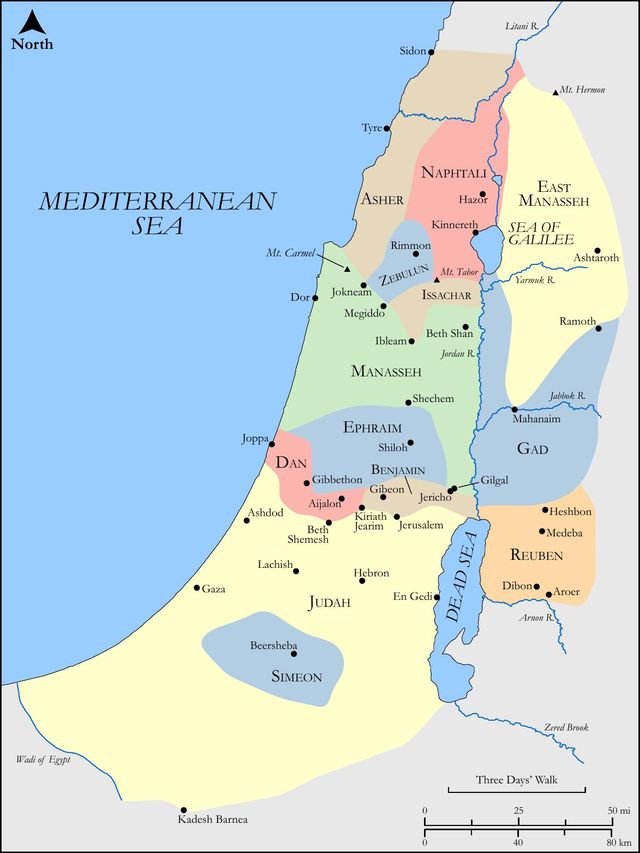
Study this verse
Public-domain commentary
Matthew Henry
From his Commentary on the Whole Bible. Henry comments on passages, not single verses — this entry covers Joshua 19:32–39.
Naphtali lay furthest north of all the tribes, bordering on Mount Libanus. The city of Leshem, or Liash, lay on the utmost edge of it to the north, and therefore when the Danites had made themselves masters of it, and called it Dan, the length of Canaan from north to south was reckoned from Dan to Beersheba. It had Zebulun on the south, Asher on the west, and Judah upon Jordan, probably a city of that name, and so distinguished from the tribe of Judah on the east. It was in the lot of this tribe, near the waters of Merom, that Joshua fought and routed Jabin, Jos 11:1. etc. In this tribe stood Capernaum and Bethsaida, on the north end of the sea of Tiberias, in which Christ did so many mighty works; and the mountain (as is supposed) on which Christ preached, Mat 5:1.
Continue studying Joshua 19:35 across the web’s major study libraries — every link below opens this exact verse, chapter, or book on the destination site.
Read & Compare
 BibleGatewayThis verse in more than 200 translations and 70 languages.
 Bible.comThe YouVersion reader — hundreds of translations, reading plans, and highlights.
 ESV.orgCrossway's official English Standard Version reader.
 NET BibleThe NET translation with 60,000+ translators' notes on every rendering decision.
 STEP BibleTyndale House's free study tool — original text, vocabulary, and scholarly resources.
 BibliaLogos Bible Software's free web reader.
 USCCBThe New American Bible (Revised Edition) with the U.S. bishops' study notes.
Commentaries
 BibleHub CommentariesDozens of classic commentaries on this verse, gathered on one page.
 StudyLightMore than 100 commentary sets — the largest collection on the web.
 BibleRefPlain-English commentary on what this verse means, verse by verse.
 Enduring WordDavid Guzik's free commentary on this chapter, widely used by Bible teachers.
 Bible Study ToolsVerse commentary alongside Greek and Hebrew study aids.
Original Language & Research
- BibleHub InterlinearThe verse word by word — original language, transliteration, and English.
- BibleHub LexiconEvery word's original-language definition and Strong's entry.
 Blue Letter BibleDeep-study tools — Strong's numbers, concordance, and word studies.
 SefariaThe Hebrew text with Rashi and centuries of Jewish commentary.
Sermons, Hymns & Audio


TrulyRandomVerse is not affiliated with these sites and doesn’t control their content. They’re linked because they’re genuinely useful.
Summary
Joshua 19:35 meticulously lists five fortified settlements—Ziddim, Zer, Hammath, Rakkath, and Chinnereth—as integral components of the tribal inheritance granted to Naphtali in the northern region of the Promised Land. This verse, situated within the detailed account of Israel's land distribution, profoundly underscores God's unwavering faithfulness in fulfilling His covenant promises, the strategic importance of these "fenced cities" for defense and administration in the nascent nation, and the precise, orderly nature of the divine provision extended to each tribe.
Context
ShowHideLiterary Context
Joshua 19 continues the detailed account of the division of the land of Canaan among the remaining Israelite tribes, building upon the initial distributions to Judah, Ephraim, and Manasseh in preceding chapters. The book of Joshua, as a whole, chronicles Israel's conquest and settlement, emphasizing God's faithfulness to His covenant promises. Within this broader narrative, Joshua 19 specifically delineates the territories for the final seven tribes, commencing with Simeon and concluding with Joshua's personal inheritance. Verses 32-39 are dedicated exclusively to the territory assigned to the tribe of Naphtali, one of Jacob's sons. The enumeration of specific cities, including the "fenced cities" in Joshua 19:35, functions as a precise geographical and administrative anchor, meticulously defining the boundaries and key strongholds within Naphtali's designated inheritance. This detailed listing reinforces the overarching theme of divine order and the complete fulfillment of God's promise to provide a secure homeland for His people, ensuring every tribe received its designated portion as recorded in Joshua 18:1-10.
Historical & Cultural Context
The period described in the book of Joshua represents a critical transition for Israel from nomadic wanderers to an established nation. While significant military campaigns had secured much of the land, the Israelites still faced the formidable challenge of fully dispossessing the remaining Canaanite inhabitants and solidifying their borders against external threats. "Fenced cities" (עָרֵי מִבְצָר, 'arei mivtzar) were indispensable in this volatile context. These were not mere settlements but highly fortified urban centers, often strategically positioned on elevated terrain or equipped with substantial defensive walls, designed to protect inhabitants, control vital trade routes, and serve as administrative hubs. The inclusion of such cities within Naphtali's allotment underscores the ongoing need for defense and the strategic significance of this northern region, which bordered other peoples and was historically prone to incursions. Culturally, the precise land division was foundational to the tribal structure of Israel, with inherited land serving as the primary source of identity, livelihood, and the tangible fulfillment of the covenant promises made to their patriarchs, as initially articulated in Genesis 12:7.
Key Themes
ShowHideThis verse, and the broader context of Joshua 19, contributes profoundly to several overarching theological and narrative themes. Firstly, it powerfully illustrates Divine Faithfulness and Fulfillment, demonstrating God's unwavering commitment to His ancient covenant promises to Abraham and his descendants to grant them the land of Canaan, as recorded in Genesis 15:18-21. Secondly, the meticulous listing of cities underscores God's Order and Meticulousness in His divine plan, leaving no ambiguity about each tribe's rightful and secure inheritance. This precision reflects a divine blueprint, not a haphazard distribution, ensuring justice and stability. Thirdly, it specifically defines Naphtali's Inheritance, providing concrete geographical markers for their assigned territory, thereby establishing their place within the emerging nation. Finally, the emphasis on "fenced cities" highlights the Strategic Importance of these locations for defense, administration, and maintaining control over the newly acquired territories, even as the process of complete conquest continued, as evidenced by later struggles mentioned in Judges 1.
Exposition and Analysis
ShowHideKey Word Analysis
ShowHide(מִבְצָר), this term denotes "a fortification, castle, or fortified city; figuratively, a defender." It emphasizes the robust defensive capabilities of these urban centers, indicating they were not merely residential areas but strategically constructed strongholds. Their inclusion signifies the importance of security and control in the newly acquired territory, reflecting the practical realities of settlement in a contested land.
(עִיר), this word refers to "a city (a place guarded by waking or a watch) in the widest sense." It suggests a place of habitation that is protected or watched over, implying a degree of organization and communal living. When combined with "fenced," it paints a picture of urban centers designed for both habitation and defense, crucial for establishing Israelite presence and authority.
(כִּנֶּרֶת), this is a significant geographical name, possibly meaning "harp-shaped." It refers to a place in Palestine, specifically the region around the large freshwater lake that would later become known as the Sea of Galilee. Its inclusion in Naphtali's inheritance places this tribe in a region that would become profoundly significant in later biblical history, particularly during the ministry of Jesus.
Verse Breakdown
ShowHide"And the fenced cities [are]"
This introductory phrase immediately establishes the focus on strategic, fortified urban centers within the allocated territory. The use of "fenced cities" (עָרֵי מִבְצָר) conveys their defensive nature, indicating they were crucial points for military control and protection. It highlights the practical aspect of God's provision—not just land, but secure strongholds for His people.
"Ziddim, Zer, and Hammath, Rakkath, and Chinnereth"
This precise enumeration lists five specific cities within Naphtali's inheritance. While the exact modern locations of Ziddim (H6661, meaning "sides") and Zer (H6863, meaning "rock") are debated, Hammath (H2575, meaning "hot springs") is often identified with the ancient site near the hot springs of Tiberias, and Rakkath (H7557, meaning "beach" or "expanded shingle") is frequently associated with the ancient city that later became Tiberias itself. Chinnereth (H3672) refers to the region around the Sea of Galilee. This detailed listing underscores the meticulousness of the land distribution, ensuring that Naphtali's inheritance included vital strategic points for defense, trade, and settlement within their designated boundaries, reflecting divine order and precision.
Literary Devices
ShowHideThe primary literary device employed in Joshua 19:35 is Enumeration or Listing. This technique is characteristic of the administrative, legal, and genealogical sections found throughout the Pentateuch and historical books. Its purpose here is to provide a detailed, precise, and authoritative record of the land divisions and tribal inheritances, thereby legitimizing and concretizing the tribal boundaries and leaving no ambiguity about the extent of Naphtali's territory. Furthermore, there is a strong element of Topography/Geography, as the specific names of these cities function as tangible geographical markers, grounding the narrative in a real, historical landscape. The mention of "Chinnereth" also carries a subtle but profound element of Foreshadowing, as this strategically important Old Testament region would later become the primary setting for the earthly ministry of Jesus Christ, transforming its significance from a military stronghold to a spiritual epicenter of the Kingdom of God.
Theological and Thematic Connections
ShowHideJoshua 19:35, though appearing as a mere list of names, profoundly reinforces the theological truth of God's covenant faithfulness and His meticulous care for His people. The precise allocation of "fenced cities" within Naphtali's inheritance is a tangible demonstration of God fulfilling His ancient promise to Abraham that his descendants would indeed possess the land. It speaks to the divine order and intentionality in establishing a secure homeland for Israel, providing not just territory but also strategic strongholds necessary for their protection and flourishing. This detailed provision underscores God's unwavering commitment to His word, ensuring that every aspect of His promise, down to the specific cities, was realized. It is a testament to God's reliability and His comprehensive provision for His people.
Reflection and Application
ShowHideThe meticulous detail of city enumeration in Joshua 19:35, particularly the emphasis on "fenced cities" within Naphtali's inheritance, offers profound insights into the character of God and His dealings with humanity. It serves as a powerful reminder that God is a God of order, precision, and unwavering faithfulness, fulfilling His promises down to the smallest detail. Just as He meticulously planned and distributed the land to each tribe, providing them with secure, fortified places for their protection and flourishing, so too does He orchestrate the details of our lives, providing security, establishing boundaries, and preparing a spiritual inheritance for us. This verse encourages us to trust in His comprehensive provision and to recognize that our spiritual "boundaries" in Christ are divinely established for our ultimate protection and flourishing. It invites us to consider the profound security we find in our spiritual inheritance, which is far more enduring and unshakeable than any earthly city. We are called to live within the parameters God has set for us, finding peace, purpose, and true rest in His perfect plan, knowing that He is intimately involved in every aspect of our journey and that His promises are always "Yes" and "Amen" in Christ.
Questions for Reflection
ShowHideFAQ
ShowHideWhat is the significance of "fenced cities" in this particular context of tribal inheritance?
ShowHideThe term "fenced cities" (עָרֵי מִבְצָר, 'arei mivtzar) refers to fortified urban centers, typically equipped with substantial defensive walls, towers, and gates, or naturally situated in highly defensible locations. Their significance in Joshua 19:35 is multifaceted and crucial for understanding the post-conquest period. Firstly, they represent strategic strongholds essential for the security and control of the newly acquired tribal territory. In a period of ongoing settlement and potential conflict with remaining Canaanite populations or neighboring peoples, these cities provided vital protection for the inhabitants and served as administrative and military bases. Secondly, their inclusion in the land allotment underscores the practical aspect of God's provision—He gave not just the land, but also the means to secure and sustain it, demonstrating His comprehensive care for His people. Finally, it highlights the reality that even after initial conquest, the Israelites still faced challenges and needed to maintain vigilance and establish firm control, emphasizing the blend of divine provision and human responsibility in establishing their nation and securing their inheritance.
Christ-Centered Fulfillment
ShowHideWhile Joshua 19:35 meticulously details an earthly inheritance of fortified cities for the tribe of Naphtali, it powerfully foreshadows the spiritual inheritance and ultimate security found in Christ. The "Promised Land" itself, with its provisions and protections, serves as a profound type of the heavenly rest and spiritual blessings that believers receive in Christ, as richly expounded in Hebrews 4:1-11. Just as the Israelites received a physical inheritance with "fenced cities" for their temporal protection and flourishing, believers are granted an eternal inheritance in Christ, secured by His finished work on the cross and His resurrection power. Our true "fenced city" is the salvation and eternal life offered through Jesus, a refuge stronger and more enduring than any earthly wall or fortress, as poetically depicted in Psalm 46:1 and confirmed in the unshakeable Kingdom of God (Hebrews 12:28). Furthermore, the specific mention of Chinnereth (the Sea of Galilee) in this verse is a direct and poignant prophetic link to the New Testament, where this very region became the primary stage for Jesus' earthly ministry. It was along the shores of this lake that He called His first disciples (e.g., Matthew 4:18-22), performed numerous miracles of healing and provision (e.g., Mark 6:30-44), and taught the crowds with unparalleled authority (e.g., Matthew 5:1-12), transforming a strategically fortified Old Testament territory into the very epicenter of the Kingdom of God and the revelation of the Messiah. Thus, the earthly inheritance of Naphtali, including its fortified cities, ultimately points to the superior, eternal, and Christ-centered inheritance and security that believers possess in Jesus, the true King and Shepherd of our souls.