


Joshua 19:34
Bible text: King James Version (1769 Blayney text) · Public domain
Bible text: King James Version with Strong's numbers · Public domain
Bible text: Berean Standard Bible · Public domain
Bible text: American Standard Version (1901) · Public domain
Bible text: World English Bible, Messianic edition · Public domain
Bible text: Geneva Bible (1599) · Public domain
Bible text: Young's Literal Translation · Public domain
- וְשָׁבve·Shavand it turns backH7725Conj-w ¦ V-Qal-ConsecPerf-3msVerb Qal Consecutive Perfect 3rd Singular Masculineוְandשָׁבit turns back
- הַגְּבוּלha·ge·Vulthe borderH1366Art ¦ N-msNoun Singular Masculine Absoluteהַtheגְּבוּלborder
- יָמָּהya·mahwest -wardH3220N-ms ¦ SfxNoun Singular Masculine Absoluteיָמָּwestה-ward
- אַזְנוֹת'az·NotAznothH243N-properNoun Proper Location
- תָּבוֹרta·VorTaborH243N-properNoun Proper Location
- וְיָצָאve·ya·Tza'and it goes outH3318Conj-w ¦ V-Qal-ConsecPerf-3msVerb Qal Consecutive Perfect 3rd Singular Masculineוְandיָצָאit goes out
- מִשָּׁםmi·Shamfrom thereH8033Prep-m ¦ AdvAdverbמִfromשָּׁםthere
- חוּקֹקָהchu·Ko·kahHukok towardsH2712N-proper ¦ SfxNoun Proper LocationחוּקֹקָHukokהtowards
- וּפָגַעu·fa·Ga'and it touchesH6293Conj-w ¦ V-Qal-ConsecPerf-3msVerb Qal Consecutive Perfect 3rd Singular Masculineוּandפָגַעit touches
- בִּזְבֻלוּןbiz·vu·Lun<on> ZebulunH2074Prep-b ¦ N-proper-mNoun Proper Masculineבִּ<on>זְבֻלוּןZebulun
- מִנֶּגֶבmi·Ne·gevfrom [the] southH5045Prep-m ¦ N-msNoun Singular Masculine Absoluteמִfromנֶּגֶב[the] south
- וּבְאָשֵׁרu·ve·'a·Sherand <on> AsherH836Conj-w ¦ Prep-b ¦ N-proper-mNoun Proper Masculineוּandבְ<on>אָשֵׁרAsher
- פָּגַעpa·Ga'it touchesH6293V-Qal-Perf-3msVerb Qal Perfect 3rd Singular Masculine
- מִיָּםmi·Yamfrom [the] westH3220Prep-m ¦ N-msNoun Singular Masculine Absoluteמִfromיָּם[the] west
- וּבִיהוּדָהu·Vi·hu·Dahand <on> JudahH3063Conj-w ¦ Prep-b ¦ N-properNoun Proper Locationוּandבִ<on>יהוּדָהJudah
- הַיַּרְדֵּןhai·yar·Denthe JordanH3383Art ¦ N-properNoun Proper LocationהַtheיַּרְדֵּןJordan
- מִזְרַחmiz·Rach[the] rising ofH4217N-mscNoun Singular Masculine Construct
- הַשָּׁמֶשׁha·Sha·meshthe sunH8121Art ¦ N-csNoun Singular common gender Absoluteהַtheשָּׁמֶשׁsun
English is a literal word-by-word gloss of the Hebrew, not the KJV's wording. Why?
This is the original text the KJV's translators worked from — each Hebrew word with its own literal English meaning in this verse, prepared by scholars at Tyndale House, Cambridge. The KJV translates whole sentences, not word by word, so its wording differs: one Hebrew word can become several English words, and the KJV may choose “the LORD” where the gloss reads “Yahweh”. Both are faithful — they answer different questions. For the KJV's own rendering, switch to the KJV text.
Details
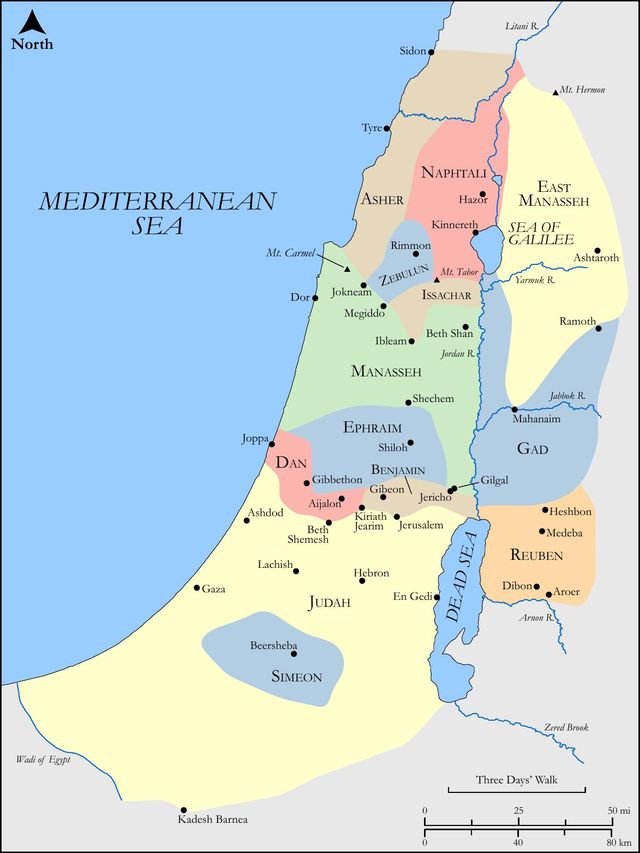
See on the biblical-era maps
Study this verse
Public-domain commentary
Matthew Henry
From his Commentary on the Whole Bible. Henry comments on passages, not single verses — this entry covers Joshua 19:32–39.
Naphtali lay furthest north of all the tribes, bordering on Mount Libanus. The city of Leshem, or Liash, lay on the utmost edge of it to the north, and therefore when the Danites had made themselves masters of it, and called it Dan, the length of Canaan from north to south was reckoned from Dan to Beersheba. It had Zebulun on the south, Asher on the west, and Judah upon Jordan, probably a city of that name, and so distinguished from the tribe of Judah on the east. It was in the lot of this tribe, near the waters of Merom, that Joshua fought and routed Jabin, Jos 11:1. etc. In this tribe stood Capernaum and Bethsaida, on the north end of the sea of Tiberias, in which Christ did so many mighty works; and the mountain (as is supposed) on which Christ preached, Mat 5:1.
Continue studying Joshua 19:34 across the web’s major study libraries — every link below opens this exact verse, chapter, or book on the destination site.
Read & Compare
 BibleGatewayThis verse in more than 200 translations and 70 languages.
 Bible.comThe YouVersion reader — hundreds of translations, reading plans, and highlights.
 ESV.orgCrossway's official English Standard Version reader.
 NET BibleThe NET translation with 60,000+ translators' notes on every rendering decision.
 STEP BibleTyndale House's free study tool — original text, vocabulary, and scholarly resources.
 BibliaLogos Bible Software's free web reader.
 USCCBThe New American Bible (Revised Edition) with the U.S. bishops' study notes.
Commentaries
 BibleHub CommentariesDozens of classic commentaries on this verse, gathered on one page.
 StudyLightMore than 100 commentary sets — the largest collection on the web.
 BibleRefPlain-English commentary on what this verse means, verse by verse.
 Enduring WordDavid Guzik's free commentary on this chapter, widely used by Bible teachers.
 Bible Study ToolsVerse commentary alongside Greek and Hebrew study aids.
Original Language & Research
- BibleHub InterlinearThe verse word by word — original language, transliteration, and English.
- BibleHub LexiconEvery word's original-language definition and Strong's entry.
 Blue Letter BibleDeep-study tools — Strong's numbers, concordance, and word studies.
 SefariaThe Hebrew text with Rashi and centuries of Jewish commentary.
Sermons, Hymns & Audio


TrulyRandomVerse is not affiliated with these sites and doesn’t control their content. They’re linked because they’re genuinely useful.
Summary
Joshua 19:34 provides a meticulous geographical description of a specific segment of the tribal boundary for Naphtali, delineating its southwestern and southern reaches. It traces the demarcation from the vicinity of Aznothtabor, proceeding westward to Hukkok, then turning south to meet the territory of Zebulun, continuing west to intersect with Asher, and finally extending eastward to the Jordan River, where it borders Judah. This precise detailing of territorial limits underscores God's unwavering faithfulness in fulfilling His ancient covenant promises of land to Israel, establishing clear and distinct tribal identities, and demonstrating the divine order and meticulousness inherent in the allocation of the Promised Land.
Context
ShowHideLiterary Context
Joshua 19:34 is embedded within the comprehensive land distribution narrative of the Book of Joshua, specifically chapters 13-19, which meticulously detail the allocation of Canaan among the twelve tribes of Israel. This section marks a significant transition from the military conquest phase (chapters 1-12) to the administrative and theological fulfillment of God's promises regarding the inheritance of the land. Chapter 19, in particular, itemizes the allotments for Simeon, Zebulun, Issachar, Asher, Naphtali, and Dan. Verse 34 falls within the detailed description of Naphtali's tribal inheritance (Joshua 19:32-39), providing specific geographical markers that define its borders. The inclusion of such precise boundary descriptions serves a crucial legal and practical purpose, establishing each tribe's legitimate claim to their territory and minimizing future disputes, thereby reinforcing the orderly and precise nature of God's provision for His people.
Historical & Cultural Context
The division of the land of Canaan was a foundational event for the nascent nation of Israel, directly fulfilling the ancient covenant God made with Abraham, Isaac, and Jacob, promising them a land for their descendants (e.g., the covenant in Genesis 15:18). In Israel, land ownership and clearly defined tribal or clan territories were paramount to identity, economic stability, and social structure. Boundaries were typically marked by prominent natural features such as rivers, mountains, wadis (dry riverbeds), or by significant towns and settlements, and sometimes by man-made cairns or pillars. The meticulous detail found in Joshua reflects the immense importance of these boundaries for legal clarity, economic viability, and social cohesion. The mention of specific towns like Aznothtabor and Hukkok indicates their recognition as established, verifiable points of reference within the ancient Canaanite landscape. The method of land allocation, often involving the casting of lots as seen in Joshua 18:6, underscored the belief that the distribution was not arbitrary but divinely ordained and impartial.
Key Themes
ShowHideThe meticulous mapping of tribal territories throughout Joshua 19 and the preceding chapters highlights several profound theological and narrative themes. Foremost among these is the theme of Divine Faithfulness and Fulfillment. The precise realization of God's ancient promise to provide a land for His people, down to the specific geographical features and tribal intersections, powerfully demonstrates His unwavering reliability and the truthfulness of His Word across generations, from the patriarchal narratives to the settlement in Canaan. Secondly, the detailed boundaries emphasize Order and Structure. God is consistently portrayed as a God of order, not chaos, and the clear delineation of territories established a foundational framework for governance, identity, and peaceful coexistence among the tribes, effectively preventing endless disputes over inheritance. Finally, this detailed allocation speaks to Tribal Identity and Coexistence. While each tribe received its distinct and secure inheritance, the adjacent and sometimes overlapping boundaries, as described in Joshua 19:34, necessitated interaction, cooperation, and a shared sense of national destiny within the larger confederation of Israel, all under the sovereign hand of God.
Exposition and Analysis
ShowHideKey Word Analysis
ShowHideThis term (H1366), often translated as "border," "boundary," or "limit," refers to the defined perimeter or edge of a territory. In the KJV, "coast" does not imply a shoreline but rather the frontier or boundary of a land area. Its use here emphasizes the precise and legally binding nature of the tribal demarcation. The meticulous detail of these "coasts" underscores the divine order and the fulfillment of God's promise to give Israel a clearly defined inheritance.
This verb (H7725), meaning "to turn back," "to turn away," or "to return," indicates a change in direction of the boundary line. It suggests a dynamic movement or tracing of the border, highlighting the specific geographical path the boundary takes. The active verb "turneth" brings the description to life, guiding the reader along the precise contours of Naphtali's land as it shifts course.
This word (H6293) means "to impinge," "to meet," "to encounter," or "to touch." It signifies the point where Naphtali's boundary physically connects or abuts the territory of another tribe. The repetition of "reacheth" emphasizes the clear points of contact and separation between the tribes, ensuring no ambiguity regarding where one tribe's land ended and another's began, thus preventing potential conflicts over disputed territory.
Verse Breakdown
ShowHide"And [then] the coast turneth westward to Aznothtabor"
This clause initiates the description of Naphtali's boundary, indicating a specific turning point from an implied prior direction (likely from the east or north, based on preceding verses) and heading westward towards the significant landmark of Aznothtabor, a town located near Mount Tabor. This establishes a key anchor point for the subsequent delineation of the border.
"and goeth out from thence to Hukkok"
Continuing from Aznothtabor, the boundary proceeds further westward to Hukkok, another identifiable location. This further defines the progression of the border, indicating a clear path between two recognized geographical markers within the region, solidifying the westward extent of this segment.
"and reacheth to Zebulun on the south side"
At this point, the boundary turns southward, meeting and connecting with the territory allocated to the tribe of Zebulun. This precisely defines Naphtali's southern border, establishing a clear line of demarcation between the two tribes and preventing encroachment or dispute over land.
"and reacheth to Asher on the west side"
The description then moves to the western side of Naphtali's territory, where it connects with that of the tribe of Asher. This indicates the extent of Naphtali's land towards the west, ensuring its distinct identity and preventing overlap with Asher's inheritance, highlighting the careful separation of tribal lands.
"and to Judah upon Jordan toward the sunrising"
This final clause describes the easternmost extent of Naphtali's boundary, reaching the Jordan River and bordering the territory of Judah. The phrase "toward the sunrising" specifies the eastward direction, confirming the Jordan as a natural eastern boundary and indicating a point of contact with Judah, whose territory also extended along the Jordan. This completes the comprehensive outline of Naphtali's detailed borders, demonstrating the full scope of its allocated land.
Literary Devices
ShowHideJoshua 19:34 primarily employs Topographical Description and Repetition. The verse is a quintessential example of Topographical Description, meticulously detailing geographical features, cardinal directions ("westward," "south side," "west side," "toward the sunrising"), and naming specific landmarks (Aznothtabor, Hukkok) and adjacent tribal territories (Zebulun, Asher, Judah, Jordan River). This precise mapping serves to legally and practically define the tribal inheritance, leaving no ambiguity regarding the extent of Naphtali's land. The Repetition of key verbs like "turneth" and "reacheth" emphasizes the precise tracing and meeting points of the boundary, reinforcing the idea of a clearly defined and unchangeable allocation. This repetitive structure contributes to the authoritative and definitive tone of the text, underscoring the divine order and meticulousness in the land's distribution. The overall effect is one of detailed precision and authoritative declaration, reflecting the divine hand in the fulfillment of promises.
Theological and Thematic Connections
ShowHideJoshua 19:34, though appearing as a dry geographical listing, is profoundly theological. It stands as a powerful testament to God's meticulous faithfulness in fulfilling His ancient covenant promises to Abraham, Isaac, and Jacob, specifically the promise of a land for their descendants. The precision of the boundaries underscores God's character as one who is true to His word, down to the smallest detail, demonstrating His reliability across generations. It also highlights the divine order established for the nascent nation of Israel, providing clear identity, a foundation for governance, and preventing chaos and endless disputes. This detailed allocation of land is not merely administrative; it is an act of divine providence, securing the physical space necessary for Israel to develop as a unique nation, worship God according to His commands, and ultimately become the conduit through which the Messiah would come. The land was both an inheritance and a responsibility, a tangible sign of God's abiding presence and provision among His people.
Reflection and Application
ShowHideWhile Joshua 19:34 describes ancient geographical boundaries, its underlying principles offer profound contemporary relevance for believers. The meticulous detail in God's provision for Naphtali reminds us that God is not vague or haphazard in His plans for His people. He is precise, intentional, and utterly faithful, ensuring that every promise is fulfilled with exactness. This truth should cultivate a deep and abiding trust in His detailed providence over our own lives, knowing that He oversees even the smallest aspects of our circumstances and destinies. Just as the tribes received a tangible, physical inheritance, believers today have an immeasurable spiritual inheritance in Christ—a new identity, spiritual blessings beyond measure, and a secure future hope. Understanding and "walking within" the boundaries of this spiritual inheritance means embracing God's purposes for us, living by His truth, and recognizing the abundant blessings He has already bestowed through Christ. Furthermore, the concept of clear boundaries applies to our personal lives: establishing healthy boundaries in relationships, responsibilities, and even our thought lives promotes order, prevents conflict, and fosters a sense of secure identity and peace, much like the tribal borders provided stability and a distinct identity for ancient Israel.
Questions for Reflection
ShowHideFAQ
ShowHideWhy is so much of Joshua dedicated to geographical descriptions like this verse?
ShowHideThe extensive geographical descriptions in the Book of Joshua, including Joshua 19:34, serve multiple crucial and interconnected purposes. Primarily, they meticulously document the precise fulfillment of God's ancient covenant promise to Abraham, Isaac, and Jacob that their descendants would indeed inherit the land of Canaan (Genesis 15:18). These detailed boundaries legally established each tribe's rightful claim to their inheritance, preventing future disputes and ensuring social and political stability for the nascent nation. They also powerfully underscore the divine order and meticulousness of God's plan, demonstrating that He is faithful to His word down to the smallest detail. Furthermore, these descriptions provided a vital administrative and historical record for the nation of Israel, defining their identity, the physical scope of their existence as God's chosen people, and the tangible manifestation of their covenant relationship with Yahweh in the Promised Land.
What is the significance of the specific places mentioned, like Aznothtabor and Hukkok?
ShowHideThe specific place names mentioned in Joshua 19:34, such as Aznothtabor and Hukkok, are highly significant because they served as identifiable and recognized landmarks in the ancient landscape. In a time before modern cartography, natural features, prominent towns, and established settlements were the primary fixed points used to delineate and verify boundaries. These specific names ensured that the tribal borders were not vague or theoretical but were clearly defined and verifiable on the ground by the people living there. Their inclusion highlights the historical accuracy and practical nature of the land division, grounding the divine promise in concrete geographical reality. These locations were crucial for the tribes to know precisely where their inheritance began and ended, fostering a sense of secure ownership and preventing encroachment or conflict over disputed territories among the tribes.
Christ-Centered Fulfillment
ShowHideWhile Joshua 19:34 meticulously details the physical inheritance of the tribe of Naphtali in the Promised Land, it serves as a profound pointer to the ultimate, spiritual inheritance found in Jesus Christ. The meticulous precision with which God allocated land to His people in the Old Testament foreshadows the equally precise, complete, and eternally secure spiritual inheritance that believers receive through their union with Jesus. Just as the land was a gift secured by God's faithfulness and the conquest of Canaan, our spiritual blessings are a gift secured by Christ's finished work on the cross, making us "blessed with every spiritual blessing in the heavenly places in Christ" (Ephesians 1:3). The clear and defined boundaries of Naphtali's territory speak to the security and certainty of our position in Christ; our "boundaries" are defined by His grace, righteousness, and the eternal covenant, ensuring our eternal belonging and preventing any spiritual encroachment from the enemy (Colossians 1:12). Moreover, the land inheritance in Joshua was a foretaste of the new heavens and new earth, the ultimate and eternal dwelling place for God's redeemed people, where Christ Himself is the center and fulfillment of all promises, ushering in an era where "God himself will be with them as their God" (Revelation 21:1-4). Thus, the ancient boundaries of Naphtali serve as a tangible reminder of God's unwavering faithfulness to provide for His people, culminating in the boundless and glorious inheritance we possess in Jesus Christ, our true and eternal land.