


Joshua 19:33
Bible text: King James Version (1769 Blayney text) · Public domain
Bible text: Berean Standard Bible · Public domain
Bible text: American Standard Version (1901) · Public domain
Bible text: World English Bible, Messianic edition · Public domain
Bible text: Geneva Bible (1599) · Public domain
Bible text: Young's Literal Translation · Public domain
- וַיְהִיvay·Hiand it wasH1961Conj-w ¦ V-Qal-ConsecImperf-3msVerb Qal Consecutive Imperfect 3rd Singular Masculineוַandיְהִיit was
- גְבוּלָםge·vu·Lamtheir borderH1366N-msc ¦ 3mpNoun Singular Masculine Constructגְבוּלָborderםtheir
- מֵחֵלֶףme·Che·leffrom HelephH2501Prep-m ¦ N-properNoun Proper LocationמֵfromחֵלֶףHeleph
- מֵאֵלוֹןme·'e·Lonfrom [the] great treeH438Prep-m ¦ N-msNoun Singular Masculine Absoluteמֵfromאֵלוֹן[the] great tree
- בְּצַעֲנַנִּיםbe·tza·'a·na·Nimin ZaanannimH6815Prep-b ¦ N-properNoun Proper LocationבְּinצַעֲנַנִּיםZaanannim
- וַאֲדָמִיva·'a·da·Miand AdamiH129Conj-w ¦ N-properNoun Proper LocationוַandאֲדָמִיAdami
- הַנֶּקֶבha·Ne·kev<the> NekebH5346Art ¦ N-properNoun Proper Locationהַ<the>נֶּקֶבNekeb
- וְיַבְנְאֵלve·yav·ne·'Eland JabneelH2995Conj-w ¦ N-properNoun Proper LocationוְandיַבְנְאֵלJabneel
- עַד'adtoH5704PrepPreposition
- לַקּוּםla·KumLakkumH3946N-properNoun Proper Location
- וַיְהִיvay·Hiand it wasH1961Conj-w ¦ V-Qal-ConsecImperf-3msVerb Qal Consecutive Imperfect 3rd Singular Masculineוַandיְהִיit was
- תֹצְאֹתָיוto·tze·'o·Tavits extremitiesH8444N-fpc ¦ 3msNoun Plural Feminine Constructתֹצְאֹתָיextremitiesוits
- הַיַּרְדֵּןhai·yar·Denthe JordanH3383Art ¦ N-properNoun Proper LocationהַtheיַּרְדֵּןJordan
English is a literal word-by-word gloss of the Hebrew, not the KJV's wording. Why?
This is the original text the KJV's translators worked from — each Hebrew word with its own literal English meaning in this verse, prepared by scholars at Tyndale House, Cambridge. The KJV translates whole sentences, not word by word, so its wording differs: one Hebrew word can become several English words, and the KJV may choose “the LORD” where the gloss reads “Yahweh”. Both are faithful — they answer different questions. For the KJV's own rendering, switch to the KJV text.
Details
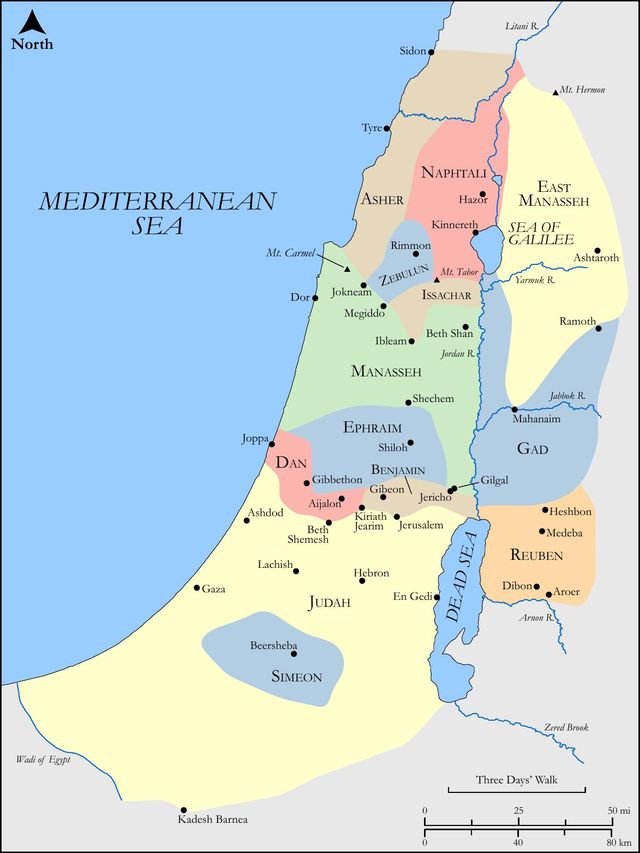
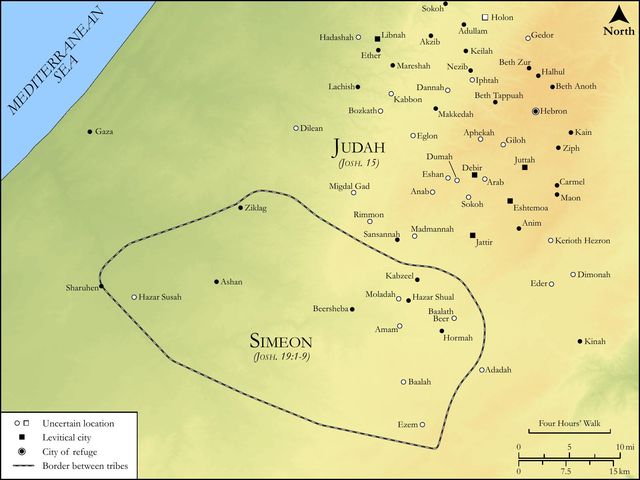
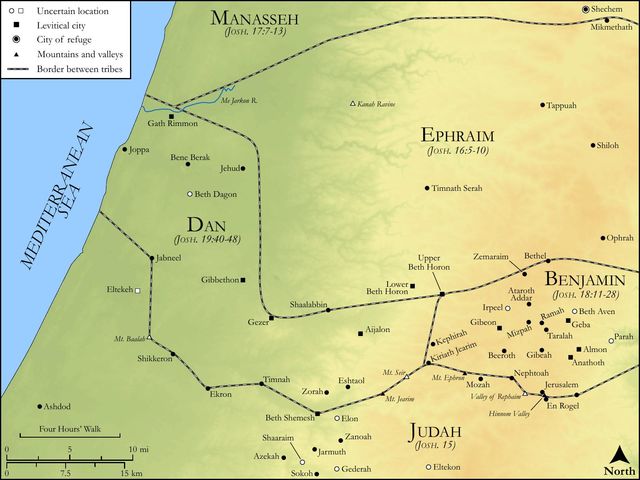
See on the biblical-era maps
Study this verse
Public-domain commentary
Matthew Henry
From his Commentary on the Whole Bible. Henry comments on passages, not single verses — this entry covers Joshua 19:32–39.
Naphtali lay furthest north of all the tribes, bordering on Mount Libanus. The city of Leshem, or Liash, lay on the utmost edge of it to the north, and therefore when the Danites had made themselves masters of it, and called it Dan, the length of Canaan from north to south was reckoned from Dan to Beersheba. It had Zebulun on the south, Asher on the west, and Judah upon Jordan, probably a city of that name, and so distinguished from the tribe of Judah on the east. It was in the lot of this tribe, near the waters of Merom, that Joshua fought and routed Jabin, Jos 11:1. etc. In this tribe stood Capernaum and Bethsaida, on the north end of the sea of Tiberias, in which Christ did so many mighty works; and the mountain (as is supposed) on which Christ preached, Mat 5:1.
Continue studying Joshua 19:33 across the web’s major study libraries — every link below opens this exact verse, chapter, or book on the destination site.
Read & Compare
 BibleGatewayThis verse in more than 200 translations and 70 languages.
 Bible.comThe YouVersion reader — hundreds of translations, reading plans, and highlights.
 ESV.orgCrossway's official English Standard Version reader.
 NET BibleThe NET translation with 60,000+ translators' notes on every rendering decision.
 STEP BibleTyndale House's free study tool — original text, vocabulary, and scholarly resources.
 BibliaLogos Bible Software's free web reader.
 USCCBThe New American Bible (Revised Edition) with the U.S. bishops' study notes.
Commentaries
 BibleHub CommentariesDozens of classic commentaries on this verse, gathered on one page.
 StudyLightMore than 100 commentary sets — the largest collection on the web.
 BibleRefPlain-English commentary on what this verse means, verse by verse.
 Enduring WordDavid Guzik's free commentary on this chapter, widely used by Bible teachers.
 Bible Study ToolsVerse commentary alongside Greek and Hebrew study aids.
Original Language & Research
- BibleHub InterlinearThe verse word by word — original language, transliteration, and English.
- BibleHub LexiconEvery word's original-language definition and Strong's entry.
 Blue Letter BibleDeep-study tools — Strong's numbers, concordance, and word studies.
 SefariaThe Hebrew text with Rashi and centuries of Jewish commentary.
Sermons, Hymns & Audio


TrulyRandomVerse is not affiliated with these sites and doesn’t control their content. They’re linked because they’re genuinely useful.
Summary
Joshua 19:33 meticulously details a segment of the southern and eastern boundaries of the territory allotted to the tribe of Naphtali within the Promised Land. This verse, through a precise enumeration of geographical landmarks, powerfully underscores the divine order, the unwavering faithfulness of God, and the tangible fulfillment of His ancient covenant promises, ensuring each tribe received a clearly defined and securely possessed portion of the land.
Context
ShowHideLiterary Context
Joshua 19 is situated within the larger section of the Book of Joshua (chapters 13-21) that systematically describes the division of the land of Canaan among the twelve tribes of Israel. This section serves as the climactic culmination of the conquest narrative, demonstrating God's absolute faithfulness in fulfilling His covenant promises to Abraham, Isaac, and Jacob that their descendants would indeed inherit the land, as first promised in Genesis 12:7. Specifically, Chapter 19 details the inheritances of the northern tribes: Zebulun, Issachar, Asher, Naphtali, and Dan. Verse 33 focuses on Naphtali, providing a granular list of specific place names that functioned as boundary markers, highlighting the administrative and legal precision with which the land was apportioned, leaving no room for ambiguity regarding tribal claims or future disputes.
Historical & Cultural Context
In Israel, the precise delineation of land ownership and clear boundaries was of paramount importance for establishing tribal identity, ensuring economic stability, and preventing inter-tribal conflicts. The meticulous listing of geographical markers in Joshua 19:33 directly reflects this cultural imperative. The mention of "Heleph," "Allon to Zaanannim," "Adami," "Nekeb," "Jabneel," and "Lakum" indicates the use of identifiable landmarks—such as specific trees (like "Allon," meaning "oak"), towns, or natural topographical features—to define borders. The concluding phrase, "and the outgoings thereof were at Jordan," firmly establishes the Jordan River as the eastern boundary, a significant natural and strategic frontier. This careful mapping was absolutely essential for the nascent Israelite nation to establish its socio-political structure and fulfill its divine mandate to settle the land.
Key Themes
ShowHideThe meticulous description of Naphtali's boundary in Joshua 19:33 contributes significantly to several overarching themes within the book. Firstly, it powerfully illustrates Divine Fulfillment and Faithfulness, demonstrating that God meticulously keeps His promises, down to the precise geographical details of the inheritance He swore to give His people, as affirmed in Joshua 21:43-45. Secondly, it highlights Order and Specificity, reflecting God's meticulous nature and the importance of divine arrangement in the establishment of His people's life in the land. Every tribe received a clearly defined portion, preventing chaos and ensuring proper stewardship. Lastly, it underscores Tribal Identity and Inheritance, as these boundaries were not merely lines on a map but defined the unique identity, responsibilities, and blessings of each tribe, including Naphtali, whose blessing was prophesied by Jacob in Genesis 49:21 and by Moses in Deuteronomy 33:23.
Exposition and Analysis
ShowHideKey Word Analysis
ShowHideThis term (H1366), often translated as "border" or "boundary," refers to a defined demarcation line or the territory enclosed by it. Its usage here emphasizes the precise, legally recognized nature of the tribal inheritance, highlighting the concrete and tangible aspect of God's provision. It signifies a fixed and undeniable claim to the land.
This word (H8444), used in the plural collective, denotes the "exit" or "final extent" of a boundary. In a geographical context, it specifically refers to the terminal points or limits of a territory. Its inclusion here clarifies that the Jordan River marked the definitive eastern termination of Naphtali's allotted land, leaving no ambiguity about its full extent.
This proper noun (H3383) refers to the principal river of Palestine, meaning "descender." As the most significant natural landmark in the region, the Jordan River served as a major geographical and historical boundary. Its mention here as the "outgoings" firmly defines the eastern extent of Naphtali's territory, connecting it to an unmistakable and enduring feature of the land.
Verse Breakdown
ShowHide"And their coast was from Heleph"
This initial clause establishes the starting point of Naphtali's boundary. "Heleph" is an ancient place name, likely a town or village, serving as an initial fixed marker for the tribal territory. The phrase "their coast" immediately identifies the subject as the boundary of the tribe of Naphtali, following the general pattern of land descriptions found throughout Joshua 19.
"from Allon to Zaanannim, and Adami, Nekeb, and Jabneel, unto Lakum;"
This is a detailed enumeration of specific geographical points that collectively define the extent and direction of Naphtali's boundary. Each name represents a known landmark in the ancient landscape, whether a settlement, a natural feature like a prominent tree or grove ("Allon to Zaanannim"), or a topographical point. This list provides a comprehensive, though for modern readers often unidentifiable, sequence of markers that meticulously delineated the tribal land.
"and the outgoings thereof were at Jordan:"
This concluding phrase precisely specifies the eastern termination of Naphtali's boundary. "Outgoings" refers to the final extent or limit of the border. By stating it was "at Jordan," the verse unequivocally indicates that the eastern border of Naphtali's inheritance extended to and was defined by the Jordan River, a crucial and unmistakable natural boundary.
Literary Devices
ShowHideThe primary literary device employed in Joshua 19:33 is Cataloging or Enumeration. The verse presents a precise list of geographical names, which serves to meticulously delineate the boundaries of Naphtali's tribal inheritance. This detailed Topographical Description lends an air of authenticity and historical accuracy to the narrative, emphasizing the tangible and verifiable nature of the land division. The very specificity of these ancient place names, even if many are difficult to identify today, highlights the legal and administrative precision with which God's promises were fulfilled. Furthermore, the use of Formulaic Language ("their coast was from... and the outgoings thereof were at...") is typical of ancient land grants and legal documents, reinforcing the authoritative and binding nature of the divine apportionment.
Theological and Thematic Connections
ShowHideJoshua 19:33, with its precise geographical details, serves as a powerful testament to God's meticulous faithfulness in fulfilling His covenant promises. The division of the land was not a haphazard affair but a divinely orchestrated act, demonstrating that every detail of God's Word is trustworthy and will come to pass. This specificity underscores the reality of God's provision for His people, providing them with a secure and defined inheritance, a place of rest and belonging. It reflects the divine order that God establishes, ensuring clarity, preventing disputes, and affirming the unique identity and responsibilities of each tribal family within the larger nation of Israel. This tangible fulfillment in the Old Testament foreshadows the spiritual inheritance believers receive in Christ, which is equally real and meticulously secured by God's faithfulness.
Reflection and Application
ShowHideThe seemingly mundane list of ancient place names in Joshua 19:33 carries profound spiritual lessons for believers today. Firstly, it reminds us of God's incredible attention to detail. If God was so precise in delineating physical boundaries for an ancient tribe, how much more does He care about the intricate details of our lives, our circumstances, and our future? This should cultivate a deep trust in His sovereign care, knowing that He oversees every aspect of our existence with meticulous love and purpose, even knowing the number of hairs on our head, as Jesus taught in Matthew 10:30. Secondly, the concept of clearly defined boundaries is vital. Just as physical boundaries brought order and prevented conflict among the tribes, healthy boundaries are essential in our personal lives, relationships, and responsibilities. They define our spheres of influence, protect our spiritual and emotional well-being, and enable us to live with greater clarity and peace. Finally, this verse speaks to the theme of inheritance. The Israelites had to physically enter and possess the land God promised. Similarly, as believers, we have been granted a rich spiritual inheritance in Christ—including peace, joy, purpose, and eternal life. We are called not just to acknowledge this inheritance but to actively "possess" and live out the realities of what God has given us through faith, walking in the newness of life He has provided.
Questions for Reflection
ShowHideFAQ
ShowHideWhy are these geographical details so important in the Book of Joshua?
ShowHideThe extensive geographical details in the Book of Joshua, including those in Joshua 19:33, are crucial for several reasons. First, they serve as undeniable evidence of God's faithfulness in fulfilling His ancient promises to Abraham that his descendants would inherit the land of Canaan, as recorded in Genesis 15:18. The specificity validates the historical reality of the biblical narrative. Second, these precise boundaries were essential for establishing order and preventing disputes among the twelve tribes of Israel. Clear demarcations ensured that each tribe knew its allotted territory, fostering stability and tribal identity. Third, the meticulous record highlights the divine authority behind the land division, demonstrating that it was not an arbitrary human act but a divinely ordained apportionment, reflecting God's sovereign plan for His people.
Are these specific locations still identifiable today?
ShowHideWhile some major landmarks mentioned in Joshua, such as the Jordan River, are clearly identifiable, many of the specific ancient place names listed in verses like Joshua 19:33 (e.g., Heleph, Allon to Zaanannim, Adami, Nekeb, Jabneel, Lakum) are indeed difficult or impossible to identify with certainty on modern maps. This is due to the passage of millennia, significant changes in topography, and the disappearance or renaming of ancient settlements. However, the difficulty in precise modern identification does not diminish their historical reality or significance in the ancient context. Their inclusion underscores the meticulous nature of the biblical record and the tangible reality of the land division for the Israelites at the time, providing concrete proof of God's faithful provision.
Christ-Centered Fulfillment
ShowHideThe physical inheritance of the Promised Land by the tribe of Naphtali, meticulously detailed in Joshua 19:33, finds its ultimate and spiritual fulfillment in Jesus Christ. The earthly territory, with its defined boundaries and secure possession, serves as a powerful type of the spiritual inheritance that believers receive in Christ. Just as Naphtali received a tangible place of rest and belonging, so too do believers receive a secure and eternal inheritance that is imperishable, undefiled, and unfading, kept in heaven for them, as promised in 1 Peter 1:4. Christ is the true "land" and "rest" for His people, the one in whom all of God's promises find their "Yes" and "Amen," as affirmed in 2 Corinthians 1:20. Through faith in Him, we are adopted into God's family and become heirs according to the promise, as declared in Galatians 3:29, sharing in the inheritance of the saints in light, according to Colossians 1:12. The precision of Naphtali's boundaries foreshadows the absolute certainty and security of our spiritual inheritance in Christ, which is not dependent on earthly markers but on the finished work of the Lamb of God, who takes away the sin of the world, as proclaimed in John 1:29.