


Joshua 19:32
Bible text: King James Version (1769 Blayney text) · Public domain
Bible text: Berean Standard Bible · Public domain
Bible text: American Standard Version (1901) · Public domain
Bible text: World English Bible, Messianic edition · Public domain
Bible text: Geneva Bible (1599) · Public domain
Bible text: Young's Literal Translation · Public domain
- לִבְנֵיliv·Neifor [the] descendants ofH1121Prep-l ¦ N-mpcNoun Plural Masculine Constructלִforבְנֵי[the] descendants of
- נַפְתָּלִיnaf·ta·LiNaphtaliH5321N-proper-mNoun Proper Masculine
- יָצָאya·Tza'it came outH3318V-Qal-Perf-3msVerb Qal Perfect 3rd Singular Masculine
- הַגּוֹרָלha·go·Ralthe lotH1486Art ¦ N-msNoun Singular Masculine Absoluteהַtheגּוֹרָלlot
- הַשִּׁשִּׁיha·shi·Shi<the> sixthH8345Art ¦ Adj-msAdjective Numerical Position Singular Masculine Absoluteהַ<the>שִּׁשִּׁיsixth
- לִבְנֵיliv·Neifor [the] descendants ofH1121Prep-l ¦ N-mpcNoun Plural Masculine Constructלִforבְנֵי[the] descendants of
- נַפְתָּלִיnaf·ta·LiNaphtaliH5321N-proper-mNoun Proper Masculine
- לְמִשְׁפְּחֹתָםle·mish·pe·cho·Tamto their clansH4940Prep-l ¦ N-fpc ¦ 3mpNoun Plural Feminine Constructלְtoמִשְׁפְּחֹתָclansםtheir
English is a literal word-by-word gloss of the Hebrew, not the KJV's wording. Why?
This is the original text the KJV's translators worked from — each Hebrew word with its own literal English meaning in this verse, prepared by scholars at Tyndale House, Cambridge. The KJV translates whole sentences, not word by word, so its wording differs: one Hebrew word can become several English words, and the KJV may choose “the LORD” where the gloss reads “Yahweh”. Both are faithful — they answer different questions. For the KJV's own rendering, switch to the KJV text.
Details
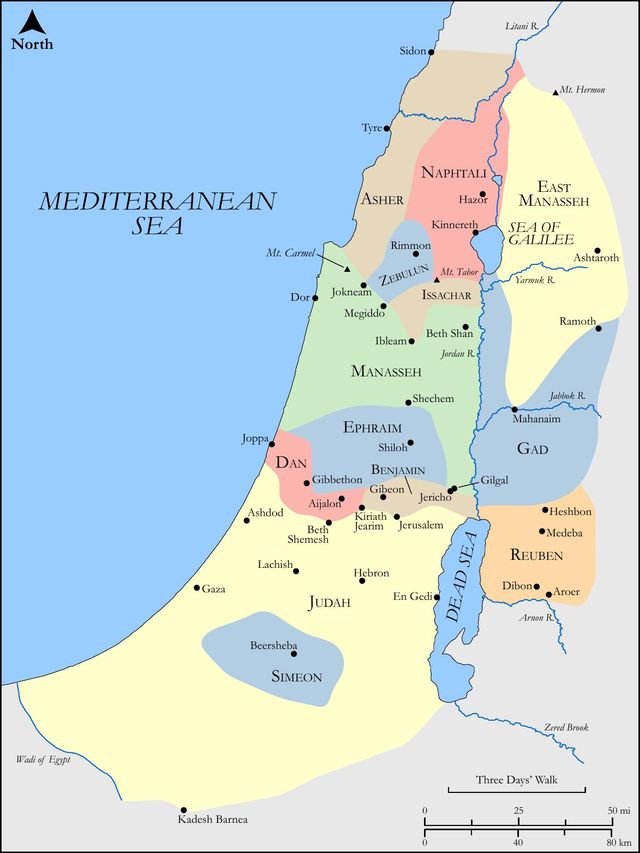
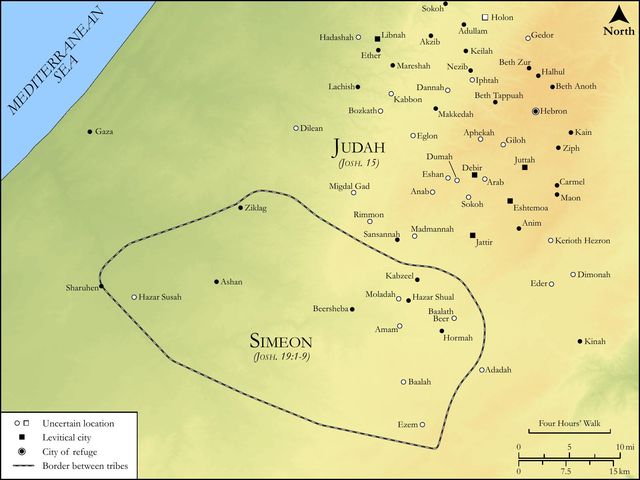
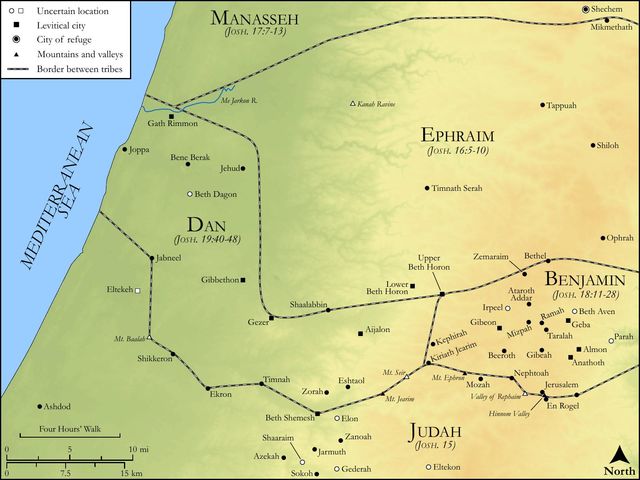
See on the biblical-era maps
Study this verse
Public-domain commentary
Matthew Henry
From his Commentary on the Whole Bible. Henry comments on passages, not single verses — this entry covers Joshua 19:32–39.
Naphtali lay furthest north of all the tribes, bordering on Mount Libanus. The city of Leshem, or Liash, lay on the utmost edge of it to the north, and therefore when the Danites had made themselves masters of it, and called it Dan, the length of Canaan from north to south was reckoned from Dan to Beersheba. It had Zebulun on the south, Asher on the west, and Judah upon Jordan, probably a city of that name, and so distinguished from the tribe of Judah on the east. It was in the lot of this tribe, near the waters of Merom, that Joshua fought and routed Jabin, Jos 11:1. etc. In this tribe stood Capernaum and Bethsaida, on the north end of the sea of Tiberias, in which Christ did so many mighty works; and the mountain (as is supposed) on which Christ preached, Mat 5:1.
Continue studying Joshua 19:32 across the web’s major study libraries — every link below opens this exact verse, chapter, or book on the destination site.
Read & Compare
 BibleGatewayThis verse in more than 200 translations and 70 languages.
 Bible.comThe YouVersion reader — hundreds of translations, reading plans, and highlights.
 ESV.orgCrossway's official English Standard Version reader.
 NET BibleThe NET translation with 60,000+ translators' notes on every rendering decision.
 STEP BibleTyndale House's free study tool — original text, vocabulary, and scholarly resources.
 BibliaLogos Bible Software's free web reader.
 USCCBThe New American Bible (Revised Edition) with the U.S. bishops' study notes.
Commentaries
 BibleHub CommentariesDozens of classic commentaries on this verse, gathered on one page.
 StudyLightMore than 100 commentary sets — the largest collection on the web.
 BibleRefPlain-English commentary on what this verse means, verse by verse.
 Enduring WordDavid Guzik's free commentary on this chapter, widely used by Bible teachers.
 Bible Study ToolsVerse commentary alongside Greek and Hebrew study aids.
Original Language & Research
- BibleHub InterlinearThe verse word by word — original language, transliteration, and English.
- BibleHub LexiconEvery word's original-language definition and Strong's entry.
 Blue Letter BibleDeep-study tools — Strong's numbers, concordance, and word studies.
 SefariaThe Hebrew text with Rashi and centuries of Jewish commentary.
Sermons, Hymns & Audio


TrulyRandomVerse is not affiliated with these sites and doesn’t control their content. They’re linked because they’re genuinely useful.
Summary
Joshua 19:32 precisely records the allocation of the sixth lot of land to the tribe of Naphtali, detailing that this inheritance was distributed "according to their families." This verse is a crucial, albeit brief, entry within the meticulous account of land division among the Israelite tribes, underscoring God's faithful fulfillment of His covenant promises to provide a homeland for His people through a divinely guided process.
Context
ShowHideLiterary Context
Joshua 19:32 is situated within the lengthy and detailed account of the land distribution among the twelve tribes of Israel, specifically spanning chapters 13-19 of the Book of Joshua. Following the successful military campaigns that secured much of Canaan, the narrative shifts from conquest to settlement, emphasizing the fulfillment of God's promise to give Israel the land. Chapters 13 and 14 introduce the general command for land division, while chapters 15-19 meticulously list the boundaries and cities for each tribe, beginning with Judah and concluding with Dan. This verse, therefore, is a precise administrative record, affirming the orderly and divinely sanctioned process by which each tribal inheritance was secured, demonstrating the thoroughness of Joshua's leadership in executing God's will.
Historical & Cultural Context
In ancient Israel, land was not merely property but a sacred inheritance, inextricably linked to tribal identity, family lineage, and the very covenant with God. The division of the land by "lot" (as seen in Joshua 18:10) was a practice known among the nations, but for Israel, it carried profound theological weight, signifying divine arbitration rather than mere chance. It ensured impartiality and underscored God's sovereignty over the land and its distribution. The phrase "according to their families" highlights the patriarchal structure of Israelite society, where land rights and identity flowed through family units, ensuring that the inheritance would be passed down through generations, preventing its permanent alienation and preserving tribal distinctiveness. Naphtali received territory in the northern part of Canaan, a fertile region that would later become known as Galilee, a strategically important area.
Key Themes
ShowHideThe allocation to Naphtali in Joshua 19:32 contributes to several overarching themes in the Book of Joshua and the broader Pentateuch. Firstly, it powerfully illustrates Divine Faithfulness and Fulfillment, demonstrating God's unwavering commitment to His ancient promises to Abraham, Isaac, and Jacob that their descendants would inherit the land of Canaan (e.g., Genesis 12:7). Secondly, the use of lots underscores Divine Providence and Order, emphasizing that the land's distribution was not haphazard but a meticulously guided process, reflecting God's sovereign hand in establishing His people in their designated inheritance. This systematic division prevented disputes and affirmed God's meticulous planning. Lastly, the phrase "according to their families" reinforces the theme of Tribal Identity and Inheritance, highlighting the importance of lineage and the preservation of distinct family units within the larger tribal structure, ensuring a lasting heritage and reinforcing the unique identity of each division of Israel.
Exposition and Analysis
ShowHideKey Word Analysis
ShowHideThe Hebrew word גּוֹרָל (gôwrâl), translated as "lot," refers to a pebble or small object cast to make a decision or to determine a share or portion. In the biblical context, especially concerning the land distribution, the casting of lots was not a matter of mere chance but a divinely guided process. It was understood that "The lot is cast into the lap, but its every decision is from the LORD" (Proverbs 16:33). This method ensured that the allocation was perceived as impartial and ultimately reflective of God's sovereign will, preventing human favoritism or disputes.
The term מִשְׁפָּחָה (mishpâchâh), translated as "families," signifies a circle of relatives, a clan, or an extended family unit, a subdivision of a tribe. Its inclusion here emphasizes that the land was not merely assigned to the tribe as a whole but was further apportioned down to its constituent family units. This detail highlights the importance of maintaining lineage, property rights, and distinct identities within the larger tribal structure. It ensured that each family had a vested interest in their specific portion of the inheritance, which was meant to be passed down through generations, reinforcing the stability and continuity of Israelite society.
Verse Breakdown
ShowHide"The sixth lot came out to the children of Naphtali"
This clause precisely identifies the recipient of the sixth portion of the land. The "lot" signifies the divinely ordained method of distribution, emphasizing that Naphtali's inheritance was not by human design or negotiation but by God's sovereign determination. Naphtali, a son of Jacob through Bilhah (Rachel's servant), was one of the northern tribes, and their inheritance would encompass the fertile region of Galilee, a significant area in later biblical history.
"[even] for the children of Naphtali"
This repetition serves to emphasize and confirm the specific tribal recipient. It reinforces the direct and unambiguous nature of the allocation, leaving no doubt as to which group received this particular inheritance. In Hebrew narrative, such repetition often adds weight and solemnity to a declaration.
"according to their families"
This crucial phrase specifies the internal distribution within the tribe. It indicates that the land allotted to Naphtali was not held communally by the tribe but was further subdivided and assigned to the individual family units within the tribe. This ensured that each family had a specific, identifiable inheritance, reflecting the patriarchal and familial structure of Israelite society and guaranteeing that the land would remain within their lineage across generations.
Literary Devices
ShowHideThe verse, though brief, employs several literary techniques. Precision and Detailing are paramount, characteristic of the administrative sections of Joshua. The text meticulously records the numerical order ("sixth lot"), the specific recipient ("children of Naphtali"), and the internal method of distribution ("according to their families"). This precision underscores the divine order and thoroughness of the land allocation, presenting it as a carefully executed plan rather than a chaotic division. The Repetition of "children of Naphtali" serves to emphasize and confirm the recipient, adding a sense of certainty and finality to the declaration. Furthermore, the underlying theological concept of Divine Sovereignty is conveyed through the implied use of the "lot," a method understood by the Israelites to reveal God's will, transforming a seemingly mundane administrative detail into an affirmation of God's active involvement in their lives and His faithfulness to His covenant promises.
Theological and Thematic Connections
ShowHideJoshua 19:32, though a mere administrative detail, is profoundly theological. It stands as a testament to God's meticulous faithfulness in fulfilling His ancient promises to Abraham, Isaac, and Jacob that their descendants would inherit the land of Canaan. The systematic and divinely guided distribution of the land, of which Naphtali's lot is a part, demonstrates God's sovereign control over history and His unwavering commitment to His covenant people. This act of inheritance is not just about physical territory; it symbolizes the security, identity, and blessing that come from dwelling in God's promised provision. It reminds us that God is a God of order, who brings His plans to fruition with precision, even in the smallest details, ensuring that every promise is kept and every provision is made for His people.
Reflection and Application
ShowHideJoshua 19:32, in its seemingly mundane detail, offers profound lessons for contemporary believers. Just as God meticulously planned and executed the distribution of the land for Naphtali and the other tribes, ensuring each received its designated inheritance, so too does He have a sovereign and perfect plan for our lives. This verse encourages us to trust in God's unseen hand guiding our paths, even when circumstances appear to be random or beyond our control. It reminds us that our "inheritance" in Christ is not by chance but by divine design, a gift of grace that secures our identity and future. We are called to be good stewards of the gifts, talents, resources, and opportunities God has allotted to us, recognizing that they are ultimately from Him and for His purposes. This passage fosters a deep sense of security and gratitude, knowing that the God who faithfully fulfilled His promises to Israel will certainly be faithful to fulfill His spiritual promises to His people today, including the promise of eternal life and a spiritual inheritance that is incorruptible.
Questions for Reflection
ShowHideFAQ
ShowHideWhy was the land divided by "lot" and not by human decision?
ShowHideThe division of the land by "lot" (Hebrew: gôwrâl) was a common practice among the nations, but for the Israelites, it carried deep theological significance. It was not seen as a random gamble but as a method by which God's will was revealed. As Proverbs 16:33 states, "The lot is cast into the lap; but the whole disposing thereof is of the LORD." This method ensured impartiality, prevented disputes among the tribes, and underscored the belief that the land was a divine inheritance, sovereignly distributed by God Himself. It affirmed His faithfulness to His covenant promises and His active involvement in establishing His people in their new home.
What is the significance of the phrase "according to their families"?
ShowHideThe phrase "according to their families" (Hebrew: mishpâchâh) emphasizes the meticulous nature of the land distribution and the importance of the family unit in ancient Israelite society. It means that the land allocated to each tribe was further subdivided and assigned to the individual extended family units within that tribe. This ensured that each family had a specific, identifiable inheritance that was meant to be passed down through generations. This practice preserved tribal identity, maintained social stability, and prevented the permanent alienation of ancestral land, reinforcing the idea that the land was a perpetual inheritance from God, tied to lineage and covenant.
Christ-Centered Fulfillment
ShowHideThe physical inheritance of land by the tribe of Naphtali, meticulously recorded in Joshua 19:32, finds its ultimate and profound fulfillment in the spiritual inheritance offered through Jesus Christ. Just as Naphtali received a tangible portion of the Promised Land, believers in Christ receive an incorruptible and eternal inheritance, "kept in heaven for you" (1 Peter 1:4). The casting of lots, signifying divine appointment for Naphtali's portion, foreshadows God's sovereign election and predestination of believers in Christ, who are "chosen in him before the foundation of the world" (Ephesians 1:4). Furthermore, the land of Naphtali, specifically the region of Galilee, became central to Jesus' earthly ministry, as He "dwelt in Capernaum, which is by the sea, in the regions of Zebulun and Naphtali" (Matthew 4:13), thereby fulfilling Isaiah's prophecy that "The people who walked in darkness have seen a great light" (Isaiah 9:2). Thus, the physical inheritance of Naphtali, given by divine lot, points forward to the spiritual inheritance of all believers in Christ, whose very presence transforms the promised land into the theater of salvation, where the ultimate fulfillment of God's promises is revealed in the person and work of the Lamb of God (John 1:29).