


Joshua 19:22
Bible text: King James Version (1769 Blayney text) · Public domain
Bible text: King James Version with Strong's numbers · Public domain
Bible text: Berean Standard Bible · Public domain
Bible text: American Standard Version (1901) · Public domain
Bible text: World English Bible, Messianic edition · Public domain
Bible text: Geneva Bible (1599) · Public domain
Bible text: Young's Literal Translation · Public domain
- וּפָגַעu·fa·Ga'and it touchesH6293Conj-w ¦ V-Qal-ConsecPerf-3msVerb Qal Consecutive Perfect 3rd Singular Masculineוּandפָגַעit touches
- הַגְּבוּלha·ge·Vulthe borderH1366Art ¦ N-msNoun Singular Masculine Absoluteהַtheגְּבוּלborder
- בְּתָבוֹרbe·ta·Vor<on> TaborH8396Prep-b ¦ N-properNoun Proper Locationבְּ<on>תָבוֹרTabor
- וְשַׁחֲצִימָהve·sha·cha·tzu·mahand to ShahazayimH7831Conj-w ¦ N-properNoun Proper Locationוְandשַׁחֲצִימָהto Shahazayim
- וּבֵיתu·Veitand BethH1053Conj-w ¦ N-properNoun Proper LocationוּandבֵיתBeth
- שֶׁמֶשׁShe·meshShemeshH1053N-properNoun Proper Location
- וְהָיוּve·ha·Yuand they areH1961Conj-w ¦ V-Qal-ConsecPerf-3cpVerb Qal Consecutive Perfect 3rd Plural common genderוְandהָיוּthey are
- תֹּצְאוֹתto·tze·'ot[the] extremities ofH8444N-fpcNoun Plural Feminine Construct
- גְּבוּלָםge·vu·Lamtheir territoryH1366N-msc ¦ 3mpNoun Singular Masculine Constructגְּבוּלָterritoryםtheir
- הַיַּרְדֵּןhai·yar·Denthe JordanH3383Art ¦ N-properNoun Proper LocationהַtheיַּרְדֵּןJordan
- עָרִים'a·RimcitiesH5892N-mpNoun Plural Masculine Absolute
- שֵׁשׁsheshsix-H8337Adj-csAdjective Numerical Singular common gender Absolute
- עֶשְׂרֵה'es·RehteenH6240Adj-csAdjective Numerical Singular common gender Absolute
- וְחַצְרֵיהֶןve·chatz·rei·Henand their villagesH2691Conj-w ¦ N-mpc ¦ 3fpNoun Plural Masculine Constructוְandחַצְרֵיvillagesהֶןtheir
English is a literal word-by-word gloss of the Hebrew, not the KJV's wording. Why?
This is the original text the KJV's translators worked from — each Hebrew word with its own literal English meaning in this verse, prepared by scholars at Tyndale House, Cambridge. The KJV translates whole sentences, not word by word, so its wording differs: one Hebrew word can become several English words, and the KJV may choose “the LORD” where the gloss reads “Yahweh”. Both are faithful — they answer different questions. For the KJV's own rendering, switch to the KJV text.
Details
See on the biblical-era maps
Study this verse
Public-domain commentary
Matthew Henry
From his Commentary on the Whole Bible. Henry comments on passages, not single verses — this entry covers Joshua 19:17–23.
The lot of Issachar ran from Jordan in the east to the great sea in the west, Manasseh on the south, and Zebulun on the north. A numerous tribe, Num 26:25. Tola, one of the judges, was of this tribe, Jdg 10:1. So was Baasha, one of the kings of Israel, Kg1 15:27. The most considerable places in this tribe were, 1. Jezreel, in which was Ahab's palace, and near it Naboth's vineyard. 2. Shunem, where lived that good Shunamite that entertained Elisha. 3. The river Kishon, on the banks of which, in this tribe, Sisera was beaten by Deborah and Barak. 4. The mountains of Gilboa, on which Saul and Jonathan were slain, which were not far from Endor, where Saul consulted the witch. 5. The valley of Megiddo, where Josiah was slain near Hadad-rimmon, Kg2 23:29; Zac 12:11.
Continue studying Joshua 19:22 across the web’s major study libraries — every link below opens this exact verse, chapter, or book on the destination site.
Read & Compare
 BibleGatewayThis verse in more than 200 translations and 70 languages.
 Bible.comThe YouVersion reader — hundreds of translations, reading plans, and highlights.
 ESV.orgCrossway's official English Standard Version reader.
 NET BibleThe NET translation with 60,000+ translators' notes on every rendering decision.
 STEP BibleTyndale House's free study tool — original text, vocabulary, and scholarly resources.
 BibliaLogos Bible Software's free web reader.
 USCCBThe New American Bible (Revised Edition) with the U.S. bishops' study notes.
Commentaries
 BibleHub CommentariesDozens of classic commentaries on this verse, gathered on one page.
 StudyLightMore than 100 commentary sets — the largest collection on the web.
 BibleRefPlain-English commentary on what this verse means, verse by verse.
 Enduring WordDavid Guzik's free commentary on this chapter, widely used by Bible teachers.
 Bible Study ToolsVerse commentary alongside Greek and Hebrew study aids.
Original Language & Research
- BibleHub InterlinearThe verse word by word — original language, transliteration, and English.
- BibleHub LexiconEvery word's original-language definition and Strong's entry.
 Blue Letter BibleDeep-study tools — Strong's numbers, concordance, and word studies.
 SefariaThe Hebrew text with Rashi and centuries of Jewish commentary.
Sermons, Hymns & Audio


TrulyRandomVerse is not affiliated with these sites and doesn’t control their content. They’re linked because they’re genuinely useful.
Summary
Joshua 19:22 meticulously details a segment of the eastern boundary for the tribal inheritance of Issachar, specifying key geographical landmarks such as Mount Tabor, Shahazimah, and Bethshemesh, and culminating at the Jordan River. This verse, part of the extensive land distribution accounts in Joshua, underscores God's precise fulfillment of His ancient promises to Israel, establishing their ordered presence in the Promised Land with clear territorial definitions and noting the significant number of settlements within their allocated region.
Context
ShowHideLiterary Context
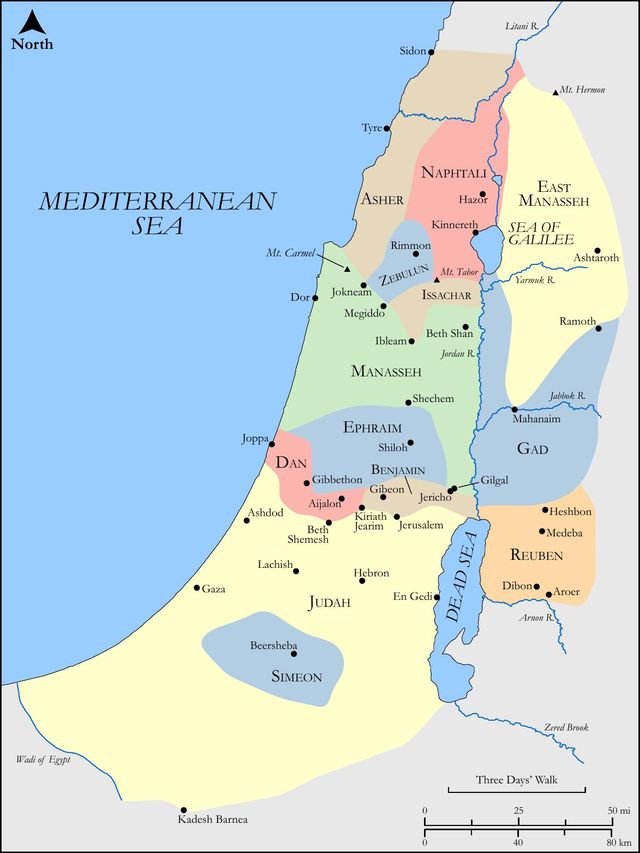
Joshua 19 falls within a larger section of the book (chapters 13-21) dedicated to the detailed allocation of the land of Canaan among the twelve tribes of Israel after the initial conquest. Following the division of land to Reuben, Gad, and the half-tribe of Manasseh east of the Jordan (chapter 13), and the major tribes of Judah, Ephraim, and the other half-tribe of Manasseh west of the Jordan (chapters 14-17), chapter 18 describes the setting up of the tabernacle at Shiloh and the surveying of the remaining land. Chapter 19 then proceeds to delineate the inheritances for the remaining seven tribes, beginning with Simeon and Zebulun before focusing on Issachar (verses 17-23). Verse 22 specifically pinpoints the eastern extent of Issachar's territory, providing a precise geographical marker within the broader narrative of divine promise and its tangible fulfillment. This meticulous record emphasizes the orderly and divinely ordained nature of Israel's settlement, ensuring each tribe received its designated portion as a secure inheritance.
Historical & Cultural Context
In Israel, land ownership and defined borders were paramount for identity, security, and economic stability. The division of land in Joshua was not merely a logistical exercise but a theological act, signifying the fulfillment of God's covenant promises to Abraham, Isaac, and Jacob that their descendants would inherit this specific land. For example, God promised Abraham this land would be for his offspring. The landmarks mentioned, such as Mount Tabor, were prominent natural features that served as unmistakable boundary markers in an era without modern cartography. The Jordan River, a significant geographical and historical landmark, as seen when Israel crossed it into the Promised Land, naturally formed a clear eastern boundary for many tribes. The mention of "sixteen cities with their villages" highlights the agricultural potential and population density of Issachar's inheritance, which primarily encompassed the fertile Jezreel Valley, a region vital for grain production and a strategic crossroads for trade and military movements.
Key Themes
ShowHideThe meticulous description of Issachar's boundary in Joshua 19:22 contributes to several overarching themes in the book of Joshua and the broader Old Testament narrative. Firstly, it powerfully illustrates the Fulfillment of God's Promises. The precise allocation of land demonstrates God's unwavering faithfulness to His covenant, bringing centuries of promise to fruition, as seen in Moses' reiteration of the promise. Secondly, it emphasizes Divine Order and Provision. Every detail, every boundary, was divinely ordained, ensuring stability and a clear identity for each tribal inheritance. This speaks to God's meticulous care for His people, providing for their physical and communal needs. Finally, the establishment of these borders reinforces the theme of Identity and Inheritance. The land was intrinsically linked to Israelite identity and their covenant relationship with Yahweh. Issachar's inheritance, known for its rich agricultural capacity, aligns with Jacob's prophetic blessing in Genesis 49, portraying them as a people settled in a prosperous, if sometimes militarily vulnerable, region. This physical inheritance served as a tangible sign of their unique status as God's chosen people.
Exposition and Analysis
ShowHideKey Word Analysis
ShowHideThis term, derived from a root meaning "to twist" or "a cord," refers properly to a boundary line or limit. By extension, it signifies the territory enclosed by such a boundary. In this context, it precisely defines the edge or border of Issachar's tribal inheritance, emphasizing the fixed and defined nature of their allotted land.
A primitive root meaning "to impinge" or "to strike upon," this verb indicates that the boundary line physically extends to and makes contact with the specified locations. It conveys the idea of the border actively touching or meeting these landmarks, marking the precise extent of the territory.
Used in the plural collective, this word literally means "exits" or "issuings forth." In a geographical sense, it refers to the final termination points or extreme limits of a boundary. Here, it signifies the ultimate eastern extent of Issachar's border, clearly indicating that it concluded at the Jordan River.
Verse Breakdown
ShowHide"And the coast reacheth to Tabor, and Shahazimah, and Bethshemesh;"
This clause delineates the initial and primary eastern markers of Issachar's territory. The "coast" or border is described as extending to these specific locations. Mount Tabor is a well-known, distinctive mountain, while Shahazimah and Bethshemesh (meaning "house of the sun," likely referring to a specific town in this region) were settlements or features that further defined the line. These points indicate a generally northeastern trajectory of the border from the interior of Issachar's land.
"and the outgoings of their border were at Jordan:"
This phrase specifies the ultimate eastern terminus of Issachar's inheritance. The "outgoings" or final extent of their boundary reached the Jordan River, which served as a clear natural barrier and a significant geographical marker for many of the eastern tribal borders. This confirms that Issachar's land stretched across the fertile Jezreel Valley all the way to the river.
"sixteen cities with their villages."
This concluding statement provides a quantitative summary of the populated areas within Issachar's allotted territory. The mention of "sixteen cities with their villages" implies a substantial and well-settled region, indicating a significant population and agricultural capacity. This detail underscores the richness and viability of the inheritance God provided for the tribe, demonstrating a comprehensive provision beyond mere land area.
Literary Devices
ShowHideThe primary literary device at play in Joshua 19:22, and indeed throughout the land distribution chapters, is Enumeration and Geographical Precision. The text meticulously lists specific locations (Tabor, Shahazimah, Bethshemesh, Jordan) to define the boundaries, providing a detailed, almost cartographic, description. This precise listing of names and the clear demarcation of "outgoings" serve to emphasize the Factuality and Verifiability of the land division. It is not a vague promise but a tangible, measurable reality. The repeated use of such detailed geographical descriptions throughout Joshua reinforces the theme of God's Faithfulness and the literal fulfillment of His promises, creating a sense of certainty and divine order for the Israelite readers.
Theological and Thematic Connections
ShowHideJoshua 19:22, with its precise geographical details, serves as a powerful testament to God's meticulous faithfulness and comprehensive provision for His people. The exact demarcation of Issachar's territory, down to specific landmarks and the number of cities, illustrates that God's promises are not vague generalities but concrete realities, fulfilled with divine precision. This level of detail underscores the truth that God is intimately involved in the practical affairs of His people, ensuring their security, identity, and flourishing within the covenant. Just as He provided a tangible inheritance for Issachar, He orchestrates the circumstances of our lives, demonstrating His unwavering commitment to His covenant people. This historical account of land distribution points to a God who is true to His word, providing an inheritance that is both physical and spiritual.
Reflection and Application
ShowHideThe meticulous detail of Joshua 19:22, describing ancient boundaries, offers profound contemporary relevance. It reminds us that God is a God of order, precision, and faithfulness, even in the seemingly mundane details of life. Just as He precisely provided for Issachar's physical needs and established their place, He cares for our individual lives, providing for our needs and guiding our paths. This verse challenges us to trust in His providence, knowing that our "boundaries" – whether they are our circumstances, our gifts, or our limitations – are often divinely appointed for our good and His glory. It invites us to find contentment within the provisions God has granted us, to steward our "inheritance" (our resources, relationships, and responsibilities) wisely, and to recognize that our ultimate security and identity are found not in earthly possessions but in our relationship with a God who is true to His every word.
Questions for Reflection
ShowHideFAQ
ShowHideWhy does the Bible include such detailed geographical lists and border descriptions?
ShowHideThe inclusion of detailed geographical lists and border descriptions, as seen in Joshua 19:22, serves several crucial purposes. Firstly, it provides irrefutable evidence of the fulfillment of God's promises to Abraham, Isaac, and Jacob that their descendants would inherit the land of Canaan, as recorded in passages like Genesis 12:7. These aren't vague prophecies but tangible, verifiable land divisions. Secondly, these details establish tribal identity and ownership, preventing disputes and ensuring order among the twelve tribes. Each tribe knew its precise inheritance, fostering stability and a sense of belonging. Thirdly, the geographical precision underscores the historical accuracy and reliability of the biblical narrative, demonstrating that these events occurred in real places at a specific time. Finally, from a theological perspective, it highlights God's meticulous care and provision for His people, demonstrating His involvement in every aspect of their lives, down to the very boundaries of their dwelling places.
Christ-Centered Fulfillment
ShowHideWhile Joshua 19:22 describes a physical inheritance in an earthly land, it powerfully foreshadows the spiritual inheritance and ultimate fulfillment found in Jesus Christ. The meticulous precision with which God allocated land to Issachar speaks to the divine order and intentionality behind His redemptive plan. Just as the Jordan River marked the eastern limit of Issachar's earthly domain, Christ is the ultimate boundary and fulfillment of all God's promises. Through His perfect life, atoning death, and glorious resurrection, Jesus has secured for believers an inheritance that is "imperishable, undefiled, and unfading, kept in heaven" (1 Peter 1:4). The "sixteen cities with their villages" granted to Issachar, representing a tangible provision, pale in comparison to the boundless spiritual blessings we receive in Christ, who has blessed us "with every spiritual blessing in the heavenly places" (Ephesians 1:3). He is our true "Promised Land," the source of our rest (Hebrews 4:9-11), and the one in whom all the promises of God find their "Yes" and "Amen" (2 Corinthians 1:20). Our ultimate identity and secure dwelling are now found not in an earthly territory, but in Christ, our eternal inheritance.