


2 Kings 14:11
Bible text: King James Version (1769 Blayney text) · Public domain
Bible text: King James Version with Strong's numbers · Public domain
Bible text: Berean Standard Bible · Public domain
Bible text: American Standard Version (1901) · Public domain
Bible text: World English Bible, Messianic edition · Public domain
Bible text: Geneva Bible (1599) · Public domain
Bible text: Young's Literal Translation · Public domain
- וְלֹאve·lo'and notH3808Conj-w ¦ NegParticle Negativeוְandלֹאnot
- שָׁמַעsha·Ma'he listenedH8085V-Qal-Perf-3msVerb Qal Perfect 3rd Singular Masculine
- אֲמַצְיָהוּ'a·matz·Ya·huAmaziahH558N-proper-mNoun Proper Masculine
- וַיַּעַלvai·Ya·'aland he went upH5927Conj-w ¦ V-Qal-ConsecImperf-3msVerb Qal Consecutive Imperfect 3rd Singular Masculineוַandיַּעַלhe went up
- יְהוֹאָשׁye·ho·'AshJehoashH3060N-proper-mNoun Proper Masculine
- מֶלֶךְMe·lekh[the] king ofH4428N-mscNoun Singular Masculine Construct
- יִשְׂרָאֵלYis·ra·'ElIsraelH3478N-properNoun Proper Location
- וַיִּתְרָאוּvai·yit·ra·'Uand they looked at one anotherH7200Conj-w ¦ V-Hithpael-ConsecImperf-3mpVerb Hithpael Consecutive Imperfect 3rd Plural Masculineוַandיִּתְרָאוּthey looked at one another
- פָנִיםfa·NimfacesH6440N-mpNoun Plural Masculine Absolute
- הוּאhu'heH1931Pro-3msPronoun Personal 3rd Singular Masculine
- וַאֲמַצְיָהוּva·'a·matz·Ya·huand AmaziahH558Conj-w ¦ N-proper-mNoun Proper MasculineוַandאֲמַצְיָהוּAmaziah
- מֶלֶךְMe·lekh[the] king ofH4428N-mscNoun Singular Masculine Construct
- יְהוּדָהye·hu·DahJudahH3063N-properNoun Proper Location
- בְּבֵיתbe·Veitat BethH1053Prep-b ¦ N-properNoun Proper LocationבְּatבֵיתBeth
- שֶׁמֶשׁShe·meshShemeshH1053N-properNoun Proper Location
- אֲשֶׁר'a·SherwhichH834RelParticle Relative
- לִיהוּדָהli·hu·Dah[belonged] to JudahH3063Prep-l ¦ N-properNoun Proper Locationלִ[belonged] toיהוּדָהJudah
English is a literal word-by-word gloss of the Hebrew, not the KJV's wording. Why?
This is the original text the KJV's translators worked from — each Hebrew word with its own literal English meaning in this verse, prepared by scholars at Tyndale House, Cambridge. The KJV translates whole sentences, not word by word, so its wording differs: one Hebrew word can become several English words, and the KJV may choose “the LORD” where the gloss reads “Yahweh”. Both are faithful — they answer different questions. For the KJV's own rendering, switch to the KJV text.
Details
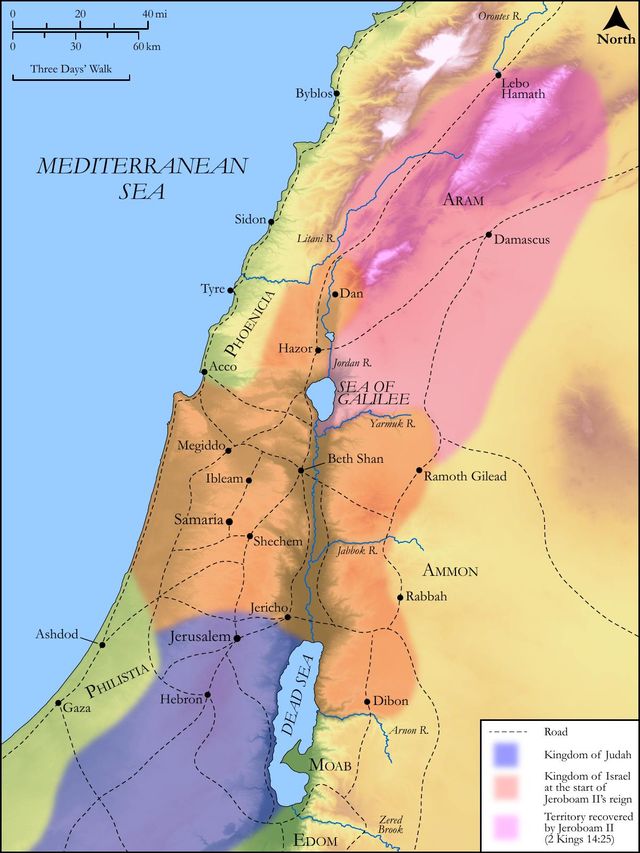
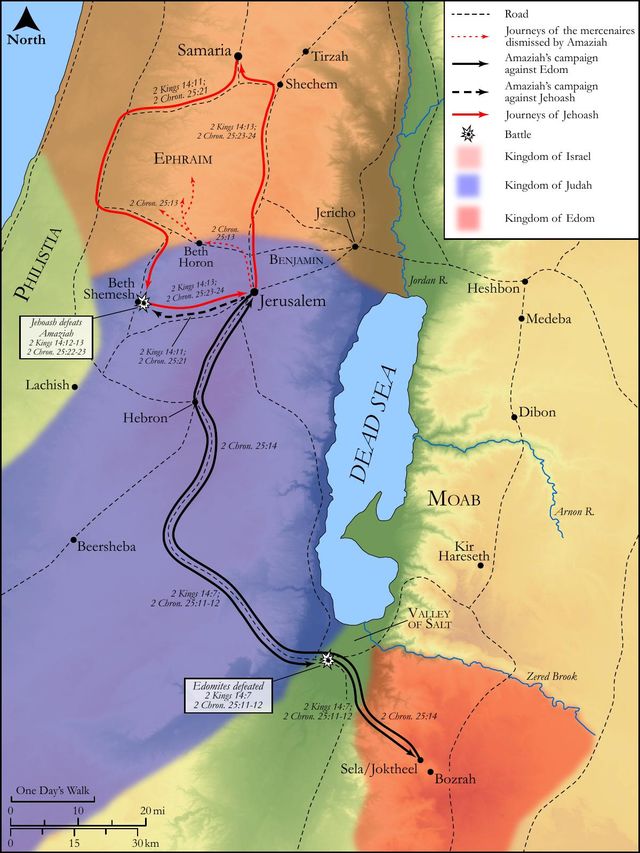
See on the biblical-era maps
Study this verse
Public-domain commentary
Matthew Henry
From his Commentary on the Whole Bible. Henry comments on passages, not single verses — this entry covers 2 Kings 14:8–14. His two-level outline is real structure in the source text, so it is rendered as structure.
For several successions after the division of the kingdoms that of Judah suffered much by the enmity of Israel. After Asa's time, for several successions, it suffered more by the friendship of Israel, and by the alliance and affinity made with them. But now we meet with hostility between them again, which had not been for some ages before.
I.Amaziah, upon no provocation, and without showing any cause of quarrel, challenged Joash into the field (Kg2 14:8):
"Come, let us look one another in the face; let us try our strength in battle." Had he challenged him to a personal duel only, the error would have remained with himself, but each must bring all their forces into the field, and thousands of lives on both sides must be sacrificed to his capricious humour. Hereby he showed himself proud, presumptuous, and prodigal of blood. Some think that he intended to avenge the injury which the dismissed disgusted Israelites had lately done to his country, in their return (Ch2 25:13), and that he had also the vanity to think of subduing the kingdom of Israel, and reuniting it to Judah. A fool's lips thus enter into contention, and his mouth calleth for strokes. Those that challenge are chargeable with that beginning of strife, which is as the letting forth of water. He that is eager either to fight or to go to law may perhaps have enough of it quickly, and be the first that repents it.
II.Joash sent him a grave rebuke for his challenge, with advice to withdraw it, Kg2 14:9, Kg2 14:10.
1.He mortifies his pride, by comparing himself to a cedar, a stately tree, and Amaziah to a thistle, a sorry weed, telling him he was so far from fearing him that he despised him, and scorned as much to have any thing to do with him, or make any alliance with him, as the cedar would to match his daughter to a thistle. The ancient house of David he thinks not worthy to be named the same day with the house of Jehu, though an upstart. How may a humble man smile to hear two proud and scornful men set their wits on work to vilify and undervalue one another!
2.He foretels his fall: A wild beast trode down the thistle, and so put an end to his treaty with the cedar; so easily does Joash think his forces can crush Amaziah, and so unable does he think him to make any resistance.
3.He shows him the folly of his challenge: "Thou hast indeed smitten Edom, a weak, unarmed, undisciplined body of men, and therefore thinkest thou canst carry all before thee and subdue the regular forces of Israel with as much ease. Thy heart has lifted thee up." See where the root of all sin lies; it is in the heart, thence it flows, and that must bear the blame. It is not Providence, the event, the occasion (whatever it is), that makes men proud, or secure, or discontented, or the like, but it is their own heart that does it. "Thou art proud of the blow thou hast given to Edom, as if that had made thee formidable to all mankind." Those wretchedly deceive themselves that magnify their own performances, and, because they have been blessed with some little success and reputation, conclude themselves fit for any thing and no less sure of it.
4.He counsels him to be content with the honour he has won, and not to hazard that, by grasping at more that was out of his reach: Why shouldst thou meddle to thy hurt, as fools often do, that will be meddling? Pro 20:3. Many would have had wealth and honour enough if they had but known when they had enough. He warns him of the consequence, that it would be fatal not to himself only, but to his kingdom, which he ought to protect.
III.Amaziah persisted in his resolution, and the issue was bad; he had better have tarried at home, for Joash gave him such a look in the face as put him to confusion. Challengers commonly prove to be on the losing side.
1.His army was routed and dispersed, Kg2 14:12. Josephus says, When they were to engage they were struck with such terror that they did not strike a stroke, but every one made the best of his way.
2.He himself was taken prisoner by the king of Israel, and then had enough of looking him in the face. Amaziah's pedigree comes in here somewhat abruptly (the son of Joash, the son of Ahaziah), because perhaps he had gloried in the dignity of his ancestors, or because he now smarted for their iniquity.
3.The conqueror entered Jerusalem, which tamely opened to him, and yet he broke down their wall (and, as Josephus says, drove his chariot in triumph through the breach), in reproach to them, and that he might, when he pleased, take possession of the royal city.
4.He plundered Jerusalem, took away all that was valuable, and returned to Samaria, laden with spoils, Kg2 14:14. It was said of Joash that he did that which was evil in the sight of the Lord, and of Amaziah that he did that which was right; and yet Joash triumphs thus over Amaziah, and why so? Because God would show, in Amaziah's fate, that he resists the proud, or because, whatever they were otherwise, Joash had lately been respectful to one of God's prophets (Kg2 13:14), but Amaziah had been abusive to another (Ch2 25:16), and God will honour those who honour him in his prophets, but those who despise them, and him in them, shall be lightly esteemed.
Historical interpretation
Historical reception
1 surviving comment on this verse from the historical church.
The Almighty, who cannot possibly will anything unjust, is able to set in motion even the inclinations of their will in people's hearts in order to accomplish through these people whatever he wishes to achieve through their agency. What meaning can these words have that the man of God addressed to King Amaziah: "Do not allow the army of Israel to go out with you, for the Lord is not with Israel and all the children of Ephraim. And if you think to prevail over them, God will put you to flight before your enemies; for it belongs to God both to help and to put to flight"?How does the power of God help some in war by giving them confidence and turns others to flight by instilling them with fear, except for this reason, that he who has made all things as he willed in heaven and on earth, also works in the human hearts? We also read of what Joash, king of Israel, said when he dispatched a messenger to King Amaziah, who had a mind to go to war with him. Having mentioned certain things, he went on to say, "Sit at home. Why do you provoke evil that you should fall and Judah with you?" The Scripture then went on to add, "And Amaziah would not listen to him because it was the Lord's will that he should be delivered into the hands of enemies because he sought after the gods of Edom."
There you see how God, wishing to punish the sin of idolatry, influenced the heart of this man with whom he was justly angry, that he would not heed salutary advice but, in his contempt for it, would engage in battle, there to perish together with his army.
Continue studying 2 Kings 14:11 across the web’s major study libraries — every link below opens this exact verse, chapter, or book on the destination site.
Read & Compare
 BibleGatewayThis verse in more than 200 translations and 70 languages.
 Bible.comThe YouVersion reader — hundreds of translations, reading plans, and highlights.
 ESV.orgCrossway's official English Standard Version reader.
 NET BibleThe NET translation with 60,000+ translators' notes on every rendering decision.
 STEP BibleTyndale House's free study tool — original text, vocabulary, and scholarly resources.
 BibliaLogos Bible Software's free web reader.
 USCCBThe New American Bible (Revised Edition) with the U.S. bishops' study notes.
Commentaries
 BibleHub CommentariesDozens of classic commentaries on this verse, gathered on one page.
 StudyLightMore than 100 commentary sets — the largest collection on the web.
 BibleRefPlain-English commentary on what this verse means, verse by verse.
 Enduring WordDavid Guzik's free commentary on this chapter, widely used by Bible teachers.
 Bible Study ToolsVerse commentary alongside Greek and Hebrew study aids.
Original Language & Research
- BibleHub InterlinearThe verse word by word — original language, transliteration, and English.
- BibleHub LexiconEvery word's original-language definition and Strong's entry.
 Blue Letter BibleDeep-study tools — Strong's numbers, concordance, and word studies.
 SefariaThe Hebrew text with Rashi and centuries of Jewish commentary.
Sermons, Hymns & Audio


TrulyRandomVerse is not affiliated with these sites and doesn’t control their content. They’re linked because they’re genuinely useful.
Summary
Second Kings 14:11 marks the tragic culmination of King Amaziah of Judah's escalating pride and stubborn refusal to heed wise counsel, directly leading to a devastating military confrontation with King Jehoash of Israel. Emboldened by a recent victory over Edom, Amaziah foolishly challenged Jehoash to battle. Despite Jehoash's clear parabolic warning against such arrogance, Amaziah's hardened heart compelled him to press forward, setting the stage for a fratricidal clash at Bethshemesh, a city within Judah's own territory. This verse encapsulates the critical moment where personal hubris overrides prudence, precipitating national disaster.
Context
ShowHideLiterary Context
This verse is deeply embedded within the narrative of King Amaziah's reign, which commences in 2 Kings 14:1. The preceding verses establish Amaziah as a king who "did that which was right in the sight of the LORD, yet not like David his father" (2 Kings 14:3). His early reign is marked by a significant military triumph over the Edomites in the Valley of Salt, where he achieved a decisive victory, slaying ten thousand and capturing Sela (2 Kings 14:7). This success, however, appears to have inflated his ego, leading him to send a provocative challenge to Jehoash, King of Israel: "Come, let us look one another in the face" (2 Kings 14:8). Jehoash's response is a shrewd parable of a thistle challenging a cedar, warning Amaziah against his pride and advising him to "tarry at home" (2 Kings 14:9-10). Our verse, 2 Kings 14:11, directly follows this ignored warning, highlighting Amaziah's willful rejection of sound counsel and the immediate consequence: the two kings "looked one another in the face," signifying the initiation of a calamitous battle.
Historical & Cultural Context
The period of the divided monarchy, following the split of Israel after Solomon's reign, was characterized by frequent political instability, religious apostasy, and intermittent warfare between the northern kingdom of Israel and the southern kingdom of Judah. Despite their shared heritage as descendants of Jacob, their political and religious divergence often led to bitter conflicts. Amaziah's victory over Edom, a long-standing adversary and often a servant of Judah, would have been a substantial achievement, potentially restoring some of Judah's lost prestige and economic leverage. Culturally, formal military challenges between kings were a recognized means of settling disputes or asserting dominance, often serving as a test of national strength and divine favor. The idiom "look one another in the face" was a direct expression of a willingness to engage in personal and military confrontation. Bethshemesh (H1053, Bêyth Shemesh), meaning "House of the Sun," was a strategically important Levitical city located in the Shephelah (lowlands) of Judah, near the border with Israel. Its selection as the battleground for this conflict underscores the tragic internal nature of this fratricidal war, fought on Judah's own soil, far from the external enemies Amaziah had just defeated.
Key Themes
ShowHideThe primary theme emerging from 2 Kings 14:11 is the peril of pride and its destructive consequences. Amaziah's inflated ego, fueled by his success against Edom, blinded him to reason and wise counsel, making him a vivid example of how pride goes before destruction, and a haughty spirit before a fall. Another significant theme is the rejection of wise counsel. Jehoash's parable was a clear, albeit veiled, warning, but Amaziah's stubbornness prevented him from heeding it. This highlights the danger of self-sufficiency and the critical importance of listening to sound advice, even when it comes from an adversary, a principle echoed throughout the wisdom literature, such as in Proverbs 12:15. Finally, the verse underscores the inevitability of confrontation when pride and obstinacy prevail, leading to a tragic and avoidable conflict between two brother nations, demonstrating the devastating impact of internal strife.
Exposition and Analysis
ShowHideKey Word Analysis
ShowHideThe Hebrew verb שָׁמַע (H8085, shâmaʻ') is profoundly significant in this context. While it literally means "to hear," its semantic range extends far beyond mere auditory perception to include "to listen attentively," "to understand," "to obey," and "to heed." In the phrase "But Amaziah would not hear," it conveys not a physical inability to perceive sound, but a deliberate and willful refusal to comprehend, accept, and act upon the wise counsel offered by Jehoash. It emphasizes Amaziah's stubborn disobedience and the hardening of his heart against prudence, which directly precipitates the ensuing conflict.
The verb רָאָה (H7201, râʼâh'), translated as "looked," is a primitive root meaning "to see," "to perceive," or "to gaze." In conjunction with "face" (pânîym), it forms a powerful idiom. Here, it signifies a direct, intentional act of confrontation. It implies more than a casual glance; it is a deliberate sizing up of an opponent, an acknowledgment of the challenge, and a readiness to engage. This "looking" is the visual manifestation of the internal resolve to enter into battle.
The noun פָּנִים (H6440, pânîym'), meaning "face," is typically plural but used singularly, and often refers to the presence or person of an individual. In the idiom "looked one another in the face" (literally "saw faces"), it denotes a direct, personal encounter, particularly in a hostile or challenging context. It signifies the acceptance of a challenge and the commitment to engage in combat. It's not a casual meeting but a deliberate act of squaring off, indicating that both parties were now prepared for the inevitable clash of arms, having exhausted or rejected other options.
Verse Breakdown
ShowHide"But Amaziah would not hear."
This opening clause immediately establishes Amaziah's culpability and the central conflict. It directly refers back to Jehoash's warning in 2 Kings 14:9-10, where the King of Israel advised Amaziah to "tarry at home" and not provoke disaster. Amaziah's refusal to "hear" signifies his willful rejection of this sound counsel, driven by an overinflated sense of pride and a desire for further glory following his victory over Edom. This stubbornness is the direct catalyst for the subsequent events, highlighting the destructive power of unheeded wisdom.
"Therefore Jehoash king of Israel went up;"
This clause indicates Jehoash's decisive response to Amaziah's obstinacy. Having offered a warning that was spurned, Jehoash had no choice but to prepare for the inevitable conflict. The phrase "went up" (H5927, ʻâlâh') implies a military advance, signifying that the confrontation was now unavoidable and the two armies were mobilizing for battle. It underscores the direct cause-and-effect relationship between Amaziah's pride and the ensuing war, demonstrating Jehoash's readiness to meet the challenge.
"and he and Amaziah king of Judah looked one another in the face"
This phrase vividly portrays the direct, personal, and hostile confrontation between the two kings and their respective armies. It is the climactic moment where the challenge is met, and the war officially begins. It's a dramatic depiction of two powerful figures, representing their nations, standing on the precipice of battle, each resolved to engage. This "face-to-face" encounter is the point of no return, sealing the fate of both kingdoms in the immediate future and underscoring the gravity of Amaziah's decision.
"at Bethshemesh, which [belongeth] to Judah."
This final detail specifies the precise location of the confrontation. Bethshemesh (H1053, Bêyth Shemesh), a city within Judah's own territory (H3063, Yᵉhûwdâh), serves as a poignant and tragic reminder that this was a civil war, a conflict between brother nations. The fact that the battle was fought on Judah's home ground emphasizes the self-destructive nature of Amaziah's pride, as his arrogance brought devastation directly to his own people and land, rather than to an external enemy, amplifying the irony and sorrow of the situation.
Literary Devices
ShowHideThe narrative of 2 Kings 14:11 masterfully employs several literary devices to convey its powerful message of pride's downfall. Foreshadowing is prominently featured in Amaziah's initial refusal to "hear" Jehoash's warning; this stubbornness clearly predicts the disastrous outcome that inevitably follows. The very act of "looking one another in the face" functions as a potent form of synecdoche or metonymy, where the direct confrontation of the kings symbolically represents the full-scale military engagement that ensues, encapsulating the entire conflict in a single, dramatic image. There is a profound sense of irony in the fact that Amaziah, having just achieved a significant victory against an external foe (Edom), now brings war and defeat upon his own kingdom by foolishly challenging a brother nation. Furthermore, the precise geographical detail of Bethshemesh, a Levitical city and part of Judah's own territory, adds a layer of pathos and reinforces the irony, emphasizing the self-inflicted wound of this fratricidal conflict. The narrative's concise and direct language contributes to its dramatic impact, highlighting the swift and inevitable consequences of unchecked pride.
Theological and Thematic Connections
ShowHideThe account of Amaziah's downfall, encapsulated in his willful refusal to "hear" in 2 Kings 14:11, serves as a profound theological lesson on the insidious nature of human pride and its devastating consequences. It vividly illustrates how success, when unmoored from humility and divine wisdom, can become a spiritual poison, leading to self-exaltation and a rejection of sound counsel, even from unexpected sources. Amaziah's actions stand in stark contrast to the biblical ideal of a leader who seeks God's guidance and listens to wise advisors. This narrative underscores the timeless biblical principle that true strength and stability are found not in human arrogance or military might alone, but in humility, discernment, and a willingness to submit to wisdom, whether human or divine. It highlights the destructive cycle of pride, rebellion, and judgment that frequently recurs throughout the historical books of the Old Testament, serving as a cautionary tale for all who would lead or live without humility.
Reflection and Application
ShowHideThe story of King Amaziah offers timeless and sobering lessons for believers today, serving as a powerful mirror for self-examination. His initial success against Edom, rather than fostering gratitude and humility before God, became the very fuel for his destructive pride. This warns us against allowing past achievements, spiritual victories, or even personal talents to inflate our ego and blind us to reality. We are often most vulnerable to pride precisely when things are going well, when we feel self-sufficient and capable. Amaziah's stubborn refusal to "hear" Jehoash's wise, albeit pointed, counsel highlights the critical importance of cultivating a humble and teachable spirit. Do we genuinely listen to constructive criticism, even when it comes from unexpected sources or challenges our preconceived notions? Are we open to the wisdom of trusted mentors, spiritual leaders, or even the quiet promptings of God's Spirit, or do we, like Amaziah, allow arrogance to deafen us to truth? The tragic outcome for Judah at Bethshemesh serves as a powerful reminder that ignoring sound advice, especially when driven by self-importance, can lead to significant and avoidable consequences, not just for ourselves but for those we influence and lead. True wisdom lies not in self-assertion, but in humility and a willingness to learn, even from perceived adversaries.
Questions for Reflection
ShowHideFAQ
ShowHideWhy did Amaziah challenge Jehoash?
ShowHideAmaziah's challenge to Jehoash, as described in 2 Kings 14:8, was primarily a direct result of his inflated pride and overconfidence following his decisive victory over the Edomites in the Valley of Salt (2 Kings 14:7). Feeling emboldened and perhaps invincible, he sought to assert Judah's dominance over the northern kingdom of Israel. This challenge may have been motivated by a desire to avenge past grievances, to reclaim territory, or simply to expand his own glory and influence. Jehoash's response, a parable of a thistle challenging a cedar (2 Kings 14:9-10), clearly indicates that he perceived Amaziah's challenge as an act of foolish arrogance rather than a legitimate cause for war, warning him of the inevitable downfall.
What was the outcome of this confrontation at Bethshemesh?
ShowHideAs a direct and tragic consequence of Amaziah's stubborn refusal to heed Jehoash's warning, the two armies indeed met at Bethshemesh. The outcome was disastrous for Judah. King Amaziah's forces were utterly defeated, and he himself was captured by Jehoash (2 Kings 14:12). Following this decisive victory, Jehoash marched on Jerusalem, broke down a significant portion of its walls (specifically, four hundred cubits from the Gate of Ephraim to the Corner Gate), and plundered the temple treasury and the king's palace, taking hostages before returning to Samaria (2 Kings 14:13-14). This profound humiliation severely weakened Judah and served as a stark demonstration of the destructive power of unchecked pride and unheeded counsel.
Christ-Centered Fulfillment
ShowHideThe tragic narrative of Amaziah's pride and fall in 2 Kings 14:11 finds its profound Christ-centered fulfillment in the stark contrast between the destructive nature of human arrogance and the redemptive power of divine humility. Amaziah, an earthly king, allowed his fleeting success to breed pride, leading him to reject wise counsel and ultimately bring ruin upon his kingdom and people. In stark opposition, Jesus Christ, the eternal King of kings, perfectly embodies humility and absolute obedience to the Father's will. He did not cling to His divine prerogatives or assert His power for earthly glory, but rather "emptied himself, by taking the form of a servant, being born in the likeness of men" (Philippians 2:7). Unlike Amaziah, who "would not hear" and thus brought destruction, Christ consistently declared, "I can do nothing on my own. As I hear, I judge, and my judgment is just, because I seek not my own will but the will of him who sent me" (John 5:30). His ultimate victory over sin and death was not achieved through earthly conquest or the assertion of power, but through the supreme act of self-sacrifice on the cross, where He humbled Himself even to the point of death (Philippians 2:8). Christ's life and ministry serve as the ultimate example of true strength found in profound humility, offering a path to eternal life and blessing for all who, unlike Amaziah, are willing to "take my yoke upon you and learn from me, for I am gentle and lowly in heart, and you will find rest for your souls" (Matthew 11:29).