


Joshua 19:38
Bible text: King James Version (1769 Blayney text) · Public domain
Bible text: Berean Standard Bible · Public domain
Bible text: American Standard Version (1901) · Public domain
Bible text: World English Bible, Messianic edition · Public domain
Bible text: Geneva Bible (1599) · Public domain
Bible text: Young's Literal Translation · Public domain
- וְיִרְאוֹןve·yir·'Onand YironH3375Conj-w ¦ N-properNoun Proper LocationוְandיִרְאוֹןYiron
- וּמִגְדַּלu·mig·daland MigdalH4027Conj-w ¦ N-properNoun Proper LocationוּandמִגְדַּלMigdal
- אֵל'ElElH4027N-properNoun Proper Location
- חֳרֵםcho·RemHoremH2765N-properNoun Proper Location
- וּבֵיתu·veitand BethH1043Conj-w ¦ N-properNoun Proper LocationוּandבֵיתBeth
- עֲנָת'a·NatAnathH1043N-properNoun Proper Location
- וּבֵיתu·Veitand BethH1053Conj-w ¦ N-properNoun Proper LocationוּandבֵיתBeth
- שָׁמֶשׁSha·meshShemeshH1053N-properNoun Proper Location
- עָרִים'a·RimcitiesH5892N-mpNoun Plural Masculine Absolute
- תְּשַׁעte·sha'nine-H8672Adj-cscAdjective Numerical Singular common gender Construct
- עֶשְׂרֵה'es·RehteenH6240Adj-csAdjective Numerical Singular common gender Absolute
- וְחַצְרֵיהֶןve·chatz·rei·Henand their villagesH2691Conj-w ¦ N-mpc ¦ 3fpNoun Plural Masculine Constructוְandחַצְרֵיvillagesהֶןtheir
English is a literal word-by-word gloss of the Hebrew, not the KJV's wording. Why?
This is the original text the KJV's translators worked from — each Hebrew word with its own literal English meaning in this verse, prepared by scholars at Tyndale House, Cambridge. The KJV translates whole sentences, not word by word, so its wording differs: one Hebrew word can become several English words, and the KJV may choose “the LORD” where the gloss reads “Yahweh”. Both are faithful — they answer different questions. For the KJV's own rendering, switch to the KJV text.
Details
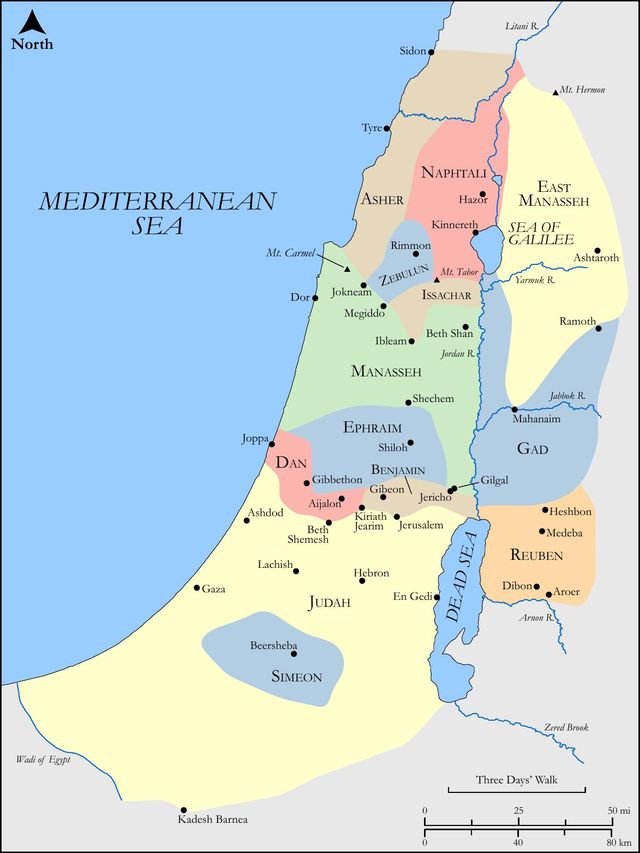
See on the biblical-era maps
Study this verse
Public-domain commentary
Matthew Henry
From his Commentary on the Whole Bible. Henry comments on passages, not single verses — this entry covers Joshua 19:32–39.
Naphtali lay furthest north of all the tribes, bordering on Mount Libanus. The city of Leshem, or Liash, lay on the utmost edge of it to the north, and therefore when the Danites had made themselves masters of it, and called it Dan, the length of Canaan from north to south was reckoned from Dan to Beersheba. It had Zebulun on the south, Asher on the west, and Judah upon Jordan, probably a city of that name, and so distinguished from the tribe of Judah on the east. It was in the lot of this tribe, near the waters of Merom, that Joshua fought and routed Jabin, Jos 11:1. etc. In this tribe stood Capernaum and Bethsaida, on the north end of the sea of Tiberias, in which Christ did so many mighty works; and the mountain (as is supposed) on which Christ preached, Mat 5:1.
Continue studying Joshua 19:38 across the web’s major study libraries — every link below opens this exact verse, chapter, or book on the destination site.
Read & Compare
 BibleGatewayThis verse in more than 200 translations and 70 languages.
 Bible.comThe YouVersion reader — hundreds of translations, reading plans, and highlights.
 ESV.orgCrossway's official English Standard Version reader.
 NET BibleThe NET translation with 60,000+ translators' notes on every rendering decision.
 STEP BibleTyndale House's free study tool — original text, vocabulary, and scholarly resources.
 BibliaLogos Bible Software's free web reader.
 USCCBThe New American Bible (Revised Edition) with the U.S. bishops' study notes.
Commentaries
 BibleHub CommentariesDozens of classic commentaries on this verse, gathered on one page.
 StudyLightMore than 100 commentary sets — the largest collection on the web.
 BibleRefPlain-English commentary on what this verse means, verse by verse.
 Enduring WordDavid Guzik's free commentary on this chapter, widely used by Bible teachers.
 Bible Study ToolsVerse commentary alongside Greek and Hebrew study aids.
Original Language & Research
- BibleHub InterlinearThe verse word by word — original language, transliteration, and English.
- BibleHub LexiconEvery word's original-language definition and Strong's entry.
 Blue Letter BibleDeep-study tools — Strong's numbers, concordance, and word studies.
 SefariaThe Hebrew text with Rashi and centuries of Jewish commentary.
Sermons, Hymns & Audio


TrulyRandomVerse is not affiliated with these sites and doesn’t control their content. They’re linked because they’re genuinely useful.
Summary
Joshua 19:38 meticulously records a segment of the tribal inheritance for Naphtali, listing five specific cities—Iron, Migdalel, Horem, Bethanath, and Bethshemesh—and concluding with the precise count of "nineteen cities with their villages." This verse, part of the detailed land distribution in Joshua, underscores God's unwavering faithfulness, the meticulous fulfillment of His covenant promises to Israel, and the tangible reality of their God-given possession in the Promised Land, serving as a powerful testament to divine order and provision.
Context
ShowHideLiterary Context
Joshua 19:38 is situated within the extensive and detailed account of the land distribution among the Israelite tribes, specifically focusing on the seventh lot drawn for the tribe of Naphtali, as detailed in Joshua 19:32-39. This section, spanning from Joshua 13 through Joshua 21, serves as the climactic fulfillment of God's promise to give Israel the land. The preceding verses (Joshua 19:32-37) delineate the borders and initial cities of Naphtali's territory, while verse 38 provides a summary count of additional cities within this allotment. The meticulous enumeration of cities and their villages across these chapters emphasizes the completeness and precision of God's provision, ensuring that each tribe received its specific, divinely ordained inheritance. The very act of listing these places validates the historical reality of the conquest and settlement, demonstrating God's faithfulness in tangible, geographical terms.
Historical & Cultural Context
The Book of Joshua chronicles the period immediately following the wilderness wanderings, as the Israelites, under Joshua's leadership, enter and conquer Canaan. This era (roughly 14th century BC) marked a pivotal transition from nomadic life to settled existence in a land promised centuries earlier to Abraham, as recorded in Genesis 15:18. The division of land was not merely a logistical exercise but a profound theological act, solidifying Israel's identity as God's chosen people in their own sovereign territory. The mention of cities like Bethanath and Bethshemesh, whose names reflect pagan deities (Anath, a Canaanite goddess of war and fertility; Shemesh, the sun god), highlights the pervasive idolatry within the cultural landscape of Canaan. Israel's possession of these places signified a spiritual conquest—the displacement of idolatry by the exclusive worship of Yahweh—and a clear demarcation of the land as belonging to God's people. Naphtali's territory, located in the fertile northern region of Canaan, was strategically important, bordering other tribes and potentially vulnerable to northern incursions, yet it was a rich agricultural area, vital for the tribe's sustenance.
Key Themes
ShowHideThis verse, and the broader context of Joshua 19, contributes significantly to several overarching themes foundational to the book of Joshua and Israel's identity. Firstly, it powerfully illustrates Divine Faithfulness, demonstrating God's unwavering commitment to His covenant promises, fulfilling what He swore to the patriarchs centuries prior. The detailed list of cities underscores God's Order and Specificity, revealing His meticulous care in providing for His people, not vaguely but with precise boundaries and possessions. This precision ensures that each tribe received its rightful portion, leaving no room for dispute over the divine allocation. Finally, the concept of Inheritance and Possession is central. The land was not merely conquered but inherited—a permanent, God-given legacy that defined the identity, security, and future of each tribe within the nascent nation of Israel. This physical inheritance foreshadows the spiritual inheritance believers receive in Christ, as seen in passages like Ephesians 1:11.
Exposition and Analysis
ShowHideKey Word Analysis
ShowHideThis name means "tower of God." Its inclusion in Naphtali's inheritance suggests a prominent fortified structure or a place whose name acknowledged divine authority or strength, now brought under the dominion of Yahweh's people. It implies a place of significant stature or a site where the divine was recognized, now claimed for the God of Israel.
This name is defined as "Beth-Anath, a place in Palestine." The name itself, meaning "House of Anath," refers to Anath, a significant Canaanite goddess of war, fertility, and hunting. The presence of a city named after her within Israel's inheritance highlights the pervasive nature of pagan worship in Canaan and the divine imperative for Israel to dispossess and displace these idolatrous practices. Israel's possession of "House of Anath" symbolically represents the triumph of Yahweh over the false gods of the land.
This name is defined as "house of (the) sun." This indicates a place associated with the worship of the sun god, a practice among the nations against which Moses warned Israel. Like Bethanath, its inclusion in the Israelite territory signifies the divine intention for God's people to purify the land from pagan idolatry and establish the exclusive worship of Yahweh. The Israelites were to claim these formerly pagan sites for the Lord, transforming places of darkness dedicated to false deities into places under the light of God's sovereignty.
Verse Breakdown
ShowHide"And Iron, and Migdalel, Horem, and Bethanath, and Bethshemesh;"
This clause lists five specific cities within the territory allotted to the tribe of Naphtali. The names themselves offer insights into the original inhabitants and the nature of the places (e.g., "Tower of God," "House of Anath," "House of the Sun"). The inclusion of these specific names underscores the meticulous detail of the land division, emphasizing that this was not a vague promise but a tangible, geographically precise fulfillment of God's covenant. Each name represents a real location, solidifying the historical and practical reality of the inheritance and demonstrating the divine precision in the allocation of territory.
"nineteen cities with their villages."
This concluding phrase provides a summary count for Naphtali's inheritance. The number "nineteen" (or twenty-one in some ancient versions, reflecting textual variations) signifies a comprehensive and complete allotment. The phrase "with their villages" indicates that the inheritance included not just the main fortified cities but also the surrounding agricultural settlements and smaller communities dependent on those cities. This detail highlights the thoroughness of the land distribution, ensuring that every aspect of the tribal territory, from urban centers to rural outposts, was accounted for and possessed by the tribe. It underscores the completeness of God's provision for His people.
Literary Devices
ShowHideThe primary literary device employed in Joshua 19:38, and indeed throughout the land distribution chapters, is Enumeration or Listing. This meticulous cataloging of cities serves to emphasize the precision, completeness, and tangible reality of God's fulfillment of His promises. It is not a vague or symbolic promise, but a concrete, geographical reality. This detailed listing also contributes to a Fulfillment Motif, where the very act of naming and counting the cities demonstrates that God's ancient promises to Abraham regarding the land are now being brought to fruition. Furthermore, there is an element of Symbolism in the names of cities like Bethanath and Bethshemesh. Their names, indicative of pagan worship, symbolize the spiritual conquest that accompanies the physical possession of the land, representing the triumph of Yahweh over the false gods of Canaan and the establishment of His sovereignty.
Theological and Thematic Connections
ShowHideJoshua 19:38, though a seemingly mundane list of place names, is profoundly theological. It stands as a powerful testament to God's unwavering faithfulness and the meticulous precision with which He fulfills His covenant promises. The detailed allocation of land, down to specific cities and their villages, demonstrates that God's plans are not vague generalities but concrete realities, executed with divine order. This physical inheritance in Canaan foreshadows the spiritual inheritance promised to believers in Christ—a secure, eternal possession that is guaranteed by God's faithfulness. Just as Israel was called to possess their physical land, believers are called to fully embrace and live out the spiritual realities of their new life in Christ, trusting in the certainty of God's promises.
Reflection and Application
ShowHideJoshua 19:38, while a historical record of ancient land division, offers profound spiritual lessons for contemporary believers. It reminds us that our God is a God of intricate detail and unwavering commitment. Just as He meticulously parceled out land to each tribe, ensuring every promise was fulfilled, so too does He work with precision in our lives. We can trust that His plans for us are not vague but purposeful, and His promises are sure. This verse encourages us to reflect on our own "inheritance" in Christ—the spiritual blessings, eternal life, and the promise of a new heaven and new earth. We are called not just to acknowledge this inheritance but to "possess" it, actively living out the realities of our faith, claiming the promises of God's Word in our daily lives, and trusting in His meticulous care for every detail. This detailed account of God's provision for Naphtali should inspire us to live with confidence in His sovereign plan for our lives, knowing that He oversees every aspect with perfect wisdom and love.
Questions for Reflection
ShowHideFAQ
ShowHideWhy are these specific cities listed, and what is their significance?
ShowHideThe listing of specific cities like Iron, Migdalel, Horem, Bethanath, and Bethshemesh in Joshua 19:38 serves several crucial purposes. Firstly, it provides a precise, tangible record of the fulfillment of God's covenant promise to give the land to Israel, underscoring the historical reality of the conquest and settlement. This meticulous detail validates the divine promise. Secondly, the names themselves often carry profound significance. "Migdalel" ("Tower of God") suggests a place of strength or divine acknowledgment. "Bethanath" ("House of Anath") and "Bethshemesh" ("House of the Sun") are particularly notable as they indicate former centers of pagan Canaanite worship. Israel's possession of these cities symbolized the triumph of Yahweh over the false gods of the land and the purification of the territory for the exclusive worship of the one true God. This detailed enumeration ensured that the boundaries and possessions of each tribe were clear and divinely ordained, minimizing future disputes and solidifying their identity within the Promised Land, as seen throughout the comprehensive land division in Joshua 13-21.
Christ-Centered Fulfillment
ShowHideJoshua 19:38, with its meticulous detailing of a physical inheritance, finds its profound Christ-centered fulfillment in the spiritual inheritance offered through Jesus. Just as Naphtali received a tangible land portion as a gift from God, believers in Christ receive an eternal, spiritual inheritance that is "imperishable, undefiled, and unfading, kept in heaven for you by the power of God" (1 Peter 1:4-5). Jesus, the true and ultimate Son of God, is the inheritor of all things, through whom God "made the universe" (Hebrews 1:2), and through Him, we become co-heirs with Him, destined for glory (Romans 8:17). The specific cities in Joshua represent a physical space and a temporal possession, but Christ offers a spiritual reality—a new covenant where we are given access to God's presence, forgiveness of sins, and eternal life, a far greater "possession" than any earthly territory. The conquest of Canaan foreshadows Christ's decisive victory over sin and death, which enables us to enter into our spiritual inheritance. Ultimately, the "Promised Land" finds its eschatological fulfillment not in a geographical location, but in the new heavens and new earth, where God dwells with His redeemed people, a reality secured by the Lamb of God who makes all things new (Revelation 21:1-4).