


Joshua 19:39
Bible text: King James Version (1769 Blayney text) · Public domain
Bible text: Berean Standard Bible · Public domain
Bible text: American Standard Version (1901) · Public domain
Bible text: World English Bible, Messianic edition · Public domain
Bible text: Geneva Bible (1599) · Public domain
Bible text: Young's Literal Translation · Public domain
- זֹאתZotthisH2063PrtParticle Demonstrative
- נַחֲלַתna·cha·Lat[was] [the] inheritance ofH5159N-fscNoun Singular Feminine Construct
- מַטֵּהma·Teh[the] tribe ofH4294N-mscNoun Singular Masculine Construct
- בְנֵיve·nei[the] descendants ofH1121N-mpcNoun Plural Masculine Construct
- נַפְתָּלִיnaf·ta·LiNaphtaliH5321N-proper-mNoun Proper Masculine
- לְמִשְׁפְּחֹתָםle·mish·pe·cho·Tamto their clansH4940Prep-l ¦ N-fpc ¦ 3mpNoun Plural Feminine Constructלְtoמִשְׁפְּחֹתָclansםtheir
- הֶעָרִיםhe·'a·Rimthe citiesH5892Art ¦ N-mpNoun Plural Masculine Absoluteהֶtheעָרִיםcities
- וְחַצְרֵיהֶןve·chatz·rei·Henand their villagesH2691Conj-w ¦ N-mpc ¦ 3fpNoun Plural Masculine Constructוְandחַצְרֵיvillagesהֶןtheir
English is a literal word-by-word gloss of the Hebrew, not the KJV's wording. Why?
This is the original text the KJV's translators worked from — each Hebrew word with its own literal English meaning in this verse, prepared by scholars at Tyndale House, Cambridge. The KJV translates whole sentences, not word by word, so its wording differs: one Hebrew word can become several English words, and the KJV may choose “the LORD” where the gloss reads “Yahweh”. Both are faithful — they answer different questions. For the KJV's own rendering, switch to the KJV text.
Details
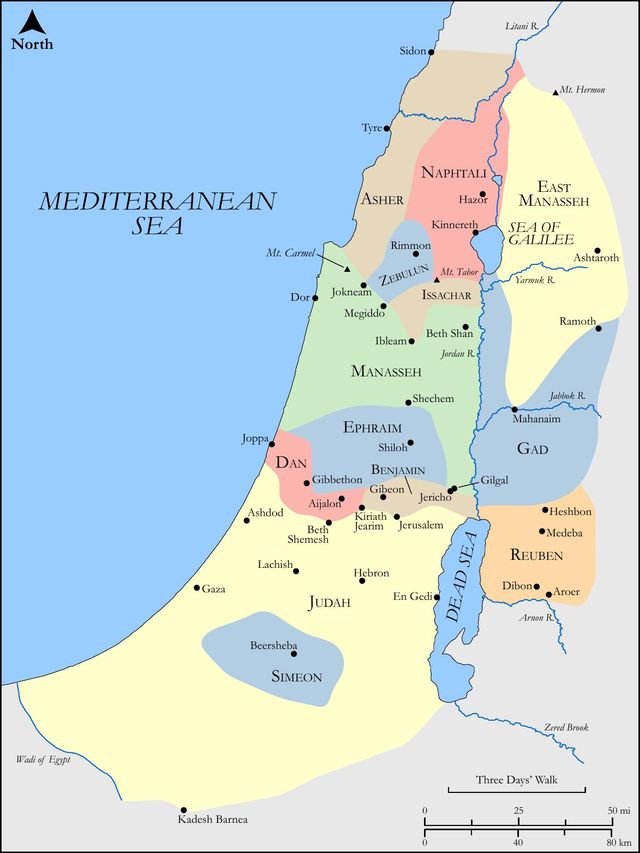
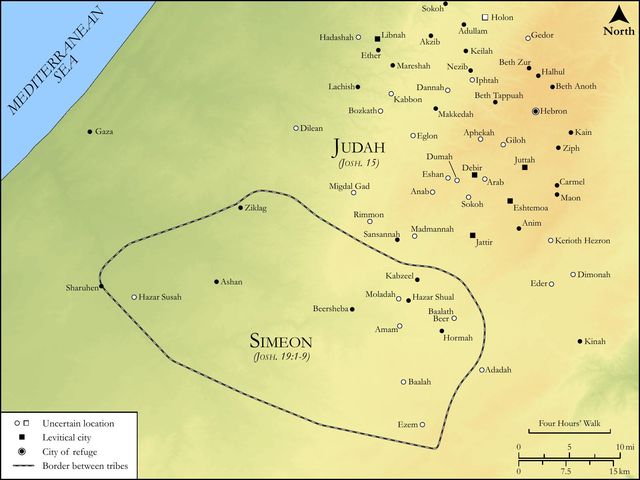
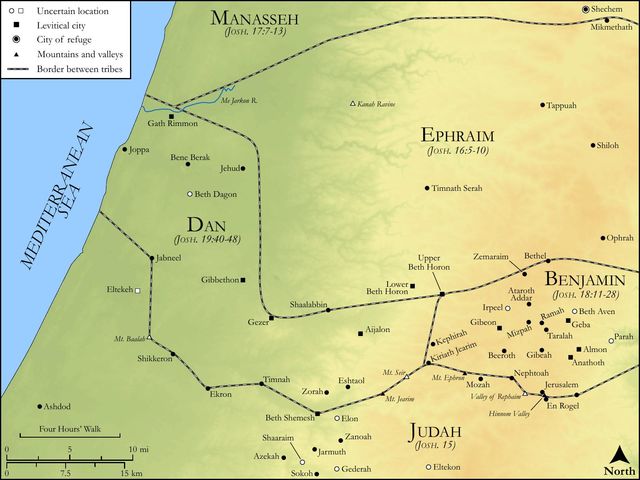
See on the biblical-era maps
Study this verse
Public-domain commentary
Matthew Henry
From his Commentary on the Whole Bible. Henry comments on passages, not single verses — this entry covers Joshua 19:32–39.
Naphtali lay furthest north of all the tribes, bordering on Mount Libanus. The city of Leshem, or Liash, lay on the utmost edge of it to the north, and therefore when the Danites had made themselves masters of it, and called it Dan, the length of Canaan from north to south was reckoned from Dan to Beersheba. It had Zebulun on the south, Asher on the west, and Judah upon Jordan, probably a city of that name, and so distinguished from the tribe of Judah on the east. It was in the lot of this tribe, near the waters of Merom, that Joshua fought and routed Jabin, Jos 11:1. etc. In this tribe stood Capernaum and Bethsaida, on the north end of the sea of Tiberias, in which Christ did so many mighty works; and the mountain (as is supposed) on which Christ preached, Mat 5:1.
Continue studying Joshua 19:39 across the web’s major study libraries — every link below opens this exact verse, chapter, or book on the destination site.
Read & Compare
 BibleGatewayThis verse in more than 200 translations and 70 languages.
 Bible.comThe YouVersion reader — hundreds of translations, reading plans, and highlights.
 ESV.orgCrossway's official English Standard Version reader.
 NET BibleThe NET translation with 60,000+ translators' notes on every rendering decision.
 STEP BibleTyndale House's free study tool — original text, vocabulary, and scholarly resources.
 BibliaLogos Bible Software's free web reader.
 USCCBThe New American Bible (Revised Edition) with the U.S. bishops' study notes.
Commentaries
 BibleHub CommentariesDozens of classic commentaries on this verse, gathered on one page.
 StudyLightMore than 100 commentary sets — the largest collection on the web.
 BibleRefPlain-English commentary on what this verse means, verse by verse.
 Enduring WordDavid Guzik's free commentary on this chapter, widely used by Bible teachers.
 Bible Study ToolsVerse commentary alongside Greek and Hebrew study aids.
Original Language & Research
- BibleHub InterlinearThe verse word by word — original language, transliteration, and English.
- BibleHub LexiconEvery word's original-language definition and Strong's entry.
 Blue Letter BibleDeep-study tools — Strong's numbers, concordance, and word studies.
 SefariaThe Hebrew text with Rashi and centuries of Jewish commentary.
Sermons, Hymns & Audio


TrulyRandomVerse is not affiliated with these sites and doesn’t control their content. They’re linked because they’re genuinely useful.
Summary
Joshua 19:39 serves as the concluding declaration for the tribal allotment of Naphtali, meticulously confirming that their designated inheritance, comprising specific cities and their surrounding villages, was distributed precisely according to their family lineages. This verse encapsulates the faithful fulfillment of God's ancient covenant promises to Israel, demonstrating His unwavering commitment to providing a secure and defined homeland for one of Jacob's descendants, thereby establishing their identity, stability, and future within the Promised Land.
Context
ShowHideLiterary Context
Joshua 19:39 marks the culmination of the detailed account of land distribution to the tribe of Naphtali, which is part of the larger narrative of Israel's territorial apportionment spanning from Joshua 13 through Joshua 19. Specifically, it follows the precise delineation of Naphtali's geographical boundaries and the enumeration of its cities in Joshua 19:32-38. This verse functions as a summary statement, a recurring literary device at the end of each tribal allotment section, providing a clear sense of completion and administrative finality for that particular tribe's inheritance. This repetitive structure underscores the systematic, thorough, and divinely ordained nature of the land's division, reinforcing God's faithfulness in fulfilling His promise to settle Israel securely in the land.
Historical & Cultural Context
The division of the land of Canaan was a monumental undertaking, representing the fulfillment of centuries of divine promise and the transition of Israel from a nomadic confederation to an established nation. Following the successful conquest campaigns led by Joshua, the allocation of territory was a critical step in actualizing God's covenant with Abraham (Genesis 12:7). This intricate process was overseen by Joshua, Eleazar the priest, and the heads of the tribal families, often involving the casting of lots (as described in Joshua 18:6) to ensure divine guidance and prevent internal disputes. The concept of "inheritance" (Hebrew: nachalah) was foundational, signifying a divinely granted, inalienable possession that provided economic stability, tribal identity, and a physical space for covenant living and worship. The meticulous listing of cities and villages was not merely an administrative record; it served as a legal and theological document, establishing clear boundaries and ownership for generations to come, ensuring the perpetuation of tribal and familial identity within the Promised Land.
Key Themes
ShowHideJoshua 19:39 powerfully reinforces several overarching themes central to the book of Joshua and the broader Old Testament narrative. Firstly, it highlights Divine Faithfulness, serving as tangible proof of God's unwavering commitment to His covenant promises made to the patriarchs regarding the land (e.g., Genesis 15:18-21). The physical possession of the land by each tribe is a direct manifestation of God's reliability. Secondly, it emphasizes Order and Fulfillment, as the systematic and detailed division of the land reflects God's orderly character and the precise execution of His prophetic word concerning Israel's settlement. The meticulous nature of the allotments, down to specific cities and families, underscores this theme. Thirdly, the concept of Identity and Belonging is paramount; the assigned territory was fundamental to each tribe's unique identity, social structure, and sense of permanent home, providing a stable foundation for their future generations and their role within the twelve tribes. Lastly, the repeated emphasis on "inheritance" (Hebrew: nachalah) signifies that the land was a Divine Gift, not merely a conquered territory, ensuring the tribe's long-term stability and livelihood as a secured portion from God's gracious hand.
Exposition and Analysis
ShowHideKey Word Analysis
ShowHideThis term signifies something inherited, an occupancy, or an heirloom; generally, an estate, patrimony, or portion. In the context of Joshua, naḥălāh is far more than mere property; it represents a divinely allotted portion of the Promised Land, an inalienable possession passed down through generations. It underscores that the land was not earned by Israel's might but was a gracious endowment from Yahweh, securing their identity and future as His covenant people. It carries profound theological weight, linking the physical land to God's faithfulness and covenant promises.
This word denotes a branch (as extending) and figuratively, a tribe; also a rod or staff. In this verse, maṭṭeh specifically refers to the distinct tribal divisions of Israel, each descended from one of Jacob's sons. The term emphasizes the organizational and familial structure through which the land was allocated. Each maṭṭeh received a unique and defined territory, signifying their corporate identity and their specific place within the nation of Israel, fulfilling the patriarchal blessings and prophecies.
This term refers to a family, i.e., a circle of relatives; figuratively, a class of persons, a species, or a sort; by extension a tribe or people. The phrase "according to their families" highlights the meticulous and equitable nature of the land distribution. It signifies that the inheritance was not merely given to the tribe as a whole but was further subdivided and allocated to each family unit within the tribe, ensuring that every household had a portion. This detail underscores the orderly administration of the land and the preservation of familial lineages, their associated rights, and responsibilities, which were foundational to Israelite society.
Verse Breakdown
ShowHide"This [is] the inheritance of the tribe of the children of Naphtali"
This opening clause serves as a definitive and declarative summary. "This" refers to the entire detailed territorial description that precedes it in Joshua 19:32-38. It explicitly states that the described territory is the divinely appointed "inheritance" (nachalah) specifically for the tribe descended from Naphtali, one of Jacob's sons. This firmly establishes the tribal claim and the divine origin of their land, underscoring God's faithfulness in fulfilling His promise.
"according to their families"
This crucial phrase clarifies the precise method and meticulous nature of the land's distribution within the tribe. It indicates that the overall tribal allotment was further subdivided and assigned to the various clans and households (the mishpachot) within the tribe of Naphtali. This ensured an equitable distribution and maintained the integrity of the family units, which were the foundational building blocks of Israelite society and land ownership. It speaks to the meticulous detail and divine order in God's provision for His people.
"the cities and their villages"
This final clause specifies the comprehensive nature of the inheritance. It confirms that the allotment included not only the major urban centers (cities, Hebrew: 'iyr) but also the smaller, surrounding agricultural settlements and hamlets (villages, Hebrew: chatsêr) that were economically and socially dependent on those cities. This comprehensive description emphasizes that the inheritance was a complete and viable territory, providing both defensive strongholds and productive agricultural lands necessary for the tribe's sustenance, flourishing, and long-term stability.
Literary Devices
ShowHideJoshua 19:39 primarily functions as a Summary Statement, bringing to a concise close the detailed enumeration of Naphtali's territory. This literary device is employed repeatedly throughout Joshua 13-19 to mark the completion of each tribal allotment, providing a sense of closure, administrative finality, and reinforcing the systematic nature of the land distribution. The verse also utilizes Meticulous Detail through its reference to "cities and their villages" and the distribution "according to their families." While brief in this summary, this detail points back to the exhaustive lists found in the preceding verses, underscoring the thoroughness and precision of the divine plan and its human execution. Furthermore, the recurring phrase "This is the inheritance..." across multiple tribal summaries creates a pattern of Repetition, which serves to reinforce the overarching theme of God's faithfulness in fulfilling His promise of land to each of the tribes of Israel, emphasizing the certainty and completeness of His provision.
Theological and Thematic Connections
ShowHideJoshua 19:39, though seemingly administrative, carries profound theological weight, serving as a tangible testament to God's unwavering faithfulness and the meticulous fulfillment of His covenant promises. The physical inheritance of land to Naphtali, like all the tribes, underscores the principle that God's word is reliable and His plans are precise. This earthly inheritance foreshadows a greater, spiritual inheritance promised to believers in the New Covenant. Just as the land provided security, identity, and sustenance for Israel, so too does our spiritual inheritance in Christ provide eternal security, a new identity as children of God, and abundant spiritual provision. It reminds us that God is not only a promise-maker but a promise-keeper, meticulously working out His redemptive purposes through history, ensuring that every promise made to His people will ultimately be fulfilled, whether in a physical land or a spiritual kingdom.
Reflection and Application
ShowHideJoshua 19:39 invites us to reflect deeply on the meticulous care and unwavering faithfulness of God. If God was so precise in fulfilling His ancient promises to Israel, down to the specific cities and villages for each family within a tribe, how much more can we trust Him with the intricate details of our own lives and the grand scope of His promises to us? This verse encourages us to find our ultimate security and identity not in fleeting earthly possessions or achievements, but in the enduring spiritual inheritance God has prepared for us through Christ. It challenges us to live in profound gratitude for the spiritual blessings we have received—salvation, adoption into His family, the indwelling Holy Spirit—recognizing that our true home and belonging are found in Him. Just as Naphtali's inheritance was a sovereign gift, so too is our salvation and all its accompanying blessings. This should inspire us to live lives that honor the Giver, faithfully stewarding the gifts and callings He has placed upon us, and confidently resting in His sovereign provision and perfect timing, knowing that He is a God who keeps His word to the smallest detail.
Questions for Reflection
ShowHideFAQ
ShowHideWhy is the distribution of land to each tribe, including Naphtali, so meticulously detailed in the Book of Joshua?
ShowHideThe meticulous detail in the land distribution, as seen in Joshua 19:39, serves several crucial purposes. Firstly, it provides a legal and historical record, validating the claims of each tribe and family to their specific territories. This was essential for establishing tribal identity, preventing future disputes over land, and ensuring the stability and order of the new nation. Secondly, it powerfully demonstrates God's unwavering faithfulness in fulfilling His ancient covenant promises to Abraham, Isaac, and Jacob that their descendants would inherit the land of Canaan (e.g., Genesis 15:18). The precision underscores that God's word is reliable and His plans are thoroughly executed down to the smallest detail. Finally, it highlights the divine order and sovereignty in the establishment of Israel as a nation, emphasizing that their possession of the land was a gracious gift from God, not merely a result of military conquest or human effort.
Christ-Centered Fulfillment
ShowHideWhile Joshua 19:39 describes a physical inheritance of land for the tribe of Naphtali, it powerfully foreshadows the spiritual inheritance that believers receive in Jesus Christ. The land of Canaan, a tangible promise fulfilled, points to the ultimate and eternal inheritance secured by Christ's redemptive work. Just as Naphtali's inheritance was a gift, not earned through their own merit, so too our spiritual blessings in Christ are a gracious gift, freely given through faith (Ephesians 2:8-9). Jesus, the true Son of God and ultimate Heir of all things (Hebrews 1:2), has secured for us an "inheritance that is imperishable, undefiled, and unfading, kept in heaven for you" (1 Peter 1:4). The meticulous division of land "according to their families" in Joshua finds its spiritual parallel in the church, the family of God, where every believer, regardless of background, is made a co-heir with Christ (Romans 8:17) and receives a full share in the spiritual blessings of the new covenant, including eternal life, reconciliation with God, and the indwelling of the Holy Spirit (Ephesians 1:3-14). Thus, the earthly inheritance of Naphtali anticipates the glorious, spiritual reality of our secure and eternal inheritance in Christ, our true Promised Land and eternal dwelling.