


2 Kings 14:12
Bible text: King James Version (1769 Blayney text) · Public domain
Bible text: Berean Standard Bible · Public domain
Bible text: American Standard Version (1901) · Public domain
Bible text: World English Bible, Messianic edition · Public domain
Bible text: Geneva Bible (1599) · Public domain
Bible text: Young's Literal Translation · Public domain
- וַיִּנָּגֶףvai·yi·Na·gefand it was defeatedH5062Conj-w ¦ V-Niphal-ConsecImperf-3msVerb Niphal Consecutive Imperfect 3rd Singular Masculineוַandיִּנָּגֶףit was defeated
- יְהוּדָהye·hu·DahJudahH3063N-properNoun Proper Location
- לִפְנֵיlif·Nei<to> beforeH6440Prep-l ¦ N-mpcNoun Plural Masculine Constructלִ<to>פְנֵיbefore
- יִשְׂרָאֵלYis·ra·'ElIsraelH3478N-properNoun Proper Location
- וַיָּנֻסוּvai·ya·Nu·suand they fledH5127Conj-w ¦ V-Qal-ConsecImperf-3mpVerb Qal Consecutive Imperfect 3rd Plural Masculineוַandיָּנֻסוּthey fled
- אִישׁ'isheveryoneH376N-msNoun Singular Masculine Absolute
- לְאֹהָלָיוle·'o·ho·lovto his tentsH168Prep-l ¦ N-mpc ¦ 3msNoun Plural Masculine Constructלְtoאֹהָלָיtentsוhis
English is a literal word-by-word gloss of the Hebrew, not the KJV's wording. Why?
This is the original text the KJV's translators worked from — each Hebrew word with its own literal English meaning in this verse, prepared by scholars at Tyndale House, Cambridge. The KJV translates whole sentences, not word by word, so its wording differs: one Hebrew word can become several English words, and the KJV may choose “the LORD” where the gloss reads “Yahweh”. Both are faithful — they answer different questions. For the KJV's own rendering, switch to the KJV text.
Details
See on the biblical-era maps
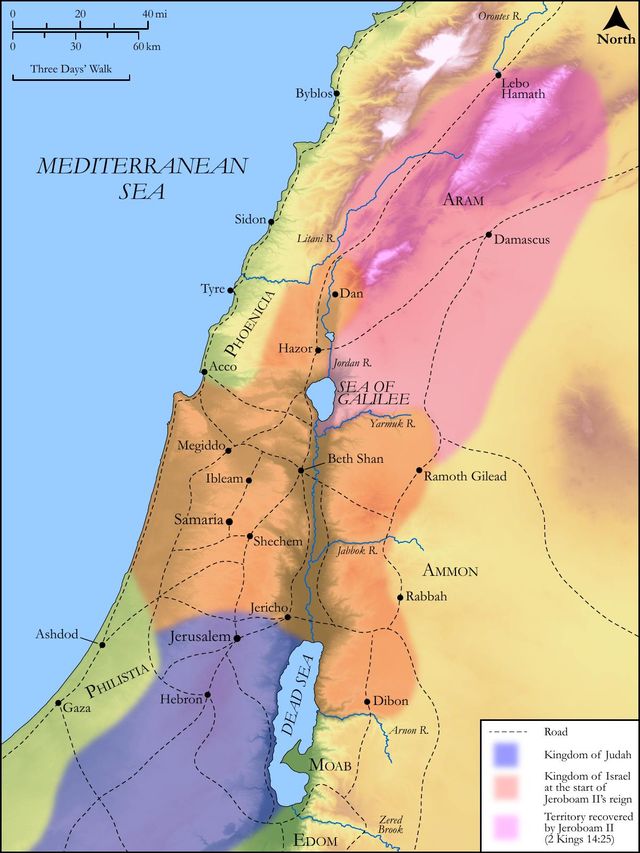
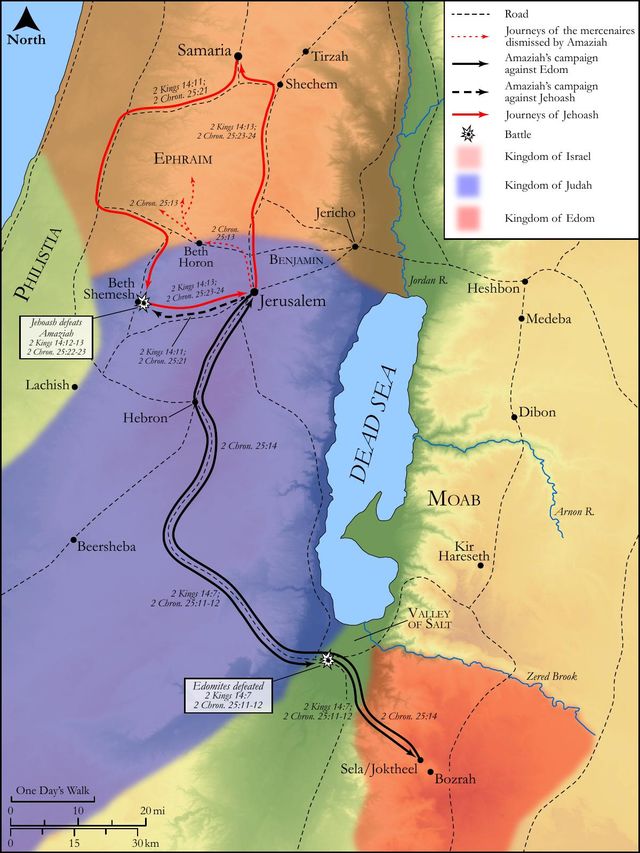
Study this verse
Public-domain commentary
Matthew Henry
From his Commentary on the Whole Bible. Henry comments on passages, not single verses — this entry covers 2 Kings 14:8–14. His two-level outline is real structure in the source text, so it is rendered as structure.
For several successions after the division of the kingdoms that of Judah suffered much by the enmity of Israel. After Asa's time, for several successions, it suffered more by the friendship of Israel, and by the alliance and affinity made with them. But now we meet with hostility between them again, which had not been for some ages before.
I.Amaziah, upon no provocation, and without showing any cause of quarrel, challenged Joash into the field (Kg2 14:8):
"Come, let us look one another in the face; let us try our strength in battle." Had he challenged him to a personal duel only, the error would have remained with himself, but each must bring all their forces into the field, and thousands of lives on both sides must be sacrificed to his capricious humour. Hereby he showed himself proud, presumptuous, and prodigal of blood. Some think that he intended to avenge the injury which the dismissed disgusted Israelites had lately done to his country, in their return (Ch2 25:13), and that he had also the vanity to think of subduing the kingdom of Israel, and reuniting it to Judah. A fool's lips thus enter into contention, and his mouth calleth for strokes. Those that challenge are chargeable with that beginning of strife, which is as the letting forth of water. He that is eager either to fight or to go to law may perhaps have enough of it quickly, and be the first that repents it.
II.Joash sent him a grave rebuke for his challenge, with advice to withdraw it, Kg2 14:9, Kg2 14:10.
1.He mortifies his pride, by comparing himself to a cedar, a stately tree, and Amaziah to a thistle, a sorry weed, telling him he was so far from fearing him that he despised him, and scorned as much to have any thing to do with him, or make any alliance with him, as the cedar would to match his daughter to a thistle. The ancient house of David he thinks not worthy to be named the same day with the house of Jehu, though an upstart. How may a humble man smile to hear two proud and scornful men set their wits on work to vilify and undervalue one another!
2.He foretels his fall: A wild beast trode down the thistle, and so put an end to his treaty with the cedar; so easily does Joash think his forces can crush Amaziah, and so unable does he think him to make any resistance.
3.He shows him the folly of his challenge: "Thou hast indeed smitten Edom, a weak, unarmed, undisciplined body of men, and therefore thinkest thou canst carry all before thee and subdue the regular forces of Israel with as much ease. Thy heart has lifted thee up." See where the root of all sin lies; it is in the heart, thence it flows, and that must bear the blame. It is not Providence, the event, the occasion (whatever it is), that makes men proud, or secure, or discontented, or the like, but it is their own heart that does it. "Thou art proud of the blow thou hast given to Edom, as if that had made thee formidable to all mankind." Those wretchedly deceive themselves that magnify their own performances, and, because they have been blessed with some little success and reputation, conclude themselves fit for any thing and no less sure of it.
4.He counsels him to be content with the honour he has won, and not to hazard that, by grasping at more that was out of his reach: Why shouldst thou meddle to thy hurt, as fools often do, that will be meddling? Pro 20:3. Many would have had wealth and honour enough if they had but known when they had enough. He warns him of the consequence, that it would be fatal not to himself only, but to his kingdom, which he ought to protect.
III.Amaziah persisted in his resolution, and the issue was bad; he had better have tarried at home, for Joash gave him such a look in the face as put him to confusion. Challengers commonly prove to be on the losing side.
1.His army was routed and dispersed, Kg2 14:12. Josephus says, When they were to engage they were struck with such terror that they did not strike a stroke, but every one made the best of his way.
2.He himself was taken prisoner by the king of Israel, and then had enough of looking him in the face. Amaziah's pedigree comes in here somewhat abruptly (the son of Joash, the son of Ahaziah), because perhaps he had gloried in the dignity of his ancestors, or because he now smarted for their iniquity.
3.The conqueror entered Jerusalem, which tamely opened to him, and yet he broke down their wall (and, as Josephus says, drove his chariot in triumph through the breach), in reproach to them, and that he might, when he pleased, take possession of the royal city.
4.He plundered Jerusalem, took away all that was valuable, and returned to Samaria, laden with spoils, Kg2 14:14. It was said of Joash that he did that which was evil in the sight of the Lord, and of Amaziah that he did that which was right; and yet Joash triumphs thus over Amaziah, and why so? Because God would show, in Amaziah's fate, that he resists the proud, or because, whatever they were otherwise, Joash had lately been respectful to one of God's prophets (Kg2 13:14), but Amaziah had been abusive to another (Ch2 25:16), and God will honour those who honour him in his prophets, but those who despise them, and him in them, shall be lightly esteemed.
Continue studying 2 Kings 14:12 across the web’s major study libraries — every link below opens this exact verse, chapter, or book on the destination site.
Read & Compare
 BibleGatewayThis verse in more than 200 translations and 70 languages.
 Bible.comThe YouVersion reader — hundreds of translations, reading plans, and highlights.
 ESV.orgCrossway's official English Standard Version reader.
 NET BibleThe NET translation with 60,000+ translators' notes on every rendering decision.
 STEP BibleTyndale House's free study tool — original text, vocabulary, and scholarly resources.
 BibliaLogos Bible Software's free web reader.
 USCCBThe New American Bible (Revised Edition) with the U.S. bishops' study notes.
Commentaries
 BibleHub CommentariesDozens of classic commentaries on this verse, gathered on one page.
 StudyLightMore than 100 commentary sets — the largest collection on the web.
 BibleRefPlain-English commentary on what this verse means, verse by verse.
 Enduring WordDavid Guzik's free commentary on this chapter, widely used by Bible teachers.
 Bible Study ToolsVerse commentary alongside Greek and Hebrew study aids.
Original Language & Research
- BibleHub InterlinearThe verse word by word — original language, transliteration, and English.
- BibleHub LexiconEvery word's original-language definition and Strong's entry.
 Blue Letter BibleDeep-study tools — Strong's numbers, concordance, and word studies.
 SefariaThe Hebrew text with Rashi and centuries of Jewish commentary.
Sermons, Hymns & Audio


TrulyRandomVerse is not affiliated with these sites and doesn’t control their content. They’re linked because they’re genuinely useful.
Summary
2 Kings 14:12 vividly records the decisive and humiliating defeat of the southern kingdom of Judah by the northern kingdom of Israel at the Battle of Beth-shemesh. This verse marks the climactic moment of King Amaziah's ill-advised challenge to King Joash, resulting in a complete rout of the Judean forces who scattered in disarray, abandoning the field and returning to their homes. It serves as a stark and immediate consequence of Amaziah's pride and disobedience, setting the stage for further repercussions and underscoring the volatility of the relationship between the divided kingdoms.
Context
ShowHideLiterary Context
This verse is the direct and devastating outcome of a pivotal confrontation between King Amaziah of Judah and King Joash of Israel, detailed extensively in 2 Kings 14. Following Amaziah's significant victory over Edom in the Valley of Salt, a triumph recounted in 2 Kings 14:7, he became dangerously overconfident and, in an act of profound hubris, challenged Joash to war. Joash's initial response, a cautionary parable about a thistle challenging a cedar, found in 2 Kings 14:9-10, clearly warned Amaziah against his pride and advised him to remain at home. However, Amaziah, refusing to heed this wise counsel, pressed forward, leading to the fateful and decisive encounter at Beth-shemesh. The immediate aftermath, described in 2 Kings 14:13-14, details Joash's subsequent invasion of Jerusalem, the breaching of its walls, and the plundering of the temple and palace treasuries, further emphasizing the severity and lasting impact of Judah's defeat.
Historical & Cultural Context
The period of the divided monarchy (roughly 931-586 BC) was characterized by frequent skirmishes, shifting alliances, and deep-seated animosity between the northern kingdom of Israel and the southern kingdom of Judah, despite their shared ancestry and religious heritage. King Amaziah of Judah (reigned c. 800-783 BC) and King Joash of Israel (reigned c. 798-782 BC) ruled concurrently for a significant portion of their reigns, making their direct confrontation a major event. The battle at Beth-shemesh, located in the Shephelah region, was strategically significant as it lay on the border between the two kingdoms, making it a natural flashpoint for conflict and a key defensive position. Culturally, military prowess and success were often interpreted as signs of divine favor, while a decisive defeat like this would be perceived not merely as a tactical failure but as a clear indication of divine displeasure or judgment. The idiom "going to their tents" (or "homes") after a rout signifies a complete abandonment of the battlefield and the cessation of hostilities, a common and universally understood expression for a total collapse of military order and morale.
Key Themes
ShowHideThe central theme powerfully underscored by this verse is the consequences of pride and hubris. Amaziah's arrogance, inflated by his recent success against Edom, directly precipitates this humiliating downfall, illustrating the timeless biblical principle articulated in Proverbs 16:18. Another crucial theme is divine judgment and sovereignty. While 2 Kings 14:12 focuses on the military outcome, the parallel account in 2 Chronicles 25:14-20 reveals that Amaziah's defeat was orchestrated by the Lord because of his idolatry following the Edomite victory. He began worshiping the gods of Seir, provoking God's wrath, highlighting God's active involvement in the affairs of nations and His judgment against unfaithfulness. Finally, the verse reinforces the tragic reality of the divided kingdom and the perpetual animosity that plagued Israel and Judah since their schism, a division rooted in the rebellion against Rehoboam, as chronicled in 1 Kings 12.
Exposition and Analysis
ShowHideKey Word Analysis
ShowHideThis verb (H5062), frequently translated as "smite," "strike," or "defeat," carries the strong connotation of a decisive, often divinely orchestrated, blow or plague. It implies a forceful and overwhelming defeat, not merely a minor setback or a contested battle. In this context, it emphasizes the absolute and comprehensive nature of Judah's collapse before Israel, indicating a rout rather than a strategic retreat.
This primitive root (H5127) means "to flit," "vanish away," or "escape," and causatively, "to chase" or "put to flight." Here, in the context of an army, it signifies a rapid and disorderly retreat, a panicked escape from the battlefield. It conveys the immediate and desperate action taken by the Judean forces as their military cohesion broke down.
This noun (H168) refers to a "tent" as a conspicuous dwelling place, often signifying a home or tabernacle. In the idiom "fled every man to their tents," it represents the soldiers' homes or encampments, symbolizing a complete abandonment of the field of battle and a return to civilian life or a secure dwelling, indicating the total and irreversible cessation of the military engagement.
Verse Breakdown
ShowHide"And Judah was put to the worse before Israel;"
This initial clause delivers the core message of the verse: Judah suffered a crushing and undeniable defeat at the hands of Israel. The passive voice ("was put to the worse") emphasizes the outcome from Judah's perspective, highlighting their vulnerability and the overwhelming power of their adversary. The phrase "before Israel" indicates that the defeat occurred directly in the presence of or by the hand of the Israelite army, underscoring the direct confrontation and immediate, public consequences. This was not a hidden skirmish but a decisive military engagement.
"and they fled every man to their tents."
This second clause describes the immediate, chaotic, and complete aftermath of Judah's defeat. The phrase "every man" emphasizes the universality of the flight – no one stood their ground, no organized resistance remained. "To their tents" is a well-established idiomatic expression in biblical Hebrew for a complete military rout, where soldiers abandon the field and return to their homes or camps, signifying the end of the engagement and the utter collapse of their fighting force. It paints a vivid picture of disarray, panic, and surrender, confirming the absolute nature of the defeat.
Literary Devices
ShowHideThe verse employs several potent literary devices to convey its powerful message with conciseness and impact. The most prominent is Idiom, specifically the phrase "fled every man to their tents." This is a concise and evocative way to describe a complete military rout and dispersal, conveying a sense of finality, humiliation, and the utter breakdown of military order far more effectively than a literal description of soldiers running away. There is also a strong element of Irony at play, though not explicitly stated within this single verse, it is deeply embedded in the broader narrative of King Amaziah's reign. Amaziah, fresh from a divinely aided victory over Edom, succumbs to pride and challenges a stronger foe, only to suffer a humiliating defeat. His past success, which should have fostered humility and continued reliance on God, instead led to his undoing. The verse also functions as a moment of Climax in the narrative arc of Amaziah's reign, marking the definitive turning point from his initial successes to his eventual downfall and the subsequent plundering of Jerusalem.
Theological and Thematic Connections
ShowHideThe defeat of Judah in 2 Kings 14:12 serves as a profound theological statement on the dangers of pride and the certainty of divine judgment for disobedience. Amaziah's presumption, fueled by his recent victory, led him to challenge a stronger adversary, ignoring both human counsel and, implicitly, divine warning. This narrative powerfully illustrates the principle that God opposes the proud but gives grace to the humble. It underscores that true strength and security come not from military might or past successes, but from humble obedience and faithfulness to the Lord. The internal conflict between the two kingdoms also speaks to the broader theme of covenant faithfulness and the consequences of apostasy, as both Israel and Judah frequently strayed from God's commands, leading to cycles of judgment and suffering, demonstrating God's sovereign hand even in the political and military affairs of His people.
Reflection and Application
ShowHideThe account of Judah's defeat at Beth-shemesh, rooted in King Amaziah's pride and disobedience, offers timeless and profound lessons for believers today. It serves as a potent reminder that spiritual victories and past successes, rather than inflating our self-reliance, should deepen our humility and dependence on God. Amaziah's failure to heed Joash's wise counsel, and more importantly, his turning to idolatry after experiencing God's favor, highlights the insidious nature of pride and its capacity to blind us to danger, divine will, and the true source of our blessings. We are called to walk in humility, recognizing that all our strengths, achievements, and even our very breath come from God, and to remain vigilant against the subtle temptations of self-sufficiency. This narrative encourages us to seek and value wise counsel from godly sources, to remain faithful in prosperity as well as adversity, and to remember that true security and lasting success are found only in humble obedience to God, not in our own perceived might, past accomplishments, or strategic prowess.
Questions for Reflection
ShowHideFAQ
ShowHideWhy did Amaziah challenge Joash, especially after his victory over Edom?
ShowHideAmaziah's challenge to Joash was primarily driven by inflated pride and overconfidence following his recent, divinely-aided victory over Edom (see 2 Kings 14:7). He likely felt invincible and sought to assert Judah's dominance over Israel, perhaps aiming to reclaim territory or prestige lost in previous conflicts. However, the parallel account in 2 Chronicles 25:14-20 reveals a deeper, spiritual reason: Amaziah had turned to idolatry after the Edomite victory, bringing the gods of Seir back to Judah and worshipping them. The Lord intended to deliver Judah into Israel's hands as a judgment for Amaziah's unfaithfulness, using Joash as an instrument of His divine discipline.
Christ-Centered Fulfillment
ShowHideThe narrative of Amaziah's pride and Judah's subsequent defeat in 2 Kings 14:12 finds its profound Christ-centered fulfillment in the stark contrast between human failure and divine perfection, and between earthly kings and the ultimate King. Amaziah's hubris, leading to a humiliating rout and the scattering of his people "to their tents," highlights the inherent weakness, unreliability, and moral fragility of human leadership, even when initially blessed by God. This foreshadows the desperate need for a perfect King who would not succumb to pride or lead His people to defeat, but rather to ultimate victory. Jesus Christ, the true King of Israel and the King of kings, perfectly embodies humility and obedience, even to the point of death on a cross (Philippians 2:8). Unlike Amaziah, whose actions brought judgment and dispersal, Christ's perfect obedience and ultimate sacrifice on the cross gather His people, bringing them into a secure and eternal "tent" or dwelling place with God (John 14:2-3). His victory over sin, death, and the powers of darkness was not achieved through military might but through self-sacrificial love and resurrection power, ensuring that those who follow Him will never be "put to the worse" but will inherit eternal life and true peace, a spiritual victory that transcends any earthly defeat (1 Corinthians 15:57).