


1 Kings 22:36
- וַיַּעֲבֹרvai·ya·'a·Vorand it passedH5674Conj-w ¦ V-Qal-ConsecImperf-3msVerb Qal Consecutive Imperfect 3rd Singular Masculineוַandיַּעֲבֹרit passed
- הָרִנָּהha·ri·Nahthe cryH7440Art ¦ N-fsNoun Singular Feminine Absoluteהָtheרִנָּהcry
- בַּמַּחֲנֶהba·ma·cha·Nehin the campH4264Prep-b ¦ N-fsNoun Singular Feminine Absoluteבַּin theמַּחֲנֶהcamp
- כְּבֹאke·Vo'when wentH935Prep-k ¦ V-Qal-InfVerb Qal Infinitive Constructכְּwhenבֹאwent
- הַשֶּׁמֶשׁha·She·meshthe sunH8121Art ¦ N-csNoun Singular common gender Absoluteהַtheשֶּׁמֶשׁsun
- לֵאמֹרle·Mor<to> sayingH559Prep-l ¦ V-Qal-InfVerb Qal Infinitive Constructלֵ<to>אמֹרsaying
- אִישׁ'isheveryoneH376N-msNoun Singular Masculine Absolute
- אֶל'eltoH413PrepPreposition
- עִירוֹi·Rohis cityH5892N-fsc ¦ 3msNoun Singular Feminine Constructעִירcityוֹhis
- וְאִישׁve·'Ishand everyoneH376Conj-w ¦ N-msNoun Singular Masculine Absoluteוְandאִישׁeveryone
- אֶל'eltoH413PrepPreposition
- אַרְצוֹ'ar·Tzohis landH776N-fsc ¦ 3msNoun Singular Feminine Constructאַרְצlandוֹhis
English is a literal word-by-word gloss of the Hebrew, not the KJV's wording. Why?
This is the original text the KJV's translators worked from — each Hebrew word with its own literal English meaning in this verse, prepared by scholars at Tyndale House, Cambridge. The KJV translates whole sentences, not word by word, so its wording differs: one Hebrew word can become several English words, and the KJV may choose “the LORD” where the gloss reads “Yahweh”. Both are faithful — they answer different questions. For the KJV's own rendering, switch to the KJV text.
Details
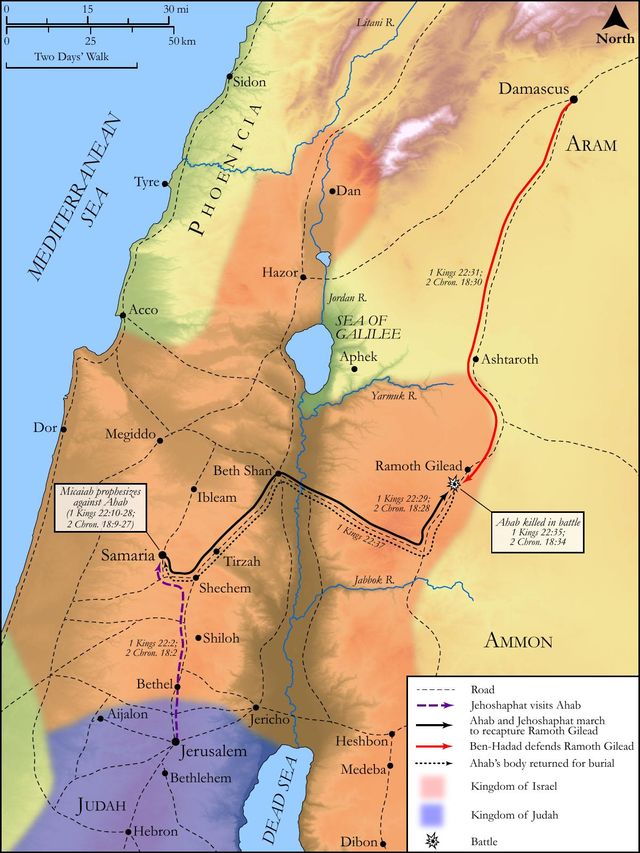
See on the biblical-era map

Study this verse
Public-domain commentary
Matthew Henry
From his Commentary on the Whole Bible. Henry comments on passages, not single verses — this entry covers 1 Kings 22:29–40. His two-level outline is real structure in the source text, so it is rendered as structure.
The matter in contest between God's prophet and Ahab's prophets is here soon determined, and it is made to appear which was in the right. Here,
I.The two kings march with their forces to Ramoth-Gilead, Kg1 22:29.
That the king of Israel, who hated God's prophet, should so far disbelieve his admonition as to persist in his resolution, notwithstanding, is not strange; but that Jehoshaphat, that pious prince, who had desired to enquire by a prophet of the Lord, as disrelishing and discrediting Ahab's prophets, should yet proceed, after so fair a warning, is matter of astonishment. But by the easiness of his temper he was carried away with the delusion (as Barnabas was with the dissimulation, Gal 2:13) of his friends. He gave too much heed to Ahab's prophets, because they pretended to speak from God too, and in his country he had never been imposed upon by such cheats. He was ready to give his opinion with the majority, and to conclude that it was 400 to one but they should succeed. Micaiah had not forbidden them to go; nay, at first, he said, Go, and prosper. If it came to the worst, it was only Ahab's fall that was foretold, and therefore Jehoshaphat hoped he might safely venture.
II.Ahab adopts a contrivance by which he hopes to secure himself and expose his friend (Kg1 22:30):
"I will disguise myself, and go in the habit of a common soldier, but let Jehoshaphat put on his robes, to appear in the dress of a general." He pretended thereby to do honour to Jehoshaphat, and to compliment him with the sole command of the army in this action. He shall direct and give orders, and Ahab will serve as a soldier under him. But he intended,
1.To make a liar of a good prophet. Thus he hoped to elude the danger, and so to defeat the threatening, as if, by disguising himself, he could escape the divine cognizance and the judgments that pursued him.
2.To make a fool of a good king, whom he did not cordially love, because he was one that adhered to God and so condemned his apostasy. He knew that if any perished it must be the shepherd (so Micaiah had foretold); and perhaps he had intimation of the charge the enemy had to fight chiefly against the king of Israel, and therefore basely intended to betray Jehoshaphat to the danger, that he might secure himself. Ahab was marked for ruin; one would not have been in his coat for a great sum; yet he will over-persuade this godly king to muster for him. See what those get that join in affinity with vicious men, whose consciences are debauched, and who are lost to every thing that is honourable. How can it be expected that he should be true to his friend that has been false to his God?
III.Jehoshaphat, having more piety than policy, put himself into the post of honour, though it was the post of danger, and was thereby brought into the peril of his life, but God graciously delivered him. The king of Syria charged his captains to level their force, not against the king of Judah, for with him he had no quarrel, but against the king of Israel only (Kg1 22:31), to aim at his person, as if against him he had a particular enmity. Now Ahab was justly repaid for sparing Ben-hadad, who, as the seed of the serpent commonly do, stung the bosom in which he was fostered and saved from perishing. Some think that he designed only to have him taken prisoner, that he might now give him as honourable a treatment as he had formerly received from him. Whatever was the reason, this charge the officers received, and endeavoured to oblige their prince in this matter; for, seeing Jehoshaphat in his royal habit, they took him for the king of Israel, and surrounded him. Now,
1.By his danger God let him know that he was displeased with him for joining in confederacy with Ahab. Jehoshaphat had said, in compliment to Ahab (Kg1 22:4), I am as thou art; and now he was indeed taken for him. Those that associate with evil doers are in danger of sharing in their plagues.
2.By his deliverance God let him know that, though he was displeased with him, yet he had not deserted him. Some of the captains that knew him perceived their mistake, and so retired from the pursuit of him; but it is said (Ch2 18:31) that God moved them (for he has all hearts in his hand) to depart from him. To him he cried out, not in cowardice, but devotion, and from him his relief came: Ahab was in no care to succour him. God is a friend that will not fail us when other friends do.
IV.Ahab receives his mortal wound in the battle, notwithstanding his endeavours to secure himself in the habit of a private sentinel.
Let no man think to hide himself from God's judgment, no, not in masquerade. Thy hand shall find out all thy enemies, whatever disguise they are in, Kg1 22:34. The Syrian that shot him little thought of doing such a piece of service to God and his king; for he drew a bow at a venture, not aiming particularly at any man, yet God so directed the arrow that,
1.He hit the right person, the man that was marked for destruction, whom, if they had taken alive, as was designed, perhaps Ben-hadad would have spared. Those cannot escape with life whom God hath doomed to death.
2.He hit him in the right place, between the joints of the harness, the only place about him where this arrow of death could find entrance. No armour is of proof against the darts of divine vengeance. Case the criminal in steel, and it is all one, he that made him can make his sword to approach him. That which to us seems altogether casual is done by the determinate counsel and fore-knowledge of God.
V.The army is dispersed by the enemy and sent home by the king.
Either Jehoshaphat or Ahab ordered the retreat of the sheep, when the shepherd was smitten: Every man to his city, for it is to no purpose to attempt any thing more, Kg1 22:36. Ahab himself lived long enough to see that part of Micaiah's prophecy accomplished that all Israel should be scattered upon the mountains of Gilead (Kg1 22:17), and perhaps with his dying lips did himself give orders for it; for though he would be carried out of the army, to have his wounds dressed (Kg1 22:34), yet he would be held up in his chariot, to see if his army were victorious. But, when he saw the battle increase against them, his spirits sunk, and he died, but his death was so lingering that he had time to feel himself die; and we may well imagine with what horror he now reflected upon the wickedness he had committed, the warnings he had slighted, Baal's altars, Naboth's vineyard, Micaiah's imprisonment. Now he sees himself flattered into his own ruin, and Zedekiah's horns of iron pushing, not the Syrians, but himself, into destruction. Thus is he brought to the king of terrors without hope in his death.
VI.The royal corpse is brought to Samaria and buried there (Kg1 22:37), and hither are brought the bloody chariot and bloody armour in which he died, Kg1 22:38. One particular circumstance is taken notice of, because there was in it the accomplishment of a prophecy, that when they brought the chariot to the pool of Samaria, to be washed, the dogs (and swine, says the Septuagint) gathered about it, and, as is usual, licked the blood, or, as some think, the water in which it was washed, with which the blood was mingled: the dogs made no difference between royal blood and other blood. Now Naboth's blood was avenged (Kg1 21:19), and that word of David, as well as Elijah's word, was fulfilled (Psa 68:23), That thy foot may be dipped in the blood of thy enemies, and the tongue of thy dogs in the same. The dogs licking the guilty blood was perhaps designed to represent the terrors that prey upon the guilty soul after death.
Lastly, The story of Ahab is here concluded in the usual form, Kg1 22:39, Kg1 22:40. Among his works mention is made of an ivory house which he built, so called because many parts of it were inlaid with ivory; perhaps it was intended to vie with the stately palace of the kings of Judah, which Solomon built.
Continue studying 1 Kings 22:36 across the web’s major study libraries — every link below opens this exact verse, chapter, or book on the destination site.
Read & Compare
 BibleGatewayThis verse in more than 200 translations and 70 languages.
 Bible.comThe YouVersion reader — hundreds of translations, reading plans, and highlights.
 ESV.orgCrossway's official English Standard Version reader.
 NET BibleThe NET translation with 60,000+ translators' notes on every rendering decision.
 STEP BibleTyndale House's free study tool — original text, vocabulary, and scholarly resources.
 BibliaLogos Bible Software's free web reader.
 USCCBThe New American Bible (Revised Edition) with the U.S. bishops' study notes.
Commentaries
 BibleHub CommentariesDozens of classic commentaries on this verse, gathered on one page.
 StudyLightMore than 100 commentary sets — the largest collection on the web.
 BibleRefPlain-English commentary on what this verse means, verse by verse.
 Enduring WordDavid Guzik's free commentary on this chapter, widely used by Bible teachers.
 Bible Study ToolsVerse commentary alongside Greek and Hebrew study aids.
Original Language & Research
- BibleHub InterlinearThe verse word by word — original language, transliteration, and English.
- BibleHub LexiconEvery word's original-language definition and Strong's entry.
 Blue Letter BibleDeep-study tools — Strong's numbers, concordance, and word studies.
 SefariaThe Hebrew text with Rashi and centuries of Jewish commentary.
Sermons, Hymns & Audio


TrulyRandomVerse is not affiliated with these sites and doesn’t control their content. They’re linked because they’re genuinely useful.
Summary
1 Kings 22:36 vividly portrays the chaotic and decisive conclusion of the battle for Ramoth-Gilead, marking the tragic end of King Ahab's reign. As the day drew to a close with the setting sun, an urgent proclamation echoed through the combined Israelite and Judean forces, ordering every soldier to return to his home city and country. This immediate and disorganized dispersal underscores the profound defeat suffered by the allied armies and directly fulfills the dire prophecies concerning King Ahab's demise and the scattering of his kingdom.
Context
ShowHideLiterary Context
This verse immediately follows the climactic account of King Ahab's fatal wounding and subsequent death in the battle for Ramoth-Gilead, detailed in 1 Kings 22:34-35. The broader narrative of 1 Kings 22 meticulously builds to this moment, emphasizing Ahab's persistent defiance of prophetic warnings, particularly those delivered by Micaiah. Micaiah explicitly foretold Ahab's demise and the scattering of Israel "as sheep that have no shepherd" (1 Kings 22:17). The proclamation in verse 36 serves as the immediate and stark fulfillment of Micaiah's prophecy regarding the army's dispersal, directly linking the king's death to the collapse of the military effort. It also sets the stage for the subsequent events of Ahab's burial and the transition of power, as recorded in 1 Kings 22:37-40.
Historical & Cultural Context
The battle for Ramoth-Gilead was a critical confrontation between the northern kingdom of Israel, allied with Judah, and the Arameans (Syrians) over a strategically vital city in Transjordan. In ancient warfare, battles typically ceased at sundown due to the practical limitations of fighting in darkness. However, the "going down of the sun" in this context carries a deeper symbolic weight; it signifies not merely the end of a day's fighting but the definitive, catastrophic end of the entire campaign, precipitated by the death of the supreme commander, King Ahab. The immediate dispersal of the "host" (army) to their "city" and "country" reflects the composition of ancient Israelite armies, which often consisted of citizen-soldiers who would return to their homes after campaigns. This was not an orderly strategic withdrawal but a chaotic flight, indicative of a profound leadership vacuum, shattered morale, and the complete failure of the military objective.
Key Themes
ShowHide1 Kings 22:36 powerfully contributes to several overarching themes within the book of 1 Kings. Firstly, it underscores the theme of Divine Sovereignty and Prophetic Fulfillment. Despite Ahab's elaborate attempts to evade his prophesied death by disguising himself, God's word, spoken through Micaiah, proved infallible, demonstrating God's ultimate control over human affairs and the destiny of kings (1 Kings 22:28). Secondly, the verse highlights the Consequences of Disobedience. Ahab's persistent rebellion against Yahweh and His prophets, his embrace of Baal worship, and his disregard for divine counsel ultimately culminated in this disastrous defeat and his ignominious death, leading to the scattering of his army. Thirdly, the "sheep without a shepherd" motif, first introduced by Micaiah in 1 Kings 22:17, finds its stark fulfillment here, emphasizing the profound impact of unrighteous leadership on a nation. The chaotic dispersal signifies the judgment not only on Ahab but on a kingdom that had strayed far from God.
Exposition and Analysis
ShowHideKey Word Analysis
ShowHiderinnâh properly means "a creaking (or shrill sound)," leading to "shout (of joy or grief)." Here, it denotes a loud, urgent, and widespread announcement or shout, signifying an official command rather than a mere rumor. The use of this word emphasizes the immediate, forceful, and perhaps desperate nature of the order to disperse, reflecting the gravity of the situation following the king's death.
machăneh refers to an "encampment (of travelers or troops)" and by extension, an "army." Its application here signifies the entire military force, encompassing both the Israelite and Judean contingents. The proclamation reaching "throughout the host" underscores the complete and pervasive impact of Ahab's death, necessitating a universal order for withdrawal and highlighting the total collapse of their combined military endeavor.
shemesh refers to "the sun." In the phrase "going down of the sun," it marks a specific time of day, dusk. This temporal marker is crucial, as it denotes not only the practical end of the day's fighting but also symbolically the definitive close of the campaign and, more profoundly, the setting of King Ahab's reign and the judgment upon his house. It imbues the moment with a sense of finality and divine timing.
Verse Breakdown
ShowHide"And there went a proclamation throughout the host"
This opening clause establishes the immediate and widespread nature of the command. The "proclamation" (Hebrew rinnâh) indicates an urgent, official order, not a spontaneous reaction. Its reach "throughout the host" signifies that the entire combined army, Israelite and Judean, was made aware of the decision to cease fighting and disperse, highlighting the rapid dissemination of critical information in a chaotic battlefield environment.
"about the going down of the sun"
This phrase precisely dates the proclamation. The setting sun not only marked the practical end of the day's fighting but also served as a powerful symbol for the definitive end of the battle itself and, by extension, the ill-fated campaign and reign of King Ahab. It adds a layer of finality and perhaps even divine orchestration to the unfolding events, marking a clear transition.
"saying, Every man to his city, and every man to his own country"
This is the precise content of the urgent command. It is an order for immediate and complete dispersal, prioritizing individual survival and the return of soldiers to their homes. The repetition of "every man" emphasizes the comprehensive and disorganized nature of the retreat, indicating a panicked flight rather than a strategic withdrawal. "His city" refers to the soldier's specific hometown, while "his own country" refers to his broader tribal or national territory (Israel or Judah), underscoring the dissolution of the unified military structure.
Literary Devices
ShowHideThe narrative in 1 Kings 22:36 employs several potent literary devices that deepen its theological impact. Irony is powerfully evident in the stark contrast between King Ahab's elaborate attempts to evade his prophesied death through disguise and the ultimate futility of his efforts. Despite his cunning, a "certain man drew a bow at a venture" (1 Kings 22:34), striking him fatally and leading directly to the chaotic dispersal of his army, thus fulfilling the divine judgment he sought to escape. Symbolism is profoundly present in the phrase "about the going down of the sun." This temporal marker not only denotes the end of the day's battle but also vividly symbolizes the setting of Ahab's reign, the definitive end of his defiance, and the conclusive judgment upon his idolatrous house. Furthermore, the command "Every man to his city, and every man to his own country" functions as a powerful metonymy for the complete dissolution of the military effort and the utter failure of the campaign. This image embodies the "sheep without a shepherd" motif prophesied by Micaiah, representing the disarray and vulnerability of a people whose leader has fallen under divine judgment.
Theological and Thematic Connections
ShowHide1 Kings 22:36 stands as a profound theological statement on the unwavering reliability of God's word and the inevitability of divine judgment against persistent disobedience. Ahab's death and the subsequent scattering of his army are not random occurrences but the precise and public fulfillment of Micaiah's prophecy, demonstrating that no human power, cunning, or military might can thwart the sovereign will of God. This verse powerfully underscores that God's warnings are not idle threats but certain pronouncements, and His justice will ultimately prevail. The chaos and disarray of the retreating army vividly illustrate the devastating consequences of rejecting divine counsel and embracing idolatry, revealing the spiritual and practical bankruptcy of leadership that defies the Lord. The scene serves as a stark reminder that true security and success are found only in obedience to God.
Reflection and Application
ShowHideThe scene described in 1 Kings 22:36 offers profound and timeless lessons for contemporary believers. It is a stark reminder that God's word, whether delivered as a warning or a promise, is utterly reliable and will always come to pass, regardless of human attempts to circumvent, ignore, or defy it. Just as Ahab's persistent defiance led to his demise and the chaotic scattering of his forces, our own choices to obey or disobey God's revealed will carry significant consequences, both individually and corporately. This verse calls us to a posture of deep humility and willing submission, recognizing that true wisdom and lasting peace are found in heeding divine counsel rather than relying on our own cunning, strength, or perceived self-interest. It also highlights the critical importance of righteous leadership, both within the church and in broader society, for when leaders stray from God's path, their followers often suffer the chaotic consequences of being "sheep without a shepherd." We are encouraged to discern the "setting suns" in our own lives—the definitive endings of seasons, patterns of behavior, or misguided pursuits that God is bringing to a close—and to respond with repentance, trust, and a renewed commitment to His righteous ways, confident that even in the midst of life's most chaotic moments, God remains eternally sovereign.
Questions for Reflection
ShowHideFAQ
ShowHideWhy was the proclamation made "about the going down of the sun"?
ShowHideThe timing of the proclamation "about the going down of the sun" was both practically necessary and deeply symbolic. Practically, ancient battles typically ceased at dusk due to the severe limitations of fighting effectively in darkness. Symbolically, however, the setting sun marked the definitive and irreversible end of the campaign and, more profoundly, the end of King Ahab's life and reign. It underscored the finality of the defeat and the immediate necessity for the army to disperse, signifying a complete and irreversible collapse of their military objective. It was a clear signal of divine judgment and the conclusion of a tragic chapter in Israel's history.
What does "Every man to his city, and every man to his own country" imply about the battle's outcome?
ShowHideThis command implies a catastrophic and disorganized defeat rather than an orderly, strategic retreat. The phrase "Every man to his city, and every man to his own country" signifies a complete breaking up of the military structure and a panicked, every-man-for-himself dispersal of individual soldiers. It indicates that the army was no longer a unified fighting force but a collection of individuals seeking self-preservation and a rapid return to their homes. This chaotic scattering precisely fulfilled Micaiah's prophecy that Israel would be "as sheep that have no shepherd" (1 Kings 22:17), underscoring the profound impact of Ahab's death and the judgment upon the nation's unrighteous leadership.
Christ-Centered Fulfillment
ShowHideThe chaotic dispersal of the Israelite and Judean forces in 1 Kings 22:36, leaderless and scattered like sheep after the death of King Ahab, deeply foreshadows humanity's ultimate need for a true and righteous Shepherd. Ahab, a king who led his people astray through idolatry and defied God's word, proved to be an utterly failed shepherd, resulting in the judgment and disarray seen in this verse. This tragic scene sets the stage for the New Testament revelation of Jesus Christ, the Good Shepherd, who stands in stark contrast to such earthly failures. Unlike Ahab, who died in his sin and left his flock scattered, Jesus willingly laid down His life for His sheep, not to abandon them but to gather them into one unified flock (John 10:11-18). The prophet Micaiah's vision of "sheep that have no shepherd" (1 Kings 22:17) finds its ultimate and glorious resolution in Christ, who, seeing the crowds "harassed and helpless, like sheep without a shepherd," was moved with compassion for them (Matthew 9:36). His sacrificial death on the cross, far from being a defeat, was the decisive victory over sin and death, ensuring that His flock would never be scattered but eternally gathered and perfectly shepherded under His enduring and perfect leadership (Hebrews 13:20). Thus, the chaotic and judgmental end of Ahab's reign points forward to the glorious and eternal reign of Christ, the King who truly gathers and shepherds His people into everlasting life.