


1 Samuel 4:10
Bible text: King James Version (1769 Blayney text) · Public domain
Bible text: King James Version with Strong's numbers · Public domain
Bible text: Berean Standard Bible · Public domain
Bible text: American Standard Version (1901) · Public domain
Bible text: World English Bible, Messianic edition · Public domain
Bible text: Geneva Bible (1599) · Public domain
Bible text: Young's Literal Translation · Public domain
- וַיִּלָּחֲמוּvai·yi·la·cha·Muand they foughtH3898Conj-w ¦ V-Niphal-ConsecImperf-3mpVerb Niphal Consecutive Imperfect 3rd Plural Masculineוַandיִּלָּחֲמוּthey fought
- פְלִשְׁתִּיםfe·lish·Tim[the] PhilistinesH6430N-mpNoun Gentilic Plural Masculine Absolute
- וַיִּנָּגֶףvai·yi·Na·gefand it was defeatedH5062Conj-w ¦ V-Niphal-ConsecImperf-3msVerb Niphal Consecutive Imperfect 3rd Singular Masculineוַandיִּנָּגֶףit was defeated
- יִשְׂרָאֵלYis·ra·'ElIsraelH3478N-properNoun Proper Location
- וַיָּנֻסוּvai·ya·Nu·suand they fledH5127Conj-w ¦ V-Qal-ConsecImperf-3mpVerb Qal Consecutive Imperfect 3rd Plural Masculineוַandיָּנֻסוּthey fled
- אִישׁ'isheach manH376N-msNoun Singular Masculine Absolute
- לְאֹהָלָיוle·'o·ha·Lavto his own tentsH168Prep-l ¦ N-mpc ¦ 3msNoun Plural Masculine Constructלְtoאֹהָלָיown tentsוhis
- וַתְּהִיva·te·Hiand it wasH1961Conj-w ¦ V-Qal-ConsecImperf-3fsVerb Qal Consecutive Imperfect 3rd Singular Feminineוַandתְּהִיit was
- הַמַּכָּהha·ma·Kahthe slaughterH4347Art ¦ N-fsNoun Singular Feminine Absoluteהַtheמַּכָּהslaughter
- גְּדוֹלָהge·do·LahgreatH1419Adj-fsAdjective Singular Feminine Absolute
- מְאֹדme·'OdexceedinglyH3966Adj-msAdjective Numerical Singular Masculine Absolute
- וַיִּפֹּלvai·yi·Poland he fellH5307Conj-w ¦ V-Qal-ConsecImperf-3msVerb Qal Consecutive Imperfect 3rd Singular Masculineוַandיִּפֹּלhe fell
- מִיִּשְׂרָאֵלmi·Yis·ra·'Elof IsraelH3478Prep-m ¦ N-properNoun Proper LocationמִofיִּשְׂרָאֵלIsrael
- שְׁלֹשִׁיםshe·lo·ShimthirtyH7970N-mpNoun Plural Masculine Absolute
- אֶלֶף'E·lefthousandH505N-csNoun Singular common gender Absolute
- רַגְלִיrag·Lifoot soldier[s]H7273Adj-msAdjective Singular Masculine Absolute
English is a literal word-by-word gloss of the Hebrew, not the KJV's wording. Why?
This is the original text the KJV's translators worked from — each Hebrew word with its own literal English meaning in this verse, prepared by scholars at Tyndale House, Cambridge. The KJV translates whole sentences, not word by word, so its wording differs: one Hebrew word can become several English words, and the KJV may choose “the LORD” where the gloss reads “Yahweh”. Both are faithful — they answer different questions. For the KJV's own rendering, switch to the KJV text.
Details
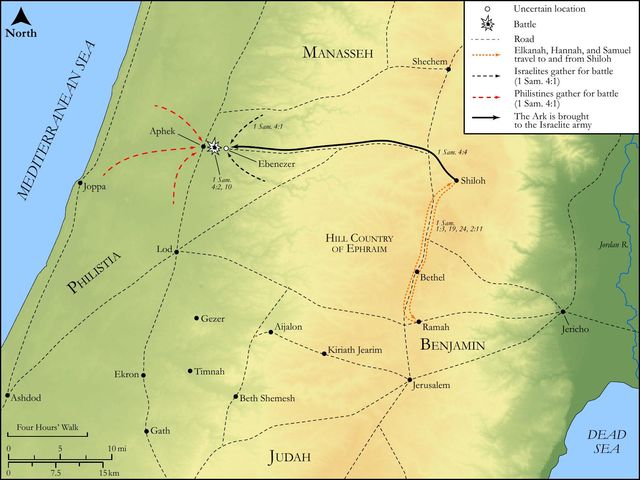
See on the biblical-era map
Study this verse
Public-domain commentary
Matthew Henry
From his Commentary on the Whole Bible. Henry comments on passages, not single verses — this entry covers 1 Samuel 4:10–11. His two-level outline is real structure in the source text, so it is rendered as structure.
Here is a short account of the issue of this battle.
I.Israel was smitten, the army dispersed and totally routed, not retiring into the camp, as before (Sa1 4:2) when they hoped to rally again, but returning to their tents, every man shifting for his own safety and making the best of his way home, despairing to make head any more; and 30,000 were slain in the field of battle, Sa1 4:10. Israel was put to the worse,
1.Though they had the better cause, were the people of God and the Philistines were uncircumcised; they stood up in necessary defence of their just rights and liberties against invaders, and yet they failed of success, for their rock had sold them. A good cause often suffers for the sake of the bad men that undertake it.
2.Though they had the greater confidence, and were the more courageous. They shouted, while the Philistines trembled, and yet, when God pleased so to order it, the Philistines' terrors were turned into triumphs, and Israel's shouts into lamentations.
3.Though they had the ark of God with them. External privileges will secure none that abuse them and do not live up to them. The ark in the camp will add nothing to its strength when there is an Achan in it.
II.The ark itself was taken by the Philistines; and Hophni and Phinehas, who it is likely kept close to it, and when it was in danger ventured far in the defense of it, because by it they got their living, were both slain, Sa1 4:11. To this sad even the Psalmist refers, Psa 78:61. 64, He delivered his strength into captivity, and his glory into the enemy's hands. Their priests fell by the sword. 1. The slaughter of the priests, considering their bad character, was no great loss to Israel, but it was a dreadful judgment upon the house of Eli. The word which God had spoken was fulfilled in it (Sa1 2:34): This shall be a sign unto thee, an earnest of the judgments threatened, thy two sons shall die both in one day, and so shall all the increase of thy house die in the flower of their age, v. 33. If Eli had done his duty, and put them, as polluted, from the priesthood (Neh 7:64), they might have lived, though in disgrace; but now God takes the work into his own hands, and chases them out of the world by the sword of the uncircumcised. The Lord is known by those judgments which he executeth. It is true the sword devours one as well as another, but these were waited for of the sword, marked for vengeance. They were out of the place; what had they to do in the camp? When men leave the way of their duty they shut themselves out of God's protection. But this was not all; they had betrayed the ark, by bringing it into danger, without a warrant from God, and this filled the measure of their iniquities. But, 2. The taking of the ark was a very great judgment upon Israel, and a certain token of God's hot displeasure against them. Now they are made to see their folly in trusting to their external privileges which they had by their wickedness forfeited them, and fancying that the ark would save them when God had departed from them. Now they are made to reflect, with the utmost regret, upon their own rashness and presumption in bringing the ark into the camp and so exposing it, and wish a thousand times they had left it where God had fixed it. Now they are convinced that God will not be prescribed to by vain and foolish men, and that though he has bound us to his ark he has not bound himself to it, but will rather deliver it into the hands of his sworn enemies than suffer it to be profaned by his false friends, and countenance their superstition. Let none think to shelter themselves from the wrath of God under the cloak of a visible profession, for there will be those cast into outer darkness that have eaten and drunk in Christ's presence.
Historical interpretation
Historical reception
1 surviving comment on this verse from the historical church.
Therefore the Philistines fought, and Israel was slaughtered, etc. The adversaries of truth, whether men or their leaders, the unclean spirits, fought against the believers in Christ; by whom, either openly raging, or covertly persuading, or injecting examples of depravity, some were slaughtered either by denial or martyrdom, others were repelled more urgently to abandon the tents of their firm faith.
Continue studying 1 Samuel 4:10 across the web’s major study libraries — every link below opens this exact verse, chapter, or book on the destination site.
Read & Compare
 BibleGatewayThis verse in more than 200 translations and 70 languages.
 Bible.comThe YouVersion reader — hundreds of translations, reading plans, and highlights.
 ESV.orgCrossway's official English Standard Version reader.
 NET BibleThe NET translation with 60,000+ translators' notes on every rendering decision.
 STEP BibleTyndale House's free study tool — original text, vocabulary, and scholarly resources.
 BibliaLogos Bible Software's free web reader.
 USCCBThe New American Bible (Revised Edition) with the U.S. bishops' study notes.
Commentaries
 BibleHub CommentariesDozens of classic commentaries on this verse, gathered on one page.
 StudyLightMore than 100 commentary sets — the largest collection on the web.
 BibleRefPlain-English commentary on what this verse means, verse by verse.
 Enduring WordDavid Guzik's free commentary on this chapter, widely used by Bible teachers.
 Bible Study ToolsVerse commentary alongside Greek and Hebrew study aids.
Original Language & Research
- BibleHub InterlinearThe verse word by word — original language, transliteration, and English.
- BibleHub LexiconEvery word's original-language definition and Strong's entry.
 Blue Letter BibleDeep-study tools — Strong's numbers, concordance, and word studies.
 SefariaThe Hebrew text with Rashi and centuries of Jewish commentary.
Sermons, Hymns & Audio


TrulyRandomVerse is not affiliated with these sites and doesn’t control their content. They’re linked because they’re genuinely useful.
Summary
1 Samuel 4:10 records the catastrophic second phase of the battle between Israel and the Philistines, culminating in an overwhelming defeat for Israel. This verse details the complete rout of the Israelite army and the staggering loss of thirty thousand footmen, signifying not merely a military failure but a profound divine judgment. This immense slaughter underscores the severity of God's rebuke for Israel's spiritual apostasy and their misplaced reliance on religious symbols rather than genuine obedience and a right relationship with the Lord.
Context
ShowHideLiterary Context
This verse serves as the devastating climax of a two-stage battle, following an initial Israelite defeat where four thousand men were lost, detailed in 1 Samuel 4:1-2. In a desperate and presumptuous act, the Israelite elders, without consulting God, brought the Ark of the Covenant from Shiloh to the battlefield, believing its mere presence would guarantee victory, as narrated in 1 Samuel 4:3-5. The Philistines, initially terrified by the Ark's arrival, rallied with fierce determination, understanding the existential stakes of the conflict, as described in 1 Samuel 4:6-9. The outcome in 1 Samuel 4:10 directly sets the stage for the capture of the Ark itself (1 Samuel 4:11) and the subsequent tragic deaths of Eli and his sons, Hophni and Phinehas, thereby fulfilling the divine judgment prophesied against Eli's house in 1 Samuel 2:27-36 and 1 Samuel 3:11-14.
Historical & Cultural Context
The events of 1 Samuel 4 unfold during the tumultuous period of the Judges, a time characterized by spiritual decline, moral corruption, and a cyclical pattern of apostasy, oppression, and temporary deliverance. Israel was under significant pressure from the Philistines, a technologically superior people who possessed iron weaponry and were expanding their control over the region. Culturally, the Ark of the Covenant was the most sacred object in Israel, symbolizing God's throne and His covenant presence among His people. It had been associated with past miraculous victories, such as the fall of Jericho (Joshua 6:6-20). However, Israel had fallen into a superstitious understanding of the Ark, treating it as a magical charm or an automatic guarantor of victory, rather than a symbol of God's conditional presence, which was dependent on their faithfulness. Their actions reflect a profound spiritual malaise, where ritual replaced relationship, and outward religious observance superseded genuine obedience. Shiloh, where the Ark resided, was the central place of worship, but its priesthood, led by Eli's corrupt sons Hophni and Phinehas (1 Samuel 2:12-17), mirrored the nation's spiritual decay.
Key Themes
ShowHideThis catastrophic defeat powerfully illustrates several key themes. Foremost is the theme of Divine Judgment, where God actively allows or orchestrates the defeat of His own people as a consequence of their persistent sin, particularly the corruption of Eli's house and the nation's presumption and idolatry. It highlights the danger of False Security in Rituals and Symbols, demonstrating that God cannot be manipulated by religious objects when the hearts of His people are far from Him. The Ark, meant to signify His holy presence, becomes a witness to their unfaithfulness and is even captured, underscoring God's Sovereignty over His own symbols and His willingness to abandon them when His people are rebellious. The immense loss of life also emphasizes the Consequences of Disobedience and the profound National Catastrophe that results from a broken covenant relationship with God. This defeat signals a low point in Israel's history, paving the way for a cry for a king and a new era. The narrative serves as a stark reminder that God's presence is not a guarantee of success when His people are living in defiance of His will, a truth echoed throughout the prophetic literature regarding Israel's covenant obligations, as seen in Deuteronomy 28.
Exposition and Analysis
ShowHideKey Word Analysis
ShowHideThe Hebrew verb נָגַף ( nâgaph , H5062) carries the primary meaning "to push, gore, defeat, stub (the toe), inflict (a disease)." While it can describe a general military defeat, its usage in contexts like Exodus 12:23 or Numbers 14:45 often suggests that God Himself is the one who "strikes" or allows the striking. In 1 Samuel 4:10, the passive voice "Israel was smitten" implies that this was not merely a superior Philistine military victory, but an outcome permitted, if not orchestrated, by God as an act of judgment against Israel's sin and presumption. It signifies a divinely sanctioned defeat.
The Hebrew verb נוּס ( nûwç , H5127) means "to flit, i.e. vanish away (subside, escape; causatively, chase, impel, deliver)." In this context, "they fled every man into his tent" signifies a complete rout and disorganized dispersion of the Israelite army. It indicates a panicked, chaotic retreat, where individual soldiers abandoned the battlefield and returned home, signaling the total collapse of their fighting force and morale. This chaotic flight underscores the absolute and humiliating nature of their defeat, leaving no hope of regrouping.
The Hebrew word מַכָּה ( makkâh , H4347) refers to "a blow," "a wound," or "carnage" (from H5062, nâkâh "to strike"). In military contexts, it denotes a severe defeat or a great loss of life. Its use here, "a very great slaughter," intensified by the adverb "very" (H3966, mᵉʼôd , "vehemence, exceedingly") and adjective "great" (H1419, gâdôwl , "great in any sense"), emphasizes the immense scale of the casualties and the overwhelming nature of Israel's defeat. This highlights the severity of the divine judgment and the devastating impact on the nation.
Verse Breakdown
ShowHide"And the Philistines fought, and Israel was smitten"
This opening clause succinctly states the direct engagement and the immediate, decisive outcome. The Philistines are presented as the active agents in the fighting, but the passive voice "Israel was smitten" (using nâgaph) subtly points to a higher power allowing or even inflicting the blow. It signifies that the defeat was not accidental or merely a result of human strategy, but had a profound divine dimension, a direct consequence of Israel's spiritual state and God's judgment upon their unfaithfulness.
"and they fled every man into his tent"
This describes the immediate and complete disintegration of the Israelite army. The phrase "every man into his tent" signifies a total rout, a panicked and disorganized retreat where soldiers abandoned the battlefield and returned to their homes, rather than regrouping. It vividly portrays the utter collapse of their military cohesion and morale, leaving them utterly defeated, dispersed, and without a fighting force.
"and there was a very great slaughter; for there fell of Israel thirty thousand footmen"
This final clause quantifies the devastating toll of the battle, providing a horrific statistic. The phrase "very great slaughter" emphasizes the immense loss of life, while the specific number "thirty thousand footmen" provides a concrete and shocking figure. This staggering casualty count underscores the catastrophic nature of the defeat, signifying a profound blow to Israel's military strength, a national tragedy, and a clear indicator of the severity of God's judgment upon His people for their sin and presumption.
Literary Devices
ShowHideThe passage employs several potent Literary Devices to convey the gravity of the event and its profound theological implications. The sheer number of casualties, "thirty thousand footmen," functions as a form of Hyperbole or Exaggeration (even if literally accurate, its impact is designed to overwhelm the reader), powerfully emphasizing the catastrophic scale of the defeat and the profound loss suffered by Israel. There is significant Irony woven throughout the narrative: the Ark of the Covenant, brought to the battlefield as a presumed guarantor of victory and divine presence, instead becomes a witness to Israel's greatest defeat and is subsequently captured. This highlights the futility and danger of relying on religious symbols without genuine faith and obedience. The entire account serves as a stark Foreshadowing of Israel's continued spiritual decline and the subsequent need for a righteous king to lead them, contrasting the current spiritual bankruptcy with the future hope of true leadership. Finally, the narrative employs Contrast between the Philistines' initial terror at the Ark's arrival and their subsequent fierce determination, set against Israel's misplaced presumption and ultimate spiritual weakness, which leads to their undoing.
Theological and Thematic Connections
ShowHideThe devastating defeat of Israel at Ebenezer, particularly the immense loss of life in 1 Samuel 4:10, serves as a stark theological lesson on the nature of God's holiness and justice. It reveals that God is not bound by human presumption or ritualistic manipulation; He will not be treated as a tribal deity whose power can be invoked by a mere object, even one as sacred as the Ark. Instead, His presence and favor are conditional upon covenant faithfulness, obedience, and genuine repentance. This event underscores that outward religious practices, divorced from inward piety and a right relationship with God, are not only ineffective but can invite divine judgment. It teaches that true security lies not in symbols or traditions, but in humble submission to the Lord's will and a sincere walk of faith, demonstrating that God prioritizes the heart over mere external observance.
Reflection and Application
ShowHideThe tragic account of Israel's defeat in 1 Samuel 4:10 offers profound and timeless lessons for believers today. It serves as a powerful warning against the dangers of superficial faith, where outward religious practices, traditions, or symbols are relied upon more than a sincere, obedient, and humble relationship with God Himself. We are reminded that God is not a vending machine, nor can His power be coerced or manipulated by our rituals. Our trust must be in the Lord, His character, and His revealed will, not in mere objects, ceremonies, or even our own spiritual disciplines if our hearts are not aligned with Him. This passage calls us to examine our own faith: are we seeking genuine intimacy and obedience, or are we merely going through the motions, presuming upon God's grace without true repentance? It reminds us that while God is merciful, He is also holy and just, and there are consequences for persistent sin, presumption, and a lack of reverence, even for those who claim His name. We are called to approach God with humility, seeking His will and direction in all things, rather than presuming upon His power for our own desires or strategies. True spiritual strength comes not from external aids, but from an internal transformation and unwavering devotion to the living God.
Questions for Reflection
ShowHideFAQ
ShowHideWhy did God allow such a devastating defeat, especially with the Ark present?
ShowHideGod allowed this devastating defeat as a severe act of judgment against Israel's profound spiritual decline and presumption. The presence of the Ark was not a guarantee of victory; rather, it was a symbol of God's covenant presence, which was conditional upon Israel's faithfulness. The nation, particularly the corrupt priesthood led by Eli's sons Hophni and Phinehas, had treated the Ark as a magical charm, believing its mere physical presence would compel God to act on their behalf, regardless of their sin and disobedience. God's allowing the defeat and even the capture of the Ark (1 Samuel 4:11) powerfully demonstrated His sovereignty, holiness, and His refusal to be manipulated. It showed that He is not bound by His own symbols when His people are in rebellion, and that true security lies in a right relationship with Him, not in external objects or rituals. This event served as a stark lesson that divine favor is a matter of covenant relationship, not magical formulas.
What is the significance of "thirty thousand footmen"?
ShowHideThe loss of "thirty thousand footmen" signifies a catastrophic and profound national tragedy for Israel. In ancient warfare, such a number represented a significant portion of a nation's fighting force and a devastating blow to its military strength and morale. This immense casualty count underscores the severity of God's judgment and the depth of Israel's spiritual decline. It was not just a military setback; it was a divine rebuke that left Israel vulnerable, demonstrated the dire consequences of their unfaithfulness and presumption, and signaled a period of national crisis. The scale of the loss highlights the gravity of the situation and sets the stage for the subsequent narrative of national humiliation and the eventual demand for a king. This number emphasizes the totality of the defeat and the profound cost of Israel's spiritual rebellion.
Christ-Centered Fulfillment
ShowHideThe catastrophic defeat of Israel in 1 Samuel 4:10, marked by their reliance on a sacred object rather than the living God, finds its profound Christ-centered fulfillment in the New Covenant. Israel's failure to understand the true nature of God's presence, reducing the Ark to a mere charm, contrasts sharply with the ultimate embodiment of God's presence in Jesus Christ. The Ark symbolized God's dwelling among His people, but it was a shadow, a temporary representation. In Christ, "the Word became flesh and dwelt among us" (John 1:14), becoming the true Tabernacle and the ultimate presence of God. Israel sought victory through an external symbol, but Christ achieved true victory not through human might or ritual, but through perfect obedience and self-sacrifice. He is the one who was truly "smitten" by divine judgment, not for His own sin, but for ours, bearing the full weight of God's wrath against sin (Isaiah 53:4-5). While Israel fled in defeat, Christ, through His death and resurrection, conquered sin and death, offering true and lasting peace and victory to all who believe. The empty rituals and symbols of the Old Covenant, which Israel misused, are now fulfilled in Christ, who is the reality to which they pointed (Colossians 2:16-17). Our victory and security are found not in religious objects or practices, but in trusting in the finished work of the Lamb of God who takes away the sin of the world, who is our ultimate and perfect High Priest and the very presence of God with us (Hebrews 9:11-14). In Him, we find the true Ark of the Covenant, the place where God's presence and mercy truly reside.