


1 Samuel 4:9
Bible text: King James Version (1769 Blayney text) · Public domain
Bible text: King James Version with Strong's numbers · Public domain
Bible text: Berean Standard Bible · Public domain
Bible text: American Standard Version (1901) · Public domain
Bible text: World English Bible, Messianic edition · Public domain
Bible text: Geneva Bible (1599) · Public domain
Bible text: Young's Literal Translation · Public domain
- הִתְחַזְּקוּhit·cha·ze·Kushow yourselves strongH2388V-Hithpael-Imp-2mpVerb Hithpael Imperative 2nd Plural Masculine
- וִהְיוּvih·Yuand becomeH1961Conj-w ¦ V-Qal-Imp-2mpVerb Qal Imperative 2nd Plural Masculineוִandהְיוּbecome
- לַאֲנָשִׁיםla·'a·na·Shim<into> menH582Prep-l ¦ N-mpNoun Plural Masculine Absoluteלַ<into>אֲנָשִׁיםmen
- פְּלִשְׁתִּיםpe·lish·TimO PhilistinesH6430N-mpNoun Gentilic Plural Masculine Absolute
- פֶּןpenlestH6435PrtParticle Conditional
- תַּעַבְדוּta·'av·Duyou should serveH5647V-Qal-Imperf-2mpVerb Qal Imperfect 2nd Plural Masculine
- לָעִבְרִיםla·'iv·Rim<to> the HebrewsH5680Prep-l ¦ N-mpNoun Gentilic Plural Masculine Absoluteלָ<to> theעִבְרִיםHebrews
- כַּאֲשֶׁרka·'a·Sherjust asH834Prep-k ¦ RelParticle Relativeכַּjustאֲשֶׁרas
- עָבְדוּ'a·ve·Duthey have servedH5647V-Qal-Perf-3cpVerb Qal Perfect 3rd Plural common gender
- לָכֶםla·Khem<to> <the> youPrep-l ¦ 2mpSuffix Personal 2nd Plural Masculineלָ<to> <the>כֶםyou
- וִהְיִיתֶםvih·yi·Temand you will becomeH1961Conj-w ¦ V-Qal-ConsecPerf-2mpVerb Qal Consecutive Perfect 2nd Plural Masculineוִandהְיִיתֶםyou will become
- לַאֲנָשִׁיםla·'a·na·Shim<into> menH582Prep-l ¦ N-mpNoun Plural Masculine Absoluteלַ<into>אֲנָשִׁיםmen
- וְנִלְחַמְתֶּםve·nil·cham·Temand you will fightH3898Conj-w ¦ V-Niphal-ConsecPerf-2mpVerb Niphal Consecutive Perfect 2nd Plural Masculineוְandנִלְחַמְתֶּםyou will fight
English is a literal word-by-word gloss of the Hebrew, not the KJV's wording. Why?
This is the original text the KJV's translators worked from — each Hebrew word with its own literal English meaning in this verse, prepared by scholars at Tyndale House, Cambridge. The KJV translates whole sentences, not word by word, so its wording differs: one Hebrew word can become several English words, and the KJV may choose “the LORD” where the gloss reads “Yahweh”. Both are faithful — they answer different questions. For the KJV's own rendering, switch to the KJV text.
Details
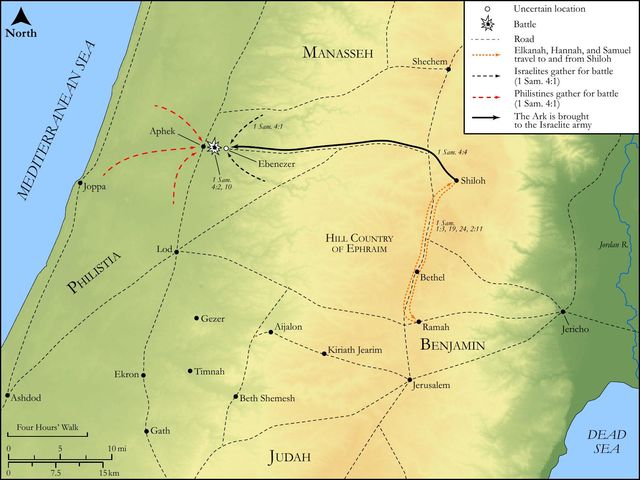
See on the biblical-era map
Study this verse
Public-domain commentary
Matthew Henry
From his Commentary on the Whole Bible. Henry comments on passages, not single verses — this entry covers 1 Samuel 4:1–9. His four-level outline is real structure in the source text, so it is rendered as structure.
The first words of this paragraph, which relate to Samuel, that his word came to all Israel, seem not to have any reference to the following story, as if it was by any direction of his that the Israelites went out against the Philistines. Had they consulted him, though but newly initiated as a prophet, his counsel might have stood them in more stead than the presence of the ark did; but perhaps the princes of Israel despised his youth, and would not have recourse to him as an oracle, and he did not as yet interpose in public affairs; nor do we find any mention of his name henceforward till some years after (Sa1 7:3), only his word came to all Israel, that is, people from all parts that were piously disposed had recourse to him as a prophet and consulted him. Perhaps it is meant of his prophecy against the house of Eli. This was generally known and talked of, and all that were serious and observing compared the events here related, when they came to pass, with the prophecy, and saw it accomplished in them. Here is,
I.A war entered into with the Philistines, Sa1 4:1.
It was an attempt to throw off the yoke of their oppression, and would have succeeded better if they had first repented and reformed, and so begun their work at the right end. It is computed that this was about the middle of the forty years' dominion that the Philistines had over Israel (Jdg 13:1) and soon after the death of Samson; so bishop Patrick, who thinks the slaughter he made at his death might encourage this attempt; but Dr. Lightfoot reckons it forty years after Samson's death, for so long Eli judged, Sa1 4:18.
II.The defeat of Israel in that war, Sa1 4:2.
Israel, who were the aggressors, were smitten, and had 4000 men killed upon the spot. God had promised that one of them should chase a thousand; but now, on the contrary, Israel is smitten before the Philistines. Sin, the accursed thing, was in the camp, and gave their enemies all the advantage against them they could wish for.
III.The measures they concerted for another engagement.
A council of war was called, and, instead of resolving to fast and pray and amend their lives, so ill taught were they (and no wonder when they had such teachers) that,
1.They quarrelled with God for appearing against them (Sa1 4:3): Wherefore has the Lord smitten us? If they meant this as an enquiry into the cause of God's displeasure, they needed not go far to find that out. It was plain enough; Israel had sinned, though they were not willing to see it and own it. But it rather seems that they expostulate boldly with God about it, are displeased at what God has done, and dispute the matter with him. They own the hand of God in their trouble (so far was right): "It is the Lord that has smitten us;" but, instead of submitting to it, they quarrel with it, and speak as those that are angry at him and his providence, and not aware of any just provocation they have given him: "Wherefore shall we, that are Israelites, be smitten before the Philistines? How absurd and unjust is it!" Note, The foolishness of man perverts his way, and then his heart frets against the Lord (Pro 19:3) and finds fault with him.
2.They imagined that they could oblige him to appear for them the next time by bringing the ark into their camp. The elders of Israel were so ignorant and foolish as to make the proposal (Sa1 4:3), and the people soon put it in execution, Sa1 4:4. They sent to Shiloh for the ark, and Eli had not courage enough to detain it, but sent his ungodly sons, Hophni and Phinehas, along with it, at least permitted them to go, though he knew that wherever they went the curse of God went along with them. Now see here,
(1.)The profound veneration the people had for the ark. "O send for that, and it will do wonders for us." The ark was, by institution, a visible token of God's presence. God had said that he would dwell between the cherubim, which were over the ark and were carried along with it; now they thought that, by paying a great respect to this sacred chest, they should prove themselves to be Israelites indeed, and effectually engage God Almighty to appear in their favour. Note, It is common for those that have estranged themselves from the vitals of religion to discover a great fondness for the rituals and external observances of it, for those that even deny the power of godliness not only to have, but to have in admiration, the form of it. The temple of the Lord is cried up, and the ark of the Lord stickled for with a great deal of seeming zeal by multitudes that have no regard at all for the Lord of the temple and the God of the ark, as if a fiery concern for the name of Christianity would atone for a profane contempt of the thing. And yet indeed they did but make an idol of the ark, and looked upon it to be as much an image of the God of Israel as those idols which the heathen worshipped were of their gods. To worship the true God, and not to worship him as God, is in effect not to worship him at all.
(2.)Their egregious folly in thinking that the ark, if they had it in their camp, would certainly save them out of the hand of their enemies, and bring victory back to their side. For,
[1.]When the ark set forward Moses prayed, Rise up, Lord, and let thy enemies be scattered, well knowing that it was not the ark moving with them, but God appearing for them, that must give them success; and here were no proper means used to engage God to favour them with his presence; what good then would the ark do them, the shell without the kernel?
[2.]They were so far from having God's leave to remove his ark that he had plainly enough intimated to them in his law that when they were settled in Canaan his ark should be settled in the place that he should choose (Deu 12:5, Deu 12:11), and that they must come to it, not it to them. How then could they expect any advantage by it when they had not a just and legal possession of it, nor any warrant to remove it from its place? Instead of honouring God by what they did, they really affronted him. Nay,
[3.]If there had been nothing else to invalidate their expectations from the ark, how could they expect it should bring a blessing when Hophni and Phinehas were the men that carried it? It would have given too much countenance to their villany if the ark had done any kindness to Israel while it was in the hands of those graceless priests.
IV.The great joy there was in the camp of Israel when the ark was brought into it (Sa1 4:5):
They shouted, so that the earth rang again. Now they thought themselves sure of victory, and therefore gave a triumphant shout before the battle, as if the day was without fail their own, intending, by this mighty shout, to animate themselves and their own forces, and to intimidate their adversaries. Note, Carnal people triumph much in the external privileges and performances of religion, and build much upon them, as if these would infallibly save them, and as if the ark, God's throne, in the camp, would bring them to heaven, though the world and the flesh should be upon the throne in the heart.
V.The consternation into which the bringing of the ark into the camp of Israel put the Philistines.
The two armies lay so near encamped that the Philistines heard the shout the Israelites gave on this great occasion. They soon understood what it was they triumphed in (Sa1 4:6), and were afraid of the consequences. For, 1. It had never been done before in their days: God has come into their camp, and therefore woe unto us (Sa1 4:7), and again, woe unto us, Sa1 4:8. The name of the God of Israel was formidable even to those that worshipped other gods, and some apprehensions even the infidels had of the danger of contending with them. Natural conscience suggests this, that those are in a woeful condition who have God against them. Yet see what gross notions they had of the divine presence, as if the God of Israel were not as much in the camp before the ark came thither, which may very well be excused in them, since the notions the Israelites themselves had of that presence were no better. "O," say they, "this is a new design upon us, more frightful than all their stratagems, for there has not been such a thing heretofore; this was the most effectual course they could take to dispirit our men and weaken their hands." 2. When it had been done in the days of old, it had wrought wonders: These are the gods that smote the Egyptians with all the plagues in the wilderness, Sa1 4:8. Here they were as much out in their history as in their divinity: the plagues of Egypt were inflicted before the ark was made and before Israel came into the wilderness; but some confused traditions they had of wonders wrought by or for Israel when this ark was carried before them, which they attributed, not to Jehovah, but to the ark. Now, say they, Who shall deliver us out of the hand of these mighty gods? taking the ark for God, as well they might when the Israelites themselves idolized it. Yet, it should seem, they scarcely believed themselves when they spoke thus formidably of these mighty gods, but only bantered; for instead of retreating, or proposing conditions of peace, which they would have done had they been really convinced of the power of Israel's God, they stirred up one another to fight so much the more stoutly; this surprising difficulty did but sharpen their resolution (Sa1 4:9): Be strong, and quit yourselves like men. The commanders inspired bold and generous thoughts into the minds of their soldiers when they bade them remember how they had lorded it over Israel, and what an intolerable grief and shame it would be if they flinched now, and suffered Israel to lord it over them.
Continue studying 1 Samuel 4:9 across the web’s major study libraries — every link below opens this exact verse, chapter, or book on the destination site.
Read & Compare
 BibleGatewayThis verse in more than 200 translations and 70 languages.
 Bible.comThe YouVersion reader — hundreds of translations, reading plans, and highlights.
 ESV.orgCrossway's official English Standard Version reader.
 NET BibleThe NET translation with 60,000+ translators' notes on every rendering decision.
 STEP BibleTyndale House's free study tool — original text, vocabulary, and scholarly resources.
 BibliaLogos Bible Software's free web reader.
 USCCBThe New American Bible (Revised Edition) with the U.S. bishops' study notes.
Commentaries
 BibleHub CommentariesDozens of classic commentaries on this verse, gathered on one page.
 StudyLightMore than 100 commentary sets — the largest collection on the web.
 BibleRefPlain-English commentary on what this verse means, verse by verse.
 Enduring WordDavid Guzik's free commentary on this chapter, widely used by Bible teachers.
 Bible Study ToolsVerse commentary alongside Greek and Hebrew study aids.
Original Language & Research
- BibleHub InterlinearThe verse word by word — original language, transliteration, and English.
- BibleHub LexiconEvery word's original-language definition and Strong's entry.
 Blue Letter BibleDeep-study tools — Strong's numbers, concordance, and word studies.
 SefariaThe Hebrew text with Rashi and centuries of Jewish commentary.
Sermons, Hymns & Audio


TrulyRandomVerse is not affiliated with these sites and doesn’t control their content. They’re linked because they’re genuinely useful.
Summary
1 Samuel 4:9 presents the desperate and urgent rallying cry of the Philistine commanders to their army. Faced with the terrifying presence of the Ark of the Covenant in the Israelite camp, and recalling the formidable reputation of Israel's God and His historical acts against Egypt, the Philistine leaders exhorted their soldiers to overcome their profound fear. Their command was to fight with extreme valor and avoid the ultimate humiliation of becoming servants to a people they had long subjugated. This pivotal moment highlights the immense stakes of the impending battle and the Philistines' reliance on sheer human resolve in the face of what they perceived as overwhelming divine intervention.
Context
ShowHideLiterary Context
This verse serves as a dramatic and pivotal turning point within the narrative of the Philistine-Israelite conflict in 1 Samuel 4. The chapter opens with Israel suffering a significant defeat at Ebenezer, losing approximately 4,000 men (1 Samuel 4:2). In a desperate and misguided attempt to secure victory, the Israelite elders decided to bring the Ark of the Covenant from Shiloh into the battle camp, believing its sacred presence would guarantee divine intervention and triumph (1 Samuel 4:3). The arrival of the Ark was met with a thunderous shout from the Israelite camp, which immediately struck fear into the Philistines. They recognized the shout and, upon learning the Ark of the Lord had arrived, were filled with terror, remembering the mighty deeds of Israel's God against Egypt (1 Samuel 4:7-8). It is in this moment of profound dread and recognition of a formidable supernatural threat that the Philistine leaders issue this urgent and forceful command to their troops, setting the stage for the dramatic events of 1 Samuel 4:10-11.
Historical & Cultural Context
The period of the Judges and early Monarchy was characterized by frequent skirmishes and power struggles between Israel and its surrounding nations, particularly the Philistines. The Philistines, an Aegean people who had settled on the coastal plain of Canaan, possessed a significant technological advantage, notably iron weaponry, which was superior to Israel's bronze tools and armaments. This technological superiority often allowed them to establish dominance over Israel, subjecting them to tribute and control (e.g., Judges 13:1). The prospect of this power dynamic reversing—of the Philistines becoming "servants unto the Hebrews"—was an utterly humiliating and unacceptable outcome for a proud and militarily advanced people. Their appeal to "quit yourselves like men" reflects a military ethos that emphasized masculine honor, courage, and the dire consequences of defeat, particularly servitude, which was often considered a fate worse than death for warriors. The Philistines' fear of Israel's God, while not leading to worship, demonstrates a pragmatic acknowledgment of His power based on historical accounts, a common feature in polytheistic cultures that recognized the potency of other nations' deities.
Key Themes
ShowHideThis verse powerfully encapsulates several key themes within the broader narrative of 1 Samuel. It highlights the stark contrast between human strength and perceived divine power; while the Philistines acknowledge the formidable reputation of Israel's God, their immediate response is a desperate appeal to their own human resolve and military prowess, rather than a turning to their own deities for aid. This reflects a theme of human agency in the face of the divine, where even pagan nations must contend with the reality of Yahweh's sovereignty. The theme of fear as a motivator is central, as the Philistines' primary drive is not courage born of conviction, but a profound dread of subjugation and humiliation. This fear of a historical role reversal—where Israel, once oppressed by them, would now subjugate them—fuels their determination to fight fiercely. Finally, the verse speaks to desperate courage, as the Philistine leaders appeal directly to their soldiers' sense of manhood, honor, and duty, urging them to fight with extreme valor despite their profound terror. This desperate resolve, though born of fear, ultimately leads to a temporary Philistine victory and the capture of the Ark (1 Samuel 4:10-11), setting in motion a series of events that further demonstrate God's sovereignty over both His people and their enemies, as detailed in 1 Samuel 5.
Exposition and Analysis
ShowHideKey Word Analysis
ShowHideThis primitive root means "to fasten upon; hence, to seize, be strong (figuratively, courageous, causatively strengthen, cure, help, repair, fortify), obstinate; to bind, restrain, conquer." In this context, it is a direct imperative for the Philistine soldiers to gather their inner fortitude, to be firm, resolute, and courageous in the face of overwhelming fear. It implies a demand for physical and mental resilience, to hold fast to their courage and not yield.
This primitive root means "to exist, i.e. be or become, come to pass (always emphatic, and not a mere copula or auxiliary)." When used in the phrase "quit yourselves like men," it carries the emphatic sense of "become" or "show yourselves to be" men. It's a powerful exhortation to embody the qualities of mature, capable, and valiant warriors, to rise to the occasion and demonstrate the behavior expected of adult males in battle, rather than succumbing to panic or cowardice.
This primitive root means "to work (in any sense); by implication, to serve, till, (causatively) enslave." The Philistines' greatest fear, expressed through this word, is to be reduced to a state of forced labor, bondage, or subjugation under the Hebrews. This was the ultimate dishonor for a proud, dominant people, representing a complete reversal of their established power dynamic and a loss of their freedom and dignity.
Verse Breakdown
ShowHide"Be strong, and quit yourselves like men, O ye Philistines,"
This opening command is a direct, urgent, and emotionally charged exhortation from the Philistine commanders to their terrified troops. "Be strong" (from châzaq) is a foundational call to courage and resilience, demanding immediate mental and physical fortitude. The subsequent "quit yourselves like men" (from hâyâh and ʼĕnôwsh) intensifies this, appealing to their very identity and honor as warriors. It is a challenge to rise above their fear and act with the valor expected of adult males in battle, emphasizing their collective identity as "O ye Philistines," a proud and dominant people.
"that ye be not servants unto the Hebrews, as they have been to you:"
This clause reveals the profound and immediate motivation behind the Philistines' desperate resolve: the avoidance of a humiliating and unthinkable role reversal. For generations, the Philistines had dominated the Israelites, often subjecting them to servitude, tribute, and military oppression. The thought of being subjugated by a people they considered inferior and had long controlled was an unbearable prospect, appealing directly to their pride and deep-seated fear of dishonor. This fear of becoming slaves fuels their determination to fight fiercely, highlighting the high stakes of the battle.
"quit yourselves like men, and fight."
The repetition of "quit yourselves like men" underscores the critical importance and non-negotiable nature of this call to courage and resolve. The addition of "and fight" serves as the ultimate, stark, and unvarnished directive. It is an imperative to engage the enemy actively and decisively, demonstrating that their very survival, honor, and freedom depend on their immediate and unwavering action in battle. The verse ends with this forceful command, leaving no room for hesitation or retreat.
Literary Devices
ShowHideThe verse is a potent example of Exhortation, a direct and forceful appeal to action delivered by the Philistine leaders to their terrified troops. The primary device is Repetition, specifically the phrase "quit yourselves like men," which is used twice. This repetition serves to emphasize the urgency, gravity, and non-negotiable nature of the command, driving home the critical need for courage and resolute action. There is also a strong Appeal to Ethos (or character/honor), as the commanders call upon their soldiers' sense of masculine duty and pride, reminding them of their identity as Philistine warriors who must not succumb to fear or humiliation. The implied Contrast between their current state of fear and the desired state of courageous action, as well as the historical reversal of "servants" versus "masters," adds dramatic tension and highlights the profound stakes. Finally, there's a degree of Irony in this pagan call for strength, as their temporary victory, achieved through human resolve, ultimately serves to further God's sovereign plan, leading to the Ark's capture and subsequent demonstration of Yahweh's power over Dagon and the Philistines themselves in 1 Samuel 5.
Theological and Thematic Connections
ShowHideThis verse, though spoken by enemies of God's people, offers profound theological insights into human nature, divine sovereignty, and the dynamics of conflict. It reveals that even those outside the covenant community can recognize and fear the power of God, albeit without truly knowing Him. The Philistines' desperate appeal to human strength and resolve in the face of a perceived supernatural threat highlights the universal human tendency to rely on self-effort and pride, rather than acknowledging a greater power. Yet, paradoxically, their very fear and subsequent human effort were ultimately orchestrated within God's sovereign plan to demonstrate His glory, even through the temporary defeat of His own people and the capture of the Ark. This event underscores that God's purposes transcend human battles and that His power is not confined to the Ark itself, but is inherent in His being, capable of working through unexpected means to achieve His will.
Reflection and Application
ShowHideWhile the Philistines' cry was rooted in fear and a desire for self-preservation, their desperate resolve offers a mirror for our own lives. In moments of crisis, when faced with daunting challenges that seem to threaten our very identity or well-being, we too are called to "be strong" and "quit yourselves like men"—not in the sense of relying solely on our own strength, but in courageously stepping into the challenges God places before us. This involves a spiritual fortitude that trusts in God's power rather than succumbing to fear or despair. It reminds us that true courage is not the absence of fear, but the willingness to act decisively despite it. As believers, our motivation should not be merely the avoidance of negative consequences, but a desire to honor God and live out our calling. This verse challenges us to examine what truly motivates our actions in times of adversity: is it fear of failure, or faith in the God who empowers us to stand firm? It also highlights the importance of leadership that can inspire and rally others, even when the odds seem insurmountable, pointing us to Christ as our ultimate leader who faced the greatest adversity with perfect resolve.
Questions for Reflection
ShowHideFAQ
ShowHideWhy were the Philistines so afraid of the Ark of the Covenant?
ShowHideThe Philistines' fear of the Ark of the Covenant was rooted in their understanding of its significance as a symbol of Israel's God, Yahweh, and His historical power. They had heard of the mighty deeds Yahweh performed for Israel, particularly the plagues He brought upon Egypt during the Exodus (1 Samuel 4:8). They viewed the Ark not just as a religious artifact, but as the very presence of a powerful, active deity who had historically defeated other gods and nations. While they were polytheistic and worshipped their own gods like Dagon, they recognized the potency of Yahweh and feared His intervention on behalf of Israel, believing His presence with the Ark would guarantee their defeat. Their fear was a pragmatic, superstitious dread of a rival, powerful deity, rather than a theological understanding or reverence for the one true God.
Did the Philistines' desperate plea for courage ultimately help them win the battle?
ShowHideYes, surprisingly, the Philistines' desperate plea for courage and their subsequent fierce fighting did lead to their victory in this particular battle. Despite their profound fear of the Ark, their human resolve and military prowess were sufficient to overcome the Israelites. The Philistines defeated Israel, killed 30,000 Israelite foot soldiers, and captured the Ark of God (1 Samuel 4:10-11). This outcome was a devastating blow to Israel and a profound theological crisis, as it seemed God had abandoned them. However, as subsequent chapters reveal (1 Samuel 5), God's sovereignty was not diminished by the Ark's capture; rather, He demonstrated His power over the Philistines and their god Dagon, proving that His presence was not confined to the Ark and that He could work even through the apparent defeat of His people to achieve His purposes.
Christ-Centered Fulfillment
ShowHideWhile 1 Samuel 4:9 is spoken by pagan enemies, their desperate call to "be strong, and quit yourselves like men" finds a profound, inverted fulfillment and spiritual echo in the person and work of Jesus Christ, and the call He extends to His followers. The Philistines sought to avoid earthly servitude through human strength, but Christ, the true Man, embraced the ultimate servitude to God, humbling Himself even to death on a cross (Philippians 2:7-8). He faced the ultimate enemy—sin, death, and the devil—not with a desperate, fearful human rallying cry, but with perfect obedience and divine power. His victory was not achieved by avoiding servitude, but by becoming the ultimate Servant, thereby freeing humanity from the true slavery to sin and fear of death (Hebrews 2:14-15). Furthermore, the Philistines' fear of Israel's God, though pragmatic, foreshadows the universal acknowledgment of Christ's ultimate authority, when "every knee should bow" (Philippians 2:10). For believers, the call to "be strong in the Lord, and in the power of his might" (Ephesians 6:10) and to "act like men; be strong" (1 Corinthians 16:13) is not a call to self-reliance like the Philistines, but a spiritual exhortation to draw strength from Christ, who has already secured the ultimate victory over all spiritual enemies (Colossians 2:15). He is the one who truly "quit Himself like a man" in Gethsemane and on Calvary, not to avoid defeat, but to secure eternal triumph for all who trust in Him.