


1 Samuel 4:2
Bible text: King James Version (1769 Blayney text) · Public domain
Bible text: King James Version with Strong's numbers · Public domain
Bible text: Berean Standard Bible · Public domain
Bible text: American Standard Version (1901) · Public domain
Bible text: World English Bible, Messianic edition · Public domain
Bible text: Geneva Bible (1599) · Public domain
Bible text: Young's Literal Translation · Public domain
- וַיַּעַרְכוּvai·ya·'ar·Khuand they deployedH6186Conj-w ¦ V-Qal-ConsecImperf-3mpVerb Qal Consecutive Imperfect 3rd Plural Masculineוַandיַּעַרְכוּthey deployed
- פְלִשְׁתִּיםfe·lish·Tim[the] PhilistinesH6430N-mpNoun Gentilic Plural Masculine Absolute
- לִקְרַאתlik·Ratto meetH7122Prep-l ¦ V-Qal-InfVerb Qal Infinitive Constructלִtoקְרַאתmeet
- יִשְׂרָאֵלYis·ra·'ElIsraelH3478N-properNoun Proper Location
- וַתִּטֹּשׁva·ti·Toshand it spread outH5203Conj-w ¦ V-Qal-ConsecImperf-3fsVerb Qal Consecutive Imperfect 3rd Singular Feminineוַandתִּטֹּשׁit spread out
- הַמִּלְחָמָהha·mil·cha·Mahthe battleH4421Art ¦ N-fsNoun Singular Feminine Absoluteהַtheמִּלְחָמָהbattle
- וַיִּנָּגֶףvai·yi·Na·gefand it was defeatedH5062Conj-w ¦ V-Niphal-ConsecImperf-3msVerb Niphal Consecutive Imperfect 3rd Singular Masculineוַandיִּנָּגֶףit was defeated
- יִשְׂרָאֵלYis·ra·'ElIsraelH3478N-properNoun Proper Location
- לִפְנֵיlif·Nei<to> beforeH6440Prep-l ¦ N-mpcNoun Plural Masculine Constructלִ<to>פְנֵיbefore
- פְלִשְׁתִּיםfe·lish·Tim[the] PhilistinesH6430N-mpNoun Gentilic Plural Masculine Absolute
- וַיַּכּוּvai·ya·Kuand they struck downH5221Conj-w ¦ V-Hiphil-ConsecImperf-3mpVerb Hiphil Consecutive Imperfect 3rd Plural Masculineוַandיַּכּוּthey struck down
- בַמַּעֲרָכָהva·ma·'a·ra·Khahin the battle lineH4634Prep-b ¦ N-fsNoun Singular Feminine Absoluteבַin theמַּעֲרָכָהbattle line
- בַּשָּׂדֶהba·sa·Dehin the fieldH7704Prep-b ¦ N-msNoun Singular Masculine Absoluteבַּin theשָּׂדֶהfield
- כְּאַרְבַּעַתke·'ar·Ba·'atabout fourH702Prep-k ¦ N-cscNoun Singular common gender Constructכְּaboutאַרְבַּעַתfour
- אֲלָפִים'a·la·Fimthousand<s>H505N-cpNoun Plural common gender Absolute
- אִישׁ'IshmanH376N-msNoun Singular Masculine Absolute
English is a literal word-by-word gloss of the Hebrew, not the KJV's wording. Why?
This is the original text the KJV's translators worked from — each Hebrew word with its own literal English meaning in this verse, prepared by scholars at Tyndale House, Cambridge. The KJV translates whole sentences, not word by word, so its wording differs: one Hebrew word can become several English words, and the KJV may choose “the LORD” where the gloss reads “Yahweh”. Both are faithful — they answer different questions. For the KJV's own rendering, switch to the KJV text.
Details
See on the biblical-era map
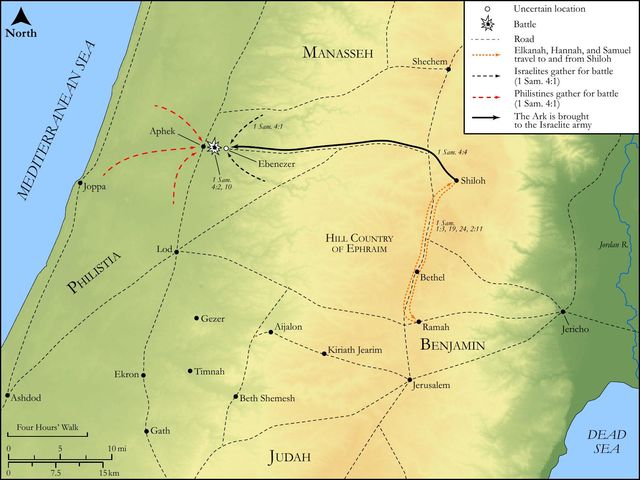
Study this verse
Public-domain commentary
Matthew Henry
From his Commentary on the Whole Bible. Henry comments on passages, not single verses — this entry covers 1 Samuel 4:1–9. His four-level outline is real structure in the source text, so it is rendered as structure.
The first words of this paragraph, which relate to Samuel, that his word came to all Israel, seem not to have any reference to the following story, as if it was by any direction of his that the Israelites went out against the Philistines. Had they consulted him, though but newly initiated as a prophet, his counsel might have stood them in more stead than the presence of the ark did; but perhaps the princes of Israel despised his youth, and would not have recourse to him as an oracle, and he did not as yet interpose in public affairs; nor do we find any mention of his name henceforward till some years after (Sa1 7:3), only his word came to all Israel, that is, people from all parts that were piously disposed had recourse to him as a prophet and consulted him. Perhaps it is meant of his prophecy against the house of Eli. This was generally known and talked of, and all that were serious and observing compared the events here related, when they came to pass, with the prophecy, and saw it accomplished in them. Here is,
I.A war entered into with the Philistines, Sa1 4:1.
It was an attempt to throw off the yoke of their oppression, and would have succeeded better if they had first repented and reformed, and so begun their work at the right end. It is computed that this was about the middle of the forty years' dominion that the Philistines had over Israel (Jdg 13:1) and soon after the death of Samson; so bishop Patrick, who thinks the slaughter he made at his death might encourage this attempt; but Dr. Lightfoot reckons it forty years after Samson's death, for so long Eli judged, Sa1 4:18.
II.The defeat of Israel in that war, Sa1 4:2.
Israel, who were the aggressors, were smitten, and had 4000 men killed upon the spot. God had promised that one of them should chase a thousand; but now, on the contrary, Israel is smitten before the Philistines. Sin, the accursed thing, was in the camp, and gave their enemies all the advantage against them they could wish for.
III.The measures they concerted for another engagement.
A council of war was called, and, instead of resolving to fast and pray and amend their lives, so ill taught were they (and no wonder when they had such teachers) that,
1.They quarrelled with God for appearing against them (Sa1 4:3): Wherefore has the Lord smitten us? If they meant this as an enquiry into the cause of God's displeasure, they needed not go far to find that out. It was plain enough; Israel had sinned, though they were not willing to see it and own it. But it rather seems that they expostulate boldly with God about it, are displeased at what God has done, and dispute the matter with him. They own the hand of God in their trouble (so far was right): "It is the Lord that has smitten us;" but, instead of submitting to it, they quarrel with it, and speak as those that are angry at him and his providence, and not aware of any just provocation they have given him: "Wherefore shall we, that are Israelites, be smitten before the Philistines? How absurd and unjust is it!" Note, The foolishness of man perverts his way, and then his heart frets against the Lord (Pro 19:3) and finds fault with him.
2.They imagined that they could oblige him to appear for them the next time by bringing the ark into their camp. The elders of Israel were so ignorant and foolish as to make the proposal (Sa1 4:3), and the people soon put it in execution, Sa1 4:4. They sent to Shiloh for the ark, and Eli had not courage enough to detain it, but sent his ungodly sons, Hophni and Phinehas, along with it, at least permitted them to go, though he knew that wherever they went the curse of God went along with them. Now see here,
(1.)The profound veneration the people had for the ark. "O send for that, and it will do wonders for us." The ark was, by institution, a visible token of God's presence. God had said that he would dwell between the cherubim, which were over the ark and were carried along with it; now they thought that, by paying a great respect to this sacred chest, they should prove themselves to be Israelites indeed, and effectually engage God Almighty to appear in their favour. Note, It is common for those that have estranged themselves from the vitals of religion to discover a great fondness for the rituals and external observances of it, for those that even deny the power of godliness not only to have, but to have in admiration, the form of it. The temple of the Lord is cried up, and the ark of the Lord stickled for with a great deal of seeming zeal by multitudes that have no regard at all for the Lord of the temple and the God of the ark, as if a fiery concern for the name of Christianity would atone for a profane contempt of the thing. And yet indeed they did but make an idol of the ark, and looked upon it to be as much an image of the God of Israel as those idols which the heathen worshipped were of their gods. To worship the true God, and not to worship him as God, is in effect not to worship him at all.
(2.)Their egregious folly in thinking that the ark, if they had it in their camp, would certainly save them out of the hand of their enemies, and bring victory back to their side. For,
[1.]When the ark set forward Moses prayed, Rise up, Lord, and let thy enemies be scattered, well knowing that it was not the ark moving with them, but God appearing for them, that must give them success; and here were no proper means used to engage God to favour them with his presence; what good then would the ark do them, the shell without the kernel?
[2.]They were so far from having God's leave to remove his ark that he had plainly enough intimated to them in his law that when they were settled in Canaan his ark should be settled in the place that he should choose (Deu 12:5, Deu 12:11), and that they must come to it, not it to them. How then could they expect any advantage by it when they had not a just and legal possession of it, nor any warrant to remove it from its place? Instead of honouring God by what they did, they really affronted him. Nay,
[3.]If there had been nothing else to invalidate their expectations from the ark, how could they expect it should bring a blessing when Hophni and Phinehas were the men that carried it? It would have given too much countenance to their villany if the ark had done any kindness to Israel while it was in the hands of those graceless priests.
IV.The great joy there was in the camp of Israel when the ark was brought into it (Sa1 4:5):
They shouted, so that the earth rang again. Now they thought themselves sure of victory, and therefore gave a triumphant shout before the battle, as if the day was without fail their own, intending, by this mighty shout, to animate themselves and their own forces, and to intimidate their adversaries. Note, Carnal people triumph much in the external privileges and performances of religion, and build much upon them, as if these would infallibly save them, and as if the ark, God's throne, in the camp, would bring them to heaven, though the world and the flesh should be upon the throne in the heart.
V.The consternation into which the bringing of the ark into the camp of Israel put the Philistines.
The two armies lay so near encamped that the Philistines heard the shout the Israelites gave on this great occasion. They soon understood what it was they triumphed in (Sa1 4:6), and were afraid of the consequences. For, 1. It had never been done before in their days: God has come into their camp, and therefore woe unto us (Sa1 4:7), and again, woe unto us, Sa1 4:8. The name of the God of Israel was formidable even to those that worshipped other gods, and some apprehensions even the infidels had of the danger of contending with them. Natural conscience suggests this, that those are in a woeful condition who have God against them. Yet see what gross notions they had of the divine presence, as if the God of Israel were not as much in the camp before the ark came thither, which may very well be excused in them, since the notions the Israelites themselves had of that presence were no better. "O," say they, "this is a new design upon us, more frightful than all their stratagems, for there has not been such a thing heretofore; this was the most effectual course they could take to dispirit our men and weaken their hands." 2. When it had been done in the days of old, it had wrought wonders: These are the gods that smote the Egyptians with all the plagues in the wilderness, Sa1 4:8. Here they were as much out in their history as in their divinity: the plagues of Egypt were inflicted before the ark was made and before Israel came into the wilderness; but some confused traditions they had of wonders wrought by or for Israel when this ark was carried before them, which they attributed, not to Jehovah, but to the ark. Now, say they, Who shall deliver us out of the hand of these mighty gods? taking the ark for God, as well they might when the Israelites themselves idolized it. Yet, it should seem, they scarcely believed themselves when they spoke thus formidably of these mighty gods, but only bantered; for instead of retreating, or proposing conditions of peace, which they would have done had they been really convinced of the power of Israel's God, they stirred up one another to fight so much the more stoutly; this surprising difficulty did but sharpen their resolution (Sa1 4:9): Be strong, and quit yourselves like men. The commanders inspired bold and generous thoughts into the minds of their soldiers when they bade them remember how they had lorded it over Israel, and what an intolerable grief and shame it would be if they flinched now, and suffered Israel to lord it over them.
Historical interpretation
Historical reception
1 surviving comment on this verse from the historical church.
When the battle began, Israel turned their backs to the Philistines, etc. Once the conflict between Israel and the pagan peoples broke out over true religion, with the former fighting for the worship of the one true God and the latter for the defense of idols, Israel’s faith failed, and it fell into the errors of the pagans more easily than the pagans could be converted to follow its faith. Nonetheless, a significant portion, although others sinned, remained steadfast in defending the camp of spiritual virtues. Do not think these words refer to the status of the ancient people of God merely allegorically, but also that they have a moral application for you. For whenever you try to fight back unclean spirits in a spiritual venture, not relying on your own strength but trusting in that stone which was cut without hands from the mountain (Dan. II), and which alone knows how to overthrow the kingdoms of the devil, immediately the enemies of truth oppose your every good deed with new fury. However, be careful not to turn the back of your mind to the enemies by sinning, as the apostle James warns: Resist the devil, and he will flee from you (James IV). Yet since it is written: The outcome of battle is varied, and now the sword consumes one, now another (2 Sam. II), if by chance you have retreated and the enemy has prevailed for a time, if he has trampled the fruitful fields of your good conduct, and boasted that he laid low prudence, fortitude, justice, and temperance, the four most excellent leaders followed by the whole army of virtues, you should not abandon the camp of your best purpose, which you have pitched near the firm rock, but rather with the remedy of humility and repentance restore the lost ranks of virtues with new forces; according to him who said: If the spirit of a ruler rises against you, do not leave your place, for composure mitigates great offenses (Eccl. X). Therefore, when the danger of conflict from adversaries presses, offer the Ark of fervent faith as your aid. But if perchance the wicked by mixing in heresy, or by any other kind of deceit, should take it away for a time, still the aid of divine mercy will not fail you, which often allows its own to fall temporarily that, recognizing their own weakness, they might afterwards be more cautious in virtues and kept perfect for rewards. Finally, the Ark soon returns home joyfully and stays in the city’s citadel for twenty years, because virtue often received again through repentance fills the mind even more ardently than before the storm of temptation, and accompanies it to fulfill the complete Decalogue of divine law, and to receive the perpetual joy of the heavenly reward. But now that we have touched on these moral interpretations, let us return to the order of the lesson and seek the new fruits of spiritual allegory in the very old forest of the letter.
Continue studying 1 Samuel 4:2 across the web’s major study libraries — every link below opens this exact verse, chapter, or book on the destination site.
Read & Compare
 BibleGatewayThis verse in more than 200 translations and 70 languages.
 Bible.comThe YouVersion reader — hundreds of translations, reading plans, and highlights.
 ESV.orgCrossway's official English Standard Version reader.
 NET BibleThe NET translation with 60,000+ translators' notes on every rendering decision.
 STEP BibleTyndale House's free study tool — original text, vocabulary, and scholarly resources.
 BibliaLogos Bible Software's free web reader.
 USCCBThe New American Bible (Revised Edition) with the U.S. bishops' study notes.
Commentaries
 BibleHub CommentariesDozens of classic commentaries on this verse, gathered on one page.
 StudyLightMore than 100 commentary sets — the largest collection on the web.
 BibleRefPlain-English commentary on what this verse means, verse by verse.
 Enduring WordDavid Guzik's free commentary on this chapter, widely used by Bible teachers.
 Bible Study ToolsVerse commentary alongside Greek and Hebrew study aids.
Original Language & Research
- BibleHub InterlinearThe verse word by word — original language, transliteration, and English.
- BibleHub LexiconEvery word's original-language definition and Strong's entry.
 Blue Letter BibleDeep-study tools — Strong's numbers, concordance, and word studies.
 SefariaThe Hebrew text with Rashi and centuries of Jewish commentary.
Sermons, Hymns & Audio


TrulyRandomVerse is not affiliated with these sites and doesn’t control their content. They’re linked because they’re genuinely useful.
Summary
The opening verses vividly recount a significant and devastating military defeat for the Israelite army at the hands of their formidable adversaries, the Philistines. This initial engagement, taking place at Ebenezer, resulted in a substantial loss of life for Israel, with approximately four thousand men slain in the field. This crushing blow serves as a grim prelude to a period of profound national crisis and spiritual reckoning, setting the stage for the dramatic events that immediately follow, including the capture of the Ark of the Covenant, the death of Eli's sons, and ultimately, Eli himself.
Context
ShowHideLiterary Context
This verse is situated within a critical juncture of Israel's history, immediately following the pronouncements of divine judgment against the house of Eli, the high priest. 1 Samuel 2 details the egregious sins of Eli's sons, Hophni and Phinehas, who "despised the offering of the Lord" (1 Samuel 2:17) and engaged in sexual immorality at the tabernacle entrance (1 Samuel 2:22). The narrative has been building towards a climax of divine discipline, with a "man of God" (1 Samuel 2:27-36) and later the young prophet Samuel (1 Samuel 3:11-14) foretelling the destruction of Eli's priestly line and the death of his two sons on the same day. The battle described in 1 Samuel 4 is the immediate fulfillment of these prophecies, acting as a catalyst for the subsequent, even greater calamity involving the Ark of the Covenant and the death of Eli and his sons. It marks a transition point from the era of the Judges to the rise of Samuel as judge and prophet, paving the way for the monarchy.
Historical & Cultural Context
The period of the Judges, leading into the early monarchy, was characterized by constant conflict between Israel and its surrounding enemies, most notably the Philistines. The Philistines were a formidable, technologically superior people, possessing iron weaponry, which gave them a significant military advantage over Israel, who were still largely using bronze. Their advanced metallurgy is highlighted elsewhere in 1 Samuel, noting that "there was no smith found throughout all the land of Israel" (1 Samuel 13:19). They were also highly organized, both politically and militarily, establishing a pentapolis (five major cities) along the coastal plain. Their presence posed a continuous threat to Israel's borders and sovereignty, particularly in the Shephelah region, where Ebenezer (meaning "stone of help") was likely located, representing a strategic frontier. Israel, at this time, was a loosely organized tribal confederacy, lacking a centralized government or standing army, often relying on charismatic leaders (judges) or, in this case, the priesthood, for direction. Their disunity and spiritual decline left them vulnerable to a well-organized external threat.
Key Themes
ShowHideThe defeat at Ebenezer powerfully illustrates several overarching themes in 1 Samuel and the broader Deuteronomistic history. Foremost among these is the Consequences of Disobedience and Divine Judgment. Israel's spiritual unfaithfulness, particularly the corruption within the priesthood, had created a chasm between the people and God, leaving them vulnerable. This defeat is not merely a military setback but a direct manifestation of God's allowing the natural consequences of sin to unfold, serving as a severe discipline upon His people. It also highlights the theme of False Security or Superficial Piety; Israel's later attempt to bring the Ark of the Covenant into battle, without genuine repentance or obedience, demonstrates a reliance on religious symbols rather than the living God (1 Samuel 4:3-4), leading to even greater disaster. This entire episode underscores that true strength and victory come from faithful reliance on the Lord, not from human might or religious ritual alone, a principle echoed throughout the historical books (e.g., Deuteronomy 28:15-68 and Joshua 7).
Exposition and Analysis
ShowHideKey Word Analysis
ShowHideThis verb (H6186) signifies to "set in order," "arrange," or "draw up in battle array." It conveys the Philistines' disciplined, strategic, and organized preparation for conflict. The use of this term highlights their professional military posture, indicating a deliberate and methodical approach to warfare. In stark contrast to Israel's spiritual and perhaps military disarray, the Philistines approached the battle with precision, showcasing their tactical advantage and readiness.
The verb (H5062) means "to push," "to gore," "to defeat," or "to strike down." In a military context, it denotes a decisive and severe blow, indicating a crushing defeat rather than a minor skirmish. This word emphasizes the overwhelming nature of Israel's initial loss and the thoroughness of the Philistine victory, suggesting a forceful and devastating impact that left Israel utterly routed.
This verb (H5221) means "to strike," "to beat," "to kill," or "to slaughter." While broadly similar to nâgaph, nâkâh often implies a more direct and fatal striking, focusing on the act of killing itself. Its use here, following "smitten," reinforces the brutal reality of the casualties. The repetition of such a strong verb underscores the severity of the slaughter, emphasizing that the defeat was not just a routing but a significant and deadly loss of life, concretized by the specific number of four thousand men.
Verse Breakdown
ShowHide"And the Philistines put themselves in array against Israel:"
This clause establishes the Philistine initiative and their organized, aggressive posture. It paints a vivid picture of a prepared and formidable enemy confronting a potentially less organized or spiritually compromised Israelite force. The phrase "put themselves in array" (Hebrew: ʻârak) highlights the Philistines' military discipline and strategic readiness, setting the stage for a confrontation where one side is clearly more prepared than the other.
"and when they joined battle, Israel was smitten before the Philistines:"
This phrase describes the immediate and decisive outcome of the confrontation. The moment the battle commenced, Israel suffered a crushing defeat. The phrase "smitten before the Philistines" (Hebrew: nâgaph) emphasizes Israel's vulnerability and the Philistines' overwhelming superiority in this engagement. It points to a swift and devastating blow, indicating the one-sided nature of the initial encounter and the immediate collapse of Israel's resistance.
"and they slew of the army in the field about four thousand men."
This final clause provides the grim statistics of the defeat, quantifying the severe human cost. The loss of "about four thousand men" represents a significant portion of a tribal army, indicating a major rout and a devastating blow to Israel's military strength and morale. This casualty count underscores the severity of God's judgment and the depth of Israel's spiritual crisis, revealing the tangible consequences of their disobedience and the withdrawal of divine favor.
Literary Devices
ShowHideThe narrative in 1 Samuel 4:2 employs several potent literary devices to convey its profound theological message. Foreshadowing is prominent, as this initial defeat serves as a grim precursor to the even greater calamity that immediately follows: the capture of the Ark of the Covenant and the deaths of Eli and his sons, fulfilling the prophecies against Eli's house. The swift and decisive nature of the defeat also creates a stark Contrast between the Philistines' organized "array" and Israel's evident disarray, both militarily and spiritually. This contrast highlights the Philistines' tactical prowess versus Israel's lack of divine backing. There is a profound Irony in God's chosen people being so utterly defeated by pagan adversaries, a defeat directly linked not to the Philistines' inherent strength, but to Israel's profound spiritual unfaithfulness and the corruption within its leadership. This irony underscores the theological message that divine favor, not human might, is the ultimate determinant of victory and security.
Theological and Thematic Connections
ShowHideThe devastating defeat of Israel at Ebenezer, as described in 1 Samuel 4:2, is deeply imbued with theological significance, serving as a powerful testament to the consequences of spiritual apostasy and the nature of divine judgment. It underscores the principle that God's covenant people are not immune to discipline when they stray from His commands and embrace corruption. This battle illustrates that true security and victory do not stem from numerical superiority or military prowess, but from a right relationship with God, characterized by obedience and genuine faith. When Israel's spiritual leadership was corrupt and the people were complacent in their sin, God allowed external forces to become instruments of His corrective discipline, demonstrating His sovereignty over all nations and His unwavering commitment to His covenant, even through severe chastisement. This event serves as a stark reminder that God's presence and power are not automatic but are contingent upon the faithfulness of His people.
Reflection and Application
ShowHideThe historical account of Israel's defeat at Ebenezer in 1 Samuel 4:2 serves as a timeless and sobering reminder that spiritual health is paramount for both individuals and communities. When a people, or indeed an individual, drifts from God's commands, neglecting genuine repentance and embracing superficial religiosity, they become susceptible to defeat. This defeat may not always manifest as a physical battle, but as the natural consequences of their choices, a withdrawal of divine favor, or an inability to stand against the spiritual forces of evil. The heavy loss of life in this passage underscores the seriousness of spiritual complacency and the dire need for authentic repentance and revival. It compels us to examine our own lives and communities: are we relying on outward forms of piety, or is our trust genuinely placed in the Lord, evidenced by obedience and a pursuit of holiness? True victory and security are found not in our own strength or strategies, but in humble submission to God's will and His empowering presence. This passage calls us to a deeper introspection, urging us to consider whether our spiritual practices are rooted in genuine devotion or merely in ritualistic performance, and to remember that God's blessing follows obedience, not presumption.
Questions for Reflection
ShowHideFAQ
ShowHideWhy was Israel defeated despite being God's chosen people?
ShowHideIsrael's defeat in 1 Samuel 4:2 was not an indication that God had abandoned His covenant with them, but rather a severe act of divine discipline due to their widespread spiritual apostasy and the profound corruption within the priesthood, particularly Eli's sons, Hophni and Phinehas (1 Samuel 2:12-17). They had violated God's laws, despised His offerings, and presumed upon His presence without genuine repentance or obedience. God, in His sovereignty, allowed the Philistines to be an instrument of judgment to bring His people to a place of reckoning. This defeat, and the subsequent capture of the Ark of the Covenant (1 Samuel 4:11), served as a stark lesson that God's favor and protection are conditional upon faithfulness, not merely upon being His chosen nation or possessing religious symbols. It demonstrated that God's holiness demands accountability, even from His own people.
Christ-Centered Fulfillment
ShowHideThe devastating defeat of Israel at Ebenezer, a consequence of their spiritual rebellion and the corruption of their priestly leadership, powerfully foreshadows humanity's ultimate defeat by sin and death. Just as Israel, despite being God's chosen people, was "smitten" by an external enemy due to their internal moral decay, so too was all humanity "smitten" and enslaved by the power of sin, which brings forth death (Romans 6:23). The Philistines' victory over Israel highlights the dire consequences of a people separated from God's active favor and presence. However, the narrative of 1 Samuel ultimately points to a greater Deliverer. In Christ, we see the true and perfect High Priest, untainted by sin, who offers the ultimate sacrifice, not for His own sin, but for the sins of the world (Hebrews 4:14-15 and Hebrews 9:11-14). Where Israel failed, Jesus triumphed. He confronted and decisively "smote" the spiritual enemies of humanity—sin, death, and the devil—on the cross, disarming the powers and authorities and putting them to open shame (Colossians 2:15). He is the true Ark of God's presence, not a mere symbol, but the very embodiment of God with us, Immanuel (Matthew 1:23), through whom we receive not defeat, but eternal victory and access to the Father (John 14:6 and Ephesians 2:18). Our spiritual security and triumph are found solely in His accomplished work, His perfect obedience, and His victorious resurrection, not in our own efforts or religious rituals.