


1 Samuel 2:17
- וַתְּהִיva·te·Hiand it wasH1961Conj-w ¦ V-Qal-ConsecImperf-3fsVerb Qal Consecutive Imperfect 3rd Singular Feminineוַandתְּהִיit was
- חַטַּאתcha·Tat[the] sin ofH2403N-fscNoun Singular Feminine Construct
- הַנְּעָרִיםha·ne·'a·Rimthe young menH5288Art ¦ N-mpNoun Plural Masculine Absoluteהַtheנְּעָרִיםyoung men
- גְּדוֹלָהge·do·LahgreatH1419Adj-fsAdjective Singular Feminine Absolute
- מְאֹדme·'OdveryH3966Adj-msAdjective Numerical Singular Masculine Absolute
- אֶת'etwithH854PrepPreposition
- פְּנֵיpe·Nei[the] presence ofH6440N-mpcNoun Plural Masculine Construct
- יְהוָהYah·wehYahwehH3068N-properNoun Proper Title
- כִּיkiforH3588PrtParticle Conditional
- נִאֲצוּni·'a·Tzuthey treated with contemptH5006V-Piel-Perf-3cpVerb Piel Perfect 3rd Plural common gender
- הָאֲנָשִׁיםha·'a·na·Shimthe menH582Art ¦ N-mpNoun Plural Masculine Absoluteהָtheאֲנָשִׁיםmen
- אֵת'et<obj.>H853DirObjMParticle Object Indicator
- מִנְחַתmin·Chat[the] offering ofH4503N-fscNoun Singular Feminine Construct
- יְהוָהYah·wehYahwehH3068N-properNoun Proper Title
English is a literal word-by-word gloss of the Hebrew, not the KJV's wording. Why?
This is the original text the KJV's translators worked from — each Hebrew word with its own literal English meaning in this verse, prepared by scholars at Tyndale House, Cambridge. The KJV translates whole sentences, not word by word, so its wording differs: one Hebrew word can become several English words, and the KJV may choose “the LORD” where the gloss reads “Yahweh”. Both are faithful — they answer different questions. For the KJV's own rendering, switch to the KJV text.
Details
See on the biblical-era map
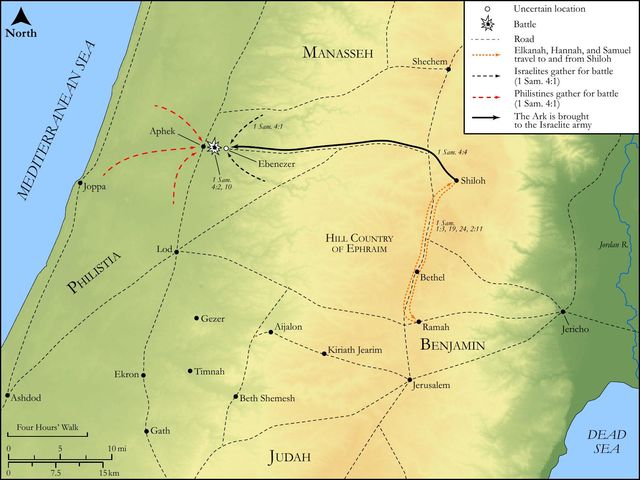
Study this verse
Public-domain commentary
Matthew Henry
From his Commentary on the Whole Bible. Henry comments on passages, not single verses — this entry covers 1 Samuel 2:11–26. His four-level outline is real structure in the source text, so it is rendered as structure.
In these verses we have the good character and posture of Elkanah's family, and the bad character and posture of Eli's family. The account of these two is observably interwoven throughout this whole paragraph, as if the historian intended to set the one over against the other, that they might set off one another. The devotion and good order of Elkanah's family aggravated the iniquity of Eli's house; while the wickedness of Eli's sons made Samuel's early piety appear the more bright and illustrious.
I.Let us see how well things went in Elkanah's family and how much better than formerly.
1.Eli dismissed them from the house of the Lord, when they had entered their little son there, with a blessing, Sa1 2:20. He blessed as one having authority: The Lord give thee more children of this woman, for the loan that is lent to the Lord. If Hannah had then had many children, it would not have been such a generous piece of piety to part with one out of many for the service of the tabernacle; but when she had but one, an only one whom she loved, her Isaac, to present him to the Lord was such an act of heroic piety as should by no means lose its reward. As when Abraham had offered Isaac he received the promise of a numerous issue (Gen 22:16, Gen 22:17), so did Hannah, when she had presented Samuel unto the Lord a living sacrifice. Note, What is lent to the Lord will certainly be repaid with interest, to our unspeakable advantage, and oftentimes in kind. Hannah resigns one child to God, and is recompensed with five; for Eli's blessing took effect (Sa1 2:21): She bore three sons and two daughters. There is nothing lost by lending to God or losing for him; it shall be repaid a hundred-fold, Mat 19:29.
2.They returned to their own habitation. This is twice mentioned, Sa1 2:11, and again Sa1 2:20. It was very pleasant to attend at God's house, to bless him, and to be blessed of him. But they have a family at home that must be looked after, and thither they return, cheerfully leaving the dear little one behind them, knowing they left him in a good place; and it does not appear that he cried after them, but was as willing to stay as they were to leave him, so soon did he put away childish things and behave like a man.
3.They kept up their constant attendance at the house of God with their yearly sacrifice, Sa1 2:19. They did not think that their son's ministering there would excuse them, or that that offering must serve instead of other offerings; but, having found the benefit of drawing near to God, they would omit no appointed season for it, and now they had one loadstone more in Shiloh to draw them thither. We may suppose they went thither to see their child oftener than once a year, for it was not ten miles from Ramah; but their annual visit is taken notice of because then they brought their yearly sacrifice, and then Hannah fitted up her son (and some think oftener than once a year) with a new suit of clothes, a little coat (Sa1 2:19) and every thing belonging to it. She undertook to find him with clothes during his apprenticeship at the tabernacle, and took care he should be well provided, that he might appear the more decent and sightly in his ministration, and to encourage him in his towardly beginnings. Parents must take care that their children want nothing that is fit for them, whether they are with them or from them; but those that are dutiful and hopeful, and minister to the Lord, must be thought worthy of double care and kindness.
4.The child Samuel did very well. Four separate times he is mentioned in these verses, and two things we are told of: - (1.) The service he did to the Lord. He did well indeed, for he ministered to the Lord (Sa1 2:11, Sa1 2:18) according as his capacity was. He learned his catechism and was constant to his devotions, soon learned to read, and took a pleasure in the book of the law, and thus he ministered to the Lord. He ministered before Eli, that is, under his inspection, and as he ordered him, not before Eli's sons; all parties were agreed that they were unfit to be his tutors. Perhaps he attended immediately on Eli's person, was ready to him to fetch and bring as he had occasion, and that is called ministering to the Lord. Some little services perhaps he was employed in about the altar, though much under the age appointed by the law for the Levites' ministration. He could light a candle, or hold a dish, or run on an errand, or shut a door; and, because he did this with a pious disposition of mind it is called ministering to the Lord, and great notice is taken of it. After awhile he did his work so well that Eli appointed that he should minister with a linen ephod as the priests did (though he was no priest), because he saw that God was with him. Note, Little children must learn betimes to minister to the Lord. Parents must train them up to it, and God will accept them. Particularly let them learn to pay respect to their teachers, as Samuel to Eli. None can begin too soon to be religious. See Psa 8:2, and Mat 21:15, Mat 21:16. (2.) The blessing he received from the Lord: He grew before the Lord, as a tender plant (Sa1 2:21), grew on (Sa1 2:26) in strength and stature, and especially in wisdom and understanding and fitness for business. Note, Those young people that serve God as well as they can will obtain grace to improve, that they may serve him better. Those that are planted in God's house shall flourish, Psa 92:13. He was in favour with the Lord and with man. Note, It is a great encouragement to children to be tractable, and virtuous, and good betimes, that if they be both God and man will love them. Such children are the darlings both of heaven and earth. What is here said of Samuel is said of our blessed Saviour, that great example, Luk 2:52.
II.Let us now see how ill things went in Eli's family, though seated at the very door of the tabernacle. The nearer the church the further from God.
1.The abominable wickedness of Eli's sons (Sa1 2:12): The sons of Eli were sons of Belial. It is emphatically expressed. Nothing appears to the contrary but that Eli himself was a very good man, and no doubt had educated his sons well, giving them good instructions, setting them good examples, and putting up many a good prayer for them; and yet, when they grew up, they proved sons of Belial, profane wicked men, and arrant rakes: They knew not the Lord. They could not but have a notional knowledge of God and his law, a form of knowledge (Rom 2:20), yet, because their practice was not conformable to it, they are spoken of as wholly ignorant of God; they lived as if they knew nothing at all of God. Note, Parents cannot give grace to their children, nor does it run in the blood. Many that are sincerely pious themselves live to see those that come from them notoriously impious and profane; for the race is not to the swift. Eli was high priest and judge in Israel. His sons were priests by their birth. Their character was sacred and honourable, and obliged them, for their reputation-sake, to observe decorum. They were resident at the fountain-head both of magistracy and ministry, and yet they were sons of Belial, and their honour, power, and learning, made them so much the worse. They did not go to serve other gods, as those did that lived at a distance from the altar, for from the house of God they had their wealth and dignity; but, which was worse, they managed the service of God as if he had been one of the dunghill deities of the heathen. It is hard to say which dishonours God more, idolatry or profaneness, especially the profaneness of the priests. Let us see the wickedness of Eli's sons; and it is a sad sight.
(1.)They profaned the offerings of the Lord, and made a gain to themselves, or rather a gratification of their own luxury, out of them. God had provided competently for them out of the sacrifices. The offerings of the Lord made by fire were a considerable branch of their revenue, but not enough to please them; they served not the God of Israel, but their own bellies (Rom 16:18), being such as the prophet calls greedy dogs that can never have enough, Isa 56:11.
[1.]They robbed the offerers, and seized for themselves some of their part of the sacrifice of the peace-offerings. The priests had for their share the wave-breast and the heave shoulder (Lev 7:34), but these did not content them; when the flesh was boiling for the offerer to feast upon religiously with his friends, they sent a servant with a flesh-hook of three teeth, a trident, and that must be stuck into the pot, and whatever that brought up the priest must have (Sa1 2:13, Sa1 2:14), and the people, out of their great veneration, suffered this to grow into a custom, so that after awhile prescription was pleaded for this manifest wrong.
[2.]They stepped in before God himself, and encroached upon his right too. As if it were a small thing to weary men, they wearied my God also, Isa 7:13. Be it observed, to the honour of Israel, that though the people tamely yielded to their unwarrantable demands from them, yet they were very solicitous that God should not be robbed: Let them not fail to burn the fat presently, Sa1 2:16. Let the altar have its due, for that is the main matter. Unless God have the fat, they can feast with little comfort upon the flesh. It was a shame that the priests should need to be thus admonished by the people of their duty; but they regarded not the admonition. The priest will be served first, and will take what he thinks fit of the fat too, for he is weary of boiled meat, he must have roast, and, in order to that, they must give it to him raw; and if the offerer dispute it, though not in his own favour (let the priest take what he pleases of his part) but in favour of the altar (let them be sure to burn the fat first), even the priest's servant had grown so very imperious that he would either have it now or take it by force, than which there could not be a greater affront to God nor a greater abuse to the people. The effect was, First, That God was displeased: The sin of the young men was very great before the Lord, Sa1 2:17. Nothing is more provoking to God than the profanation of sacred things, and men serving their lusts with the offerings of the Lord. Secondly, That religion suffered by it: Men abhorred the offerings of the Lord. All good men abhorred their management of the offerings, and too many insensibly fell into a contempt of the offerings themselves for their sakes. It was the people's sin to think the worse of God's institutions, but it was the much greater sin of the priests that gave them occasion to do so. Nothing brings a greater reproach upon religion than ministers' covetousness, sensuality, and imperiousness. In the midst of this sad story comes in the repeated mention of Samuel's devotion. But Samuel ministered before the Lord, as an instance of the power of God's grace, in preserving him pure and pious in the midst of this wicked crew; and this helped to keep up the sinking credit of the sanctuary in the minds of the people, who, when they had said all they could against Eli's sons, could not but admire Samuel's seriousness, and speak well of religion for his sake.
(2.)They debauched the women that came to worship at the door of the tabernacle, Sa1 2:22. They had wives of their own, but were like fed horses, Jer 5:8. To have gone to the harlots' houses, the common prostitutes, would have been abominable wickedness, but to use the interest which as priests they had in those women that had devout dispositions and were religiously inclined, and to bring them to commit their wickedness, was such horrid impiety as one can scarcely think it possible that men who called themselves priests should ever be guilty of. Be astonished, O heavens! at this, and tremble, O earth! No words can sufficiently express the villany of such practices as these.
2.The reproof which Eli gave his sons for this their wickedness: Eli was very old (Sa1 2:22) and could not himself inspect the service of the tabernacle as he had done, but left all to his sons, who, because of the infirmities of his age, slighted him, and did what they would. However, he was told of the wickedness of his sons, and we may well imagine what a heart-breaking it was to him, and how much it added to the burdens of his age; but it should seem he did not so much as reprove them till he heard of their debauching the women, and then he thought fit to give them a check. Had he rebuked them for their greediness and luxury, this might have been prevented. Young people should be told of their faults as soon as it is perceived that they begin to be extravagant, lest their hearts be hardened. Now concerning the reproof he gave them observe,
(1.)That it was very just and rational. That which he said was very proper. [1.] He tells them that the matter of fact was too plain to be denied and too public to be concealed: "I hear of your evil dealings by all this people, Sa1 2:23. It is not the surmise of one or two, but the avowed testimony of many; all your neighbours cry out shame on you, and bring their complaints to me, expecting that I should redress the grievance." [2.] He shows them the bad consequences of it, that they not only sinned, but made Israel to sin, and would have the people's sin to answer for as well as their own: "You that should turn men from iniquity (Mal 2:6), you make the Lord's people to transgress, and corrupt the nation instead of reforming it; you tempt people to go and serve other gods when they see the God of Israel so ill served." [3.] He warns them of the danger they brought themselves into by it, Sa1 2:25. He intimates to them what God afterwards told him, that the iniquity would not be purged with sacrifice nor offering, Sa1 3:14. If one man sin against another, the judge (that is, the priest, who was appointed to be the judge in many cases, Deu 17:9) shall judge him, shall undertake his cause, arbitrate the matter, and make atonement for the offender; but if a man sin against the Lord (that is, if a priest profane the holy things of the Lord, if a man that deals with God for others do himself affront him) who shall entreat for him? Eli was himself a judge, and had often made intercession for transgressors, but, says he, "You that sin against the Lord," that is, "against the law and honour of God, in those very things which immediately pertain to him, and by which reconciliation is to be made, how can I entreat for you?" Their condition was deplorable indeed when their own father could not speak a good word for them, nor could have the face to appear as their advocate. Sins against the remedy, the atonement itself, are most dangerous, treading under foot the blood of the covenant, for then there remains no more sacrifice, Heb 10:26.
(2.)It was too mild and gentle. He should have rebuked them sharply. Their crimes deserved sharpness; their temper needed it; the softness of his dealing with them would but harden them the more. The animad-version was too easy when he said, It is no good report. he should have said, "It is a shameful scandalous thing, and not to be suffered!" Whether it was because he loved them or because he feared them that he dealt thus tenderly with them, it was certainly an evidence of his want of zeal for the honour of God and his sanctuary. He bound them over to God's judgment, but he should have taken cognizance of their crimes himself, as high priest and judge, and have restrained and punished them. What he said was right, but it was not enough. Note, It is sometimes necessary that we put an edge upon the reproofs we give. There are those that must be saved with fear, Jde 1:23. 3. Their obstinacy against this reproof. His lenity did not at all work upon them: They hearkened not to their father, though he was also a judge. They had no regard either to his authority or to his affection, which was to them an evident token of perdition; it was because the Lord would slay them. They had long hardened their hearts, and now God, in a way of righteous judgment, hardened their hearts, and seared their consciences, and withheld from them the grace they had resisted and forfeited. Note, Those that are deaf to the reproofs of wisdom are manifestly marked for ruin. The Lord has determined to destroy them, Ch2 25:16. See Pro 29:1. Immediately upon this, Samuel's tractableness is again mentioned (Sa1 2:26), to shame their obstinacy: The child Samuel grew. God's grace is his own; he denied it to the sons of the high priest and gave it to the child of an obscure country Levite.
Historical interpretation
Three Centuries of Reception
2 surviving comments on this verse. Each one is dated, so this reads as a timeline rather than a list.
Select a marker to jump to its quote. Markers stagger vertically where authors wrote within a few decades of each other.
Samuel bore with the wicked sons of Eli, his debased sons whom the people would not bear and who were thereupon accused by divine truth or disciplined by divine wrath; finally he bore with the people themselves in their pride and rejection of God.… Let them read who wish, and who can, the heavenly language. They will find that all the saints have had to tolerate among their own people those who were recognized as servants and friends of God.
The sin of the boys was therefore exceedingly great, etc. The sin of the scribes and Pharisees was exceedingly great before the Lord, although before men they justified themselves through hypocrisy (Luke 11); because they, being men, annulled the commandment of God through their traditions; or certainly taking away the key of knowledge, they themselves did not enter, and they prohibited those who wished to enter. If, however, the boys committed exceedingly great sin before the Lord, who unworthily handled the flesh of sacrificial victims, what do you think those deserve of punishment who, with childish foolishness, have trampled underfoot the Son of God and considered the blood of the eternal covenant polluted (Hebr. 10)? Who receiving, do not discern the body of the Lord (1 Cor. 11), that is, from the perception of common and mean foods, they by no means discern the mystery of heavenly life.
Continue studying 1 Samuel 2:17 across the web’s major study libraries — every link below opens this exact verse, chapter, or book on the destination site.
Read & Compare
 BibleGatewayThis verse in more than 200 translations and 70 languages.
 Bible.comThe YouVersion reader — hundreds of translations, reading plans, and highlights.
 ESV.orgCrossway's official English Standard Version reader.
 NET BibleThe NET translation with 60,000+ translators' notes on every rendering decision.
 STEP BibleTyndale House's free study tool — original text, vocabulary, and scholarly resources.
 BibliaLogos Bible Software's free web reader.
 USCCBThe New American Bible (Revised Edition) with the U.S. bishops' study notes.
Commentaries
 BibleHub CommentariesDozens of classic commentaries on this verse, gathered on one page.
 StudyLightMore than 100 commentary sets — the largest collection on the web.
 BibleRefPlain-English commentary on what this verse means, verse by verse.
 Enduring WordDavid Guzik's free commentary on this chapter, widely used by Bible teachers.
 Bible Study ToolsVerse commentary alongside Greek and Hebrew study aids.
Original Language & Research
- BibleHub InterlinearThe verse word by word — original language, transliteration, and English.
- BibleHub LexiconEvery word's original-language definition and Strong's entry.
 Blue Letter BibleDeep-study tools — Strong's numbers, concordance, and word studies.
 SefariaThe Hebrew text with Rashi and centuries of Jewish commentary.
Sermons, Hymns & Audio


TrulyRandomVerse is not affiliated with these sites and doesn’t control their content. They’re linked because they’re genuinely useful.
Summary
1 Samuel 2:17 delivers a profound and damning indictment of the egregious sin committed by Eli's sons, Hophni and Phinehas, in their priestly duties at the Tabernacle in Shiloh. Their actions were not merely neglectful but actively contemptuous and exploitative, directly dishonoring God and corrupting the sacred sacrificial system. This verse meticulously articulates the divine perspective on their conduct, declaring their sin "very great before the LORD" because it directly caused the people of Israel to despise and abhor the very offerings intended for God, thereby undermining the spiritual integrity and reverence due to divine worship and eroding the nation's faith.
Context
ShowHideLiterary Context
This verse is strategically positioned within a narrative that starkly contrasts the burgeoning godliness and faithfulness of Hannah and the young prophet Samuel with the profound moral and spiritual corruption of Eli's priestly household. Immediately preceding 1 Samuel 2:17, verses 1 Samuel 2:12-16 meticulously detail the specific abuses perpetrated by Hophni and Phinehas. They are explicitly characterized as "worthless men" (literally "sons of Belial") who demonstrated no regard whatsoever for the LORD. Their flagrant offenses included demanding the choicest portions of the sacrificial meat for themselves before it was properly offered to God, even resorting to taking it by force with a three-pronged fork, and insisting on raw meat for roasting, in direct violation of the prescribed Mosaic method of boiling the meat and burning the fat to the LORD first. This blatant disregard for the Mosaic Law and the sanctity of the altar directly led to the people's revulsion, as articulated in verse 17. The subsequent narrative, particularly 1 Samuel 2:22-36 and 1 Samuel 3:11-14, meticulously chronicles God's severe judgment against Eli's house due to this deep-seated corruption and Eli's culpable failure to restrain his sons.
Historical & Cultural Context
The events of 1 Samuel unfold during the tumultuous and morally ambiguous period of the Judges, a time notoriously characterized by spiritual decline and anarchy, where "everyone did what was right in his own eyes" (Judges 21:25). The Tabernacle at Shiloh served as the central, divinely appointed place of worship for all Israel, housing the Ark of the Covenant and functioning as the primary site for sacrifices, national religious gatherings, and the administration of the Law. The priests, as divinely appointed mediators between God and His people, wielded immense spiritual authority and bore profound responsibility. Their sacred role was to facilitate proper worship, meticulously administer the Law, and scrupulously maintain the sanctity of the holy things. Sacrifices were not merely perfunctory rituals; they were divinely ordained means of atonement, thanksgiving, and intimate communion with God, absolutely central to Israel's covenant relationship. The actions of Hophni and Phinehas were therefore not merely personal moral failings but a public desecration of God's holy ordinances, a profound betrayal of their sacred trust, and a direct assault on the spiritual well-being of the entire nation. Their pervasive corruption at the very heart of Israelite worship had far-reaching implications, systematically eroding the people's faith and their reverence for God's institutions.
Key Themes
ShowHideThe central theme powerfully underscored in this verse is the profound sacrilege and blatant disrespect for God's holiness. The priests' actions directly defiled the offerings, which were foundational to Israelite worship and atonement, rendering their sin a direct affront to God's immutable character and His meticulously prescribed way of approaching Him. This also vividly highlights the theme of corrupt leadership and abuse of power. As sons of the High Priest, their moral decay set a devastating example, leading the people astray and bringing widespread disrepute to the entire priesthood, unequivocally demonstrating how leadership failure can precipitate pervasive spiritual harm. Furthermore, the verse ominously foreshadows the severe consequences of sin and inevitable divine judgment that God would soon unleash upon Eli's family and, by extension, the entire nation due to this widespread spiritual decay, as meticulously detailed in 1 Samuel 3:11-14 and the subsequent calamitous capture of the Ark in 1 Samuel 4. It also emphatically underscores the paramount importance of proper worship and genuine reverence, demonstrating that God cares deeply not only about the act of worship itself but also, and critically, about the manner in which it is conducted, demanding unwavering obedience and heartfelt sincerity.
Exposition and Analysis
ShowHideKey Word Analysis
ShowHideThe Hebrew word חַטָּאת (chaṭṭâʼâh) denotes an offense, a missing of the mark, or guilt. In this context, it signifies not merely an unintentional error or oversight, but a deliberate, profound, and culpable transgression against God's explicit law and inherent holiness. The employment of this robust term unequivocally indicates the immense gravity of their actions, which transcended simple negligence to embody active contempt and rebellious disregard for divine ordinances.
The Hebrew word גָּדֹול (gâdôwl) signifies something large, mighty, or significant in any sense. When applied to sin, as here, it emphasizes the immense magnitude and severity of the transgression from God's perspective. It highlights that their actions were not trivial or minor but carried profound implications for their relationship with God and for the spiritual health of the nation, marking their transgression as particularly heinous and consequential in the divine court.
The verb נָאַץ (nâʼats) means to scorn, despise, treat with contempt, or even to blaspheme. It conveys more than mere dislike or disapproval; it implies an active, disdainful rejection and mockery of something sacred and revered. This powerful term underscores the devastating impact of the priests' actions: they caused the people, who were meant to approach God with reverence through these offerings, to instead treat God's holy provisions with utter contempt, disdain, and spiritual revulsion.
Verse Breakdown
ShowHide"Wherefore the sin of the young men was very great before the LORD:"
This opening clause serves as a divine verdict, establishing God's direct judgment on the actions of Hophni and Phinehas. It emphatically highlights that their sin was not merely a human failing or a societal transgression but a direct, personal offense against the LORD Himself, observed, measured, and judged by His holy standard. The intensifying phrase "very great" underscores the extreme severity and immense magnitude of their transgression, indicating that it was a profound affront to God's inherent holiness and His sacred covenant relationship with Israel. Their privileged and sacred position as priests made their sin all the more grievous, as they were specifically entrusted with maintaining the sanctity and integrity of God's worship.
"for men abhorred the offering of the LORD."
This second clause provides the crucial, devastating reason and direct consequence for the "very great" sin. The priests' corrupt, self-serving, and sacrilegious practices directly led the common people to despise, treat with contempt, and ultimately reject the very sacrifices that were divinely instituted to facilitate atonement, worship, and intimate communion with God. By exploiting the sacred system for personal gain and systematically desecrating the holy offerings, Hophni and Phinehas fundamentally undermined the people's faith and their essential reverence for God's institutions, effectively placing a formidable stumbling block in the spiritual path of those sincerely seeking to worship the LORD. Their actions tragically transformed a sacred, life-giving act into something detestable and spiritually repugnant in the eyes of the worshippers.
Literary Devices
ShowHide1 Samuel 2:17 employs several potent literary devices to convey its profound and sobering message. Cause and Effect is central to the verse's structure, as it explicitly states that the "very great" sin of the young men was a direct consequence of their actions, for it led people to "abhor" the LORD's offering. This directly links the priests' moral corruption to the spiritual decay and disillusionment of the populace. Irony is also powerfully present: those divinely appointed to facilitate worship and meticulously uphold God's law are precisely the ones causing the people to despise sacred things. Their sacred role as mediators is tragically perverted into a severe stumbling block. Furthermore, the phrase "very great" functions as a form of intensification or hyperbole, emphasizing the profound and immeasurable degree of their transgression from God's holy perspective, unequivocally underscoring that this was no minor offense but a severe, covenant-breaking breach of trust and holiness. The broader narrative also employs juxtaposition throughout 1 Samuel 2, starkly contrasting the depravity and spiritual bankruptcy of Eli's sons with the exemplary piety of Hannah and the rising integrity and faithfulness of young Samuel, thereby making the darkness and gravity of their sin even more pronounced and horrifying.
Theological and Thematic Connections
ShowHideThe profound declaration in 1 Samuel 2:17 echoes throughout the entire tapestry of biblical theology, underscoring the immutable sanctity of worship, the absolute accountability of leadership, and the unwavering justice of God. It unequivocally reveals that God takes with utmost seriousness any defilement of His sacred name or His divinely established institutions, especially when such desecration is perpetrated by those explicitly entrusted with their care. The priests' actions not only violated specific Mosaic laws but also struck directly at the very heart of Israel's covenant relationship with God, a relationship profoundly mediated through the sacrificial system. Their self-serving greed and spiritual negligence transformed a divinely ordained means of grace into an object of widespread contempt, powerfully demonstrating how human corruption can tragically obstruct divine revelation and lead countless others astray. This foundational principle extends far beyond the ancient sacrificial system, serving as a timeless reminder that genuine reverence, unwavering integrity, and purity of heart are absolutely paramount in all forms of worship and devoted service to God in every era.
Reflection and Application
ShowHide1 Samuel 2:17 serves as a timeless and profoundly sobering warning about the immense gravity of spiritual corruption, particularly when it emanates from those occupying positions of religious leadership. For believers today, this verse emphatically underscores the critical importance of approaching God with genuine reverence, heartfelt sincerity, and unblemished purity of heart in all aspects of our worship and devoted service. Our "offerings," whether they manifest as expressions of praise, the giving of our resources, the dedication of our time, or the performance of our service, must be presented with a heart that truly honors God, never with contempt, self-interest, or a casual disregard for His inherent holiness. This passage also profoundly highlights the immense, solemn responsibility incumbent upon spiritual leaders to live lives of unimpeachable integrity, faithfully uphold God's unchanging standards, and diligently shepherd His precious flock. When leaders exploit their sacred positions, compromise divine principles, or allow personal gain to overshadow eternal truth, they not only incur God's righteous wrath but also cause countless others to stumble, lose faith, and potentially "abhor" the very spiritual truths and practices they are meant to uphold. We are unequivocally called to be radiant examples of Christ, not stumbling blocks, diligently ensuring that our lives and ministries consistently point others to God's glorious presence and not away from it.
Questions for Reflection
ShowHideFAQ
ShowHideWhat exactly did Eli's sons do wrong, according to the preceding verses?
ShowHideEli's sons, Hophni and Phinehas, committed multiple egregious offenses meticulously detailed in 1 Samuel 2:12-16. Firstly, they brazenly demanded the best portions of the sacrificial meat for themselves before it was properly offered to God, even resorting to taking it by force with a three-pronged fork directly from the boiling pot. The Mosaic Law explicitly stipulated that the fat was to be burned to the LORD first, and the priest's designated portion was specific and was to be received after God had received His due. Secondly, they defiantly insisted on raw meat for roasting, thereby violating the prescribed method of boiling the meat. This deviation was likely driven by a desire for immediate gratification or a personal preference for roasted meat over boiled. Their actions demonstrated a profound and contemptuous disregard for God's explicit commands regarding sacrifices, revealing deep-seated greed, arrogance, and a complete lack of reverence for the sacred.
Why was their sin considered "very great before the LORD"?
ShowHideTheir sin was unequivocally deemed "very great before the LORD" for several critical and interconnected reasons. Firstly, it constituted a direct and blatant affront to God's inherent holiness and His explicit, divinely ordained instructions for worship. Sacrifices were the divinely appointed means for Israel to approach God, seek atonement, and meticulously maintain their covenant relationship. By corrupting and defiling this sacred system, Eli's sons were directly dishonoring God Himself. Secondly, as priests, they held a sacred trust and were divinely commissioned to represent God to the people and the people to God. Their blatant abuse of this privileged position represented a profound betrayal of that trust, rendering their sin far more culpable. Thirdly, and most devastatingly, their actions directly caused others to stumble and fall away. As 1 Samuel 2:17 explicitly states, "men abhorred the offering of the LORD" because of their scandalous behavior. Their conduct systematically undermined the people's faith, led them to despise sacred rituals, and thus created an insurmountable barrier to genuine worship and communion with God. This pervasive spiritual corruption, originating from the very heart of the religious establishment, was an absolute abomination in God's holy sight.
What were the ultimate consequences of the actions of Eli's sons?
ShowHideThe consequences of their actions were severe, swift, and far-reaching, powerfully demonstrating God's unwavering and righteous justice. God pronounced a devastating judgment upon Eli's entire house, declaring that there would be no old man in his family and that his priestly line would be cut off (1 Samuel 2:31-33). Both Hophni and Phinehas were tragically killed on the same day in a decisive battle against the Philistines (1 Samuel 4:11). Furthermore, the Ark of the Covenant, which they had presumptuously brought into battle, was captured by the Philistines, a devastating blow to Israel's national and spiritual identity (1 Samuel 4:1-11). Eli himself died upon hearing the news of the Ark's capture and his sons' deaths, collapsing and breaking his neck (1 Samuel 4:18). This entire tragic narrative serves as a powerful and enduring testament to God's absolute intolerance for sacrilege and His unwavering demand for holiness, especially from those entrusted with leadership.
Christ-Centered Fulfillment
ShowHideThe profound corruption of Eli's sons, which tragically led the people to "abhor the offering of the LORD," stands in stark and absolute contrast to the perfect, once-for-all offering of Jesus Christ. The Old Testament sacrificial system, though divinely instituted, was always a mere shadow of the ultimate spiritual reality that was to come (Hebrews 10:1). Its temporary efficacy was dependent on the integrity of the human priests and the reverent heart of the offerer, yet it was inherently prone to human corruption, as tragically exemplified by Hophni and Phinehas. Their self-serving actions and spiritual negligence defiled the very means by which people sought to draw near to God, causing widespread spiritual stumbling and disillusionment. In stark contrast, Jesus Christ, our great and perfect High Priest, offered Himself as the spotless Lamb of God, who takes away the sin of the world!. His unparalleled sacrifice was not motivated by greed, self-interest, or compulsion, but by perfect love, unwavering obedience to the Father, and a boundless desire to redeem humanity (Hebrews 9:14). Unlike the repeated, imperfect sacrifices offered by fallible human priests, Christ's single, definitive offering on the cross perfectly and eternally atoned for sin, making a new and living way for all who believe to draw near to God with unwavering confidence and a clear conscience (Hebrews 10:10-14). He did not cause people to "abhor" the offering but rather drew them powerfully to God through His incomparable love and the absolute purity of His self-giving, thereby establishing a new covenant where all believers become a royal priesthood, divinely empowered to offer spiritual sacrifices of praise and good deeds through Him (Hebrews 13:15).