


Genesis 22:16
Bible text: King James Version (1769 Blayney text) · Public domain
Bible text: Berean Standard Bible · Public domain
Bible text: American Standard Version (1901) · Public domain
Bible text: World English Bible, Messianic edition · Public domain
Bible text: Geneva Bible (1599) · Public domain
Bible text: Young's Literal Translation · Public domain
- וַיֹּאמֶרvai·Yo·merand he saidH559Conj-w ¦ V-Qal-ConsecImperf-3msVerb Qal Consecutive Imperfect 3rd Singular Masculineוַandיֹּאמֶרhe said
- בִּיbiby <the> myselfPrep-b ¦ 1csSuffix Personal 1st Singular common genderבִּby <the>יmyself
- נִשְׁבַּעְתִּיnish·Ba'·tiI swearH7650V-Niphal-Perf-1csVerb Niphal Perfect 1st Singular common gender
- נְאֻםne·'um[the] utterance ofH5002N-mscNoun Singular Masculine Construct
- יְהוָהYah·wehYahwehH3068N-properNoun Proper Title
- כִּיKithatH3588PrtParticle Conditional
- יַעַןYa·'anbecauseH3282ConjConjunction
- אֲשֶׁר'a·SherthatH834RelParticle Relative
- עָשִׂיתָ'a·Si·tayou have doneH6213V-Qal-Perf-2msVerb Qal Perfect 2nd Singular Masculine
- אֶת'et<obj.>H853DirObjMParticle Object Indicator
- הַדָּבָרha·da·Varthe thingH1697Art ¦ N-msNoun Singular Masculine Absoluteהַtheדָּבָרthing
- הַזֶּהha·Zeh<the> thisH2088Art ¦ PrtParticle Demonstrativeהַ<the>זֶּהthis
- וְלֹאve·Lo'and notH3808Conj-w ¦ NegParticle Negativeוְandלֹאnot
- חָשַׂכְתָּcha·Sakh·tayou have withheldH2820V-Qal-Perf-2msVerb Qal Perfect 2nd Singular Masculine
- אֶת'et<obj.>H853DirObjMParticle Object Indicator
- בִּנְךָbin·Khayour sonH1121N-msc ¦ 2msNoun Singular Masculine Constructבִּנְsonךָyour
- אֶת'et<obj.>H853DirObjMParticle Object Indicator
- יְחִידֶךָye·chi·De·khayour only [son]H3173Adj-msc ¦ 2msAdjective Singular Masculine Constructיְחִידֶonly [son]ךָyour
English is a literal word-by-word gloss of the Hebrew, not the KJV's wording. Why?
This is the original text the KJV's translators worked from — each Hebrew word with its own literal English meaning in this verse, prepared by scholars at Tyndale House, Cambridge. The KJV translates whole sentences, not word by word, so its wording differs: one Hebrew word can become several English words, and the KJV may choose “the LORD” where the gloss reads “Yahweh”. Both are faithful — they answer different questions. For the KJV's own rendering, switch to the KJV text.
Details
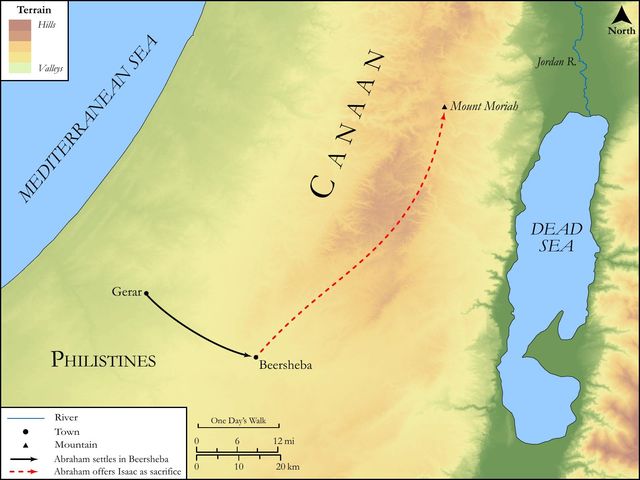
See on the biblical-era maps


Study this verse
Public-domain commentary
Matthew Henry
From his Commentary on the Whole Bible. Henry comments on passages, not single verses — this entry covers Genesis 22:15–19.
Abraham's obedience was graciously accepted; but this was not all: here we have it recompensed, abundantly recompensed, before he stirred from the place; probably while the ram he had sacrificed was yet burning God sent him this gracious message, renewed and ratified his covenant with him. All covenants were made by sacrifice, so was this by the typical sacrifices of Isaac and the ram. Very high expressions of God's favour to Abraham are employed in this confirmation of the covenant with him, expressions exceeding any he had yet been blessed with. Note, Extraordinary services shall be crowned with extraordinary honours and comforts; and favours in the promise, though not yet performed, ought to be accounted real and valuable recompences. Observe, 1. God is pleased to make mention of Abraham's obedience as the consideration of the covenant; and he speaks of it with an encomium: Because thou hast done this thing, and hast not withheld thy son, thine only son, Gen 22:16. He lays a strong emphasis on this, and (Gen 22:18) praises it as an act of obedience: in it thou hast obeyed my voice, and to obey is better than sacrifice. Not that this was a proportionable consideration, but God graciously put this honour upon that by which Abraham had honoured him. 2. God now confirmed the promise with an oath. It was said and sealed before; but now it is sworn: By myself have I sworn; for he could swear by no greater, Heb 6:13. Thus he interposed himself by an oath, as the apostle expresses it, Heb 6:17. He did (to speak with reverence) even pawn his own life and being upon it (As I live), that by all those immutable things, in which it was impossible for God to lie, he and his might have strong consolation. Note, If we exercise faith, God will encourage it. Improve the promises, and God will ratify them. 3. The particular promise here renewed is that of a numerous offspring: Multiplying, I will multiply thee, Gen 22:17. Note, Those that are willing to part with any thing for God shall have it made up to them with unspeakable advantage. Abraham has but one son, and is willing to part with that one, in obedience to God. "Well," said God, "thou shalt be recompensed with thousands and millions." What a figure does the seed of Abraham make in history! How numerous, how illustrious, were his known descendants, who, to this day, triumph in this, that they have Abraham to their father! Thus he received a thousand-fold in this life, Mat 19:29. 4. The promise, doubtless, points at the Messiah, and the grace of the gospel. This is the oath sworn to our father Abraham, which Zacharias refers to, Luk 1:73, etc. And so here is a promise, (1.) Of the great blessing of the Spirit: In blessing, I will bless thee, namely, with that best of blessings the Gift of the Holy Ghost; the promise of the Spirit was that blessing of Abraham which was to come upon the Gentiles through Jesus Christ, Gal 3:14. (2.) Of the increase of the church that believers, his spiritual seed, should be numerous as the stars of heaven. (3.) Of spiritual victories: Thy seed shall possess the gate of his enemies. Believers, by their faith, overcome the world, and triumph over all the powers of darkness, and are more than conquerors. Probably Zacharias refers to this part of the oath (Luk 1:74), That we, being delivered out of the hand of our enemies, might serve him without fear. But the crown of all is the last promise. (4.) Of the incarnation of Christ: In thy see, one particular person that shall descend from thee (for he speaks not of many, but of one, as the apostle observers, Gal 3:16), shall all the nations of the earth be blessed, or shall bless themselves, as the phrase is, Isa 65:16. In him all may be happy if they will, and all that belong to him shall be so, and shall think themselves so. Christ is the great blessing of the world. Abraham was ready to give up his son for a sacrifice to the honour of God, and, on that occasion, God promised to give his Son a sacrifice for the salvation of man.
Continue studying Genesis 22:16 across the web’s major study libraries — every link below opens this exact verse, chapter, or book on the destination site.
Read & Compare
 BibleGatewayThis verse in more than 200 translations and 70 languages.
 Bible.comThe YouVersion reader — hundreds of translations, reading plans, and highlights.
 ESV.orgCrossway's official English Standard Version reader.
 NET BibleThe NET translation with 60,000+ translators' notes on every rendering decision.
 STEP BibleTyndale House's free study tool — original text, vocabulary, and scholarly resources.
 BibliaLogos Bible Software's free web reader.
 USCCBThe New American Bible (Revised Edition) with the U.S. bishops' study notes.
Commentaries
 BibleHub CommentariesDozens of classic commentaries on this verse, gathered on one page.
 StudyLightMore than 100 commentary sets — the largest collection on the web.
 BibleRefPlain-English commentary on what this verse means, verse by verse.
 Enduring WordDavid Guzik's free commentary on this chapter, widely used by Bible teachers.
 Bible Study ToolsVerse commentary alongside Greek and Hebrew study aids.
Original Language & Research
- BibleHub InterlinearThe verse word by word — original language, transliteration, and English.
- BibleHub LexiconEvery word's original-language definition and Strong's entry.
 Blue Letter BibleDeep-study tools — Strong's numbers, concordance, and word studies.
 SefariaThe Hebrew text with Rashi and centuries of Jewish commentary.
Sermons, Hymns & Audio


TrulyRandomVerse is not affiliated with these sites and doesn’t control their content. They’re linked because they’re genuinely useful.
Summary
Genesis 22:16 records the LORD's profound and irrevocable oath to Abraham, delivered by the Angel of the LORD, immediately following Abraham's supreme act of obedience in offering his son Isaac on Mount Moriah. This pivotal divine declaration solidifies God's unwavering covenant promises, underscoring the absolute certainty of His word in response to Abraham's demonstrated faith and radical surrender.
Context
ShowHideLiterary Context
This verse is the climactic divine pronouncement following the harrowing narrative of the Akedah, or "the binding of Isaac," recounted in Genesis 22:1-19. God had issued a seemingly contradictory command to Abraham: "Take now thy son, thine only son Isaac, whom thou lovest, and get thee into the land of Moriah; and offer him there for a burnt offering upon one of the mountains which I will tell thee of" (Genesis 22:2). Abraham's immediate and unwavering obedience, culminating in his raising the knife to sacrifice Isaac, is met with the Angel of the LORD's intervention, preventing the act and providing a ram as a substitute (Genesis 22:11-13). Verse 16, therefore, is not a new command but a powerful, unprompted divine affirmation and sealing of the Abrahamic covenant, serving as God's response to Abraham's ultimate test of faith. It transitions the narrative from the test itself to the renewed and strengthened covenant promises.
Historical & Cultural Context
In Scripture, oaths were solemn and binding, for "men verily swear by the greater," and are often sworn by God to guarantee a promise. When a deity swore an oath, it was considered immutable and irrevocable. The concept of child sacrifice, while abhorrent to the God of Israel, was tragically practiced by the pagan nations round about (e.g., Molech worship), which makes God's command to Abraham, though a test, particularly jarring and potent. Abraham's willingness to offer his "only son" would have been understood by his contemporaries as the ultimate act of devotion, paralleling (but fundamentally differing from) the extreme sacrifices made to pagan deities. The location, "the land of Moriah," would later become the site of Solomon's Temple (2 Chronicles 3:1), adding prophetic significance to Abraham's act as a foundational moment in Israel's sacred history.
Key Themes
ShowHideGenesis 22:16 contributes significantly to several overarching themes in the book of Genesis and biblical theology. The primary theme is Obedience and Faith, demonstrating that true faith is active and willing to surrender even the most precious possessions to God, as seen in Abraham's response to God's command in Genesis 22:3. This act of faith is then met with Divine Faithfulness and Covenant Certainty, as God's self-oath irrevocably guarantees His promises, reinforcing the covenant first initiated in Genesis 12:1-3. The narrative also powerfully introduces the theme of Divine Provision, epitomized by the name "Jehovah-jireh" ("The LORD will provide") in Genesis 22:14, showcasing God's ability to intervene and supply what is needed at the moment of ultimate trust. Finally, the "only son" motif deeply foreshadows the ultimate sacrifice of God's own Son, a theme that resonates throughout the biblical narrative, particularly in the New Testament.
Exposition and Analysis
ShowHideIn Genesis 22:16, the LORD declares, "By myself have I sworn, saith the LORD, for because thou hast done this thing, and hast not withheld thy son, thine only [son]:" This divine utterance is a direct, emphatic declaration, emphasizing the absolute certainty and irrevocability of the ensuing promises (detailed in the subsequent verses, Genesis 22:17-18). God, having no one greater by whom to swear, pledges His very being and immutable character as the ultimate guarantee for His word. The explicit reason for this unparalleled oath is Abraham's profound act of obedience—his willingness to offer his beloved son, Isaac, demonstrating a faith that trusted God's promise even when it seemed contradictory to human reason.
Key Word Analysis
ShowHideFrom a primitive root meaning "to seven oneself," implying a repetition of a declaration seven times for emphasis and completion. In this context, it signifies the act of taking an oath, making a solemn, binding promise. When God swears by Himself, it indicates the highest possible form of assurance, as His own perfect and unchangeable nature is the guarantee of His word. This divine self-oath elevates the covenant promises to an immutable reality.
From a root meaning "to speak." This word is remarkably broad, encompassing "a word," "a matter," "an affair," "a deed," or "a cause." Here, "this thing" refers specifically to Abraham's entire act of obedience on Mount Moriah—his readiness to sacrifice Isaac. It signifies not just an isolated action but the profound spiritual reality of his trust and surrender, a "matter" of ultimate significance in God's eyes.
Meaning "united," "sole," "unique," or "beloved." While Isaac was not Abraham's only biological son (Ishmael was born earlier), he was the "only" son of promise, the unique heir through whom the covenant lineage would continue. This term emphasizes Isaac's singular importance to Abraham and to God's redemptive plan, highlighting the immense cost of Abraham's obedience and foreshadowing the unique status of God's "only begotten" Son.
Verse Breakdown
ShowHide"And said, By myself have I sworn, saith the LORD"
This opening clause establishes the divine speaker and the absolute nature of the declaration. The phrase "By myself have I sworn" (Hebrew: nishba'ti bi) is a divine self-oath, the most potent form of guarantee. Since there is no one greater than God, He swears by His own immutable character and existence, making His promise utterly certain and irreversible. The repeated "saith the LORD" (Hebrew: nᵉʼum Yᵉhôvâh) further emphasizes the direct, authoritative, and binding nature of this divine oracle.
"for because thou hast done this thing"
This clause provides the immediate divine rationale for the oath. The "thing" refers to Abraham's complete obedience in preparing to sacrifice Isaac. It is not that Abraham's action earned the covenant, which was established by grace, but rather that his obedience demonstrated the depth and genuineness of his faith, making him a worthy recipient and steward of God's promises. It validated the faith God had already credited to him as righteousness.
"and hast not withheld thy son, thine only [son]:"
This final clause specifies the particular act of obedience that moved God to this profound oath. "Withheld" (Hebrew: châsak) means to restrain, refrain, or spare. Abraham's refusal to "withhold" Isaac, his "only son" (the son of promise, unique and beloved), signifies his complete surrender and trust. It underscores that Abraham valued God's command and promise above his deepest human affection and hope for the future, proving his unreserved devotion.
Literary Devices
ShowHideThe passage employs several potent literary devices. Divine Oath is central, with God swearing "by myself," which is the highest possible form of guarantee, emphasizing the Immutability and Irrevocability of His promises. The repetition of "thy son, thine only son" in this verse and throughout the Akedah narrative (e.g., Genesis 22:2) serves as a powerful instance of Anaphora and Emphasis, highlighting the immense personal cost of Abraham's obedience and the unique significance of Isaac. The narrative also uses Foreshadowing, as Abraham's willingness to offer his "only son" powerfully prefigures God the Father's ultimate sacrifice of His own unique Son, Jesus Christ. The entire episode functions as a Type, where Abraham's act and God's provision serve as a pattern pointing to a greater spiritual reality in the future.
Theological and Thematic Connections
ShowHideGenesis 22:16 stands as a monumental declaration of God's unwavering faithfulness and the certainty of His covenant promises. God's self-oath underscores His absolute reliability; His word is not subject to human fallibility or change, providing an immutable anchor for faith across all generations. Abraham's profound act of obedience, his willingness to surrender his most cherished possession and the heir of the promise, highlights the immense cost of absolute devotion to God. It exemplifies that true faith may demand radical surrender, demonstrating that God desires our hearts and our ultimate trust above all else. This divine response to Abraham's faith also solidifies the principle that while salvation is by grace through faith, genuine faith is never barren but produces works of obedience, which in turn are affirmed and blessed by God.
Reflection and Application
ShowHideGenesis 22:16 offers profound encouragement for believers to trust implicitly in God's unwavering faithfulness and the absolute certainty of His promises. Abraham's willingness to surrender his most cherished possession, the son of promise, teaches us the depth of devotion God desires—a willingness to hold nothing back from Him. This passage challenges us to examine what "only son" or "most cherished thing" we might be withholding from God. When we obey God, even when it demands great sacrifice, seems illogical, or involves surrendering what we hold most dear, we position ourselves to experience His perfect provision and the profound confirmation of His blessing in our lives. This divine oath reminds us that God is eternally true to His word, and His covenants are steadfast, providing a secure and unshakeable foundation for our hope, trust, and obedience in every circumstance.
Questions for Reflection
ShowHideFAQ
ShowHideWhy does God swear by Himself in Genesis 22:16?
ShowHideGod swears by Himself because there is no one greater than He is. Among men, an oath was typically sworn by a superior to guarantee a promise to an inferior, invoking a higher authority to ensure its binding nature. Since God is the supreme, all-sufficient, and ultimate being, He cannot swear by anyone higher than Himself. Therefore, to provide the highest possible assurance and to demonstrate the absolute certainty, immutability, and irrevocability of His promise, He swears by His own divine character, being, and perfect nature. This makes His word utterly dependable and unchangeable, as further emphasized in Hebrews 6:13-18. It underscores that God's promises are as certain as His very existence.
Christ-Centered Fulfillment
ShowHideGenesis 22:16 finds its ultimate Christ-centered fulfillment in God the Father's own unparalleled act of love and sacrifice. Abraham's willingness to offer his "only son" Isaac powerfully prefigures God's divine and ultimate sacrifice in giving His "only begotten Son," Jesus Christ, for the redemption of humanity (John 3:16). Just as a substitute ram was provided for Isaac on Mount Moriah, Jesus became the perfect and final substitute, the Lamb of God, whose sacrifice on Calvary (part of the same general region as Moriah) atones for the sins of the world (John 1:29). God's oath to Abraham, guaranteeing countless descendants and blessings through his seed, is ultimately fulfilled in Christ, the true "seed" of Abraham (Galatians 3:16), through whom all nations of the earth are blessed by spiritual adoption into God's family (Galatians 3:29). Abraham's faith in God's ability to raise Isaac from the dead (Hebrews 11:19) also foreshadows the resurrection of Christ, the ultimate triumph over death that secures the promises of God for all who believe.