


Romans 4:13
Bible text: King James Version (1769 Blayney text) · Public domain
Bible text: King James Version with Strong's numbers · Public domain
Bible text: Berean Standard Bible · Public domain
Bible text: American Standard Version (1901) · Public domain
Bible text: World English Bible, Messianic edition · Public domain
Bible text: Geneva Bible (1599) · Public domain
Bible text: Young's Literal Translation · Public domain
- οὐouNotG3756PRT-NNegative Particle Negative
- γὰρgarforG1063CONJConjunction
- διὰdiathroughG1223PREPPreposition
- νόμουnomou[the] LawG3551N-GSMNoun Genitive Singular Masculine
- ἡhē[was] theG3588T-NSFDefinite article Nominative Singular Feminine
- ἐπαγγελίαepangeliapromiseG1860N-NSFNoun Nominative Singular Feminine
- τῷtō<the>G3588T-DSMDefinite article Dative Singular Masculine
- ἈβραὰμAbraamto AbrahamG11N-DSM-PNoun Dative Singular Masculine Individual
- ἢēorG2228CONJConjunction
- τῷtōto theG3588T-DSNDefinite article Dative Singular Neuter
- σπέρματιspermatidescendantsG4690N-DSNNoun Dative Singular Neuter
- αὐτοῦautouof himG846P-GSMPersonal pronoun Genitive Singular Masculine
- τὸtothatG3588T-NSNDefinite article Nominative Singular Neuter
- κληρονόμονklēronomonheirG2818N-ASMNoun Accusative Singular Masculine
- αὐτὸνautonheG846P-ASMPersonal pronoun Accusative Singular Masculine
- εἶναιeinaibeingG1511V-PANVerb Present Active Infinitive
- τοῦtouof theG3588T-GSMDefinite article Genitive Singular Masculine
- κόσμουkosmouworldG2889N-GSMNoun Genitive Singular Masculine
- ἀλλὰallabutG235CONJConjunction
- διὰdiathroughG1223PREPPreposition
- δικαιοσύνηςdikaiosunēs[the] righteousnessG1343N-GSFNoun Genitive Singular Feminine
- πίστεωςpisteōsof faithG4102N-GSFNoun Genitive Singular Feminine
English is a literal word-by-word gloss of the Greek, not the KJV's wording. Why?
This is the original text the KJV's translators worked from — each Greek word with its own literal English meaning in this verse, prepared by scholars at Tyndale House, Cambridge. The KJV translates whole sentences, not word by word, so its wording differs: one Greek word can become several English words, and the KJV may choose “charity” where the gloss reads “love”. Both are faithful — they answer different questions. For the KJV's own rendering, switch to the KJV text.
Details
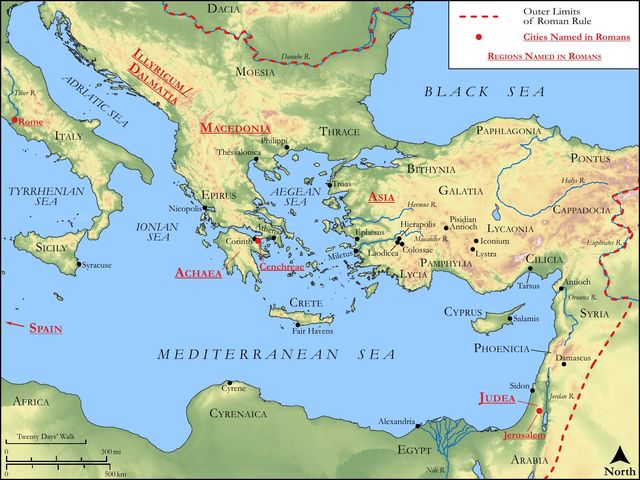
See on the biblical-era maps

Study this verse
Public-domain commentary
Matthew Henry
From his Commentary on the Whole Bible. Henry comments on passages, not single verses — this entry covers Romans 4:9–16. His four-level outline is real structure in the source text, so it is rendered as structure.
St. Paul observes in this paragraph when and why Abraham was thus justified; for he has several things to remark upon that. It was before he was circumcised, and before the giving of the law; and there was a reason for both.
I.It was before he was circumcised, Rom 4:10.
His faith was counted to him for righteousness while he was in uncircumcision. It was imputed, Gen 15:6, and he was not circumcised till ch. 17. Abraham is expressly said to be justified by faith fourteen years, some say twenty-five years, before he was circumcised. Now this the apostle takes notice of in answer to the question (Rom 4:9), Cometh this blessedness then on the circumcision only, or on the uncircumcision also? Abraham was pardoned and accepted in uncircumcision, a circumstance which, as it might silence the fears of the poor uncircumcised Gentiles, so it might lower the pride and conceitedness of the Jews, who gloried in their circumcision, as if they had the monopoly of all happiness. Here are two reasons why Abraham was justified by faith in uncircumcision: -
1.That circumcision might be a seal of the righteousness of faith, Rom 4:11. The tenour of the covenants must first be settled before the seal can be annexed. Sealing supposes a previous bargain, which is confirmed and ratified by that ceremony. After Abraham's justification by faith had continued several years only a grant by parole, for the confirmation of Abraham's faith God was pleased to appoint a sealing ordinance, and Abraham received it; though it was a bloody ordinance, yet he submitted to it, and even received it as a special favour, the sign of circumcision, etc. Now we may hence observe,
(1.)The nature of sacraments in general: they are signs and seals - signs to represent and instruct, seals to ratify and confirm. They are signs of absolute grace and favour; they are seals of the conditional promises; nay, they are mutual seals: God does in the sacraments seal to us to be to us a God, and we do therein seal to him to be to him a people.
(2.)The nature of circumcision in particular: it was the initiating sacrament of the Old Testament; and it is here said to be,
[1.]A sign - a sign of that original corruption which we are all born with, and which is cut off by spiritual circumcision, - a commemorating sign of God's covenant with Abraham, - a distinguishing sign between Jews and Gentiles, - a sign of admission into the visible church, - a sign prefiguring baptism, which comes in the room of circumcision, now under the gospel, when (the blood of Christ being shed) all bloody ordinances are abolished; it was an outward and sensible sign of an inward and spiritual grace signified thereby.
[2.]A seal of the righteousness of the faith. In general, it was a seal of the covenant of grace, particularly of justification by faith - the covenant of grace, called the righteousness which is of faith (Rom 10:6), and it refers to an Old Testament promise, Deu 30:12. Now if infants were then capable of receiving a seal of the covenant of grace, which proves that they then were within the verge of that covenant, how they come to be now cast out of the covenant and incapable of the seal, and by what severe sentence they were thus rejected and incapacitated, those are concerned to make out that not only reject, but nullify and reproach, the baptism of the seed of believers.
2.That he might be the father of all those that believe. Not but that there were those that were justified by faith before Abraham; but of Abraham first it is particularly observed, and in him commenced a much clearer and fuller dispensation of the covenant of grace than any that had been before extant; and there he is called the father of all that believe, because he was so eminent a believer, and so eminently justified by faith, as Jabal was the father of shepherds and Jubal of musicians, Gen 4:20, Gen 4:21. The father of all those that believe; that is, a standing pattern of faith, as parents are examples to their children; and a standing precedent of justification by faith, as the liberties, privileges, honours, and estates, of the fathers descend to their children. Abraham was the father of believers, because to him particularly the magna charta was renewed.
(1.)The father of believing Gentiles, though they be not circumcised. Zaccheus, a publican, if he believe, is reckoned a son of Abraham, Luk 19:9. Abraham being himself uncircumcised when he was justified by faith, uncircumcision can never be a bar. Thus were the doubts and fears of the poor Gentiles anticipated and no room left to question but that righteousness might be imputed to them also, Col 3:11; Gal 5:6.
(2.)The father of believing Jews, not merely as circumcised, and of the seed of Abraham according to the flesh, but because believers, because they are not of the circumcision only (that is, are not only circumcised), but walk in the steps of that faith - have not only the sign, but the thing signified - not only are of Abraham's family, but follow the example of Abraham's faith. See here who are the genuine children and lawful successors of those that were the church's fathers: not those that sit in their chairs, and bear their names, but those that tread in their steps; this is the line of succession, which holds, notwithstanding interruptions. It seems, then, those were most loud and forward to call Abraham father that had least title to the honours and privileges of his children. Thus those have most reason to call Christ Father, not that bear his name in being Christians in profession, but that tread in his steps.
II.It was before the giving of the law, Rom 4:13-16.
The former observation is levelled against those that confined justification to the circumcision, this against those that expected it by the law; now the promise was made to Abraham long before the law. Compare Gal 3:17, Gal 3:18. Now observe,
1.What that promise was - that he should be the heir of the world, that is, of the land of Canaan, the choicest spot of ground in the world, - or the father of many nations of the world, who sprang from him, besides the Israelites, - or the heir of the comforts of the life which now is. The meek are said to inherit the earth, and the world is theirs. Though Abraham had so little of the world in possession, yet he was heir of it all. Or, rather, it points at Christ, the seed here mentioned; compare Gal 3:16, To thy seed, which is Christ. Now Christ is the heir of the world, the ends of the earth are his possession, and it is in him that Abraham was so. And it refers to that promise (Gen 12:3), In thee shall all the families of the earth be blessed.
2.How it was made to him: Not through the law, but through the righteousness of faith. Not through the law, for that was not yet given: but it was upon that believing which was counted to him for righteousness; it was upon his trusting God, in his leaving his own country when God commanded him, Heb 11:8. Now, being by faith, it could not be by the law, which he proves by the opposition there is between them (Rom 4:14, Rom 4:15): If those who are of the law be heirs; that is, those, and those only, and they by virtue of the law (the Jews did, and still do, boast that they are the rightful heirs of the world, because to them the law was given), then faith is made void; for, if it were requisite to an interest in the promise that there should be a perfect performance of the whole law, then the promise can never take its effect, nor is it to any purpose for us to depend upon it, since the way to life by perfect obedience to the law, and spotless sinless innocency, is wholly blocked up, and the law in itself opens no other way. This he proves, Rom 4:15. The law worketh wrath - wrath in us to God; it irritates and provokes that carnal mind which is enmity to God, as the damming up of a stream makes it swell - wrath in God against us. It works this, that is, it discovers it, or our breach of the law works it. Now it is certain that we can never expect the inheritance by a law that worketh wrath. How the law works wrath he shows very concisely in the latter part of the verse: Where no law is there is no transgression, an acknowledged maxim, which implies, Where there is a law there is transgression and that transgression is provoking, and so the law worketh wrath.
3.Why the promise was made to him by faith; for three reasons, Rom 4:16.
(1.)That it might be by grace, that grace might have the honour of it; by grace, and not by the law; by grace, and not of debt, nor of merit; that Grace, grace, might be cried to every stone, especially to the top-stone, in this building. Faith hath particular reference to grace granting, as grace hath reference to faith receiving. By grace, and therefore through faith, Eph 2:8. For God will have every crown thrown at the feet of grace, free grace, and every song in heaven sung to that tune, Not unto us, O Lord, not unto us, but unto thy name be the praise.
(2.)That the promise might be sure. The first covenant, being a covenant of works, was not sure: but, through man's failure, the benefits designed by it were cut off; and therefore, the more effectually to ascertain and ensure the conveyance of the new covenant, there is another way found out, not by works (were it so, the promise would not be sure, because of the continual frailty and infirmity of the flesh), but by faith, which receives all from Christ, and acts in a continual dependence upon him, as the great trustee of our salvation, and in whose keeping it is safe. The covenant is therefore sure, because it is so well ordered in all things, Sa2 23:5.
(3.)That it might be sure to all the seed. If it had been by the law, it had been limited to the Jews, to whom pertained the glory, and the covenants, and the giving of the law (Rom 9:4); but therefore it was by faith that Gentiles as well as Jews might become interested in it, the spiritual as well as the natural seed of faithful Abraham. God would contrive the promise in such a way as might make it most extensive, to comprehend all true believers, that circumcision and uncircumcision might break no squares; and for this (Rom 4:17) he refers us to Gen 17:5, where the reason of the change of his name from Abram - a high father, to Abraham - the high father of a multitude, is thus rendered: For a father of many nations have I made thee; that is, all believers, both before and since the coming of Christ in the flesh, should take Abraham for their pattern, and call him father. The Jews say Abraham was the father of all proselytes to the Jewish religion. Behold, he is the father of all the world, which are gathered under the wings of the Divine Majesty. - Maimonides.
Historical interpretation
Two Centuries of Reception
5 surviving comments on this verse. Each one is dated, so this reads as a timeline rather than a list.
Select a marker to jump to its quote. Markers stagger vertically where authors wrote within a few decades of each other.
Long before Moses ever existed, the Lord appeared to Abraham and said: “Go from your country and your kindred and your father’s house to the land that I will show you. And I will make of you a great nation, and I will bless you and make your name great, so that you will be a blessing. I will bless those who bless you, and him who curses you I will curse; and by you all the families of the earth will be blessed.”
It is clear that the law had not yet been given, neither was there as yet circumcision, when the promise was made to Abraham the believer and to his seed, which is Christ, who would cleanse the sins of all. Therefore Abraham was made heir to the world not by the merit earned from keeping the law but by faith. The heir of the world is the heir of the earth, which he obtained in his children. For Christ is the heir of the nations, as David sings: “I will make the nations your heritage and the ends of the earth your possession.”
"For the promise, that he should be the heir of the world, was not to Abraham, or to his seed, through the law, but through the righteousness of faith."
He had shown that faith is necessary, that it is older than circumcision, that it is more mighty than the Law, that it establisheth the Law. For if all sinned, it was necessary: if one being uncircumcised was justified, it is older: if the knowledge of sin is by the Law and yet it was without the Law made evident, it is more mighty: if it has testimony borne to it by the Law, and establisheth the Law, it is not opposed to it, but friendly and allied to it.
Here Paul calls circumcision the law, because every commandment can be regarded as part of the law. Abraham inherited the world, either because in his seed (viz., Christ) all the nations which were given to him by the Father might be blessed or because the nations would sup with him in the kingdom of heaven.
Paul says that the righteous will inherit the world because the ungodly will be thrown out and handed over to punishment on the day of judgment, but the righteous will possess the universe which remains, and will have been renewed, and the good things of heaven and earth will be theirs.
Continue studying Romans 4:13 across the web’s major study libraries — every link below opens this exact verse, chapter, or book on the destination site.
Read & Compare
 BibleGatewayThis verse in more than 200 translations and 70 languages.
 Bible.comThe YouVersion reader — hundreds of translations, reading plans, and highlights.
 ESV.orgCrossway's official English Standard Version reader.
 NET BibleThe NET translation with 60,000+ translators' notes on every rendering decision.
 STEP BibleTyndale House's free study tool — original text, vocabulary, and scholarly resources.
 BibliaLogos Bible Software's free web reader.
 USCCBThe New American Bible (Revised Edition) with the U.S. bishops' study notes.
Commentaries
 BibleHub CommentariesDozens of classic commentaries on this verse, gathered on one page.
 StudyLightMore than 100 commentary sets — the largest collection on the web.
 BibleRefPlain-English commentary on what this verse means, verse by verse.
 Enduring WordDavid Guzik's free commentary on this chapter, widely used by Bible teachers.
 Bible Study ToolsVerse commentary alongside Greek and Hebrew study aids.
Original Language & Research
- BibleHub InterlinearThe verse word by word — original language, transliteration, and English.
- BibleHub LexiconEvery word's original-language definition and Strong's entry.
 Blue Letter BibleDeep-study tools — Strong's numbers, concordance, and word studies.
 CNTR CollationThe earliest Greek manuscripts of this verse, collated letter by letter.
Sermons, Hymns & Audio


TrulyRandomVerse is not affiliated with these sites and doesn’t control their content. They’re linked because they’re genuinely useful.
Summary
Romans 4:13 serves as a foundational declaration in Paul's exposition on justification by faith, asserting that God's monumental promise to Abraham—that he would become the heir of the world—was not contingent upon adherence to the Mosaic Law, which had not yet been given, nor upon human works. Instead, this universal inheritance was secured and received through a righteousness that stems from faith, thereby establishing a principle applicable to all, Jew and Gentile alike, who believe.
Context
ShowHideLiterary Context
Romans 4:13 is situated within Paul's profound theological argument in Romans 3-5, where he systematically dismantles the notion of justification by works of the Law and establishes justification by faith as the sole means of salvation. Having concluded in Romans 3:20-26 that "by the deeds of the law there shall no flesh be justified in his sight," Paul then turns to Abraham in Romans 4 as the preeminent biblical example. Paul demonstrates that Abraham, the revered patriarch of Israel, was declared righteous not by circumcision or adherence to the Law (which came centuries later), but by his belief, as stated in Genesis 15:6. Verse 13 specifically elaborates on the nature of the promise made to Abraham and his "seed," clarifying the mechanism of its reception as being "through the righteousness of faith" rather than "through the law," thereby reinforcing the argument against legalism and in favor of grace.
Historical & Cultural Context
In Paul's time, the Jewish people largely understood their covenant relationship with God and their status as His chosen people to be intrinsically linked to the Mosaic Law. Observance of the Law, including circumcision and dietary regulations, was considered central to their identity and their hope of righteousness. Paul's argument in Romans 4, using Abraham as an example, directly challenges this deeply ingrained perspective. Abraham lived centuries before the Law was given at Mount Sinai (Exodus 19-20), making it impossible for him to be justified by it. By demonstrating that Abraham's righteousness was credited through faith, Paul strategically undermines the Jewish reliance on the Law as a means of salvation, thereby opening the door for Gentiles to be included in God's covenant people on the same basis of faith. The concept of "heir of the world" also expands the scope of God's promise beyond merely the land of Canaan, hinting at a universal, spiritual inheritance that transcends ethnic and geographical boundaries, a radical idea for many first-century Jews.
Key Themes
ShowHideThis verse powerfully contributes to several overarching themes in Romans. The primary theme is Justification by Faith, emphasizing that a right standing with God is not earned through human effort or adherence to religious codes, but is freely given by God and received through trust in Him. This stands in stark contrast to Justification by Law, which Paul explicitly rejects as a path to righteousness, highlighting its inability to provide life or true righteousness (Romans 8:3). The verse also develops the theme of God's Promise and Covenant Faithfulness, showing that God's promises to Abraham were unconditional and rooted in His character, not in human performance. Furthermore, it expands the understanding of Abraham's Seed to include not just physical descendants but all who share Abraham's faith, whether Jew or Gentile, thereby laying the groundwork for the inclusion of the nations into God's family (Romans 4:16-17). Finally, the concept of Universal Inheritance ("heir of the world") broadens the scope of God's redemptive plan beyond Israel to encompass all humanity, foreshadowing the global reach of the Gospel.
Exposition and Analysis
ShowHideKey Word Analysis
ShowHideThis term refers to an announcement, specifically a divine assurance of good. In this context, it denotes God's solemn and binding declaration to Abraham, encompassing not only the promise of countless descendants and land but, as Paul interprets it, a universal inheritance. This "promise" is distinct from the Law, being given centuries earlier and based on God's sovereign initiative and grace.
Literally meaning "a sharer by lot" or "inheritor," this word signifies one who receives an inheritance. Paul uses it to describe Abraham's destined role not just as a father of a nation, but as a recipient of a global, spiritual inheritance. This inheritance is not earned but is a gift, aligning with the concept of grace.
This term denotes equity of character or act, and in a Christian theological sense, refers to justification—a state of being declared righteous by God. Paul's emphasis on "the righteousness of faith" highlights that this right standing before God is imputed to believers on the basis of their trust in Him, rather than being achieved through their own moral performance or adherence to the Law.
Verse Breakdown
ShowHide"For the promise, that he should be the heir of the world"
This clause introduces the subject of Paul's argument: the specific nature and scope of God's promise to Abraham. The "promise" here is not merely the land of Canaan, but a far grander, universal inheritance, implying a spiritual dominion or a share in God's redemptive plan for all humanity. This expansive understanding elevates Abraham's role beyond a national patriarch to a figure of global significance.
"[was] not to Abraham, or to his seed, through the law"
This crucial negative assertion directly refutes the idea that the promise was given or secured through the Mosaic Law. Paul emphasizes that the Law came much later than Abraham, making it impossible for his justification or the promise's fulfillment to be dependent on it. This statement serves to dismantle the Jewish reliance on legal obedience as the path to righteousness and inheritance. The phrase "or to his seed" extends this principle to Abraham's descendants, both physical and spiritual, ensuring that the same condition applies to all who claim Abraham as their father.
"but through the righteousness of faith"
This positive declaration provides the true means by which the promise was received. The "righteousness of faith" signifies a right standing with God that is not achieved by human effort or merit, but is freely given by God and apprehended through Abraham's belief and trust in God's word. This principle establishes faith, not works of the law, as the singular pathway to receiving God's promises and being declared righteous.
Literary Devices
ShowHideRomans 4:13 employs several effective literary devices to convey its profound theological message. Antithesis is central to the verse, starkly contrasting "through the law" with "through the righteousness of faith." This direct opposition highlights the mutually exclusive nature of these two paths to God's promise, underscoring Paul's argument that one cannot be justified by both. The use of Emphasis is also evident, particularly through the negative "not" followed by the affirmative "but," which forcefully redirects the reader's understanding from a works-based system to a faith-based one. Furthermore, the phrase "heir of the world" functions as Hyperbole or Metonymy, expanding the literal promise of land to a figurative, universal spiritual inheritance, thereby signifying the expansive and inclusive nature of God's redemptive plan through Abraham's faith.
Theological and Thematic Connections
ShowHideRomans 4:13 is a cornerstone of Pauline theology, asserting that the Abrahamic covenant, with its promise of a global inheritance, was established on the principle of faith, not legalistic adherence. This truth profoundly shapes our understanding of God's grace and the universal scope of salvation. By demonstrating that Abraham was justified by faith centuries before the Law, Paul dismantles any notion that human effort or ethnic identity is the basis for a right relationship with God. This verse underscores that God's method of salvation has always been consistent: through faith. It reveals a God who initiates covenant relationships based on His sovereign grace and invites a response of trust, leading to an imputed righteousness that is a gift, not an achievement. This foundational principle ensures that salvation is accessible to all, regardless of their background, provided they respond with faith.
Reflection and Application
ShowHideRomans 4:13 offers profound comfort and liberation for believers today. It assures us that our standing before God, our hope of eternal life, and our share in God's kingdom are not precarious achievements dependent on our perfect performance of rules or rituals. Instead, they are secure gifts, freely given by God and received through simple, trusting faith in Him. This truth frees us from the exhausting burden of trying to earn God's favor or prove our worthiness. It calls us to rest in the finished work of Christ and the faithfulness of God, just as Abraham did. Our response to this grace should be one of profound gratitude, leading to a life of joyful obedience that flows from love and trust, rather than from a desperate attempt to gain acceptance. It reminds us that the inheritance we receive is not limited to earthly blessings but encompasses a spiritual reality that transcends all boundaries, inviting us to live as citizens of a heavenly kingdom, heirs with Abraham through faith.
Questions for Reflection
ShowHideFAQ
ShowHideWhat does it mean for Abraham to be "heir of the world"?
ShowHideThe phrase "heir of the world" expands the scope of God's promise to Abraham beyond the literal land of Canaan (Genesis 12:7). Paul interprets this promise in a universal, spiritual sense. It signifies that through Abraham's faith, and through his spiritual descendants (both Jews and Gentiles who believe), God's redemptive plan would encompass all nations and ultimately establish a new creation, a spiritual inheritance that transcends geographical boundaries and includes all who are in Christ. It points to a global, spiritual dominion and participation in God's cosmic plan of salvation, culminating in the new heavens and new earth where righteousness dwells (2 Peter 3:13).
Why is it so important that the promise was "not to Abraham... through the law"?
ShowHideThis distinction is crucial for Paul's argument about justification by faith. The Mosaic Law was given centuries after Abraham (Exodus 19). If Abraham's righteousness or the promise's fulfillment depended on the Law, then the Law would supersede or invalidate the prior promise, and salvation would be limited to those who could perfectly keep the Law. Paul argues that since Abraham was justified by faith before the Law, God's method of salvation is consistent and accessible to all, not just those under the Law. This highlights that salvation is a gift of grace received through faith, not an earned reward for legal obedience, thereby opening the door for Gentile inclusion in God's covenant family (Romans 3:21-22).
Christ-Centered Fulfillment
ShowHideRomans 4:13 finds its ultimate and most profound fulfillment in Jesus Christ. The "promise" to Abraham, that he would be the "heir of the world," is realized in Christ, who is the true and ultimate "seed" of Abraham (Galatians 3:16). Through His perfect life, atoning death, and glorious resurrection, Christ has secured the inheritance not just for a nation, but for all who believe in Him, making them co-heirs with Him (Romans 8:17). The "righteousness of faith" that Abraham exemplified is fully and perfectly embodied in Christ, whose righteousness is imputed to all who trust in Him (2 Corinthians 5:21). Thus, the universal scope of the promise—Abraham being "heir of the world"—is fulfilled as the Gospel, through Christ, extends to every tribe, tongue, people, and nation, gathering a redeemed humanity from across the globe into God's eternal kingdom (Revelation 7:9-10). Christ is the means, the content, and the guarantor of this glorious, worldwide inheritance, making all who are "in Christ" true children of Abraham by faith and partakers of the divine promise (Galatians 3:29).