


Genesis 22:17
Bible text: King James Version (1769 Blayney text) · Public domain
Bible text: King James Version with Strong's numbers · Public domain
Bible text: Berean Standard Bible · Public domain
Bible text: American Standard Version (1901) · Public domain
Bible text: World English Bible, Messianic edition · Public domain
Bible text: Geneva Bible (1599) · Public domain
Bible text: Young's Literal Translation · Public domain
- כִּיkiforH3588PrtParticle Conditional
- בָרֵךְva·Rekhsurely <bless>H1288V-Piel-InfVerb Piel Infinitive Construct
- אֲבָרֶכְךָ'a·va·rekh·KhaI will bless youH1288V-Piel-Imperf-1cs ¦ 2msVerb Piel Imperfect 1st Singular common genderאֲבָרֶכְI will blessךָyou
- וְהַרְבָּהve·har·Bahand certainly <to increase>H7235Conj-w ¦ V-Hiphil-InfAbsVerb Hiphil Infinitive Absoluteוְandהַרְבָּהcertainly <to increase>
- אַרְבֶּה'ar·BehI will increaseH7235V-Hiphil-Imperf-1csVerb Hiphil Imperfect 1st Singular common gender
- אֶת'et<obj.>H853DirObjMParticle Object Indicator
- זַרְעֲךָzar·'a·Khayour offspringH2233N-msc ¦ 2msNoun Singular Masculine Constructזַרְעֲoffspringךָyour
- כְּכוֹכְבֵיke·chokh·Veilike [the] stars ofH3556Prep-k ¦ N-mpcNoun Plural Masculine Constructכְּlikeכוֹכְבֵי[the] stars of
- הַשָּׁמַיִםha·sha·Ma·yimthe heavensH8064Art ¦ N-mpNoun Plural Masculine Absoluteהַtheשָּׁמַיִםheavens
- וְכַחוֹלve·kha·Choland like the sandH2344Conj-w ¦ Prep-k ¦ N-msNoun Singular Masculine Absoluteוְandכַlike theחוֹלsand
- אֲשֶׁר'a·SherwhichH834RelParticle Relative
- עַל'al[is] onH5921PrepPreposition
- שְׂפַתse·Fat[the] shore ofH8193N-fscNoun Singular Feminine Construct
- הַיָּםhai·Yamthe seaH3220Art ¦ N-msNoun Singular Masculine Absoluteהַtheיָּםsea
- וְיִרַשׁve·yi·Rashso <it> may take possession ofH3423Conj-w ¦ V-Qal-ConjImperf-3msVerb Qal Conjunction+Imperfect 3rd Singular Masculineוְsoיִרַשׁ<it> may take possession of
- זַרְעֲךָzar·'a·Khayour offspringH2233N-msc ¦ 2msNoun Singular Masculine Constructזַרְעֲoffspringךָyour
- אֵת'et<obj.>H853DirObjMParticle Object Indicator
- שַׁעַרSha·'ar[the] gate ofH8179N-mscNoun Singular Masculine Construct
- אֹיְבָיו'o·ye·Vavits enemiesH341V-Qal-Prtcpl-mp ¦ 3msVerb Qal Participle Plural Masculine Constructאֹיְבָיenemiesוits
English is a literal word-by-word gloss of the Hebrew, not the KJV's wording. Why?
This is the original text the KJV's translators worked from — each Hebrew word with its own literal English meaning in this verse, prepared by scholars at Tyndale House, Cambridge. The KJV translates whole sentences, not word by word, so its wording differs: one Hebrew word can become several English words, and the KJV may choose “the LORD” where the gloss reads “Yahweh”. Both are faithful — they answer different questions. For the KJV's own rendering, switch to the KJV text.
Details
See on the biblical-era maps


Study this verse
Public-domain commentary
Matthew Henry
From his Commentary on the Whole Bible. Henry comments on passages, not single verses — this entry covers Genesis 22:15–19.
Abraham's obedience was graciously accepted; but this was not all: here we have it recompensed, abundantly recompensed, before he stirred from the place; probably while the ram he had sacrificed was yet burning God sent him this gracious message, renewed and ratified his covenant with him. All covenants were made by sacrifice, so was this by the typical sacrifices of Isaac and the ram. Very high expressions of God's favour to Abraham are employed in this confirmation of the covenant with him, expressions exceeding any he had yet been blessed with. Note, Extraordinary services shall be crowned with extraordinary honours and comforts; and favours in the promise, though not yet performed, ought to be accounted real and valuable recompences. Observe, 1. God is pleased to make mention of Abraham's obedience as the consideration of the covenant; and he speaks of it with an encomium: Because thou hast done this thing, and hast not withheld thy son, thine only son, Gen 22:16. He lays a strong emphasis on this, and (Gen 22:18) praises it as an act of obedience: in it thou hast obeyed my voice, and to obey is better than sacrifice. Not that this was a proportionable consideration, but God graciously put this honour upon that by which Abraham had honoured him. 2. God now confirmed the promise with an oath. It was said and sealed before; but now it is sworn: By myself have I sworn; for he could swear by no greater, Heb 6:13. Thus he interposed himself by an oath, as the apostle expresses it, Heb 6:17. He did (to speak with reverence) even pawn his own life and being upon it (As I live), that by all those immutable things, in which it was impossible for God to lie, he and his might have strong consolation. Note, If we exercise faith, God will encourage it. Improve the promises, and God will ratify them. 3. The particular promise here renewed is that of a numerous offspring: Multiplying, I will multiply thee, Gen 22:17. Note, Those that are willing to part with any thing for God shall have it made up to them with unspeakable advantage. Abraham has but one son, and is willing to part with that one, in obedience to God. "Well," said God, "thou shalt be recompensed with thousands and millions." What a figure does the seed of Abraham make in history! How numerous, how illustrious, were his known descendants, who, to this day, triumph in this, that they have Abraham to their father! Thus he received a thousand-fold in this life, Mat 19:29. 4. The promise, doubtless, points at the Messiah, and the grace of the gospel. This is the oath sworn to our father Abraham, which Zacharias refers to, Luk 1:73, etc. And so here is a promise, (1.) Of the great blessing of the Spirit: In blessing, I will bless thee, namely, with that best of blessings the Gift of the Holy Ghost; the promise of the Spirit was that blessing of Abraham which was to come upon the Gentiles through Jesus Christ, Gal 3:14. (2.) Of the increase of the church that believers, his spiritual seed, should be numerous as the stars of heaven. (3.) Of spiritual victories: Thy seed shall possess the gate of his enemies. Believers, by their faith, overcome the world, and triumph over all the powers of darkness, and are more than conquerors. Probably Zacharias refers to this part of the oath (Luk 1:74), That we, being delivered out of the hand of our enemies, might serve him without fear. But the crown of all is the last promise. (4.) Of the incarnation of Christ: In thy see, one particular person that shall descend from thee (for he speaks not of many, but of one, as the apostle observers, Gal 3:16), shall all the nations of the earth be blessed, or shall bless themselves, as the phrase is, Isa 65:16. In him all may be happy if they will, and all that belong to him shall be so, and shall think themselves so. Christ is the great blessing of the world. Abraham was ready to give up his son for a sacrifice to the honour of God, and, on that occasion, God promised to give his Son a sacrifice for the salvation of man.
Historical interpretation
Two Centuries of Reception
10 surviving comments on this verse. Each one is dated, so this reads as a timeline rather than a list.
Select a marker to jump to its quote. Markers stagger vertically where authors wrote within a few decades of each other.
For when God made promise to Abraham, because he could swear by no greater, he sware by himself, Saying, Surely blessing I will bless thee, and multiplying I will multiply thee. [Genesis 22:17] And so, after he had patiently endured, he obtained the promise. For men verily swear by the greater: and an oath for confirmation is to them an end of all strife. Wherein God, willing more abundantly to show unto the heirs of promise the immutability of his counsel, confirmed it by an oath: That by two immutable things, in which it was impossible for God to lie, we might have a strong consolation, who have fled for refuge to lay hold upon the hope set before us: Which hope we have as an anchor of the soul, both sure and stedfast, and which entereth into that within the veil; Whither the forerunner is for us entered, even Jesus, made an high priest for ever after the order of Melchisedec.
Let us then cling to his blessing, and let us see what are the ways of blessedness. Let us recall the events of old. Why was our father Abraham blessed? Was it not because he performed justice and truth through faith? Isaac, knowing the future in confidence, was willingly led forth as a sacrifice.
Rightly then is he blessed because he was faithful; and rightly was he faithful because he was patient.
Let us return now to ourselves and treat the moral subject in every detail.The apostle says, as we have already related above, “The first man was of the earth, earthly; the second man from heaven, heavenly. Such as is the earthly, such also are the earthly; and such as is the heavenly, such also are they that are heavenly. As we have borne the image of the earthly, let us bear also the image of the heavenly.” You see what he is showing, that if you remain in that which is first, which is of the earth, you will be rejected, unless you change yourself, unless you have been converted, unless, having been made “heavenly,” you have received “the image of the heavenly.” This is the same thing he also says elsewhere: “Stripping yourselves of the old man with his deeds and putting on the new, who has been created according to God.” He writes that very thing also in another place: “Behold, the old things are passed away, all things are made new.”19
For this reason therefore God renews his promises to show you that you also ought to be renewed. He does not continue in the old, lest you also continue as “the old man”; this is said “from heaven,” that you also might receive “the image of the heavenly.” For what will it profit you if God should renew the promises and you should not be renewed? If he should speak from heaven and you should hear from earth? What does it profit you if God binds himself with an oath and you should pass over these things as if hearing a common story?
What person now needs an explanation to know how the seed of Christ is multiplied who sees the preaching of the gospel extended from the ends of the earth “to the ends of the earth”? And who sees that there is now almost no place which has not received the seed of the Word? For indeed this also was prefigured in the beginnings of the world when God said to Adam, “Increase and multiply.”
The bonds indeed with which they bind us are our passions and vices with which we are bound until “we crucify our flesh with the vices and concupiscences” and so at last “break their bonds asunder and cast away their yoke from us.”47The seed of Abraham, therefore, that is, the seed of the Word, which is the preaching of the gospel and faith in Christ, has occupied “the cities of their enemies.”
To be able to find [these treasures], we need the help of God who alone can “break in pieces the doors of bronze” by which they are shut up and hidden and who “cuts asunder the bars of iron” and the bolts by which access was prohibited for attaining all the truths that were written and hidden in Genesis. [These truths are] concerning the different kinds of souls, concerning the seeds and generations that either pertain directly to Israel or are separated much further from his offspring.
In the former promise there was only the statement; here an oath is interposed, which the holy apostle writing to the Hebrews interprets in this way, saying, “God, meaning to show the heirs of the promise the immutability of his counsel, interposed an oath.” And again, Scripture says, “Men swear by one greater than themselves.” “But God, because he had no one greater by whom he might swear,” “ ‘I swear by myself,’ said the Lord.” It was not that necessity forced God to swear (for who would exact the oath from him?), but as the apostle Paul has interpreted it, that by this he might point out to his worshipers “the immutability of his counsel.” So also elsewhere it is said by the prophet, “The Lord has sworn nor will he repent: You are a priest forever according to the order of Melchizedek.”12At that time in the first promise there is no reason stated why the promise is given, only that he brought him forth and “showed him,” Scripture says, “the stars of heaven, and said, ‘So shall your seed be.’ ” But now he adds the reason on account of which he confirms with an oath the promise which will be steadfast. For he says, “Because you have done this thing and have not spared your son.” He shows therefore that because of the offering or passion of the son the promise is steadfast. This clearly points out that the promise remains steadfast because of the passion of Christ for the people of the Gentiles “who are of the faith of Abraham.”
It is written in the prophet speaking in the person of the Lord, “I have used similitudes by the ministries of the prophets.” What this statement means is this: Although our Lord Jesus Christ is one in his substance and is nothing other than the Son of God, nevertheless he is represented as various and diverse in the figures and images of the Scripture.For example, as I recall we have explained in what precedes that Christ himself was Isaac, in type, when he was offered as a holocaust. Nevertheless the ram also represented him. I say furthermore that he is exhibited also in the angel who spoke to Abraham and says to him, “Lay not your hand on the boy.” For he says to him, “Because you have done this thing, I will certainly bless you.”
He is said to be the sheep or the lamb that is sacrificed in the Passover, and he is designated as the shepherd of the sheep. He is also described, no less, as the high priest who offers the sacrifice.
But what does it profit me, if the seed of Abraham, “which is Christ,” should possess “the cities of his enemies for an inheritance” and should not possess my city? If in my city, that is in my soul, which is “the city of the great king,” neither his laws nor his ordinances should be observed? What does it profit me that he has subjected the whole world and possesses the cities of his enemies if he should not also conquer his enemies in me, if he should not destroy “the law which is in my members fighting against the law of my mind and which leads me captive in the law of sin”?So therefore let each one of us do what is necessary that Christ may also conquer the enemies in his soul and in his body, and, subjecting and triumphing over them, may possess the city even of his soul. For in this way we are made to belong to his portion, the better portion, which is “as the stars of heaven in glory,” that also we might be able to receive the blessing of Abraham through Christ our Lord, “to whom belongs glory and sovereignty forever and ever. Amen.”
Continue studying Genesis 22:17 across the web’s major study libraries — every link below opens this exact verse, chapter, or book on the destination site.
Read & Compare
 BibleGatewayThis verse in more than 200 translations and 70 languages.
 Bible.comThe YouVersion reader — hundreds of translations, reading plans, and highlights.
 ESV.orgCrossway's official English Standard Version reader.
 NET BibleThe NET translation with 60,000+ translators' notes on every rendering decision.
 STEP BibleTyndale House's free study tool — original text, vocabulary, and scholarly resources.
 BibliaLogos Bible Software's free web reader.
 USCCBThe New American Bible (Revised Edition) with the U.S. bishops' study notes.
Commentaries
 BibleHub CommentariesDozens of classic commentaries on this verse, gathered on one page.
 StudyLightMore than 100 commentary sets — the largest collection on the web.
 BibleRefPlain-English commentary on what this verse means, verse by verse.
 Enduring WordDavid Guzik's free commentary on this chapter, widely used by Bible teachers.
 Bible Study ToolsVerse commentary alongside Greek and Hebrew study aids.
Original Language & Research
- BibleHub InterlinearThe verse word by word — original language, transliteration, and English.
- BibleHub LexiconEvery word's original-language definition and Strong's entry.
 Blue Letter BibleDeep-study tools — Strong's numbers, concordance, and word studies.
 SefariaThe Hebrew text with Rashi and centuries of Jewish commentary.
Sermons, Hymns & Audio


TrulyRandomVerse is not affiliated with these sites and doesn’t control their content. They’re linked because they’re genuinely useful.
Summary
Genesis 22:17 presents God's solemn, sworn oath to Abraham, delivered immediately following his supreme act of faith and obedience in offering Isaac. This pivotal verse powerfully reiterates and intensifies the foundational promises of the Abrahamic Covenant: an overwhelming outpouring of divine blessing, the multiplication of his descendants into an immeasurable host, and the guaranteed triumph of his offspring over their adversaries, ultimately culminating in the spiritual victory achieved through Jesus Christ.
Context
ShowHideLiterary Context
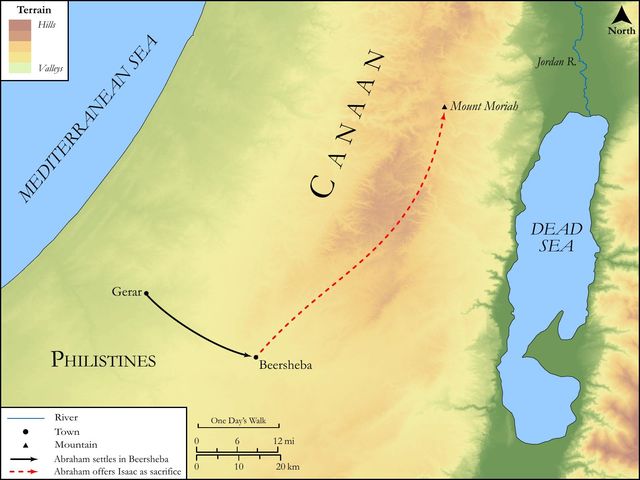
This profound divine declaration is delivered at one of the most climactic moments in Abraham's narrative, immediately after his willingness to sacrifice his beloved son, Isaac, on Mount Moriah. This event, often referred to as the Akedah, or the binding of Isaac, served as the ultimate test and confirmation of Abraham's unwavering faith and devotion to God. Rather than merely repeating previous promises, this verse constitutes God's emphatic, sworn oath, highlighting the immutable and unbreakable nature of the Abrahamic Covenant, now confirmed and intensified by Abraham's demonstrated faithfulness. It marks a turning point where God's commitment to Abraham's lineage is sealed with an oath, ensuring its fulfillment.
Historical & Cultural Context
In the days of the patriarchs, oaths were profoundly binding, often sworn with God as witness and carrying severe consequences for breach. God's swearing by Himself (as recorded in Genesis 22:16) underscores the absolute certainty and immutability of His promises, a concept understood and highly valued in Abraham's cultural milieu. The concept of "seed" (posterity) was central throughout Scripture, representing continuity, legacy, and power. Furthermore, the "gate" of a city was not merely an entrance but its strategic, economic, judicial, and military hub. To "possess the gate" of an enemy signified complete conquest, control, and dominion, a powerful image of decisive victory.
Key Themes
ShowHideGenesis 22:17 contributes significantly to several overarching themes within the book of Genesis and the broader biblical narrative. It powerfully reinforces the theme of Divine Faithfulness, demonstrating God's unwavering commitment to His covenant promises despite human frailty. It highlights the Covenant Intensification that occurs through Abraham's obedience, illustrating that while the covenant is initiated by grace, human response plays a role in its unfolding. The promise of Innumerable Seed underscores God's plan for a vast people, foreshadowing both the nation of Israel and the global community of believers. Finally, the declaration of Victory and Dominion through the seed's possession of the enemy's gate points to the ultimate triumph of God's redemptive plan over all opposing forces, a theme that finds its ultimate expression in the person and work of Christ, as seen throughout the New Testament, particularly in Paul's epistles.
Exposition and Analysis
ShowHideKey Word Analysis
ShowHideThis primitive root means "to kneel," implying adoration towards God and benefit towards man. The repetition of the verb "bless" (in blessing I will bless) uses the Hebrew infinitive absolute construction, which intensifies the action, conveying absolute certainty, abundance, and an overwhelming outpouring of divine favor. It signifies that God will surely and abundantly bestow His favor upon Abraham and his descendants.
This noun refers to "seed" in a literal sense, but figuratively it denotes "fruit," "plant," "sowing-time," and most importantly, "posterity" or "descendants." In this context, it refers to Abraham's offspring, which can be understood collectively as numerous descendants (the nation of Israel and spiritual offspring) and singularly, prophetically pointing to Jesus Christ, the ultimate "seed" through whom all nations would be blessed.
A primitive root meaning "to occupy (by driving out previous tenants, and possessing in their place)." It implies seizing, robbing, inheriting, expelling, or gaining possession. When applied to "the gate of his enemies," it denotes not just a passive inheritance but an active, forceful acquisition of control and dominion, signifying conquest and ultimate triumph over adversaries.
Verse Breakdown
ShowHide"That in blessing I will bless thee, and in multiplying I will multiply thy seed"
This opening phrase employs the Hebrew infinitive absolute construction for both "blessing" (barak 'abarekka) and "multiplying" (harbah 'arbeh). This grammatical feature serves to intensify the verbs, conveying absolute certainty, immense magnitude, and an overwhelming outpouring of divine favor. God is not merely promising a blessing or multiplication, but an unquestionably abundant blessing and an immeasurably vast multiplication of Abraham's descendants. This promise extends beyond Abraham's personal well-being to the vast lineage that would spring from him, both physically and spiritually.
"as the stars of the heaven, and as the sand which [is] upon the sea shore"
This vivid double simile powerfully illustrates the innumerable nature of Abraham's promised descendants. The imagery of "stars of the heaven" speaks to a celestial, unquantifiable multitude, while "sand which is upon the sea shore" emphasizes a terrestrial, equally impossible-to-count host. Together, these metaphors convey the vastness and impossibility of numbering Abraham's future progeny, underscoring the miraculous scale of God's plan for his lineage, encompassing both physical Israel and the global community of believers.
"and thy seed shall possess the gate of his enemies"
This is a profound promise of dominance, victory, and authority. In the cities of Scripture, such as Sodom where Lot sat in the gate, the "gate" of a city was its most vital point—the center of commerce, justice, defense, and governance. To "possess the gate" meant to conquer, control, and exercise supreme authority over an adversary. It implies decisive strategic victory, military conquest, and ultimate dominion. This speaks to the future triumphs of Abraham's descendants, culminating in the ultimate spiritual victory achieved through the singular "Seed," Christ, over all spiritual adversaries, including sin, death, and the powers of darkness.
Literary Devices
ShowHideGenesis 22:17 is rich with literary artistry that amplifies its theological weight. The most prominent device is the Infinitive Absolute ("in blessing I will bless," "in multiplying I will multiply"), a Hebrew grammatical construction that intensifies the verb, conveying absolute certainty, emphasis, and abundance. This ensures the reader understands the unreserved and overwhelming nature of God's commitment. Furthermore, the verse employs powerful Simile through the double imagery of "as the stars of the heaven, and as the sand which is upon the sea shore." This dual comparison creates a vivid and unforgettable picture of countless progeny, emphasizing the sheer impossibility of numbering them and highlighting the miraculous scale of God's promise. Finally, the phrase "possess the gate of his enemies" functions as a Metonymy or Synecdoche, where "gate" stands for the entire city, its power, and its inhabitants. It also serves as a potent Metaphor for complete conquest and dominion, signifying strategic victory and ultimate authority over adversaries. This multifaceted imagery elevates the promise beyond mere numerical increase to a comprehensive assurance of divine favor and ultimate triumph.
Theological and Thematic Connections
ShowHideGenesis 22:17 stands as a monumental declaration of God's unwavering faithfulness and the immutable nature of His covenant. It underscores that divine promises are not contingent on human merit but are secured by God's own character and sealed by His oath. Abraham's radical obedience, while not earning the covenant, served as the catalyst for God's intensified reaffirmation, demonstrating the reciprocal trust that God desires in His relationship with humanity. This verse highlights the vast scope of God's redemptive plan, extending beyond Abraham personally to his physical descendants, the nation of Israel, and ultimately, to his spiritual descendants—all believers in Christ—demonstrating the universal reach of God's grace and the ultimate victory of His kingdom.
Reflection and Application
ShowHideGenesis 22:17 offers profound and enduring encouragement for believers today, serving as a powerful reminder of God's unwavering faithfulness to His promises, even when circumstances appear insurmountable or human efforts seem inadequate. Abraham's radical obedience, rooted in deep and abiding faith, did not earn God's promises but provided the context for their solemn, sworn reaffirmation, unlocking a cascade of blessings that continue to flow through history and into eternity. For us, this verse underscores that God honors faith and obedience, not always with immediate material rewards, but always in accordance with His perfect, trustworthy, and sovereign plan. Just as God swore by Himself to Abraham, His promises to us in Christ are absolutely certain and will be fully realized. This assurance empowers us to trust His word completely, to step out in courageous obedience, and to face spiritual adversaries with the unshakable confidence of ultimate victory through Him who has already triumphed over sin, death, and the grave.
Questions for Reflection
ShowHideFAQ
ShowHideWhat is the significance of the phrase "in blessing I will bless thee"?
ShowHideThis phrase utilizes a Hebrew grammatical construction known as the infinitive absolute. It is employed to intensify the verb, conveying the meaning "I will surely bless you" or "I will bless you abundantly and overwhelmingly." This emphasizes the absolute certainty, magnitude, and irreversible nature of God's commitment to fulfill His promise to Abraham, highlighting the divine guarantee behind the blessing.
How can Abraham's "seed" be both innumerable and singular?
ShowHideThe Hebrew word zeraʻ (seed) is a collective noun that can refer to multiple descendants, as illustrated by the similes of "stars of the heaven" and "sand on the seashore," signifying an innumerable multitude. However, it can also refer to a singular descendant. The Apostle Paul clarifies this dual meaning in Galatians 3:16, explaining that while the promise was made to Abraham and his "seeds" (plural), the ultimate and primary fulfillment of "the Seed" is Jesus Christ. Through Christ, the spiritual blessings of the covenant extend to all who believe, forming a vast, spiritual "seed" that is indeed innumerable.
What does it mean to "possess the gate of his enemies"?
ShowHideIn the cities of Scripture, the city gate was the most strategically important part of a city, serving as its economic, judicial, and military center. It was the point of entry, defense, and control. Therefore, to "possess the gate" signifies complete conquest, control, and dominion over an enemy. It is a powerful promise of decisive victory and authority, foreshadowing both the military triumphs of the nation of Israel and, supremely, the ultimate spiritual victory of the followers of Christ over sin, death, and all opposing powers.
Christ-Centered Fulfillment
ShowHideGenesis 22:17 finds its ultimate and most profound fulfillment in the person and work of Jesus Christ. He is uniquely "the Seed" (singular) of Abraham, as explicitly affirmed by the Apostle Paul in Galatians 3:16, through whom all the promises made to Abraham are realized. Through His sacrificial death and glorious resurrection, Christ definitively "possessed the gate of his enemies," triumphing decisively over sin, death, and the powers of darkness (Colossians 2:15). Furthermore, the promise of innumerable descendants is fulfilled in the vast spiritual family of believers from every tribe, tongue, people, and nation, who are united to Christ by faith and thereby become Abraham's spiritual children, inheriting the blessings of the covenant (Romans 4:16). Thus, in Christ, God's abundant blessing is poured out upon all humanity, and His people are granted victory and dominion over spiritual adversaries, fulfilling the ancient promise in a way far grander and more expansive than Abraham could have ever imagined (Ephesians 1:3).