


Genesis 26:4
Bible text: King James Version (1769 Blayney text) · Public domain
Bible text: King James Version with Strong's numbers · Public domain
Bible text: Berean Standard Bible · Public domain
Bible text: American Standard Version (1901) · Public domain
Bible text: World English Bible, Messianic edition · Public domain
Bible text: Geneva Bible (1599) · Public domain
Bible text: Young's Literal Translation · Public domain
- וְהִרְבֵּיתִיve·hir·bei·Tiand I will multiplyH7235Conj-w ¦ V-Hiphil-ConsecPerf-1csVerb Hiphil Consecutive Perfect 1st Singular common genderוְandהִרְבֵּיתִיI will multiply
- אֶת'et<obj.>H853DirObjMParticle Object Indicator
- זַרְעֲךָzar·'a·Khayour offspringH2233N-msc ¦ 2msNoun Singular Masculine Constructזַרְעֲoffspringךָyour
- כְּכוֹכְבֵיke·chokh·Veilike [the] stars ofH3556Prep-k ¦ N-mpcNoun Plural Masculine Constructכְּlikeכוֹכְבֵי[the] stars of
- הַשָּׁמַיִםha·sha·Ma·yimthe heavensH8064Art ¦ N-mpNoun Plural Masculine Absoluteהַtheשָּׁמַיִםheavens
- וְנָתַתִּיve·na·ta·Tiand I will giveH5414Conj-w ¦ V-Qal-ConsecPerf-1csVerb Qal Consecutive Perfect 1st Singular common genderוְandנָתַתִּיI will give
- לְזַרְעֲךָle·zar·'a·Khato your offspringH2233Prep-l ¦ N-msc ¦ 2msNoun Singular Masculine Constructלְtoזַרְעֲoffspringךָyour
- אֵת'et<obj.>H853DirObjMParticle Object Indicator
- כָּלkolallH3605N-mscNoun Singular Masculine Construct
- הָאֲרָצֹתha·'a·ra·Tzotthe landsH776Art ¦ N-fpNoun Plural Feminine Absoluteהָtheאֲרָצֹתlands
- הָאֵלha·'El<the> theseH411Art ¦ PrtParticle Demonstrativeהָ<the>אֵלthese
- וְהִתְבָּרֲכוּve·hit·ba·ra·Khuand they will bless themselvesH1288Conj-w ¦ V-Hithpael-ConsecPerf-3cpVerb Hithpael Consecutive Perfect 3rd Plural common genderוְandהִתְבָּרֲכוּthey will bless themselves
- בְזַרְעֲךָve·zar·'a·Khaby your offspringH2233Prep-b ¦ N-msc ¦ 2msNoun Singular Masculine Constructבְbyזַרְעֲoffspringךָyour
- כֹּלkolallH3605N-mscNoun Singular Masculine Construct
- גּוֹיֵיgo·Yei[the] nations ofH1471N-mpcNoun Plural Masculine Construct
- הָאָרֶץha·'A·retzthe earthH776Art ¦ N-fsNoun Singular Feminine Absoluteהָtheאָרֶץearth
English is a literal word-by-word gloss of the Hebrew, not the KJV's wording. Why?
This is the original text the KJV's translators worked from — each Hebrew word with its own literal English meaning in this verse, prepared by scholars at Tyndale House, Cambridge. The KJV translates whole sentences, not word by word, so its wording differs: one Hebrew word can become several English words, and the KJV may choose “the LORD” where the gloss reads “Yahweh”. Both are faithful — they answer different questions. For the KJV's own rendering, switch to the KJV text.
Details
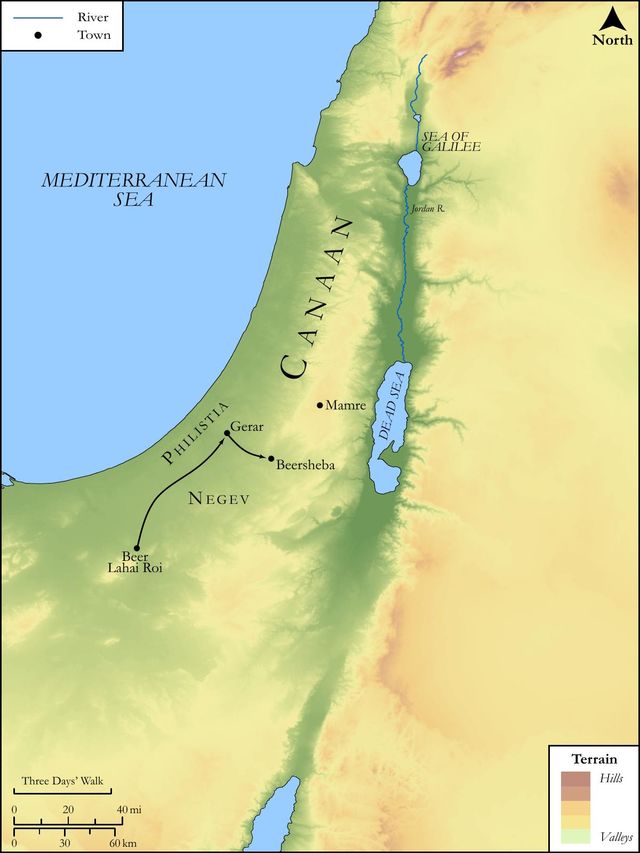
See on the biblical-era maps


Study this verse
Public-domain commentary
Matthew Henry
From his Commentary on the Whole Bible. Henry comments on passages, not single verses — this entry covers Genesis 26:1–5. His two-level outline is real structure in the source text, so it is rendered as structure.
Here, I. God tried Isaac by his providence. Isaac had been trained up in a believing dependence upon the divine grant of the land of Canaan to him and his heirs; yet now there is a famine in the land, Gen 26:1. What shall he think of the promise when the promised land will not find him bread? Is such a grant worth accepting, upon such terms, and after so long a time? Yes, Isaac will still cleave to the covenant; and the less valuable Canaan in itself seems to be the better he is taught to value it, 1. As a token of God's everlasting kindness to him; and, 2. As a type of heaven's everlasting blessedness. Note, The intrinsic worth of God's promises cannot be lessened in a believer's eye by any cross providences.
II.He directed him under this trial by his word.
Isaac finds himself straitened by the scarcity of provisions. Somewhere he must go for supply; it should seem, he set out for Egypt, whither his father went in the like strait, but he takes Gerar in his way, full of thoughts, no doubt, which way he had best steer his course, till God graciously appeared to him, and determined him, abundantly to his satisfaction.
1.God bade him stay where he was, and not go down into Egypt: Sojourn in this land, Gen 26:2, Gen 26:3. There was a famine in Jacob's days, and God bade him go down into Egypt (Gen 46:3, Gen 46:4), a famine in Isaac's days, and God bade him not to go down, a famine in Abraham's days, and God left him to his liberty, directing him neither way. This variety in the divine procedure (considering that Egypt was always a place of trial and exercise to God's people) some ground upon the different characters of these three patriarchs. Abraham was a man of very high attainments, and intimate communion with God; and to him all places and conditions were alike. Isaac was a very good man, but not cut out for hardship; therefore he is forbidden to go to Egypt. Jacob was inured to difficulties, strong and patient; and therefore he must go down into Egypt, that the trial of his faith might be to praise, and honour, and glory. Thus God proportions his people's trials to their strength.
2.He promised to be with him, and bless him, Gen 26:3. As we may go any where with comfort when God's blessing goes with us, so we may stay any where contentedly if that blessing rest upon us.
3.He renewed the covenant with him, which had so often been made with Abraham, repeating and ratifying the promises of the land of Canaan, a numerous issue, and the Messiah, Gen 26:3, Gen 26:4. Note, Those that must live by faith have need often to review, and repeat to themselves, the promises they are to live upon, especially when they are called to any instance of suffering or self-denial.
4.He recommended to him the good example of his father's obedience, as that which had preserved the entail of the covenant in his family (Gen 26:5): "Abraham obeyed my voice; do thou do so too, and the promise shall be sure to thee." Abraham's obedience is here celebrated, to his honour; for by it he obtained a good report both with God and men. A great variety of words is here used to express the divine will, to which Abraham was obedient (my voice, my charge, my commandments, my statutes, and my laws), which may intimate that Abraham's obedience was universal; he obeyed the original laws of nature, the revealed laws of divine worship, particularly that of circumcision, and all the extraordinary precepts God gave him, as that of quitting his country, and that (which some think is more especially referred to) of the offering up of his son, which Isaac himself had reason enough to remember. Note, Those only shall have the benefit and comfort of God's covenant with their godly parents that tread in the steps of their obedience.
Historical interpretation
Four Centuries of Reception
5 surviving comments on this verse. Each one is dated, so this reads as a timeline rather than a list.
Select a marker to jump to its quote. Markers stagger vertically where authors wrote within a few decades of each other.
O foolish Galatians, who hath bewitched you, that ye should not obey the truth, before whose eyes Jesus Christ hath been evidently set forth, crucified among you? This only would I learn of you, Received ye the Spirit by the works of the law, or by the hearing of faith? Are ye so foolish? having begun in the Spirit, are ye now made perfect by the flesh? Have ye suffered so many things in vain? if it be yet in vain. He therefore that ministereth to you the Spirit, and worketh miracles among you, doeth he it by the works of the law, or by the hearing of faith? Even as Abraham believed God, and it was accounted to him for righteousness. Know ye therefore that they which are of faith, the same are the children of Abraham. And the scripture, foreseeing that God would justify the heathen through faith, preached before the gospel unto Abraham, saying, In thee shall all nations be blessed. [Genesis 26:4] So then they which be of faith are blessed with faithful Abraham. For as many as are of the works of the law are under the curse: for it is written, Cursed is every one that continueth not in all things which are written in the book of the law to do them. But that no man is justified by the law in the sight of God, it is evident: for, The just shall live by faith. And the law is not of faith: but, The man that doeth them shall live in them. Christ hath redeemed us from the curse of the law, being made a curse for us: for it is written, Cursed is every one that hangeth on a tree: That the blessing of Abraham might come on the Gentiles through Jesus Christ; that we might receive the promise of the Spirit through faith.
And now, brethren, I wot that through ignorance ye did it, as did also your rulers. But those things, which God before had showed by the mouth of all his prophets, that Christ should suffer, he hath so fulfilled. Repent ye therefore, and be converted, that your sins may be blotted out, when the times of refreshing shall come from the presence of the Lord; And he shall send Jesus Christ, which before was preached unto you: Whom the heaven must receive until the times of restitution of all things, which God hath spoken by the mouth of all his holy prophets since the world began. For Moses truly said unto the fathers, A prophet shall the Lord your God raise up unto you of your brethren, like unto me; him shall ye hear in all things whatsoever he shall say unto you. And it shall come to pass, that every soul, which will not hear that prophet, shall be destroyed from among the people. Yea, and all the prophets from Samuel and those that follow after, as many as have spoken, have likewise foretold of these days. Ye are the children of the prophets, and of the covenant which God made with our fathers, saying unto Abraham, And in thy seed shall all the kindreds of the earth be blessed. [Genesis 26:4] Unto you first God, having raised up his Son Jesus, sent him to bless you, in turning away every one of you from his iniquities.
Observe, too, how the same promises are made to Isaac and to Jacob. For thus He speaks to Isaac: "And in thy seed shall all the nations of the earth be blessed." And to Jacob: "And in thee and in thy seed shall all families of the earth be blessed." He says that neither to Esau nor to Reuben, nor to any other; only to those of whom the Christ should arise, according to the dispensation, through the Virgin Mary. But if you would consider the blessing of Judah, you would perceive what I say. For the seed is divided from Jacob, and comes down through Judah, and Phares, and Jesse, and David. And this was a symbol of the fact that some of your nation would be found children of Abraham, and found, too, in the lot of Christ; but that others, who are indeed children of Abraham, would be like the sand on the sea-shore, barren and fruitless, much in quantity, and without number indeed, but bearing no fruit whatever, and only drinking the water of the sea.
For this is that nation which God of old promised to Abraham, when He declared that He would make him a father of many nations; not meaning, however, the Arabians, or Egyptians, or Idumaeans, since Ishmael became the father of a mighty nation, and so did Esau; and there is now a great multitude of Ammonites. Noah, moreover, was the father of Abraham, and in fact of all men; and others were the progenitors of others. What larger measure of grace, then, did Christ bestow on Abraham? This, namely, that He called him with His voice by the like calling, telling him to quit the land wherein he dwelt. And He has called all of us by that voice, and we have left already the way of living in which we used to spend our days, passing our time in evil after the fashions of the other inhabitants of the earth; and along with Abraham we shall inherit the holy land, when we shall receive the inheritance for an endless eternity, being children of Abraham through the like faith. For as he believed the voice of God, and it was imputed to him for righteousness, in like manner we having believed God's voice spoken by the apostles of Christ, and promulgated to us by the prophets, have renounced even to death all the things of the world. Accordingly, He promises to him a nation of similar faith, God-fearing, righteous, and delighting the Father; but it is not you, "in whom is no faith."
Then he teaches Isaac what it was he promised and the things about which God had given him confirmation. “I will make your descendants as numerous as the stars of heaven.” This, you remember, he had said to the patriarch as well, that his descendants would be so numerous as to be compared with the stars and the sand: “I will give all this land to your descendants,” he said, “and in your descendants will all the nations of the earth be blessed.” Hence the promises made to him I will fulfill in you, “for the reason that your father Abraham obeyed my voice and kept my commands, my judgments and my laws.” See God’s wisdom in stirring up the good man’s thinking, making him more enthusiastic and having the effect of rendering him an imitator of his father. After all, God is saying, if Abraham was judged worthy of such a wonderful promise for obeying my voice, on account of his virtue I am about to fulfill it in you, the child born to him. And if you yourself become an imitator of him and tread in his path, consider the degree of favor you will enjoy from me and the care you will be accorded. I mean, the man destined to prosper for someone else’s virtue will be accorded much greater favor if he himself proves virtuous.
Continue studying Genesis 26:4 across the web’s major study libraries — every link below opens this exact verse, chapter, or book on the destination site.
Read & Compare
 BibleGatewayThis verse in more than 200 translations and 70 languages.
 Bible.comThe YouVersion reader — hundreds of translations, reading plans, and highlights.
 ESV.orgCrossway's official English Standard Version reader.
 NET BibleThe NET translation with 60,000+ translators' notes on every rendering decision.
 STEP BibleTyndale House's free study tool — original text, vocabulary, and scholarly resources.
 BibliaLogos Bible Software's free web reader.
 USCCBThe New American Bible (Revised Edition) with the U.S. bishops' study notes.
Commentaries
 BibleHub CommentariesDozens of classic commentaries on this verse, gathered on one page.
 StudyLightMore than 100 commentary sets — the largest collection on the web.
 BibleRefPlain-English commentary on what this verse means, verse by verse.
 Enduring WordDavid Guzik's free commentary on this chapter, widely used by Bible teachers.
 Bible Study ToolsVerse commentary alongside Greek and Hebrew study aids.
Original Language & Research
- BibleHub InterlinearThe verse word by word — original language, transliteration, and English.
- BibleHub LexiconEvery word's original-language definition and Strong's entry.
 Blue Letter BibleDeep-study tools — Strong's numbers, concordance, and word studies.
 SefariaThe Hebrew text with Rashi and centuries of Jewish commentary.
Sermons, Hymns & Audio


TrulyRandomVerse is not affiliated with these sites and doesn’t control their content. They’re linked because they’re genuinely useful.
Summary
Genesis 26:4 is a pivotal reaffirmation of the Abrahamic Covenant to Isaac, articulating three foundational promises: an innumerable multitude of descendants, the perpetual inheritance of the land of Canaan, and a universal blessing for "all the nations of the earth" through his singular "seed." This verse powerfully underscores God's unwavering faithfulness across generations and prophetically foreshadows the global redemptive work ultimately fulfilled in Jesus Christ.
Context
ShowHideLiterary Context
This divine pronouncement to Isaac in Genesis 26 occurs immediately after God's explicit instruction for Isaac to remain in Gerar during a severe famine, rather than migrating to Egypt as his father Abraham had once done (though Abraham later returned). God's command in Genesis 26:2-3 precedes this verse, promising His presence, blessing, and the fulfillment of the oath sworn to Abraham. The reaffirmation in Genesis 26:4 directly echoes and expands upon the foundational promises first made to Abraham, particularly those concerning land and seed, ensuring their continuation through the chosen lineage of Isaac. This narrative segment emphasizes God's active involvement in guiding His covenant people and His steadfast commitment to His sworn word, even amidst challenging circumstances.
Historical & Cultural Context
Isaac lived in the patriarchal period, a time characterized by semi-nomadic pastoralism in the Fertile Crescent. Famine was a recurring threat, forcing migrations in search of sustenance, as seen with Abraham's sojourn in Egypt (Genesis 12:10). The Philistine city of Gerar, where Isaac resided, was a significant urban center in the Negev region, indicative of a more settled, agricultural society adjacent to the nomadic routes. Covenants among the patriarchs were solemn agreements, often involving oaths and rituals, as when Isaac and Abimelech swore one to another, and were considered binding. God's covenant with Abraham, now reaffirmed to Isaac, was unique in its unilateral, unconditional nature, demonstrating divine initiative and faithfulness. The concept of "seed" (descendants) was paramount for family continuity and societal strength, while land ownership was crucial for security and identity.
Key Themes
ShowHideGenesis 26:4 contributes significantly to several overarching themes in the book of Genesis and the broader biblical narrative. It powerfully reinforces the theme of Divine Faithfulness, demonstrating God's unwavering commitment to His covenant promises across generations, even when human faith falters or circumstances are dire. The verse also highlights Covenant Continuity and Succession, as the promises made to Abraham are explicitly passed down to Isaac, establishing the chosen lineage through whom God's redemptive plan will unfold. Furthermore, the promise of blessing "all the nations of the earth" introduces the profound theme of Universal Blessing and Redemptive Scope, revealing God's ultimate intention to extend salvation and reconciliation beyond a single ethnic group, foreshadowing the global reach of the Gospel. This verse also implicitly touches upon Sovereignty over Circumstance, as God's promises are reaffirmed and guaranteed even during a severe famine, underscoring His ability to fulfill His word irrespective of human limitations or environmental challenges, as seen elsewhere in the patriarch narratives, such as Genesis 12:1-3.
Exposition and Analysis
ShowHideGenesis 26:4 encapsulates the core elements of the covenant God established with Abraham, now explicitly passed to Isaac. The verse outlines three distinct, yet interconnected, promises that form the bedrock of Israel's identity and global purpose.
Key Word Analysis
ShowHideThis term refers to offspring, descendants, or posterity. While it can function as a collective noun (referring to numerous descendants), it can also denote a singular descendant. In the context of the Abrahamic covenant, it encompasses both the multitude of the nation of Israel and, prophetically, a specific individual through whom the ultimate blessing would come.
This word typically refers to foreign nations or Gentiles, distinct from Israel. Its inclusion here signifies the universal scope of God's redemptive plan, indicating that the blessings flowing from Abraham's lineage are not confined to one people group but are intended for all humanity.
This primitive root means to kneel, and by implication, to bestow favor, prosperity, and spiritual well-being. When God blesses, He imparts divine favor, resulting in flourishing, fruitfulness, and spiritual benefit. In this context, it signifies a profound spiritual transformation and reconciliation with God, not merely material gain.
Verse Breakdown
ShowHide"And I will make thy seed to multiply as the stars of heaven"
This clause reiterates the promise of innumerable descendants, a theme first introduced to Abraham in Genesis 15:5. The imagery of "stars of heaven" conveys an immeasurable multitude, emphasizing the vastness and divine guarantee of Isaac's future progeny, which would eventually form the nation of Israel. This promise speaks to God's power to create and sustain life, fulfilling His covenant despite natural limitations or barrenness.
"and will give unto thy seed all these countries"
This refers to the land of Canaan, which God had promised to Abraham and his descendants as an everlasting possession. The phrase "all these countries" points to the specific geographical region Isaac was currently inhabiting (Gerar, within Canaan) and the surrounding territories. This covenantal land grant is fundamental to Israel's identity, establishing their physical inheritance and the designated place where God's redemptive plan would unfold, serving as a tangible sign of His faithfulness.
"and in thy seed shall all the nations of the earth be blessed"
This is the most far-reaching and universally significant promise within the verse. It transcends the immediate blessings for Isaac and his direct descendants, pointing towards a global benefit for all humanity. The dual nature of "seed" (collective and singular) is crucial here; while it refers to the nation of Israel as a conduit of blessing, its ultimate fulfillment, as later clarified in the New Testament, points to a singular descendant, Jesus Christ. Through this "seed," salvation, spiritual blessings, and reconciliation with God are extended to all peoples, regardless of their nationality or origin.
Literary Devices
ShowHideGenesis 26:4 employs several potent literary devices. Hyperbole is evident in the phrase "multiply as the stars of heaven," which uses exaggeration to convey the immeasurable number of descendants, emphasizing God's boundless power and the vastness of His promise. This is also a form of Simile, directly comparing Isaac's future offspring to the countless stars, making an abstract promise tangible and awe-inspiring. Furthermore, the verse utilizes Synecdoche in the term "seed," where a part (a singular descendant) represents the whole (the entire lineage) and vice-versa, allowing for both immediate and prophetic interpretations. Most significantly, the entire verse functions as Prophecy, foretelling future events—the multiplication of a nation, the inheritance of land, and a universal blessing—which find their ultimate fulfillment in the unfolding of God's redemptive history through Israel and, climactically, in Jesus Christ.
Theological and Thematic Connections
ShowHideGenesis 26:4 serves as a profound testament to God's unwavering faithfulness and the enduring nature of His covenant promises. By reaffirming the Abrahamic covenant to Isaac, God demonstrates His commitment to His chosen lineage and His long-term plan for humanity's redemption. This verse highlights that God's promises are not contingent on human merit but on His divine character and sovereign will, ensuring that His redemptive purposes will be brought to fruition across generations. The universal scope of the blessing, extending to "all the nations of the earth," underscores God's heart for all humanity from the very beginning, revealing that His covenant with Abraham was always intended to have global implications, culminating in the spiritual blessing offered through Christ to every tribe, tongue, people, and nation.
Reflection and Application
ShowHideGenesis 26:4 stands as a powerful beacon of hope and a profound reminder of God's unwavering faithfulness to His covenant promises. For believers today, this verse assures us that God's ancient word is trustworthy and ultimately fulfilled in Jesus Christ, the singular "Seed" through whom all spiritual blessings flow. The expansive promise that "all the nations of the earth" would be blessed through Isaac's seed calls us to recognize the global scope of God's love and the inclusive nature of the Gospel. It challenges us to move beyond narrow perspectives and embrace God's heart for every people group, actively participating in spreading the good news of the blessing found in Christ to all corners of the earth. Our spiritual heritage is rooted in these ancient promises, empowering us to live as channels of God's blessing in a world desperately in need of His grace and truth, aligning with the mandate of the Great Commission.
Questions for Reflection
ShowHideFAQ
ShowHideHow does "in thy seed shall all the nations of the earth be blessed" apply to non-Israelites?
ShowHideThis phrase reveals the universal scope of God's redemptive plan, which extends beyond the physical descendants of Abraham. While the immediate "seed" refers to Isaac's lineage and the nation of Israel, the ultimate fulfillment, as clarified by the Apostle Paul in Galatians 3:16, refers to Jesus Christ, the singular "Seed." Through Christ's atoning work on the cross, salvation, reconciliation with God, and all spiritual blessings are made available to people from "all the nations of the earth"—meaning all ethnic groups and nationalities—who believe in Him by faith. This demonstrates that God's covenant with Abraham had a global, inclusive purpose from its inception, culminating in the church, which is comprised of believers from every nation, united in Christ.
Christ-Centered Fulfillment
ShowHideThe promise in Genesis 26:4, particularly "and in thy seed shall all the nations of the earth be blessed," finds its ultimate and glorious fulfillment in Jesus Christ. While the immediate "seed" refers to Isaac's numerous descendants and the nation of Israel, the singular form of "seed" (zera) prophetically points to one specific individual. The Apostle Paul explicitly identifies this "Seed" as Christ in Galatians 3:16, asserting that the Abrahamic Covenant's promise of blessing for all nations is realized through Him. Jesus, as the perfect descendant of Abraham and Isaac, embodies the spiritual blessing intended for all humanity. Through His life, His atoning death on the cross, and His resurrection, salvation, reconciliation with God, and the indwelling of the Holy Spirit are extended to all who believe, transcending ethnic and national boundaries. This fulfillment is evident in the Gospel's global spread and the formation of the Church, a new humanity comprised of believers from every nation, tribe, people, and language, all united in Christ, thereby fulfilling God's ancient promise to bless the entire world through Abraham's "Seed," as foretold in Revelation 5:9.