


Genesis 22:11
Bible text: King James Version (1769 Blayney text) · Public domain
Bible text: Berean Standard Bible · Public domain
Bible text: American Standard Version (1901) · Public domain
Bible text: World English Bible, Messianic edition · Public domain
Bible text: Geneva Bible (1599) · Public domain
Bible text: Young's Literal Translation · Public domain
- וַיִּקְרָאvai·yik·Ra'and he calledH7121Conj-w ¦ V-Qal-ConsecImperf-3msVerb Qal Consecutive Imperfect 3rd Singular Masculineוַandיִּקְרָאhe called
- אֵלָיו'e·Lavto himH413Prep ¦ 3msPreposition Definiteאֵלָיtoוhim
- מַלְאַךְmal·'Akh[the] angel ofH4397N-mscNoun Singular Masculine Construct
- יְהוָהYah·wehYahwehH3068N-properNoun Proper Title
- מִןminfromH4480PrepPreposition
- הַשָּׁמַיִםha·sha·Ma·yimthe heavensH8064Art ¦ N-mpNoun Plural Masculine Absoluteהַtheשָּׁמַיִםheavens
- וַיֹּאמֶרvai·Yo·merand he saidH559Conj-w ¦ V-Qal-ConsecImperf-3msVerb Qal Consecutive Imperfect 3rd Singular Masculineוַandיֹּאמֶרhe said
- אַבְרָהָם'av·ra·HamO AbrahamH85N-proper-mNoun Proper Masculine
- אַבְרָהָם'av·ra·HamAbrahamH85N-proper-mNoun Proper Masculine
- וַיֹּאמֶרvai·Yo·merand he saidH559Conj-w ¦ V-Qal-ConsecImperf-3msVerb Qal Consecutive Imperfect 3rd Singular Masculineוַandיֹּאמֶרhe said
- הִנֵּנִיhi·Ne·nihere [am] IH2009Prt ¦ 1csParticle Interjectionהִנֵּנִhere [am]יI
English is a literal word-by-word gloss of the Hebrew, not the KJV's wording. Why?
This is the original text the KJV's translators worked from — each Hebrew word with its own literal English meaning in this verse, prepared by scholars at Tyndale House, Cambridge. The KJV translates whole sentences, not word by word, so its wording differs: one Hebrew word can become several English words, and the KJV may choose “the LORD” where the gloss reads “Yahweh”. Both are faithful — they answer different questions. For the KJV's own rendering, switch to the KJV text.
Details
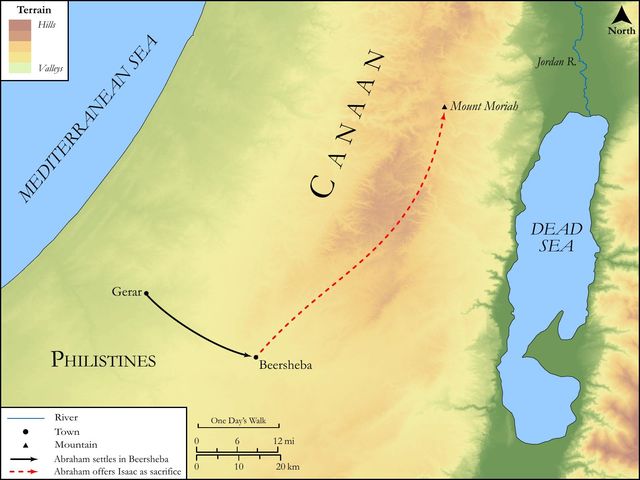
See on the biblical-era maps


Study this verse
Public-domain commentary
Matthew Henry
From his Commentary on the Whole Bible. Henry comments on passages, not single verses — this entry covers Genesis 22:11–14. His two-level outline is real structure in the source text, so it is rendered as structure.
Hitherto this story has been very melancholy, and seemed to hasten towards a most tragical period; but here the sky suddenly clears up, the sun breaks out, and a bright and pleasant scene opens. The same hand that had wounded and cast down here heals and lifts up; for, though he cause grief, he will have compassion. The angel of the Lord, that is, God himself, the eternal Word, the angel of the covenant, who was to be the great Redeemer and comforter, he interposed, and gave a happy issue to this trial.
I.Isaac is rescued, Gen 22:11, Gen 22:12.
The command to offer him was intended only for trial, and it appearing, upon trial, that Abraham did indeed love God better than he loved Isaac, the end of the command was answered; and therefore the order is countermanded, without any reflection at all upon the unchangeableness of the divine counsels: Lay not thy hand upon the lad. Note,
1.Our creature-comforts are most likely to be continued to us when we are most likely to be continued to us when we are most willing to resign them up to God's will.
2.God's time to help and relieve his people is when they are brought to the greatest extremity. The more imminent the danger is, and the nearer to be put in execution, the more wonderful and the more welcome is the deliverance.
II.Abraham is not only approved, but applauded.
He obtains an honourable testimony that he is righteous: Now know I that thou fearest God. God knew it before, but now Abraham had given a most memorable evidence of it. He needed do no more; what he had done was sufficient to prove the religious regard he had to God and his authority. Note,
1.When God, by his providence, hinders the performance of our sincere intentions in his services, he graciously accepts the will for the deed, and the honest endeavour, though it come short of finishing.
2.The best evidence of our fearing God is our being willing of serve and honour him with that which is dearest to us, and to part with all to him or for him.
III.Another sacrifice is provided instead of Isaac, Gen 22:13.
Now that the altar was built, and the wood laid in order, it was necessary that something should be offered. For,
1.God must be acknowledged with thankfulness for the deliverance of Isaac; and the sooner the better, when here is an altar ready.
2.Abraham's words must be made good: God will provide himself a lamb. God will not disappoint those expectations of his people which are of his own raising; but according to their faith it is to them. Thou shalt decree a thing, and it shall be established.
3.Reference must be had to the promised Messiah, the blessed seed. (1.) Christ was sacrificed in our stead, as this ram instead of Isaac, and his death was our discharge. "Here am I (said he,) let these go their way." (2.) Though that blessed seed was lately promised, and now typified by Isaac, yet the offering of him up should be suspended till the latter end of the world: and in the mean time the sacrifice of beasts should be accepted, as this ram was, as a pledge of that expiation which should one day be made by that great sacrifice. And it is observable that the temple, the place of sacrifice, was afterwards built upon this mount Moriah (Ch2 3:1); and mount Calvary, where Christ was crucified, was not far off.
IV.A new name is given to the place, to the honour of God, and for the encouragement of all believers, to the end of the world, cheerfully to trust in God in the way of obedience: Jehovah-jireh, The Lord will provide (Gen 22:14), probably alluding to what he had said (Gen 22:8), God will provide himself a lamb. I was not owing to any contrivance of Abraham, nor was it in answer to his prayer, though he was a distinguished intercessor; but it was purely the Lord's doing. Let it be recorded for the generations to come,
1.That the Lord will see; he will always have his eye upon his people in their straits and distresses, that he may come in with seasonable succour in the critical juncture.
2.That he will be seen, be seen in the mount, in the greatest perplexities of his people. He will not only manifest, but magnify, his wisdom, power, and goodness, in their deliverance. Where God sees and provides, he should be seen and praised. And, perhaps, it may refer to God manifest in the flesh.
Continue studying Genesis 22:11 across the web’s major study libraries — every link below opens this exact verse, chapter, or book on the destination site.
Read & Compare
 BibleGatewayThis verse in more than 200 translations and 70 languages.
 Bible.comThe YouVersion reader — hundreds of translations, reading plans, and highlights.
 ESV.orgCrossway's official English Standard Version reader.
 NET BibleThe NET translation with 60,000+ translators' notes on every rendering decision.
 STEP BibleTyndale House's free study tool — original text, vocabulary, and scholarly resources.
 BibliaLogos Bible Software's free web reader.
 USCCBThe New American Bible (Revised Edition) with the U.S. bishops' study notes.
Commentaries
 BibleHub CommentariesDozens of classic commentaries on this verse, gathered on one page.
 StudyLightMore than 100 commentary sets — the largest collection on the web.
 BibleRefPlain-English commentary on what this verse means, verse by verse.
 Enduring WordDavid Guzik's free commentary on this chapter, widely used by Bible teachers.
 Bible Study ToolsVerse commentary alongside Greek and Hebrew study aids.
Original Language & Research
- BibleHub InterlinearThe verse word by word — original language, transliteration, and English.
- BibleHub LexiconEvery word's original-language definition and Strong's entry.
 Blue Letter BibleDeep-study tools — Strong's numbers, concordance, and word studies.
 SefariaThe Hebrew text with Rashi and centuries of Jewish commentary.
Sermons, Hymns & Audio


TrulyRandomVerse is not affiliated with these sites and doesn’t control their content. They’re linked because they’re genuinely useful.
Summary
Genesis 22:11 marks the climactic moment of Abraham's ultimate test of faith, as the Angel of the LORD dramatically intervenes from heaven, halting Abraham's hand just as he was poised to sacrifice his son Isaac. This pivotal divine interruption not only powerfully demonstrates God's profound mercy and active involvement in human affairs, but also unequivocally confirms Abraham's unwavering obedience and deep trust, solidifying his legacy as the father of faith and highlighting God's faithfulness in providing for His people.
Context
ShowHideLiterary Context
Genesis 22:11 is the crucial turning point in one of the most intense and profound narratives in the Hebrew Bible: the binding of Isaac (the Akedah). The preceding verses detail God's shocking command to Abraham to sacrifice his "only son, whom you love, Isaac" upon Mount Moriah. Abraham's immediate, silent obedience is striking; he rises early, prepares for a three-day journey, and proceeds to build an altar, lay the wood, bind Isaac, and raise the knife. The tension builds to an unbearable peak, making the sudden, urgent call from heaven in this verse a moment of immense relief and profound theological significance. It is the precise moment God reveals His true intent for the test, not to demand the sacrifice of Isaac, but to prove Abraham's faith and provide a substitute.
Historical & Cultural Context
In Abraham's day, child sacrifice, though abhorrent to Yahweh, was practiced by some of the surrounding nations (e.g., Moabites, Ammonites, Canaanites) as a desperate act of propitiation to their gods, particularly in times of crisis or to secure blessings. God's command to Abraham, therefore, would have resonated with a horrifying cultural parallel, yet it was fundamentally different. God's purpose was not to accept human sacrifice but to utterly forbid it while simultaneously testing the depth of Abraham's devotion and demonstrating His own divine provision. The concept of a covenant, a binding agreement between God and His chosen people, was also central to this era, and Abraham's obedience here was a pivotal reaffirmation of his commitment to that covenant.
Key Themes
ShowHideThis verse powerfully encapsulates several overarching themes found throughout Genesis and the broader biblical narrative. Firstly, it highlights the theme of divine testing, where God refines and reveals the genuineness of His servants' faith, as seen in Abraham's journey of trust from Ur of the Chaldeans. Secondly, it underscores radical obedience to God's commands, even when they seem incomprehensible or contrary to human reason, echoing Abraham's initial response to God's call in Genesis 12. Thirdly, the narrative profoundly illustrates God's provision, culminating in the naming of the place Jehovah-jireh, "The LORD Will Provide". Finally, the identity of "the Angel of the LORD" introduces the theme of divine presence and intervention, often understood as a pre-incarnate appearance of God Himself, actively involved in the lives of His covenant people.
Exposition and Analysis
ShowHideKey Word Analysis
ShowHideThis word signifies a "messenger" or "deputy." In the context of "the Angel of the LORD," it often refers to a unique divine manifestation, not merely a created angelic being. This figure frequently speaks with the authority of God Himself, using first-person divine pronouncements, leading many theologians to understand it as a Christophany—a pre-incarnate appearance of Jesus Christ. The intervention here is therefore understood as God Himself directly intervening.
This is the sacred covenant name of God, often rendered as Yahweh or Jehovah. Its presence signifies God's personal, active, and covenantal relationship with Abraham. The use of this name emphasizes that the one calling out of heaven is the faithful, self-existent God who made promises to Abraham and is now fulfilling them by preventing the sacrifice and providing a substitute.
This primitive root means "to call out to," "to address by name," or "to proclaim." In this context, it conveys an urgent, authoritative, and direct summons. The double calling of Abraham's name ("Abraham, Abraham") intensifies this urgency and intimacy, ensuring the patriarch's immediate and undivided attention at the most critical moment of the test.
Verse Breakdown
ShowHide"And the angel of the LORD called unto him out of heaven"
This phrase establishes the source and nature of the intervention. The voice emanates "out of heaven," signifying its divine origin and absolute authority. The "angel of the LORD," as discussed in the key word analysis, represents God's direct and personal intervention, preventing Abraham from completing the act of sacrifice. This highlights God's omniscience and His timing, intervening precisely when Abraham's faith had been fully demonstrated.
"and said, Abraham, Abraham:"
The repetition of Abraham's name is a significant Hebrew idiom. It conveys extreme urgency, deep emotion, and a profound personal address. It is a summons that demands immediate and focused attention, signaling a moment of immense importance and the cessation of Abraham's action. It also underscores the intimate relationship between God and His faithful servant.
"and he said, Here [am] I."
Abraham's immediate and simple response, "Here am I" (Hebrew: hinneni), is a profound declaration of readiness and availability. It signifies not merely his physical presence, but his complete spiritual readiness and willingness to obey God's voice, whatever the command might be. This echoes his earlier responses to God's call (e.g., Genesis 22:1), demonstrating a consistent posture of humble submission and unwavering trust in the face of the most agonizing circumstances.
Literary Devices
ShowHideThe verse employs several powerful literary devices to heighten its dramatic impact and theological significance. The most prominent is Repetition, specifically the urgent double calling of "Abraham, Abraham." This device emphasizes the divine urgency and the critical nature of the moment, ensuring Abraham's full attention and signaling a pivotal turning point in the narrative. Divine Intervention is the central plot device, showcasing God's active involvement in human affairs and His precise timing. The voice "out of heaven" underscores the Transcendence of God, yet His direct address highlights His Immanence and personal relationship with Abraham. There is also a strong element of Dramatic Irony, as the reader knows God's ultimate plan for provision, while Abraham, though trusting, is proceeding with the intent to sacrifice. This builds immense tension, which is then released by the divine call.
Theological and Thematic Connections
ShowHideGenesis 22:11 is a profound theological statement on the nature of God, the essence of faith, and the dynamics of divine-human relationship. It reveals a God who tests His people not to destroy them, but to refine their faith and demonstrate its genuineness, ultimately providing for them in their greatest need. Abraham's unwavering obedience, even to the point of sacrificing his beloved son, showcases a faith that trusts God's character and promises above all else, solidifying his status as the father of all who believe. This moment also powerfully prefigures God's ultimate provision in Christ, where the Father would not spare His own Son, but provide Him as the ultimate sacrifice.
Reflection and Application
ShowHideFor believers today, Genesis 22:11 offers profound reassurance and instruction regarding the nature of faith and God's faithfulness. It teaches that even in our deepest trials, when God seems to call us to unimaginable sacrifices or leads us into seemingly impossible situations, He is intimately aware of our struggles and our faithful obedience. Just as He did for Abraham, God often provides a timely intervention, revealing His provision precisely when our faith is stretched to its limit. God's tests are designed not to break us, but to refine our faith, reveal the true state of our hearts, and deepen our reliance on Him, proving the genuineness of our trust. Abraham's immediate and unreserved "Here am I" serves as a powerful model for our own response to God's call, speaking to a heart ready to listen, obey, and remain available, even when the path is unclear or difficult. This willingness to respond is key to experiencing God's miraculous provision and blessing, akin to how God provided a ram as a substitute for Isaac and subsequently renewed His covenant promises to Abraham, demonstrating His unwavering faithfulness.
Questions for Reflection
ShowHideFAQ
ShowHideWho was "the Angel of the LORD" who called out to Abraham?
ShowHideThe phrase "the Angel of the LORD" (Hebrew: Malak Yahweh) is often understood in Old Testament theology not merely as a created angel, but as a Christophany—a pre-incarnate appearance of Jesus Christ. This figure frequently speaks with divine authority, using "I" statements that are attributable only to God (as seen in Genesis 22:15-18), strongly suggesting a direct manifestation of God Himself, personally involved in the critical moments of redemptive history.
Why did God allow Abraham to go so far in the sacrifice before intervening?
ShowHideGod allowed Abraham to proceed to the very last moment to fully test and demonstrate the depth of Abraham's faith and obedience, not for God's knowledge (for God is omniscient), but for Abraham's (and for all who would read his story) to fully comprehend his own absolute trust in God. This extreme test revealed Abraham's willingness to surrender his most cherished possession, confirming his genuine faith and setting the stage for God's dramatic provision and the reaffirmation of His covenant promises, as detailed in Genesis 22:12-18.
Christ-Centered Fulfillment
ShowHideThe dramatic intervention in Genesis 22:11 and the broader narrative of Abraham's offering of Isaac serve as a profound and multi-layered foreshadowing of Christ's ultimate sacrifice. Isaac, Abraham's "only son" whom he loved (Genesis 22:2), carried the wood for his own sacrifice up the mountain, powerfully mirroring Christ who carried His own cross to Golgotha (John 19:17). Abraham's willingness to offer his son, and God's subsequent provision of a substitute ram (Genesis 22:13), powerfully prefigure God the Father's ultimate and unparalleled sacrifice of His own "only begotten Son," Jesus Christ (John 3:16), as the perfect and final substitute for humanity's sins (Romans 8:32). Just as Isaac was "as good as dead" to Abraham and received back from the dead in a figurative sense (Hebrews 11:19), so Christ was truly sacrificed and resurrected, fulfilling the typology of God's provision and demonstrating His boundless love and redemptive plan for all humanity. The "Angel of the LORD" who intervened, often understood as a Christophany, further underscores Christ's active involvement in the unfolding of salvation history from the very beginning.