


Genesis 16:9
Bible text: King James Version (1769 Blayney text) · Public domain
Bible text: Berean Standard Bible · Public domain
Bible text: American Standard Version (1901) · Public domain
Bible text: World English Bible, Messianic edition · Public domain
Bible text: Geneva Bible (1599) · Public domain
Bible text: Young's Literal Translation · Public domain
- וַיֹּאמֶרvai·Yo·merand he saidH559Conj-w ¦ V-Qal-ConsecImperf-3msVerb Qal Consecutive Imperfect 3rd Singular Masculineוַandיֹּאמֶרhe said
- לָהּlahto <the> herPrep-l ¦ 3fsSuffix Personal 3rd Singular Feminineלָto <the>הּher
- מַלְאַךְmal·'Akh[the] angel ofH4397N-mscNoun Singular Masculine Construct
- יְהוָהYah·wehYahwehH3068N-properNoun Proper Title
- שׁוּבִיShu·vireturnH7725V-Qal-Imp-2fsVerb Qal Imperative 2nd Singular Feminine
- אֶל'eltoH413PrepPreposition
- גְּבִרְתֵּךְge·vir·Tekhyour mistressH1404N-fsc ¦ 2fsNoun Singular Feminine Constructגְּבִרְתֵּmistressךְyour
- וְהִתְעַנִּיve·hit·'a·Niand humble yourselfH6031Conj-w ¦ V-Hithpael-Imp-2fsVerb Hithpael Imperative 2nd Singular Feminineוְandהִתְעַנִּיhumble yourself
- תַּחַתTa·chatunderH8478N-mscNoun Singular Masculine Construct
- יָדֶיהָya·Dei·haher handsH3027N-cdc ¦ 3fsNoun Dual common gender Constructיָדֶיhandsהָher
English is a literal word-by-word gloss of the Hebrew, not the KJV's wording. Why?
This is the original text the KJV's translators worked from — each Hebrew word with its own literal English meaning in this verse, prepared by scholars at Tyndale House, Cambridge. The KJV translates whole sentences, not word by word, so its wording differs: one Hebrew word can become several English words, and the KJV may choose “the LORD” where the gloss reads “Yahweh”. Both are faithful — they answer different questions. For the KJV's own rendering, switch to the KJV text.
Details
See on the biblical-era maps


Study this verse
Public-domain commentary
Matthew Henry
From his Commentary on the Whole Bible. Henry comments on passages, not single verses — this entry covers Genesis 16:7–9. His three-level outline is real structure in the source text, so it is rendered as structure.
Here is the first mention we have in scripture of an angel's appearance. Hagar was a type of the law, which was given by the disposition of angels; but the world to come is not put in subjection to them, Heb 2:5. Observe,
I.How the angel arrested her in her flight, Heb 2:7.
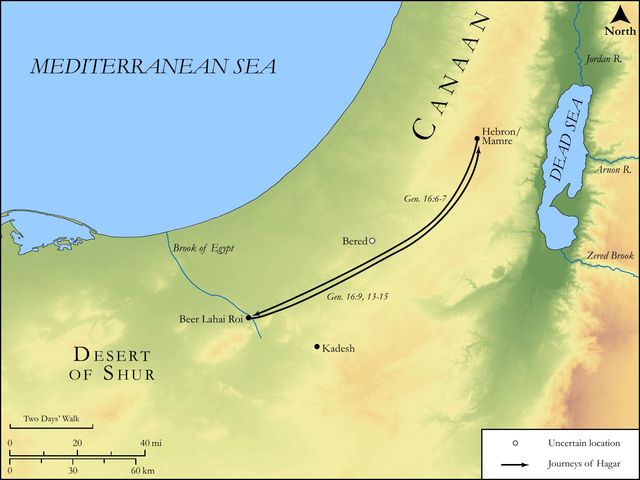
It should seem, she was making towards her own country; for she was in the way to Shur, which lay towards Egypt. It were well if our afflictions would make us think of our home, the better country. But Hagar was now out of her place, and out of the way of her duty, and going further astray, when the angel found her. Note,
1.It is a great mercy to be stopped in a sinful way either by conscience or by Providence.
2.God suffers those that are out of the way to wander awhile, that when they see their folly, and what a loss they have brought themselves to, they may be the better disposed to return. Hagar was not stopped till she was in the wilderness, and had set down, weary enough, and glad of clear water to refresh herself with. God brings us into a wilderness, and there meets us, Hos 2:14.
II.How he examined her, Gen 16:8. Observe,
1.He called her Hagar, Sarai's maid,
(1.)As a check to her pride. Though she was Abram's wife, and, as such, was obliged to return, yet he calls her Sarai's maid, to humble her. Note, Though civility teaches us to call others by their highest titles, yet humility and wisdom teach us to call ourselves by the lowest.
(2.)As a rebuke to her flight. Sarai's maid ought to be in Sarai's tent, and not wandering in the wilderness and sauntering by a fountain of water. Note, It is good for us often to call to mind what our place and relation are. See Ecc 10:4.
2.The questions the angel put to her were proper and very pertinent. (1.) "Whence comest thou? Consider that thou art running away both from the duty thou wast bound to and the privileges thou wast blessed with in Abram's tent." Note, It is a great advantage to live in a religious family, which those ought to consider who have that advantage, yet upon every slight inducement are forward to quit it. (2.) "Whither wilt thou go? Thou art running thyself into sin, in Egypt" (if she return to that people, she will return to their gods), "and into danger, in the wilderness," through which she must travel, Deu 8:15. Note, Those who are forsaking God and their duty would do well to remember not only whence they have fallen, but whither they are falling. See Jer 2:18, What hast thou to do (with Hagar) in the way of Egypt? Joh 6:68.
3.Her answer was honest, and a fair confession: I flee from the face of my mistress. In this,
(1.)She acknowledges her fault in fleeing from her mistress, and yet,
(2.)Excuses it, that it was from the face, of displeasure, of her mistress. Note, Children and servants must be treated with mildness and gentleness, lest we provoke them to take any irregular courses and so become accessory to their sins, which will condemn us, though it will not justify them.
4.How he sent her back, with suitable and compassionate counsel: "Return to thy mistress, and submit thyself under her hand, Gen 16:9. Go home, and humble thyself for what thou hast done amiss, and beg pardon, and resolve for the future to behave thyself better." He makes no question but she would be welcome, though it does not appear that Abram sent after her. Note, Those that have gone away from their place and duty, when they are convinced of their error, must hasten their return and reformation, how mortifying soever it may be.
Historical interpretation
Historical reception
2 surviving comments on this verse. Each one is dated, so this reads as a timeline rather than a list.
Select a marker to jump to its quote. Markers stagger vertically where authors wrote within a few decades of each other.
The literal sense is clear enough. From the point of view of allegory, it is suggested that even in the case of one who has done a purposeless act that he believes to be obligatory for those who revere the shadow of the law and who is in a sense fleeing from its spiritual sense, the Word of the Master brings him back to the original divine intention. And in fact the Lord gradually made it clear that the things in Scripture that were of the shadow would cease to be, when he says, “What to me is the multitude of your sacrifices?” and “Do I eat the flesh of bulls or drink the blood of goats? Offer to God a sacrifice of thanksgiving, and pay your vows to the Most High.”11It is a great thing then to be “under the hands” of the spiritual doctrine, referred to as “mistress,” and to be “humble under her hands”; not that the slave girl is of lowly estate in herself, but only with respect to the mistress. For in this matter what is glorified is not really glorified at all, because its glory is transcendent.
As in concrete image, we see here foreshadowed the fact that once the Emmanuel has appeared and his mystery has been shown to the world, the types of the Mosaic cult necessarily disappear, giving way to the evangelical teachings, the better and more perfect precepts. Of what image am I speaking? Because Sarah had not had children, Hagar, after having given birth to Ishmael, began to show arrogant contempt for her owner, the free woman. Sarah was unable to bear that arrogance and began also to mistreat the Egyptian woman. The latter fled from the house and lost her way in the desert. An angel from heaven asked her where she was going and where she had come from. She replied, “I am fleeing from my mistress, Sarah.” And the holy angel replied, “Return to your mistress, and humble yourself under her hands.” She was ordered then, by the voice of the angel, not to depart from the free woman—from instruction, that is, which summons to the dignity of free persons—and to humble herself instead under the free woman’s hands. The cult according to the law, in fact, which takes place through images and types, is as it were the servant of evangelical teachings. In it, obscurely, the beauty of the truth is revealed. At this point in time, the law, which was once established by Moses through the ministry of angels, receives an order from the voice of an angel to bend the neck to the evangelical oracles and to bow and yield, even if unwillingly, to the free woman. This, I maintain, is the spiritual interpretation of Hagar’s imposed submission to the rule of Sarah. We should remember, moreover, that even the venerable Paul sees Hagar and Sarah as prefiguring the two Testaments: “One, who bears children for slavery, and corresponds to the present Jerusalem,” and the other—Sarah—who bears for the dignity of the free.
Continue studying Genesis 16:9 across the web’s major study libraries — every link below opens this exact verse, chapter, or book on the destination site.
Read & Compare
 BibleGatewayThis verse in more than 200 translations and 70 languages.
 Bible.comThe YouVersion reader — hundreds of translations, reading plans, and highlights.
 ESV.orgCrossway's official English Standard Version reader.
 NET BibleThe NET translation with 60,000+ translators' notes on every rendering decision.
 STEP BibleTyndale House's free study tool — original text, vocabulary, and scholarly resources.
 BibliaLogos Bible Software's free web reader.
 USCCBThe New American Bible (Revised Edition) with the U.S. bishops' study notes.
Commentaries
 BibleHub CommentariesDozens of classic commentaries on this verse, gathered on one page.
 StudyLightMore than 100 commentary sets — the largest collection on the web.
 BibleRefPlain-English commentary on what this verse means, verse by verse.
 Enduring WordDavid Guzik's free commentary on this chapter, widely used by Bible teachers.
 Bible Study ToolsVerse commentary alongside Greek and Hebrew study aids.
Original Language & Research
- BibleHub InterlinearThe verse word by word — original language, transliteration, and English.
- BibleHub LexiconEvery word's original-language definition and Strong's entry.
 Blue Letter BibleDeep-study tools — Strong's numbers, concordance, and word studies.
 SefariaThe Hebrew text with Rashi and centuries of Jewish commentary.
Sermons, Hymns & Audio


TrulyRandomVerse is not affiliated with these sites and doesn’t control their content. They’re linked because they’re genuinely useful.
Summary
Genesis 16:9 presents a pivotal divine encounter where the Angel of the LORD commands Hagar, who has fled from Sarai's harsh treatment, to return to her mistress and submit to her authority. This instruction, delivered in the wilderness, underscores God's active involvement in the lives of individuals, His compassionate care for the distressed and overlooked, and the often counter-intuitive nature of divine wisdom that calls for humility and obedience even in challenging and seemingly unfair circumstances, all within the unfolding tapestry of His sovereign plan for Abraham's descendants.
Context
ShowHideLiterary Context
This verse is situated within a crucial narrative arc in the Abrahamic saga, specifically concerning the promise of an heir. Following years of barrenness, Sarai, Abram's wife, takes matters into her own hands by giving her Egyptian servant, Hagar, to Abram to bear a child on her behalf (Genesis 16:1-3). This cultural practice, while common, quickly leads to domestic strife. Once Hagar conceives, she begins to despise Sarai, prompting Sarai to deal harshly with her. This mistreatment forces Hagar to flee into the wilderness, pregnant and alone (Genesis 16:4-6). It is in this vulnerable state that the Angel of the LORD intervenes, finding Hagar by a spring of water and initiating a direct dialogue that includes both a command to return and a promise concerning her unborn child, Ishmael. This divine encounter sets the stage for Ishmael's birth within Abram's household, linking him directly to the patriarchal narrative, even as the ultimate covenant promise rests with Isaac.
Historical & Cultural Context
The practice of a barren wife providing a slave-girl to her husband to bear children was a recognized custom among the patriarchs, as when Rachel gave her handmaid Bilhah to Jacob. Such children were legally considered the offspring of the primary wife. However, the social dynamics were complex; the slave-girl's status could rise upon conception, leading to tension with the primary wife, as seen between Sarai and Hagar. Fleeing into the wilderness was a desperate act for a pregnant woman, fraught with dangers from lack of water, wild animals, and exposure. The patriarchal household was a fundamental social unit, and the "hands" of the mistress (H1404, H3027) signified her authority and control over her servants. The Angel's command to return and submit was therefore a directive to re-enter this established social structure, albeit under divine oversight, rather than face the certain perils of the wild.
Key Themes
ShowHideGenesis 16:9 contributes significantly to several overarching themes in the book of Genesis and the broader biblical narrative. It highlights the theme of Divine Sovereignty and Providence, demonstrating God's active involvement in human affairs, even when human choices (like Sarai's impatience) create complications. God's intervention with Hagar, an overlooked foreign slave, powerfully illustrates His Compassion for the Vulnerable and Outcast, a theme echoed throughout Scripture, from the care for the widow and orphan in the Law to Jesus' ministry among the poor and sick. The command to "return and submit" introduces the theme of Obedience and Humility in the face of difficult circumstances, suggesting that God's path to blessing often involves a posture of trust and surrender rather than escape. Furthermore, this episode, particularly the identity of the "Angel of the LORD," foreshadows the Unveiling of God's Presence and His direct communication with humanity, a motif that culminates in the Incarnation of Christ. The continued unfolding of God's covenant promises to Abram, despite human missteps, is also a central theme, with Hagar's return ensuring Ishmael's birth within the household, contributing to the broader story of Abram's descendants as promised in Genesis 15:5.
Exposition and Analysis
ShowHideKey Word Analysis
ShowHideFrom an unused root meaning "to despatch as a deputy," this term refers to a messenger. Specifically, when used in conjunction with "of the LORD" (H3068, Yᵉhôvâh), it often denotes a divine messenger or, as many theologians interpret, a pre-incarnate appearance of God Himself (a Christophany). The authority and divine prerogatives (such as promising to multiply offspring) attributed to this figure throughout the narrative support this understanding, indicating a direct manifestation of God's presence and will.
This feminine noun, derived from a root meaning "to be strong" or "master," denotes a lady or mistress. In this context, it refers to Sarai, signifying her position of authority and control within the household over her servant Hagar. The command to return to her mistress underscores the hierarchical structure of the ancient household and Hagar's subordinate status, which the Angel of the LORD acknowledges as the divinely ordained social order for her return.
This primitive root carries the primary meaning "to depress literally or figuratively." Its various applications include "to abase self," "afflict self," "chasten self," "humble (self)," and "submit self." The command to "submit thyself under her hands" implies a posture of humility, obedience, and acceptance of one's position, even in a challenging and potentially oppressive situation. It is not merely passive endurance but an active choice to humble oneself and yield to authority, trusting in God's overarching plan.
Verse Breakdown
ShowHide"And the angel of the LORD said unto her,"
This opening phrase establishes the divine origin and authority of the subsequent command. The "angel of the LORD" is not merely a created being but a manifestation of God Himself, speaking with direct divine authority. This encounter highlights God's personal and direct engagement with Hagar, an outcast, demonstrating His compassionate awareness of her plight and His sovereign right to direct her steps.
"Return to thy mistress,"
This is the first of two imperative commands. It instructs Hagar to reverse her flight and go back to Sarai's household. While seemingly harsh given Sarai's treatment, this command was crucial for Hagar's physical safety in the wilderness and for the birth of Ishmael within the established patriarchal lineage. It signifies God's intention to bring order out of chaos and to ensure the unfolding of His broader plans for Abram's family, even through difficult circumstances.
"and submit thyself under her hands."
This second command defines the posture Hagar is to adopt upon her return. "Under her hands" (H3027, yâd) metaphorically signifies being under her authority, power, and control. The verb "submit" (H6031, ʻânâh) implies humbling oneself, accepting one's subordinate position, and yielding to Sarai's authority. This was a call not to passive resignation to abuse, but to a posture of humility and trust in God's wisdom, allowing Him to work through the difficult relational dynamics and to fulfill His promises to Hagar and her son.
Literary Devices
ShowHideThe passage employs several significant literary devices. The most prominent is Theophany or Christophany, referring to the appearance of God or a pre-incarnate Christ. The "angel of the LORD" is consistently depicted throughout the Old Testament as speaking with divine authority, accepting worship, and performing actions only God can do, strongly suggesting a direct manifestation of God Himself. This divine encounter underscores the Dramatic Irony of the situation, as Hagar, a seemingly insignificant slave, receives direct divine communication and promises, while Sarai and Abram are left to grapple with their human-driven solutions. The commands themselves are Imperatives, direct and authoritative, emphasizing the non-negotiable nature of God's will. Furthermore, the entire episode serves as Foreshadowing, hinting at God's ongoing involvement in the lives of His people, His care for the vulnerable, and the often unexpected ways His redemptive plan unfolds, even through human imperfection and suffering.
Theological and Thematic Connections
ShowHideGenesis 16:9 profoundly illustrates God's active and personal involvement in the lives of individuals, even those who are despised or overlooked by society. It reveals that divine providence extends beyond the covenant family to encompass all who are touched by His plan. God's command to Hagar, though challenging, reflects a deeper wisdom that seeks to restore order, ensure safety, and facilitate the unfolding of His purposes, even if it requires humility and submission in difficult circumstances. This passage teaches us that true obedience often means trusting God's direction even when it contradicts our immediate desires or seems counter-intuitive, knowing that His ultimate aim is always for our good and the advancement of His kingdom.
Reflection and Application
ShowHideGenesis 16:9 offers profound lessons for contemporary believers navigating challenging relationships and difficult life circumstances. Like Hagar, we often face situations where our natural inclination is to flee from discomfort, conflict, or perceived injustice. However, this passage calls us to consider that God's wisdom may sometimes lead us back into, or through, such trials with a posture of humility and trust. It reminds us that God sees our distress, hears our cries, and is intimately involved in our lives, even when we feel abandoned or overlooked. His commands, though sometimes demanding, are always rooted in His perfect wisdom and love, designed to bring about His ultimate good and to align us with His sovereign purposes. Our willingness to submit to His direction, even when it requires us to humble ourselves or endure hardship, positions us to experience His continued provision, protection, and the unfolding of His blessings in ways we might not anticipate. It encourages us to seek His guidance not just for escape, but for transformation within our trials.
Questions for Reflection
ShowHideFAQ
ShowHideWhy did the Angel of the LORD command Hagar to return to a potentially abusive situation?
ShowHideThe command to "return to thy mistress, and submit thyself under her hands" was not an endorsement of abuse, but a directive within God's larger sovereign plan for Hagar, Ishmael, and the Abrahamic lineage. Firstly, it ensured Hagar's physical safety from the perils of the wilderness, where she was pregnant and alone. Secondly, it was crucial for the birth of Ishmael within Abram's household, connecting him to the patriarchal narrative and ensuring his place as a descendant of Abram, through whom God would also establish a great nation (Genesis 16:10). God's intervention also included a promise of blessing and a prophecy about Ishmael's future, indicating His continued care and provision for Hagar even in difficult circumstances (Genesis 16:11-12). The submission was about humility and trust in God's path, allowing Him to work out His purposes, rather than passively accepting mistreatment without divine oversight. God's presence and promises to Hagar transformed her return from an act of simple subjugation into an act of faith.
Who is the "angel of the LORD" mentioned in this verse?
ShowHideThe "angel of the LORD" (Hebrew: mălʼâk Yᵉhôvâh) is a significant and unique figure in the Old Testament. In many theological interpretations, particularly within evangelical Christianity, this figure is understood as a pre-incarnate appearance of Jesus Christ (a Christophany) or a direct manifestation of God Himself. This interpretation is strongly supported by the divine authority the Angel exercises throughout the narrative, speaking and acting with the prerogatives of God. For instance, this "Angel" promises to multiply Hagar's offspring (Genesis 16:10), hears her prayer, and is subsequently referred to by Hagar as "You are the God who sees me" (Genesis 16:13). This encounter highlights God's direct, personal, and compassionate engagement with humanity, foreshadowing the ultimate revelation of God in the person of Jesus Christ.
Christ-Centered Fulfillment
ShowHideGenesis 16:9, with the appearance of the "angel of the LORD," serves as a profound foreshadowing of Jesus Christ, the ultimate Messenger and Embodiment of God's presence. The Angel's divine authority, compassionate pursuit of the distressed and overlooked (Hagar in the wilderness), and direct intervention in human affairs resonate deeply with Christ's own ministry. Just as the Angel called Hagar to a difficult path of return and submission for her ultimate good and the unfolding of God's plan, so too does Christ, our Good Shepherd, call His followers to humble submission to God's will, even when it involves hardship or suffering. His own life perfectly exemplified this radical obedience, culminating in His submission to the cross for the redemption of humanity (Philippians 2:8). The Angel's promise of blessing to Hagar's descendants, and His role in preserving the lineage through which Christ would eventually come, points to Jesus as the one who brings true fulfillment to all of God's promises (2 Corinthians 1:20) and offers ultimate refuge, peace, and reconciliation to all who humble themselves and submit to His Lordship (Matthew 11:28-30).