


Genesis 16:13
Bible text: King James Version (1769 Blayney text) · Public domain
Bible text: Berean Standard Bible · Public domain
Bible text: American Standard Version (1901) · Public domain
Bible text: World English Bible, Messianic edition · Public domain
Bible text: Geneva Bible (1599) · Public domain
Bible text: Young's Literal Translation · Public domain
- וַתִּקְרָאva·tik·Ra'and she calledH7121Conj-w ¦ V-Qal-ConsecImperf-3fsVerb Qal Consecutive Imperfect 3rd Singular Feminineוַandתִּקְרָאshe called
- שֵׁםshem[the] name ofH8034N-mscNoun Singular Masculine Construct
- יְהוָהYah·wehYahwehH3068N-properNoun Proper Title
- הַדֹּבֵרha·do·Verwho spokeH1696Art ¦ V-Qal-Prtcpl-msVerb Qal Participle Singular Masculine Absoluteהַwhoדֹּבֵרspoke
- אֵלֶיהָ'e·Lei·hato herH413Prep ¦ 3fsPreposition Definiteאֵלֶיtoהָher
- אַתָּה'a·TahyouH859Pro-2msPronoun Personal 2nd Singular Masculine
- אֵל'el[are] a God ofH410N-mscNoun Singular Masculine Construct
- רֳאִיro·'IseeingH7210N-msNoun Singular Masculine Absolute
- כִּיkiforH3588PrtParticle Conditional
- אָמְרָה'a·me·Rahshe saidH559V-Qal-Perf-3fsVerb Qal Perfect 3rd Singular Feminine
- הֲגַםha·Gam¿ alsoH1571Interrog ¦ AdvAdverbהֲ¿גַםalso
- הֲלֹםha·LomhereH1988AdvAdverb
- רָאִיתִיra·'I·tihave I seenH7200V-Qal-Perf-1csVerb Qal Perfect 1st Singular common gender
- אַחֲרֵי'a·cha·Rei[the] back<s> ofH310Adj-mpcAdjective Numerical Plural Masculine Construct
- רֹאִיro·'I[the] [one who] sees meH7200V-Qal-Prtcpl-ms ¦ 1csVerb Qal Participle Singular Masculine Constructרֹאִ[the] [one who] seesיme
English is a literal word-by-word gloss of the Hebrew, not the KJV's wording. Why?
This is the original text the KJV's translators worked from — each Hebrew word with its own literal English meaning in this verse, prepared by scholars at Tyndale House, Cambridge. The KJV translates whole sentences, not word by word, so its wording differs: one Hebrew word can become several English words, and the KJV may choose “the LORD” where the gloss reads “Yahweh”. Both are faithful — they answer different questions. For the KJV's own rendering, switch to the KJV text.
Details
See on the biblical-era maps


Study this verse
Public-domain commentary
Matthew Henry
From his Commentary on the Whole Bible. Henry comments on passages, not single verses — this entry covers Genesis 16:10–14. His four-level outline is real structure in the source text, so it is rendered as structure.
We may suppose that the angel having given Hagar that good counsel (Gen 16:9) to return to her mistress she immediately promised to do so, and was setting her face homeward; and then the angel went on to encourage her with an assurance of the mercy God had in store for her and her seed: for God will meet those with mercy that are returning to their duty. I said, I will confess, and thou forgavest, Psa 32:5. Here is,
I.A prediction concerning her posterity given her for her comfort in her present distress.
Notice is taken of her condition: Behold, thou art with child; and therefore this is not a fit place for thee to be in. Note, It is a great comfort to women with child to think that they are under the particular cognizance and care of the divine Providence. God graciously considers their case and suits supports to it. Now,
1.The angel assures her of a safe delivery, and that of a son, which Abram desired. This fright and ramble of hers might have destroyed her hope of an offspring; but God dealt not with her according to her folly: Thou shalt bear a son. She was saved in child-bearing, not only by providence, but by promise.
2.He names her child, which was an honour both to her and it: Call him Ishmael, God will hear; and the reason is, because the Lord has heard; he has, and therefore he will. Note, The experience we have had of God's seasonable kindness to us in distress would encourage us to hope for similar help in similar exigencies, Psa 10:17. He has heard thy affliction, Gen 16:11. Note, Even where there is little cry of devotion, the God of pity sometimes graciously hears the cry of affliction. Tears speak as well as prayers. This speaks comfort to the afflicted, that God not only sees what their afflictions are, but hears what they say. Note, further, Seasonable succours, in a day of affliction, ought always to be remembered with thankfulness to God. Such a time, in such a strait, the Lord heard the voice of my affliction, and helped me. See Deu 26:7; Psa 31:22.
3.He promises her a numerous offspring, (Gen 16:10): I will multiply thy seed exceedingly, Heb. multiplying, I will multiply it, that is, multiply it in every age, so as to perpetuate it. It is supposed that the Turks at this day descend from Ishmael; and they are a great people. This was in pursuance of the promise made to Abram: I will make thy seed as the dust of the earth, Gen 13:16. Note, Many that are children of godly parents have, for their sakes, a very large share of outward common blessings, though, like Ishmael, they are not taken into covenant: many are multiplied that are not sanctified.
4.He gives a character of the child she should bear, which, however it may seem to us, perhaps was not very disagreeable to her (Gen 16:12): He will be a wild man; a wild ass of a man (so the word is), rude, and bold, and fearing no man - untamed, untractable living at large, and impatient of service and restraint. Note, The children of the bondwoman, who are out of covenant with God, are, as they were born, like the wild ass's colt; it is grace that reclaims men, civilizes them, and makes them wise, and good for something. It is foretold,
(1.)That he should live in strife, and in a state of war: His hand against every man - this is his sin; and every man's hand against him - this is his punishment. Note, Those that have turbulent spirits have commonly troublesome lives; those that are provoking, vexatious, and injurious to others, must expect to be repaid in their own coin. He that has his hand and tongue against every man shall have every man's hand and tongue against him, and he has no reason to complain of it. And yet,
(2.)That he should live in safety, and hold his own against all the world: He shall dwell in the presence of all his brethren; though threatened and insulted by all his neighbours, yet he shall keep his ground, and for Abram's sake, more than his own, shall be able to make his part good with them. Accordingly we read (Gen 25:18), that he died, as he lived, in the presence of all his brethren. Note, Many that are much exposed by their own imprudence are yet strangely preserved by the divine Providence, so much better is God to them than they deserve, when they not only forfeit their lives by sin, but hazard them.
II.Hagar's pious reflection upon this gracious appearance of God to her, Gen 16:13, Gen 16:14. Observe in what she said,
1.Her awful adoration of God's omniscience and providence, with application of it to herself: She called the name of the Lord that spoke unto her, that is, thus she made confession of his name, this she said to his praise, Thou God seest me: this should be, with her, his name for ever, and this his memorial, by which she will know him and remember him while she lives, Thou God seest me. Note,
(1.)The God with whom we have to do is a seeing God, and all-seeing God. God is (as the ancients express it) all eye.
(2.)We ought to acknowledge this with application to ourselves. He that sees all sees me, as David (Psa 139:1), O Lord, thou hast searched me, and known me.
(3.)A believing regard to God, as a God that sees us, will be of great use to us in our returns to him. It is a proper word for a penitent: - [1.] "Thou seest my sin and folly." I have sinned before thee, says the prodigal; in thy sight, says David. [2.] "Thou seest my sorrow and affliction;" this Hagar especially refers to. When we have brought ourselves into distress by our own folly, yet God has not forsaken us. [3.] "Thou seest the sincerity and seriousness of my return and repentance. Thou seest my secret mournings for sin, and secret motions towards thee." [4.] "Thou seest me, if in any instance I depart from thee," Psa 44:20, Psa 44:21. This thought should always restrain us from sin and excite us to duty: Thou God seest me.
2.Her humble admiration of God's favour to her: "Have I here also looked after him that seeth me? Have I here seen the back parts of him that seeth me?" so it might be read, for the word is much the same with that, Exo 33:23. She saw not face to face, but as through a glass darkly, Co1 13:12. Probably she knew not who it was that talked with her, till he was departing (as Jdg 6:21, Jdg 6:22; Jdg 13:21), and then she looked after him, with a reflection like that of the two disciples, Luk 24:31, Luk 24:32. Or, Have I here seen him that sees me? Note,
(1.)The communion which holy souls have with God consists in their having an eye of faith towards him, as a God that has an eye of favour towards them. The intercourse is kept up by the eye.
(2.)The privilege of our communion with God is to be looked upon with wonder and admiration,
[1.]Considering what we are who are admitted to this favour. "Have I? I that am so mean, I that am so vile?" Sa2 7:18.
[2.]Considering the place where we are thus favoured - "here also? Not only in Abram's tent and at his altar, but here also, in this wilderness? Here, where I never expected it, where I was out of the way of my duty? Lord, how is it?" Joh 14:22. Some make the answer to this question to be negative, and so look upon it as a penitent reflection; "Have I here also, in my distress and affliction, looked after God? No, I was a careless and unmindful of him as ever I used to be; and yet he has thus visited and regarded me:" for God often anticipates us with his favours, and is found of those that seek him not, Isa 65:1.
III.The name which this gave to the place:
Beer-lahai-roi, The well of him that liveth and seeth me, Gen 16:14. It is probable that Hagar put this name upon it; and it was retained long after, in perpetuam rei memoriam - a lasting memorial of this event. This was a place where the God of glory manifested the special cognizance and care he took of a poor woman in distress. Note,
1.He that is all-seeing is ever-living; he lives and sees us.
2.Those that are graciously admitted into communion with God, and receive seasonable comforts from him, should tell others what he has done for their souls, that they also may be encouraged to seek him and trust in him.
3.God's gracious manifestations of himself to us are to be had in everlasting remembrance by us, and should never be forgotten.
Historical interpretation
Three Centuries of Reception
3 surviving comments on this verse. Each one is dated, so this reads as a timeline rather than a list.
Select a marker to jump to its quote. Markers stagger vertically where authors wrote within a few decades of each other.
In the verses read before, it was an “angel of God” who was speaking with Hagar. Here she names him “Lord” and “God.” It is not too much of a stretch to say that the angel was not in the service of his own words but of God’s, as are also the prophets. For, in a certain sense, when angels exercise their ministry and when they foretell the future, they do the work of prophets. The name angel indicates an activity, not a substance; the same is true of the name prophet. [Since] the angel was speaking the words of God, Hagar called him God because of the One who lived in him. Similarly, when Isaiah prophesies, he sometimes speaks in his own person, as a man who has within himself the prophetic spirit, and he sometimes, as it were, makes God the character who speaks, without adding “says the Lord.” For example, he writes, “I made the earth and created man upon it,” but (it is he himself speaking) as one sent by the Lord he proclaims, “Hear, O heavens, and give ear, O earth; for the Lord has spoken.” We say this to show that the words of Isaiah are not all spoken as though he were merely an intermediary but that participation in God confers also the authority of God; and because of God’s dwelling in them, those who share in him are called gods. This is so true that an angel speaking to Moses was also called God. It is written in fact: And the angel of the Lord called him and said to him, “I am the God of Abraham, the God of Isaac and the God of Jacob.” If one looks at the minister, these are words of angels, but if one looks at the sense, they are words of God.
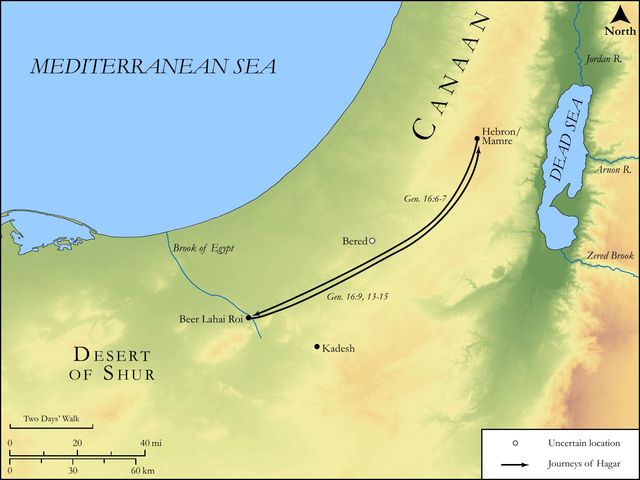
It is well too that the vision of the instructing Word was seen “between Kadesh and Bered.” Kadesh in fact is interpreted to mean “holy,” and Bered, “lightning.” It is between these two things that divine education takes place: the holy, on the one hand, to which it belongs (to see the divine things) and the lightning, on the other, which is a luminous state. For “your lightnings lighted up the world.”
She called on the name of the Lord who spoke to her: "You are the God who sees me." For she said, "Surely here I have seen the back of the one who sees me," therefore she called that well, "The well of the living one who sees me." It is clear from these words that Hagar could not see the face of the angel speaking with her, but only the back as he was departing; nevertheless, she recognized that she had seen him showing mercy and that he was living, that is, that he was truly God, or had come to her in the presence of the living God. The woman's wisdom is remarkable, or rather not remarkable at all, since she belonged to Abraham's household, in naming the well, by which she was comforted by the divine oracle, after that same God's name; as if clearly understanding that the well signified the deep divine dispensations by which He showed mercy to her affliction, commanded her to return to her mistress, and foretold that her offspring would be great; and just as in that well or fountain, as mentioned above, she saw living and perpetual water, so she understood the depth of the divine substance as always living and enduring without end or beginning, and rightly believed the well should be named after it. In correspondence with this figure, the Psalmist, having said: "As the deer longs for the streams of water, so my soul longs for you, O God" (Psal. 41:2); immediately added: "My soul thirsts for the living God." So that we might understand that just as the fountains have living and unfailing water, so God maintains an enduring life within himself. It is also noteworthy that Hagar’s well between the wilderness of Kadesh and Bered is still shown today, and rightly so; as a testimony of her faith and confession.
Continue studying Genesis 16:13 across the web’s major study libraries — every link below opens this exact verse, chapter, or book on the destination site.
Read & Compare
 BibleGatewayThis verse in more than 200 translations and 70 languages.
 Bible.comThe YouVersion reader — hundreds of translations, reading plans, and highlights.
 ESV.orgCrossway's official English Standard Version reader.
 NET BibleThe NET translation with 60,000+ translators' notes on every rendering decision.
 STEP BibleTyndale House's free study tool — original text, vocabulary, and scholarly resources.
 BibliaLogos Bible Software's free web reader.
 USCCBThe New American Bible (Revised Edition) with the U.S. bishops' study notes.
Commentaries
 BibleHub CommentariesDozens of classic commentaries on this verse, gathered on one page.
 StudyLightMore than 100 commentary sets — the largest collection on the web.
 BibleRefPlain-English commentary on what this verse means, verse by verse.
 Enduring WordDavid Guzik's free commentary on this chapter, widely used by Bible teachers.
 Bible Study ToolsVerse commentary alongside Greek and Hebrew study aids.
Original Language & Research
- BibleHub InterlinearThe verse word by word — original language, transliteration, and English.
- BibleHub LexiconEvery word's original-language definition and Strong's entry.
 Blue Letter BibleDeep-study tools — Strong's numbers, concordance, and word studies.
 SefariaThe Hebrew text with Rashi and centuries of Jewish commentary.
Sermons, Hymns & Audio


TrulyRandomVerse is not affiliated with these sites and doesn’t control their content. They’re linked because they’re genuinely useful.
Summary
Genesis 16:13 profoundly records Hagar's naming of God as "Thou God seest me" (El Roi) following her divine encounter with the Angel of the LORD in the desolate wilderness. This pivotal moment reveals God's intimate omniscience, His personal and compassionate gaze upon the distressed and overlooked, and His active presence and provision even in the most desperate and isolated circumstances, affirming His unwavering care for all creation.
Context
ShowHideLiterary Context
Genesis 16:13 is the climax of Hagar's dramatic flight from Sarai, her mistress. The preceding verses detail the escalating tension in Abraham's household: Sarai, barren, gives Hagar to Abraham to bear children on her behalf, a common practice for securing an heir. However, Hagar's subsequent contempt for Sarai, coupled with Sarai's harsh treatment of Hagar, leads the pregnant maidservant to flee into the wilderness. It is there, by a spring on the way to Shur, that the Angel of the LORD intercepts her, as recounted in Genesis 16:7. The Angel commands Hagar to return and submit to Sarai, but also delivers a remarkable, unconditional promise of countless descendants and the naming of her son, Ishmael, meaning "God hears," as detailed in Genesis 16:10-12. Hagar's response in verse 13 is a direct, theological articulation of her profound understanding of the God who not only heard her cry but actively saw her in her despair.
Historical & Cultural Context
The practice of a barren wife providing a maidservant (concubine) to her husband to bear children was a recognized custom among the patriarchs, as when Rachel gave her handmaid Bilhah to Jacob. This was intended to secure an heir and maintain the family line. However, such arrangements frequently led to social complexities and power imbalances, as seen in the strained relationship between Sarai and Hagar. Hagar, an Egyptian slave, held a precarious position, and her flight into the wilderness was an act of desperation, a common, albeit dangerous, recourse for those without status or protection. The wilderness itself was not merely a geographical location but often a place of vulnerability, testing, and profound spiritual encounter, where individuals were stripped bare and confronted with their dependence on divine provision, as seen in the experiences of figures like Moses and Elijah. Hagar's ability to name God after this encounter signifies a unique, personal revelation, particularly remarkable for a foreign slave woman.
Key Themes
ShowHideGenesis 16:13 encapsulates several significant theological and narrative themes. Firstly, it highlights God's sovereignty and active involvement in human affairs, even in the midst of domestic strife and human folly. The Angel of the LORD's intervention demonstrates that God is not a distant deity but one who directly engages with His creation. Secondly, the passage underscores God's profound compassion for the lowly and vulnerable. Hagar, an outcast and a slave, is not overlooked but becomes the recipient of divine revelation and promise, demonstrating God's care extending beyond the immediate covenant family. Thirdly, the act of naming God as "El Roi" (the God who sees) is a crucial theme, signifying a unique revelation of God's character derived from a personal experience of His omniscience and intimate presence. This naming affirms that God truly sees and knows the deepest sufferings and hidden circumstances of individuals. Finally, the narrative subtly reinforces the theme of God's covenant faithfulness, even as His plan unfolds through unexpected channels, demonstrating His broader redemptive purposes beyond the immediate lineage of Abraham and Sarai, as the promise to Ishmael foreshadows a distinct, though secondary, line of blessing.
Exposition and Analysis
ShowHideHagar's declaration in Genesis 16:13 is a profound theological statement, born from a moment of deep desperation and divine intervention. Having fled into the desolate wilderness, she encounters the Angel of the LORD, who provides both direction and a remarkable promise. Her response is not merely an acknowledgment but a naming of God, revealing a unique aspect of His character.
Key Word Analysis
ShowHideMeaning "(the) self-Existent or Eternal; Jehovah, Jewish national name of God." This is the covenant name of God, YHWH. Hagar's use of this name, rather than a generic term for deity, signifies a profound recognition of the personal, covenant-keeping God of Abraham, who has now revealed Himself to her, an outsider. It underscores that her encounter was not with a mere angel but with the very presence of God.
Shortened from אַיִל, meaning "strength; as adjective, mighty; especially the Almighty (but used also of any deity); God (god), goodly, great, idol, might(-y one), power, strong." When combined with YHWH (LORD), as implied in the full name "El Roi," it emphasizes God's inherent power, majesty, and divine authority. Hagar acknowledges Him as the mighty, powerful God who is capable of seeing and intervening in her life.
Meaning "sight, whether abstractly (vision) or concretely (a spectacle)." This word is derived from the primitive root H7200 (râʼâh), "to see, literally or figuratively (in numerous applications, direct and implied, transitive, intransitive and causative)." This phrase is the core of Hagar's naming of God as "El Roi" (אַתָּה אֵל רֳאִי, 'Atta El Ro'i), meaning "You are the God who sees me." It encapsulates God's active, personal, and comprehensive perception of Hagar's distress, even in her hidden, vulnerable state in the wilderness.
Verse Breakdown
ShowHide"And she called the name of the LORD that spake unto her"
This clause highlights Hagar's profound response to the divine encounter. It is a significant act of worship and theological insight for a non-Israelite woman. By "calling the name" of the LORD, she is not merely labeling Him but acknowledging His revealed character and authority, giving Him a title based on her personal experience of His intervention and communication. The fact that the LORD "spake unto her" underscores the personal and direct nature of this divine revelation.
"Thou God seest me"
This is Hagar's direct address to God, forming the basis for the divine epithet "El Roi." It is a powerful affirmation of God's omniscience, not in an abstract sense, but as a deeply personal and compassionate gaze. Hagar recognizes that despite her low status, her flight, and her isolation, she was not hidden from God's watchful eye. This statement brings immense comfort, signifying that God is intimately aware of the individual, their suffering, and their circumstances, even when they feel utterly alone.
"for she said, Have I also here looked after him that seeth me?"
This concluding rhetorical question expresses Hagar's astonishment and awe. The phrase "here" (H1988, hălôm) emphasizes the unexpected and desolate location of this divine encounter. The phrase "looked after him that seeth me" (H7200, râʼâh + H310, ʼachar) can be interpreted in several ways: "Have I truly seen the One who sees me and survived?" or "Have I, in this place, been able to perceive the One who sees me?" It reflects the ancient belief that seeing God could be fatal, and Hagar's wonder at having survived such a direct encounter. It also suggests a reciprocal awareness: she was seen, and she, in turn, was granted the ability to perceive or acknowledge the reality of the One who saw her, confirming the authenticity and profound nature of her experience.
Literary Devices
ShowHideThe passage employs several potent literary devices. Theophany is central, as the "Angel of the LORD" is understood as a manifestation of God Himself, directly intervening in Hagar's life. This direct divine appearance underscores the significance of the event. Naming is another crucial device; Hagar's act of naming God "El Roi" is not just descriptive but performative, establishing a unique theological understanding of God's character for all time. This act of naming reflects a deep, personal revelation. There is also a subtle Irony at play: Hagar, the unseen, forgotten, and fleeing servant, is precisely the one singled out and deeply "seen" by the Almighty God. Her neglect is met with divine attention. Finally, the Symbolism of the wilderness as a place of both despair and divine encounter is powerful, illustrating that God meets individuals in their most vulnerable and isolated moments, transforming a place of desolation into a site of profound spiritual revelation and hope.
Theological and Thematic Connections
ShowHideGenesis 16:13 establishes a foundational truth about God's character: He is not a distant, impersonal deity, but "El Roi," the God who intimately sees and acknowledges every individual, particularly those in distress and among the outcasts. Hagar's encounter demonstrates God's active involvement in human affairs, intervening with compassion and purpose even for those outside the immediate covenant line. This revelation highlights that God's omniscience is deeply personal and compassionate, turning a moment of desperate flight into an opportunity for profound spiritual insight and divine promise. It underscores that God often reveals deeper aspects of His nature during times of great hardship, providing solace and direction where human help is absent.
Reflection and Application
ShowHideHagar's testimony in Genesis 16:13 offers profound comfort and enduring reassurance for believers across all generations. In a world where it is easy to feel overlooked, forgotten, or insignificant, Hagar's naming of God as "El Roi" reminds us that no circumstance, no hidden struggle, and no personal despair escapes the watchful eye of our compassionate God. Whether we are navigating a literal wilderness of physical hardship or a metaphorical wilderness of emotional pain, spiritual dryness, or social isolation, the truth remains: God sees us. He is intimately aware of our tears, our fears, and our deepest longings. This truth transforms our understanding of suffering, reminding us that even in our most vulnerable moments, we are not alone. Just as God met Hagar with direction and promise, He is present in our "wilderness experiences," offering guidance, comfort, and hope. This profound awareness of being seen by God fosters a deeper sense of security, trust, and intimacy in our relationship with Him, knowing that His gaze is always upon us, full of love and purpose.
Questions for Reflection
ShowHideFAQ
ShowHideWhat does "Thou God seest me" mean in Hebrew?
ShowHideThe Hebrew phrase Hagar utters is 'Atta El Ro'i (אַתָּה אֵל רֳאִי), which literally translates to "You are the God who sees me." This profound declaration is the origin of the unique name for God, "El Roi," found only here in the Old Testament, signifying God's personal and active perception.
Why is Hagar's encounter with God significant?
ShowHideHagar's encounter is profoundly significant for several reasons. It reveals God's personal attention and boundless compassion for the lowly and distressed, even those outside the direct covenant line of Abraham. It establishes God as "El Roi," emphasizing His omniscience and active presence in human suffering, demonstrating that no one is beyond His sight or care. Furthermore, it highlights God's sovereign involvement in human history, even using unexpected individuals and circumstances to advance His broader purposes, as seen in the promises given to Hagar concerning her son, Ishmael, as detailed in Genesis 16:10-12.
Did Hagar "see" God in this encounter?
ShowHideHagar's question, "Have I also here looked after him that seeth me?" (KJV), or more precisely, "Have I even here seen the One who sees me?" (NIV/ESV), suggests a profound perception rather than a literal, physical sight of God's full essence, which was often believed to be fatal (e.g., Exodus 33:20). Her astonishment likely stems from the fact that she, a mere servant, had not only been seen by God in her hidden despair but had also survived this divine encounter. It implies that she had perceived His presence and His watchful eye upon her, acknowledging the reality of His being and His gaze, transforming her flight into a sacred, revelatory experience.
Christ-Centered Fulfillment
ShowHideThe revelation of God as "El Roi," the God who sees, in Genesis 16:13 finds its most profound and tangible fulfillment in the person of Jesus Christ. While Hagar experienced God's watchful eye from a distance through His Angel, Christ is God incarnate, who perfectly embodies the "God who sees" by entering directly into human suffering and experience. He is not merely a God who observes from afar, but one who actively sees our pain, our brokenness, and our deepest needs, and then responds with redemptive love. Jesus is the Good Shepherd who sees the lost sheep wandering and goes out to find it, bringing it home with joy, as beautifully illustrated in Luke 15:4-7. He is the one who saw the Samaritan woman at the well in her complex brokenness and offered her living water, bringing healing and transformation, as recounted in John 4:1-42. He saw Nathanael under the fig tree even before their physical meeting, demonstrating His divine omniscience and intimate knowledge of individuals, as recorded in John 1:48. In Christ, the abstract concept of God seeing us becomes a tangible, personal, and redemptive reality, demonstrating God's compassionate gaze that leads not only to awareness but to salvation, restoration, and intimate relationship.