


Judges 6:22
- וַיַּרְאvai·Yar'and he sawH7200Conj-w ¦ V-Qal-ConsecImperf-3msVerb Qal Consecutive Imperfect 3rd Singular Masculineוַandיַּרְאhe saw
- גִּדְעוֹןgid·'onGideonH1439N-proper-mNoun Proper Masculine
- כִּיkithatH3588PrtParticle Conditional
- מַלְאַךְmal·'Akh[was] [the] angel ofH4397N-mscNoun Singular Masculine Construct
- יְהוָהYah·wehYahwehH3068N-properNoun Proper Title
- הוּאHu'itH1931Pro-3msPronoun Personal 3rd Singular Masculine
- וַיֹּאמֶרvai·Yo·merand he saidH559Conj-w ¦ V-Qal-ConsecImperf-3msVerb Qal Consecutive Imperfect 3rd Singular Masculineוַandיֹּאמֶרhe said
- גִּדְעוֹןgid·'onGideonH1439N-proper-mNoun Proper Masculine
- אֲהָהּ'a·Hahalas!H162PrtParticle Interjection
- אֲדֹנָי'a·do·NaiO LordH136N-properNoun Proper Title
- יְהוִהYah·wehYahwehH3069N-properNoun Proper Title
- כִּיkiforH3588PrtParticle Conditional
- עַל'alsinceH5921PrepPreposition
- כֵּןken<thus>H3651AdvAdverb
- רָאִיתִיra·'I·tiI have seenH7200V-Qal-Perf-1csVerb Qal Perfect 1st Singular common gender
- מַלְאַךְmal·'Akh[the] angel ofH4397N-mscNoun Singular Masculine Construct
- יְהוָהYah·wehYahwehH3068N-properNoun Proper Title
- פָּנִיםpa·NimfaceH6440N-mpNoun Plural Masculine Absolute
- אֶל'eltoH413PrepPreposition
- פָּנִיםpa·NimfaceH6440N-mpNoun Plural Masculine Absolute
English is a literal word-by-word gloss of the Hebrew, not the KJV's wording. Why?
This is the original text the KJV's translators worked from — each Hebrew word with its own literal English meaning in this verse, prepared by scholars at Tyndale House, Cambridge. The KJV translates whole sentences, not word by word, so its wording differs: one Hebrew word can become several English words, and the KJV may choose “the LORD” where the gloss reads “Yahweh”. Both are faithful — they answer different questions. For the KJV's own rendering, switch to the KJV text.
Details
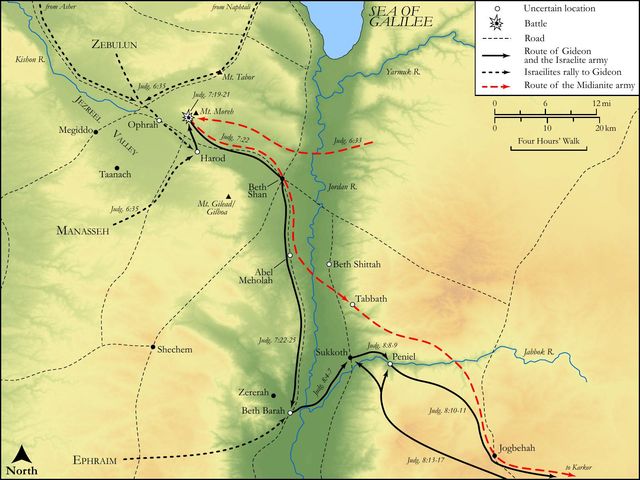
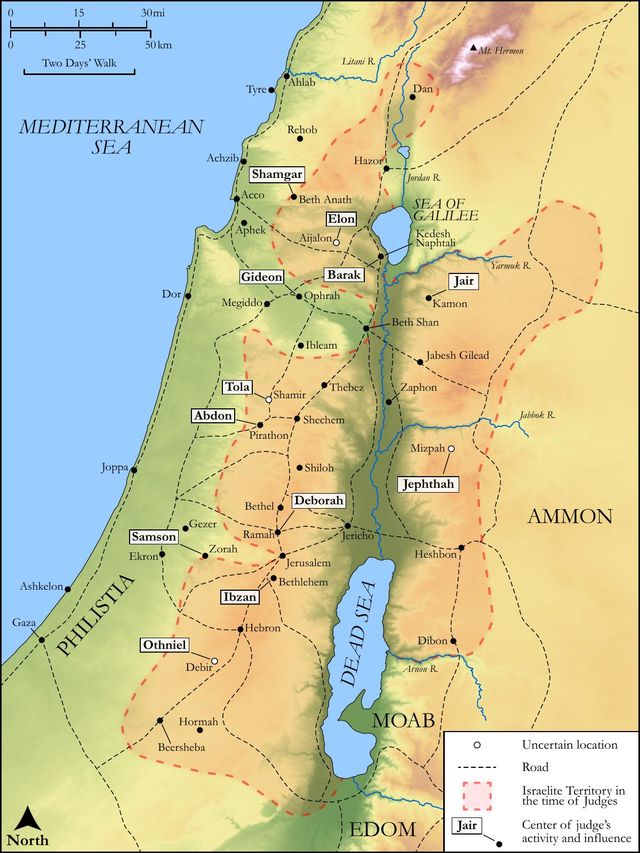
See on the biblical-era maps
Study this verse
Public-domain commentary
Matthew Henry
From his Commentary on the Whole Bible. Henry comments on passages, not single verses — this entry covers Judges 6:11–24. His four-level outline is real structure in the source text, so it is rendered as structure.
It is not said what effect the prophet's sermon had upon the people, but we may hope it had a good effect, and that some of them at least repented and reformed upon it; for here, immediately after, we have the dawning of the day of their deliverance, by the effectual calling of Gideon to take upon him the command of their forces against the Midianites.
I.The person to be commissioned for this service was Gideon, the son of Joash, Jdg 6:14.
The father was now living, but he was passed by, and this honour put upon the son, for the father kept up in his own family the worship of Baal (Jdg 6:25), which we may suppose this son, as far as was in his power, witnessed against. He was of the half tribe of Manasseh that lay in Canaan, of the family of Abiezer; the eldest house of that tribe, Jos 17:2. Hitherto the judges were raised up out of that tribe which suffered most by the oppression, and probably it was so here.
II.The person that gave him the commission was an angel of the Lord; it should seem not a created angel, but the Son of God himself, the eternal Word, the Lord of the angels, who then appeared upon some great occasions in human shape, as a prelude (says the learned bishop Patrick) to what he intended in the fulness of time, when he would take our nature upon him, as we say, for good and all. This angel is here called Jehovah, the incommunicable name of God (Jdg 6:14, Jdg 6:16), and he said, I will be with thee.
1.This divine person appeared here to Gideon, and it is observable how he found him,
(1.)Retired - all alone. God often manifests himself to his people when they are out of the noise and hurry of this world. Silence and solitude befriend our communion with God.
(2.)Employed in threshing wheat, with a staff or rod (so the word signifies), such as they used in beating out fitches and cummin (Isa 28:27), but now used for wheat, probably because he had but little to thresh, he needed not the oxen to tread it out. It was not then looked upon as any diminution to him, though he was a person of some account and a mighty man of valour, to lay his hand to the business of the husbandman. He had many servants (Jdg 6:27), and yet would not himself live in idleness. We put ourselves in the way of divine visits when we employ ourselves in honest business. Tidings of Christ's birth were brought to the shepherds when they were keeping their flocks. The work he was about was an emblem of that greater work to which he was now to be called, as the disciples' fishing was. From threshing corn he is fetched to thresh the Midianites, Isa 41:15.
(3.)Distressed; he was threshing his wheat, not in the threshing-floor, the proper place, but by the wine-press, in some private unsuspected corner, for fear of the Midianites. He himself shared in the common calamity, and now the angel came to animate him against Midian when he himself could speak so feelingly of the heaviness of their yoke. The day of the greatest distress is God's time to appear for his people's relief.
2.Let us now see what passed between the angel and Gideon, who knew not with certainty, till after he was gone, that he was an angel, but supposed he was a prophet.
(1.)The angel accosted him with respect, and assured him of the presence of God with him, Jdg 6:12. He calls him a mighty man of valour, perhaps because he observed how he threshed his corn with all his might; and seest thou a man diligent in his business? whatever his business is, he shall stand before kings. He that is faithful in a few things shall be ruler over many. Gideon was a man of a brave active spirit, and yet buried alive in obscurity, through the iniquity of the times; but he is here animated to undertake something great, like himself, with that word, The Lord is with thee, or, as the Chaldee reads it, the Word of the Lord is thy help. It was very sure that the Lord was with him when this angel was with him. By this word,
[1.]He gives him his commission. If we have God's presence with us, this will justify us and bear us out in our undertakings.
[2.]He inspires him with all necessary qualifications for the execution of his commission. "The Lord is with thee to guide and strengthen thee, to animate and support thee." [3.] He assures him of success; for, if God be for us, who can prevail against us? If he be with us, nothing can be wanting to us. The presence of God with us is all in all to our prosperity, whatever we do. Gideon was a mighty man of valour, and yet he could bring nothing to pass without the presence of God, and that presence is enough to make any man mighty in valour and to give a man courage at any time.
(2.)Gideon gave a very melancholy answer to this joyful salutation (Jdg 6:13): O my Lord! if the Lord be with us (which the Chaldee reads, Is the Shechinah of the Lord our help? making that the same with the Word of the Lord) why then has all this befallen us? "all this trouble and distress from the Midianites' incursions, which force me to thresh wheat here by the wine-press - all this loss, and grief, and fright; and where are all the miracles which our fathers told us of?" Observe, In his reply he regards not the praise of his own valour, nor does this in the least elevate him or give him any encouragement, though it is probable the angel adapted what he said to that which Gideon was at the same time thinking of; while his labouring hands were employed about his wheat, his working head and daring heart were meditating Israel's rescue and Midian's ruin, with which thought he that knows the heart seasonably sets in, calls him a man of valour for his brave projects, and open him a way to put them in execution; yet Gideon, as if not conscious to himself of any thing great or encouraging in his own spirit, fastens only on the assurance the angel had given him of God's presence, as that by which they held all their comfort. Observe, The angel spoke in particular to him: The Lord is with thee; but he expostulates for all: If the Lord be with us, herding himself with the thousands of Israel, and admitting no comfort but what they might be sharers in, so far is he from the thoughts of monopolizing it, though he had so fair an occasion given him. Note, Public spirits reckon that only an honour and joy to themselves which puts them in a capacity of serving the common interests of God's church. Gideon was a mighty man of valour, but as yet weak in faith, which makes it hard to him to reconcile to the assurances now given him of the presence of God,
[1.]The distress to which Israel was reduced: Why has all this (and all this was no little) befallen us? Note, It is sometimes hard, but never impossible, to reconcile cross providences with the presence of God and his favour.
[2.]The delay of their deliverance: "Where are all the miracles which our fathers told us of? Why does not the same power which delivered our fathers from the yoke of the Egyptians deliver us out of the hands of the Midianites?" As if because God did not immediately work miracles for their deliverance, though they had by their sins forfeited his favour and help, it must be questioned whether ever he had wrought the miracles which their fathers told them of, or, if he had, whether he had now the same wisdom, and power, and good-will to his people, that he had had formerly. This was his weakness. We must not expect that the miracles which were wrought when a church was in the forming, and some great truth in the settling, should be continued and repeated when the formation and settlement are completed: no, nor that the mercies God showed to our fathers that served him, and kept close to him, should be renewed to us, if we degenerate and revolt from him. Gideon ought not to have said either, First, That God had delivered them into the hands of the Midianites, for by their iniquities they had sold themselves, or, Secondly, That now they were in their hands he had forsaken them, for he had lately sent them a prophet (Jdg 6:8), which was a certain indication that he had not forsaken them.
(3.)The angel gave him a very effectual answer to his objections, by giving him a commission to deliver Israel out of the hands of the Midianites, and assuring him of success therein, Jdg 6:14. Now the angel is called Jehovah, for he speaks as one having authority, and not as a messenger.
[1.]There was something extraordinary in the look he now gave to Gideon; it was a gracious favourable look, which revived his spirits that dropped, and silenced his fears, such a look as that with which God's countenance beholds the upright, Psa 11:7. He looked upon him, and smiled at the objections he made, which he gave him no direct answer to, but girded and clothed him with such power as would shortly enable him to answer them himself, and make him ashamed that ever he had made them. It was a speaking look, like Christ's upon Peter (Luk 22:61), a powerful look, a look that strangely darted new light and life into Gideon's breast, and inspired him with a generous heat, far above what he felt before.
[2.]But there was much more in what he said to him. First, He commissioned him to appear and act as Israel's deliverer. Such a one the few thinking people in the nation, and Gideon among the rest, were now expecting to be raised up, according to God's former method, in answer to the cries of oppressed Israel; and now Gideon is told, "Thou art the man: Go in this thy might, this might wherewith thou art now threshing wheat; go and employ it to a nobler purpose; I will make thee a thresher of men." Or, rather, "this might wherewith thou art now endued by this look." God gave him his commission by giving him all the qualifications that were necessary for the execution of it, which is more than the mightiest prince and potentate on earth can do for those to whom he gives commissions. God's fitting men for work is a sure and constant evidence of his calling them to it. "Go, not in thy might, that which is natural, and of thyself, depend not on thy own valour; but go in this thy might, this which thou hast now received, go in the strength of the Lord God, that is, the strength with which thou must strengthen thyself." Secondly, He assured him of success. This was enough to put courage into him; he might be confident he should not miscarry in the attempt; it should not turn either to his own disgrace or the damage of his people (as baffled enterprises do), but to his honour and their happiness: Thou shalt save Israel from the hand of the Midianites, and so shalt not only be an eye-witness, but a glorious instrument, of such wonders as thy fathers told thee of. Gideon, we may suppose, looked as one astonished at this strange and surprising power conferred upon him, and questions whether he may depend upon what he hears: the angel ratifies his commission with a teste meipso - an appeal to his own authority; there needed no more. "Have not I commanded thee - I that have all power in heaven and earth, and particular authority here as Israel's King, giving commissions immediately - I who am that I am, the same that sent Moses?" Exo 3:14.
(4.)Gideon made a very modest objection against this commission (Jdg 6:15): O my Lord! wherewith shall I save Israel? This question bespeaks him either,
[1.]Distrustful of God and his power, as if, though God should be with him, yet it were impossible for him to save Israel. True faith is often weak, yet it shall not be rejected, but encouraged and strengthened. Or,
[2.]Inquisitive concerning the methods he must take: "Lord, I labour under all imaginable disadvantages for it; if I must do it, thou must put me in the way." Note, Those who receive commissions from God must expect and seek for instructions from him. Or rather,
[3.]Humble, self-diffident, and self-denying. The angel had honoured him, but see how meanly he speaks of himself: "My family is comparatively poor in Manasseh" (impoverished, it may be, more than other families by the Midianites), "and I am the least, that have the least honour and interest, in my father's house; what can I pretend to do? I am utterly unfit for the service, and unworthy of the honour." Note, God often chooses to do great things by those that are little, especially that are so in their own eyes. God delights to advance the humble.
(5.)This objection was soon answered by a repetition of the promise that God would be with him, v. 16. "Object not thy poverty and meanness; such things have indeed often hindered men in great enterprises, but what are they to a man that has the presence of God with him, which will make up all the deficiencies of honour and estate. Surely I will be with thee, to direct and strengthen thee, and put such a reputation upon thee that, how weak soever thy personal interest is, thou shalt have soldiers enough to follow thee, and be assured thou shalt smite the Midianites as one men, as easily as if they were but one man and as effectually. All the thousands of Midian shall be as if they had but one neck, and thou shalt have the cutting of it off."
(6.)Gideon desires to have his faith confirmed touching this commission; for he would not be over-credulous of that which tended so much to his own praise, would not venture upon an undertaking so far above him, and in which he must engage many more, but he would be well satisfied himself of his authority, and would be able to give satisfaction to others as to him who gave him that authority. He therefore humbly begs of this divine person, whoever he was,
[1.]That he would give him a sign, Jdg 6:17. And, the commission being given him out of the common road of providence, he might reasonably expect it should be confirmed by some act of God out of the common course of nature: "Show me a sign to assure me of the truth of this concerning which thou talkest with me, that it is something more than talk, and that thou art in earnest." Now, under the dispensation of the Spirit, we are not to expect signs before our eyes, such as Gideon here desired, but must earnestly pray to God that, if we have found grace in his sight, he would show us a sign in our heart, by the powerful operations of his Spirit there, fulfilling the work of faith, and perfecting what is lacking in it.
[2.]In order hereunto, that he would accept of a treat, and so give him a further and longer opportunity of conversation with him, Jdg 6:18. Those who know what it is to have communion with God desire the continuance of it, and are loth to part, praying with Gideon, Depart not hence, I pray thee. That which Gideon desired in courting his stay was that he might bring out some provision of meat for this stranger. He did not take him into the house to entertain him there, perhaps because his father's house were not well affected to him and his friends, or because he desired still to be in private with this stranger, and to converse with him alone (therefore he calls not for a servant to bring the provision, but fetches it himself), or because thus his father Abraham entertained angels unawares, not in his tent, but under a tree, Gen 18:8. Upon the angel's promise to stay to dinner with him, he hastened to bring out a kid, which, it is likely, was ready boiled for his own dinner, so that in making it ready he had nothing to do but to put it in the basket (for here was no sauce to serve it up in, nor the dish garnished) and the broth in a vessel, and so he presented it, Jdg 6:19. Hereby he intended, First, To testify his grateful and generous respects to this stranger, and, in him, to God who sent him, as one that studied what he should render. He had pleaded the poverty of his family (Jdg 6:15) to excuse himself from being a general, but not here to excuse himself from being hospitable. Out of the little which the Midianites had left him he would gladly spare enough to entertain a friend, especially a messenger from heaven. Secondly, To try who and what this extraordinary person was. What he brought out is called his present, Jdg 6:18. It is the same word that is used for a meat-offering, and perhaps that word is used which signifies both because Gideon intended to leave it to this divine person to determine which it should be when he had it before him: whether a feast or a meat-offering, and accordingly he would be able to judge concerning him: if he ate of it as common meat, he would suppose him to be a man, a prophet; if otherwise, as it proved, he should know him to be an angel.
(7.)The angel gives him a sign in and by that which he had kindly prepared for his entertainment. For what we offer to God for his glory, and in token of our gratitude to him, will be made by the grace of God to turn to our own comfort and satisfaction. The angel ordered him to take the flesh and bread out of the basket, and lay it upon a hard and cold rock, and to pour out the broth upon it, which, if he brought it hot, would soon be cold there; and Gideon did so (Jdg 6:20), believing that the angel appointed it, not in contempt of his courtesy, but with an intention to give him a sign, which he did, abundantly to his satisfaction. For,
[1.]He turned the meat into an offering made by fire, of a sweet savour unto himself, showing hereby that he was not a man who needed meat, but the Son of God who was to be served and honoured by sacrifice, and who in the fulness of time was to make himself a sacrifice.
[2.]He brought fire out of the rock, to consume this sacrifice, summoning it, not by striking the rock, as we strike fire out of a flint, but by a gentle touch given to the offering with the end of his staff, Jdg 6:21. Hereby he gave him a sign that he had found grace in his sight, for God testified his acceptance of sacrifices by kindling them, if public, with fire from heaven, as those of Moses and Elias, if private, as this, with fire out of the earth, which was equivalent: both were the effect of divine power; and this acceptance of his sacrifice evidenced the acceptance of his person, confirmed his commission, and perhaps was intended to signify his success in the execution of it, that he and his army should be a surprising terror and consumption to the Midianites, like this fire out of the rock.
[3.]He departed out of his sight immediately, did not walk off as a man, but vanished and disappeared as a spirit. Here was as much of a sign as he could wish.
(8.)Gideon, though no doubt he was confirmed in his faith by the indications given of the divinity of the person who had spoken to him, yet for the present was put into a great fright by it, till God graciously pacified him and removed his fears.
[1.]Gideon speaks peril to himself (Jdg 6:22): When he perceived that he was an angel (which was not till he had departed, as the two disciples knew not it was Jesus they had been talking with till he was going, Luk 24:31), then he cried out, Alas! O Lord God! be merciful to me, I am undone, for I have seen an angel, as Jacob, who wondered that his life was preserved when he had seen God, Gen 32:30. Ever since man has by sin exposed himself to God's wrath and curse an express from heaven has been a terror to him, as he scarcely dares to expect good tidings thence; at least, in this world of sense, it is a very awful thing to have any sensible conversation with that world of spirits to which we are so much strangers. Gideon's courage failed him now.
[2.]God speaks peace to him, Jdg 6:23. It might have been fatal to him, but he assures him it should not. The Lord had departed out of his sight, Jdg 6:21. But though he must no longer walk by sight he might still live by faith, that faith which comes by hearing; for the Lord said to him, with an audible voice (as bishop Patrick thinks) these encouraging words, "Peace be unto thee, all is well, and be thou satisfied that it is so. Fear not; he that came to employ thee did not intend to slay thee; thou shalt not die." See how ready God is to revive the hearts of those that tremble at his word and presence, and to give those that stand in awe of his majesty assurances of his mercy.
3.The memorial of this vision which Gideon set up was a monument in form of an altar, the rather because it was by a kind of sacrifice upon a rock, without the solemnity of an altar, that the angel manifested his acceptance of him; then an altar was unnecessary (the angel's staff was sufficient to sanctify the gift without an altar), but now it was of use to preserve the remembrance of the vision, which was done by the name Gideon gave to this memorial, Jehovah-shalom (Jdg 6:24) - The Lord peace. This is,
(1.)The title of the Lord that spoke to him. Compare Gen 16:13. The same that is the Lord our righteousness is our peace (Eph 2:14), our reconciler and so our Saviour. Or,
(2.)The substance of what he said to him: "The Lord spoke peace, and created that fruit of the lips, bade me be easy when I was in that agitation." Or,
(3.)A prayer grounded upon what he had said, so the margin understands it: The Lord send peace, that is, rest from the present trouble, for still the public welfare lay nearest his heart.
Continue studying Judges 6:22 across the web’s major study libraries — every link below opens this exact verse, chapter, or book on the destination site.
Read & Compare
 BibleGatewayThis verse in more than 200 translations and 70 languages.
 Bible.comThe YouVersion reader — hundreds of translations, reading plans, and highlights.
 ESV.orgCrossway's official English Standard Version reader.
 NET BibleThe NET translation with 60,000+ translators' notes on every rendering decision.
 STEP BibleTyndale House's free study tool — original text, vocabulary, and scholarly resources.
 BibliaLogos Bible Software's free web reader.
 USCCBThe New American Bible (Revised Edition) with the U.S. bishops' study notes.
Commentaries
 BibleHub CommentariesDozens of classic commentaries on this verse, gathered on one page.
 StudyLightMore than 100 commentary sets — the largest collection on the web.
 BibleRefPlain-English commentary on what this verse means, verse by verse.
 Enduring WordDavid Guzik's free commentary on this chapter, widely used by Bible teachers.
 Bible Study ToolsVerse commentary alongside Greek and Hebrew study aids.
Original Language & Research
- BibleHub InterlinearThe verse word by word — original language, transliteration, and English.
- BibleHub LexiconEvery word's original-language definition and Strong's entry.
 Blue Letter BibleDeep-study tools — Strong's numbers, concordance, and word studies.
 SefariaThe Hebrew text with Rashi and centuries of Jewish commentary.
Sermons, Hymns & Audio


TrulyRandomVerse is not affiliated with these sites and doesn’t control their content. They’re linked because they’re genuinely useful.
Summary
Judges 6:22 captures the dramatic climax of Gideon's initial encounter with the divine, as he suddenly comprehends that his mysterious visitor is none other than the Angel of the LORD. This profound realization, triggered by a supernatural sign, immediately plunges Gideon into intense fear and an exclamation of distress, stemming from the deeply held ancient Israelite belief that a direct sight of God would inevitably lead to death. The verse powerfully conveys the awe and terror inherent in a direct divine revelation, setting the stage for God's subsequent reassurance and the unfolding of Gideon's reluctant but divinely appointed mission.
Context
ShowHideLiterary Context
Judges 6:22 serves as the pivotal turning point in the narrative of Gideon's call, following a series of interactions designed to overcome his skepticism. The preceding verses detail the Angel of the LORD's initial appearance to Gideon, who is depicted as a fearful man threshing wheat in a winepress to hide from the Midianites. The Angel's surprising declaration, "The LORD is with you, you mighty man of valor" (Judges 6:12), is met with Gideon's profound doubt and questioning of God's presence amidst Israel's suffering. Gideon then requests a sign, preparing an elaborate offering of meat and unleavened cakes. In a miraculous display of divine power, the Angel instructs Gideon to place the offering on a rock, touches it with his staff, and fire consumes the sacrifice, after which the Angel vanishes (Judges 6:21). It is this undeniable, supernatural act that shatters Gideon's doubt, revealing the true identity of his interlocutor in Judges 6:22 and eliciting his immediate, terrified response.
Historical & Cultural Context
The book of Judges portrays a tumultuous period in Israelite history (approximately 14th-11th century BCE) characterized by a recurring cycle of disobedience, oppression by foreign powers, Israel's cry for help, and God raising up a "judge" for deliverance. At this time, the Midianites, often in league with Amalekites and other "people of the East," were annual invaders who systematically plundered Israel's agricultural produce and livestock, forcing the Israelites to seek refuge in caves and strongholds (Judges 6:2). This dire situation explains Gideon's initial fear and his unusual method of threshing wheat. Culturally, the belief that a direct, unmediated encounter with the divine would result in death was a deeply ingrained theological conviction within ancient Israel (Exodus 33:20). This perception arose from an understanding of God's absolute holiness and humanity's inherent sinfulness, rendering such an encounter perilous for mortals. Gideon's reaction is thus not merely personal terror but a culturally and theologically informed response to a perceived existential threat.
Key Themes
ShowHideJudges 6:22 powerfully contributes to several overarching themes within the book of Judges and broader biblical theology. Firstly, it underscores the theme of Divine Revelation and Recognition, illustrating God's direct, personal intervention in human history and the transformative moment when a skeptical individual's eyes are opened to His majestic presence. Secondly, it highlights the profound Fear of God's Presence (often termed the "fear of the LORD"), a pervasive biblical motif that denotes not just terror but also deep awe, reverence, and humble submission to divine authority. Gideon's cry, "Alas, O Lord GOD!", is a quintessential expression of this holy dread, reflecting the ancient understanding of the danger and overwhelming nature of encountering the holy. Lastly, the verse deepens the theological mystery surrounding the Identity of the "Angel of the LORD," a figure who consistently speaks with divine authority, accepts worship, and is frequently presented as indistinguishable from Yahweh Himself, thereby laying crucial groundwork for later theological discussions concerning pre-incarnate appearances of Christ.
Exposition and Analysis
ShowHideKey Word Analysis
ShowHideThis verb, H7200, signifies more than mere observation; it denotes a deep, experiential knowing or discerning. Gideon's "perception" is a profound recognition that transcends intellectual understanding, leading to an undeniable, visceral conviction of the Angel's true, divine identity. It implies a sudden, revelatory insight that transforms his previous skepticism into absolute certainty, encompassing the idea of "seeing" in a comprehensive and discerning manner.
This is a crucial theological designation, combining H4397 ("messenger") with H3068 (God's covenant name, "Jehovah" or "the LORD"). While mălʼâk literally means "messenger," its pairing with Yᵉhôvâh elevates this figure far beyond a mere created angel. Throughout the Old Testament, the "Angel of the LORD" often acts and speaks as God Himself, receiving worship and performing divine acts. Gideon's recognition is not simply of an angelic being, but of a direct, authoritative manifestation of Yahweh's presence and authority.
Gideon's cry is an interjection of profound distress, fear, and lament. H162, ʼăhâhh, is a primitive word expressing pain exclamatorily, conveying woe or sorrow. H136, ʼĂdônây, is an emphatic and reverential title for God, meaning "my Lord" or "my Master," often used by Jews to avoid speaking the ineffable name Yahweh. H3069, Yᵉhôvih, is a variation of Yᵉhôvâh used specifically after ʼĂdônây to prevent repetition of the same sound. The combination expresses a deep sense of dread and unworthiness in the face of the divine, reflecting the ancient belief that such an encounter was fatal for mortals.
Verse Breakdown
ShowHide"And when Gideon perceived that he [was] an angel of the LORD"
This clause describes the climactic moment of Gideon's sudden and terrifying realization. The miraculous consumption of the offering by fire, immediately followed by the Angel's disappearance, served as the undeniable, requested sign. This was not merely a human visitor, nor even an ordinary angelic being, but a direct, authoritative manifestation of God's presence and power, specifically identified as "the Angel of the LORD." Gideon's perception is a sudden, crystal-clear, and profoundly unsettling understanding.
"Gideon said, Alas, O Lord GOD!"
This is Gideon's immediate, visceral, and deeply emotional reaction to his profound realization. The exclamation "Alas!" (Hebrew ʼăhâhh) conveys intense distress, fear, and a sense of impending doom. His address to the divine being as "O Lord GOD!" (Hebrew ʼĂdônây Yᵉhôvih) signifies his recognition of the supreme authority, holiness, and majesty of the one he had just encountered. This is a cry of terror, born from the deep-seated theological conviction that a direct encounter with the divine would inevitably result in death.
"for because I have seen an angel of the LORD face to face"
This final clause explicitly states the reason for Gideon's overwhelming fear. The phrase "face to face" (Hebrew pânîym el-pânîym) denotes a direct, unmediated, and personal encounter. Gideon believes that having directly witnessed this divine manifestation, his life is now forfeit. This fear is entirely consistent with other biblical accounts where individuals react with terror or despair upon encountering God's unmasked presence, believing it to be a death sentence due to humanity's sinfulness in the presence of divine holiness.
Literary Devices
ShowHideThe passage employs several potent Literary Devices to heighten the drama and theological impact. Irony is powerfully present in Gideon's journey from profound skepticism and repeated demands for signs to a revelation so overwhelming that it evokes terror rather than simple confirmation. The very act of God accommodating Gideon's doubt leads to a profound, fear-inducing encounter, contrasting with his initial desire for reassurance. Foreshadowing is also evident; Gideon's overwhelming fear in the face of divine power hints at the immense challenges he will face in his future mission and the absolute reliance on God's strength that will be required to overcome them. The phrase "face to face" is a form of hyperbole or intense expression, emphasizing the perceived directness and danger of the encounter, even though Gideon does not physically die. This dramatic language underscores the awe-inspiring, potentially terrifying, and truly transformative nature of divine presence.
Theological and Thematic Connections
ShowHideJudges 6:22 profoundly illustrates the awe-inspiring and often terrifying nature of encountering God's unmediated presence. Gideon's immediate reaction of fear and his conviction that he would die for seeing the "Angel of the LORD face to face" reflects a consistent theological theme throughout the Old Testament: the holiness of God is so absolute that sinful humanity cannot endure a direct encounter without perishing. This highlights the immense chasm between the transcendent Creator and His fallen creation, emphasizing God's purity and awesome power. Yet, the very next verse (Judges 6:23) reveals God's patient and reassuring nature, providing peace and dispelling Gideon's fear, demonstrating that God's ultimate purpose in revealing Himself is not to destroy but to call, empower, and save.
Reflection and Application
ShowHideGideon's experience in Judges 6:22 offers a powerful lens through which to examine our own encounters with the divine. Like Gideon, we may initially approach God with skepticism, doubt, or a desire for tangible proof. However, when God chooses to reveal Himself in ways that shatter our expectations or challenge our comfort zones, our response can often be one of profound awe, inadequacy, or even fear. This verse reminds us that genuine encounters with the holy are inherently transformative and can expose our vulnerability and sinfulness in the blazing light of God's immense power and purity. Yet, it also implicitly points to the subsequent reassurance God provides, inviting us to move beyond our initial terror to embrace the peace and purpose He offers. Our call is to recognize God's presence, even when it feels overwhelming, and to trust in His character, knowing that His ultimate desire is not to condemn but to redeem and empower us for His kingdom purposes.
Questions for Reflection
ShowHideFAQ
ShowHideWhat is the significance of Gideon's fear upon realizing he saw the Angel of the LORD?
ShowHideGideon's fear is highly significant because it reflects a deep-seated theological belief prevalent in ancient Israel: that no human could see God and live. This conviction is rooted in the understanding of God's absolute holiness and humanity's inherent sinfulness. Biblical figures such as Jacob, who wrestled with God at Peniel (Genesis 32:30), Moses, who was told he could not see God's face and live (Exodus 33:20), and Isaiah, who cried "Woe is me! For I am lost; for I am a man of unclean lips" upon seeing the Lord (Isaiah 6:5), all expressed similar fear or a sense of impending doom upon encountering God's unmediated presence. Gideon's "Alas, O Lord GOD!" is a profound expression of this holy dread, signifying his immediate realization of the divine nature of his visitor and his expectation of death as a direct consequence of such a direct encounter. It powerfully underscores the immense gap between finite, sinful humanity and the infinite, holy God.
Christ-Centered Fulfillment
ShowHideThe "Angel of the LORD" in Judges 6:22, whom Gideon perceives "face to face," is frequently interpreted by theologians as a Christophany—a pre-incarnate appearance of Jesus Christ. This divine figure consistently acts and speaks with the authority of God Himself, accepts worship, and is often presented as indistinguishable from Yahweh, thereby laying crucial theological groundwork for the New Testament revelation of God's nature. While Old Testament figures like Gideon feared death upon seeing God, the ultimate fulfillment in Christ reveals a God who, far from bringing death, actively seeks to bring life through personal encounter. In Jesus, the invisible God is made visible (Colossians 1:15), and the one who saw God and lived is the one through whom we can now approach God without fear of condemnation. Jesus, the Son, is the "radiance of the glory of God and the exact imprint of his nature" (Hebrews 1:3), and He declared, "Whoever has seen me has seen the Father" (John 14:9). Thus, the terrifying "face to face" encounter of Gideon is transformed in Christ into an invitation to intimate fellowship, where God's presence brings not death, but peace and eternal life (John 1:18).