


Genesis 32:30
Bible text: King James Version (1769 Blayney text) · Public domain
Bible text: Berean Standard Bible · Public domain
Bible text: American Standard Version (1901) · Public domain
Bible text: World English Bible, Messianic edition · Public domain
Bible text: Geneva Bible (1599) · Public domain
Bible text: Young's Literal Translation · Public domain
- וַיִּקְרָאvai·yik·Ra'and he calledH7121Conj-w ¦ V-Qal-ConsecImperf-3msVerb Qal Consecutive Imperfect 3rd Singular Masculineוַandיִּקְרָאhe called
- יַעֲקֹבya·'a·KoJacobH3290N-proper-mNoun Proper Masculine
- שֵׁםshem[the] name ofH8034N-mscNoun Singular Masculine Construct
- הַמָּקוֹםha·ma·Komthe placeH4725Art ¦ N-msNoun Singular Masculine Absoluteהַtheמָּקוֹםplace
- פְּנִיאֵלpe·ni·'ElPenielH6439N-properNoun Proper Location
- כִּיkiforH3588PrtParticle Conditional
- רָאִיתִיra·'I·tiI have seenH7200V-Qal-Perf-1csVerb Qal Perfect 1st Singular common gender
- אֱלֹהִים'E·lo·HimGodH430N-mpNoun Plural Masculine Absolute
- פָּנִיםpa·NimfaceH6440N-mpNoun Plural Masculine Absolute
- אֶל'eltoH413PrepPreposition
- פָּנִיםpa·NimfaceH6440N-mpNoun Plural Masculine Absolute
- וַתִּנָּצֵלva·ti·na·Tzeland it has been deliveredH5337Conj-w ¦ V-Niphal-ConsecImperf-3fsVerb Niphal Consecutive Imperfect 3rd Singular Feminineוַandתִּנָּצֵלit has been delivered
- נַפְשִׁיnaf·Shimy lifeH5315N-fsc ¦ 1csNoun Singular Feminine Constructנַפְשִׁlifeיmy
English is a literal word-by-word gloss of the Hebrew, not the KJV's wording. Why?
This is the original text the KJV's translators worked from — each Hebrew word with its own literal English meaning in this verse, prepared by scholars at Tyndale House, Cambridge. The KJV translates whole sentences, not word by word, so its wording differs: one Hebrew word can become several English words, and the KJV may choose “the LORD” where the gloss reads “Yahweh”. Both are faithful — they answer different questions. For the KJV's own rendering, switch to the KJV text.
Details
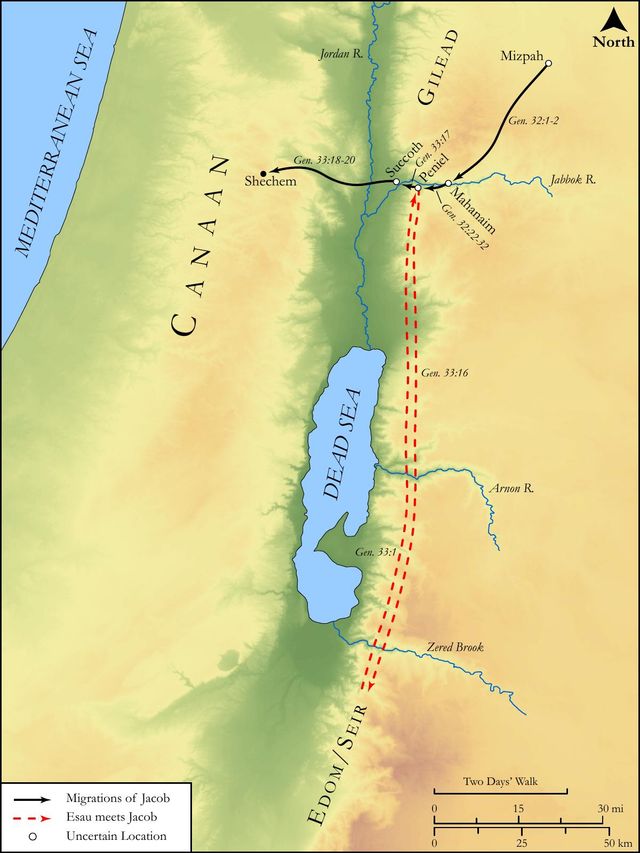
See on the biblical-era maps


Study this verse
Public-domain commentary
Matthew Henry
From his Commentary on the Whole Bible. Henry comments on passages, not single verses — this entry covers Genesis 32:24–32. His two-level outline is real structure in the source text, so it is rendered as structure.
We have here the remarkable story of Jacob's wrestling with the angel and prevailing, which is referred to, Hos 12:4. Very early in the morning, a great while before day, Jacob had helped his wives and his children over the river, and he desired to be private, and was left alone, that he might again more fully spread his cares and fears before God in prayer. Note, We ought to continue instant in prayer, always to pray and not to faint: frequency and importunity in prayer prepare us for mercy. While Jacob was earnest in prayer, stirring up himself to take hold on God, an angel takes hold on him. Some think this was a created angel, the angel of his presence (Isa 63:9), one of those that always behold the face of our Father and attend on the shechinah, or the divine Majesty, which probably Jacob had also in view. Others think it was Michael our prince, the eternal Word, the angel of the covenant, who is indeed the Lord of the angels, who often appeared in a human shape before he assumed the human nature for a perpetuity; whichsoever it was, we are sure God's name was in him, Exo 23:21. Observe,
I.How Jacob and this angel engaged, Gen 32:24.
It was a single combat, hand to hand; they had neither of them any seconds. Jacob was now full of care and fear about the interview he expected, next day, with his brother, and, to aggravate the trial, God himself seemed to come forth against him as an enemy, to oppose his entrance into the land of promise, and to dispute the pass with him, not suffering him to follow his wives and children whom he had sent before. Note, Strong believers must expect divers temptations, and strong ones. We are told by the prophet (Hos 12:4) how Jacob wrestled: he wept, and made supplication; prayers and tears were his weapons. It was not only a corporal, but a spiritual, wrestling, by the vigorous actings of faith and holy desire; and thus all the spiritual seed of Jacob, that pray in praying, still wrestle with God.
II.What was the success of the engagement.
1.Jacob kept his ground; though the struggle continued long, the angel, prevailed not against him (Gen 32:25), that is, this discouragement did not shake his faith, nor silence his prayer. It was not in his own strength that he wrestled, nor by his own strength that he prevailed, but in and by strength derived from Heaven. That of Job illustrates this (Job 23:6), Will he plead against me with his great power? No (had the angel done so, Jacob had been crushed), but he will put strength in me; and by that strength Jacob had power over the angel, Hos 12:4. Note, We cannot prevail with God but in his own strength. It is his Spirit that intercedes in us, and helps our infirmities, Rom 8:26.
2.The angel put out Jacob's thigh, to show him what he could do, and that it was God he was wrestling with, for no man could disjoint his thigh with a touch. Some think that Jacob felt little or no pain from this hurt; it is probable that he did not, for he did not so much as halt till the struggle was over (Gen 32:31), and, if so, this was an evidence of a divine touch indeed, which wounded and healed at the same time. Jacob prevailed, and yet had his thigh put out. Note, Wrestling believers may obtain glorious victories, and yet come off with broken bones; for when they are weak then are they strong, weak in themselves, but strong in Christ, Co2 12:10. Our honours and comforts in this world have their alloys.
3.The angel, by an admirable condescension, mildly requests Jacob to let him go (Gen 32:26), as God said to Moses (Exo 32:10), Let me alone. Could not a mighty angel get clear of Jacob's grapples? He could; but thus he would put an honour on Jacob's faith and prayer, and further try his constancy. The king is held in the galleries (Sol 7:5); I held him (says the spouse) and would not let him go, Sol 3:4. The reason the angel gives why he would be gone is because the day breaks, and therefore he would not any longer detain Jacob, who had business to do, a journey to go, a family to look after, which, especially in this critical juncture, called for his attendance. Note, Every thing is beautiful in its season; even the business of religion, and the comforts of communion with God, must sometimes give way to the necessary affairs of this life: God will have mercy, and not sacrifice.
4.Jacob persists in his holy importunity: I will not let thee go, except thou bless me; whatever becomes of his family and journey, he resolves to make the best he can of this opportunity, and not to lose the advantage of his victory: he does not mean to wrestle all night for nothing, but humbly resolves he will have a blessing, and rather shall all his bones be put out of joint than he will go away without one. The credit of a conquest will do him no good without the comfort of a blessing. In begging this blessing he owns his inferiority, though he seemed to have the upper hand in the struggle; for the less is blessed of the better. Note, Those that would have the blessing of Christ must be in good earnest, and be importunate for it, as those that resolve to have no denial. It is the fervent prayer that is the effectual prayer.
5.The angel puts a perpetual mark of honour upon him, by changing his name (Gen 32:27, Gen 32:28): "Thou art a brave combatant" (says the angel), "a man of heroic resolution; what is thy name?" "Jacob," says he, a supplanter; so Jacob signifies: "Well," says the angel, "be thou never so called any more; henceforth thou shalt be celebrated, not for craft and artful management, but for true valour; thou shalt be called Israel, a prince with God, a name greater than those of the great men of the earth." He is a prince indeed that is a prince with God, and those are truly honourable that are mighty in prayer, Israels, Israelites indeed. Jacob is here knighted in the field, as it were, and has a title of honour given him by him that is the fountain of honour, which will remain, to his praise, to the end of time. Yet this was not all; having power with God, he shall have power with men too. Having prevailed for a blessing from heaven, he shall, no doubt, prevail for Esau's favour. Note, Whatever enemies we have, if we can but make God our friend, we are well off; those that by faith have power on earth as they have occasion for.
6.He dismisses him with a blessing, Gen 32:29. Jacob desired to know the angel's name, that he might, according to his capacity, do him honour, Jdg 13:17. But that request was denied, that he might not be too proud of his conquest, nor think he had the angel at such an advantage as to oblige him to what he pleased. No, "Wherefore dost thou ask after my name? What good will it do thee to know that?" The discovery of that was reserved for his death-bed, upon which he was taught to call him Shiloh. But, instead of telling him his name, he gave him his blessing, which was the thing he wrestled for: He blessed him there, repeated and ratified the blessing formerly given him. Note, Spiritual blessings, which secure our felicity, are better and much more desirable than fine notions which satisfy our curiosity. An interest in the angel's blessing is better than an acquaintance with his name. The tree of life is better than the tree of knowledge. Thus Jacob carried his point; a blessing he wrestled for, and a blessing he had; nor did ever any of his praying seed seek in vain. See how wonderfully God condescends to countenance and crown importunate prayer: those that resolve, though God slay them, yet to trust in him, will, at length, be more than conquerors.
7.Jacob gives a new name to the place; he calls it Peniel, the face of God (Gen 32:30), because there he had seen the appearance of God, and obtained the favour of God. Observe, The name he gives to the place preserves and perpetuates, not the honour of his valour or victory, but only the honour of God's free grace. He does not say, "In this place I wrestled with God, and prevailed;" but, "In this place I saw God face to face, and my life was preserved;" not, "It was my praise that I came off a conqueror, but it was God's mercy that I escaped with my life." Note, It becomes those whom God honours to take shame to themselves, and to admire the condescensions of his grace to them. Thus David did, after God had sent him a gracious message (Sa2 7:18), Who am I, O Lord God?
8.The memorandum Jacob carried of this in his bones: He halted on his thigh (Gen 32:31); some think he continued to do so to his dying-day; and, if he did, he had no reason to complain, for the honour and comfort he obtained by this struggle were abundantly sufficient to countervail the damage, though he went limping to his grave. He had no reason to look upon it as his reproach thus to bear in his body the marks of the Lord Jesus (Gal 6:17); yet it might serve, like Paul's thorn in the flesh, to keep him from being lifted up with the abundance of the revelations. Notice is taken of the sun's rising upon him when he passed over Penuel; for it is sunrise with that soul that has communion with God. The inspired penman mentions a traditional custom which the seed of Jacob had, in remembrance of this, never to eat of that sinew, or muscle, in any beast, by which the hip-bone is fixed in its cup: thus they preserved the memorial of this story, and gave occasion to their children to enquire concerning it; they also did honour to the memory of Jacob. And this use we may still make of it, to acknowledge the mercy of God, and our obligations to Jesus Christ, that we may now keep up our communion with God, in faith, hope, and love, without peril either of life or limb.
Historical interpretation
Historical reception
2 surviving comments on this verse. Each one is dated, so this reads as a timeline rather than a list.
Select a marker to jump to its quote. Markers stagger vertically where authors wrote within a few decades of each other.
Do you see how much confidence Jacob gained from the vision he had? That is to say, “my spirit survived,” he is saying, “which had almost perished from fear. Since I was privileged to see God face to face, ‘my spirit survived.’ ” Now the sun rose on him as he passed the sight of God.Do you see how the Lord shows considerateness for our human limitations in all he does and in arranging everything in a way that gives evidence of his characteristic love? Don’t be surprised, dearly beloved, at the extent of his considerateness; rather, remember that with the patriarch as well, when Abraham was sitting by the oak tree, God came in human form as the good man’s guest in the company of the angels, giving us a premonition from on high at the beginning that he would one day take human form to liberate all human nature by this means from the tyranny of the devil and lead us to salvation. At that time, however, since it was the very early stages, God appeared to each of them in the guise of an apparition, as he says himself through the inspired author, “I multiplied visions and took various likenesses in the works of the inspired authors.”
(Verse 29 and 30.) And he blessed him there and called the name of that place Face of God: for I have seen God face to face, and my soul has been saved; in Hebrew it is called Phanuel (), so that we know that it is the same place, which in the other sacred volumes of Scripture, as it is written in Hebrew, is read as Phanuel in Greek.
Continue studying Genesis 32:30 across the web’s major study libraries — every link below opens this exact verse, chapter, or book on the destination site.
Read & Compare
 BibleGatewayThis verse in more than 200 translations and 70 languages.
 Bible.comThe YouVersion reader — hundreds of translations, reading plans, and highlights.
 ESV.orgCrossway's official English Standard Version reader.
 NET BibleThe NET translation with 60,000+ translators' notes on every rendering decision.
 STEP BibleTyndale House's free study tool — original text, vocabulary, and scholarly resources.
 BibliaLogos Bible Software's free web reader.
 USCCBThe New American Bible (Revised Edition) with the U.S. bishops' study notes.
Commentaries
 BibleHub CommentariesDozens of classic commentaries on this verse, gathered on one page.
 StudyLightMore than 100 commentary sets — the largest collection on the web.
 BibleRefPlain-English commentary on what this verse means, verse by verse.
 Enduring WordDavid Guzik's free commentary on this chapter, widely used by Bible teachers.
 Bible Study ToolsVerse commentary alongside Greek and Hebrew study aids.
Original Language & Research
- BibleHub InterlinearThe verse word by word — original language, transliteration, and English.
- BibleHub LexiconEvery word's original-language definition and Strong's entry.
 Blue Letter BibleDeep-study tools — Strong's numbers, concordance, and word studies.
 SefariaThe Hebrew text with Rashi and centuries of Jewish commentary.
Sermons, Hymns & Audio


TrulyRandomVerse is not affiliated with these sites and doesn’t control their content. They’re linked because they’re genuinely useful.
Summary
Genesis 32:30 marks the profound culmination of Jacob's all-night wrestling match with a divine being, as he names the place "Peniel," signifying "the face of God." This pivotal declaration encapsulates Jacob's astonishment and gratitude for having encountered the Almighty directly, surviving the encounter, and being profoundly transformed by this intimate, yet awe-inspiring, communion with the divine.
Context
ShowHideLiterary Context
This verse is the climactic moment immediately following Jacob's solitary, all-night struggle at the ford of Jabbok. Jacob, deeply apprehensive about reuniting with his estranged brother Esau, had strategically sent his family and possessions ahead, leaving himself alone in the darkness. This isolation often serves as a crucible for significant spiritual encounters in biblical narratives, setting the stage for Jacob's intense physical and spiritual wrestling. The preceding verses detail the mysterious nature of his opponent and the relentless struggle, which culminates in Jacob's refusal to release the figure until he received a blessing, leading to his new name, Israel, meaning "he struggles with God" or "God strives" (Genesis 32:28). The naming of Peniel thus provides the geographical and theological anchor for this transformative event.
Historical & Cultural Context
In Israel, a direct, unmediated encounter with God was generally believed to be fatal for mortals. This belief is reflected in various biblical passages, such as Exodus 33:20, where God tells Moses, "Thou canst not see my face: for there shall no man see me, and live." Therefore, Jacob's declaration of seeing God "face to face" and surviving was an extraordinary and miraculous event, highlighting God's sovereign grace and unique purpose for Jacob. The act of naming a place after a significant event or divine revelation was also a common practice, serving as a permanent memorial and a testament to the encounter for future generations.
Key Themes
ShowHideGenesis 32:30 contributes significantly to several overarching themes within the book of Genesis and biblical theology. Foremost is the theme of Divine Encounter and Revelation, showcasing God's willingness to directly engage with humanity, even in a physical and challenging manner, to bring about spiritual growth and transformation. It underscores God's Preserving Grace, as Jacob's life is miraculously spared despite the traditional belief that seeing God would result in death, demonstrating God's mercy and His desire for relationship over judgment. Furthermore, this encounter is central to the theme of Transformation of Identity, as Jacob, the "supplanter," is humbled and given a new name, Israel, signifying a shift from self-reliance and cunning to dependence on God, a journey that began with the divine promises in Genesis 28:10-22. The struggle itself foreshadows the ongoing Struggle of Faith that characterizes the lives of God's people, where perseverance in seeking God leads to blessing and deeper intimacy.
Exposition and Analysis
ShowHideKey Word Analysis
ShowHideThis name, meaning "face of God," is a compound of the Hebrew words panim (face) and el (God). Jacob's act of naming the place Peniel serves as a permanent, tangible memorial to his extraordinary and intensely personal encounter with the divine. It signifies that this specific location became consecrated by the direct presence of God, a sacred space where the veil between the human and divine was momentarily lifted. The name itself encapsulates the core theological assertion of the verse: a direct, unmediated vision of God.
While ʼĕlôhîym is a plural noun, it is frequently used in the Old Testament with singular verbs and adjectives to refer to the one supreme God of Israel. In this context, it unequivocally refers to the divine being with whom Jacob wrestled. The use of ʼĕlôhîym here emphasizes the majesty, power, and ultimate authority of Jacob's opponent, confirming that this was no mere human or angel, but a manifestation of the divine presence itself, capable of both physical engagement and profound spiritual revelation.
The repetition of pânîym ("face to face") emphasizes the directness and intimacy of Jacob's encounter. It signifies an unmediated, personal confrontation, not merely a vision or a dream. In biblical thought, "face" can represent the presence, essence, or full manifestation of a person. Thus, "face to face" implies a direct, unhindered interaction, highlighting the unique privilege granted to Jacob, especially in light of the Hebrew belief that such an encounter would be lethal.
Verse Breakdown
ShowHide"And Jacob called the name of the place Peniel"
This clause records Jacob's immediate and decisive action following his divine encounter. The naming of the place is a declarative act, establishing a perpetual memorial to the extraordinary event that transpired there. "Peniel," meaning "face of God," directly reflects Jacob's profound realization and the central truth of his experience: he had seen God. This naming solidifies the location's sacred significance in the biblical narrative and for Jacob's personal spiritual journey.
"for I have seen God face to face"
This declaration reveals the core reason for the naming and the overwhelming nature of Jacob's experience. The phrase "face to face" (Hebrew: panim el panim) denotes a direct, unmediated, and intensely personal encounter. It implies a level of intimacy and revelation rarely granted to mortals in Scripture. Jacob's assertion, despite the mysterious nature of his wrestling opponent, confirms his conviction that he had indeed grappled with the divine presence itself, not merely an angelic messenger.
"and my life is preserved"
This concluding clause expresses Jacob's astonishment and gratitude. It directly addresses the widespread biblical belief that seeing God's face would result in death (Exodus 33:20). Jacob's survival is therefore perceived as a miraculous act of divine grace and mercy. His preservation underscores that God's purpose in this encounter was not destruction but transformation, allowing Jacob to live and carry forward the covenant promises despite the overwhelming power of the divine presence he experienced.
Literary Devices
ShowHideThe verse employs several significant literary devices. Naming is central, as Jacob's act of calling the place "Peniel" permanently inscribes the divine encounter into the landscape and the narrative. This act of naming serves as a memorial, ensuring that the profound significance of the event is never forgotten. The phrase "face to face" is a powerful instance of repetition and emphasis, underscoring the direct and unmediated nature of the encounter, which is rare and highly significant in biblical literature. Furthermore, the entire episode, culminating in this verse, functions as a theophany, a visible manifestation of God to humanity, albeit one shrouded in mystery and struggle. The very survival of Jacob after such a direct encounter introduces an element of miracle, highlighting God's sovereign power to both reveal Himself and preserve His chosen ones.
Theological and Thematic Connections
ShowHideJacob's encounter at Peniel profoundly illustrates God's sovereign initiative in revealing Himself to humanity, even in challenging and mysterious ways. It highlights the paradox of divine intimacy: God can be approached and wrestled with, yet His presence remains awe-inspiring and potentially overwhelming. Jacob's survival, contrary to common belief, underscores God's preserving grace and His ultimate desire for relationship and transformation rather than destruction. This pivotal moment solidifies Jacob's new identity as Israel, marking a transition from a life of self-reliance to one of profound dependence on God, demonstrating that true spiritual growth often emerges from intense, faith-testing struggles.
Reflection and Application
ShowHideJacob's experience at Peniel offers profound and enduring lessons for believers today, inviting us to re-evaluate our understanding of divine encounter and spiritual struggle. It encourages us to embrace moments of profound challenge, solitude, and even "wrestling" with God as opportunities for deep, transformative intimacy. Like Jacob, we may discover that God's most profound revelations and blessings are often found not in comfort or ease, but in the crucible of our most desperate circumstances, where persistent prayer and unwavering faith lead to a deeper understanding of His character and His preserving grace. This encounter reminds us that God is actively engaged in our lives, willing to meet us in our weakness and reshape our identity, moving us from self-sufficiency to a humble, yet powerful, reliance on His divine strength, ultimately for His glory and our eternal good.
Questions for Reflection
ShowHideFAQ
ShowHideWhy did Jacob name the place Peniel?
ShowHideJacob named the place Peniel, which literally means "face of God," as an enduring memorial to his extraordinary and direct encounter with a divine being. This name signifies the profound spiritual significance of the location where he wrestled through the night and, against all expectations, saw God "face to face" yet miraculously survived. It served as a testament to the unique revelation he received and the transformative impact it had on his life.
How could Jacob see God "face to face" when the Bible states that no one can see God and live?
ShowHideThe Bible presents a nuanced understanding of "seeing God." While passages like Exodus 33:20 clearly state that no one can behold God's full, unveiled glory and survive, other instances describe individuals "seeing" God in various mediated or veiled forms. Jacob's encounter at Peniel is understood as one such unique theophany, a physical manifestation of God, perhaps in a form that allowed for interaction without consuming the mortal. It emphasizes God's sovereign choice to reveal Himself in a way that aligns with His redemptive purposes, demonstrating His grace in preserving Jacob for the continuation of the covenant line, rather than His consuming holiness. The "face to face" here signifies an unmediated, personal interaction rather than a full comprehension of God's infinite essence.
What is the significance of Jacob's limp after the encounter?
ShowHideJacob's limp, mentioned in Genesis 32:31, serves as a permanent physical reminder of his divine encounter and his new identity as Israel. It symbolizes his transition from a life characterized by self-reliance and cunning to one of humble dependence on God. The injury, inflicted by the divine being, marked him as one who had wrestled with God and prevailed, yet was also humbled and transformed by the encounter. It signifies that while he gained a blessing and a new name, the struggle left an indelible mark, ensuring he would forever walk in reliance on divine strength rather than his own.
Christ-Centered Fulfillment
ShowHideJacob's astonishing experience at Peniel, where he saw God "face to face" and was miraculously preserved, finds its ultimate and perfect fulfillment in the person of Jesus Christ. While Jacob encountered a veiled manifestation of the divine, Jesus is the very image of the invisible God, the radiance of God's glory and the exact imprint of his nature, through whom humanity can truly behold the Father without perishing. As John 1:18 declares, "No one has ever seen God; the only God, who is at the Father's side, he has made him known." Christ is the ultimate "face of God" revealed to humanity, making the invisible God visible and accessible. Furthermore, just as Jacob wrestled for a blessing, Christ is the one who truly "wrestles" for humanity in the Garden of Gethsemane and on the cross, enduring the full wrath of God for sin so that believers might be preserved from eternal death and receive a new identity as children of God (John 1:12). Through His atoning work, we are not merely preserved, but granted unhindered access to God, entering into a spiritual "face to face" relationship with Him, ultimately looking forward to the day when we will see Him as He is (1 John 3:2).