


Genesis 16:7
Bible text: King James Version (1769 Blayney text) · Public domain
Bible text: Berean Standard Bible · Public domain
Bible text: American Standard Version (1901) · Public domain
Bible text: World English Bible, Messianic edition · Public domain
Bible text: Geneva Bible (1599) · Public domain
Bible text: Young's Literal Translation · Public domain
- וַיִּמְצָאָהּvai·yim·tza·'Ahand he found herH4672Conj-w ¦ V-Qal-ConsecImperf-3ms ¦ 3fsVerb Qal Consecutive Imperfect 3rd Singular Masculineוַandיִּמְצָאָhe foundהּher
- מַלְאַךְmal·'Akh[the] angel ofH4397N-mscNoun Singular Masculine Construct
- יְהוָהYah·wehYahwehH3068N-properNoun Proper Title
- עַל'alatH5921PrepPreposition
- עֵין'ein[the] spring ofH5869N-fscNoun Singular Feminine Construct
- הַמַּיִםha·Ma·yim<the> waterH4325Art ¦ N-mpNoun Plural Masculine Absoluteהַ<the>מַּיִםwater
- בַּמִּדְבָּרba·mid·Barin the wildernessH4057Prep-b ¦ N-msNoun Singular Masculine Absoluteבַּin theמִּדְבָּרwilderness
- עַל'alatH5921PrepPreposition
- הָעַיִןha·'A·yinthe springH5869Art ¦ N-fsNoun Singular Feminine Absoluteהָtheעַיִןspring
- בְּדֶרֶךְbe·De·rekhon [the] way ofH1870Prep-b ¦ N-cscNoun Singular common gender Constructבְּonדֶרֶךְ[the] way of
- שׁוּרShurShurH7793N-properNoun Proper Location
English is a literal word-by-word gloss of the Hebrew, not the KJV's wording. Why?
This is the original text the KJV's translators worked from — each Hebrew word with its own literal English meaning in this verse, prepared by scholars at Tyndale House, Cambridge. The KJV translates whole sentences, not word by word, so its wording differs: one Hebrew word can become several English words, and the KJV may choose “the LORD” where the gloss reads “Yahweh”. Both are faithful — they answer different questions. For the KJV's own rendering, switch to the KJV text.
Details
See on the biblical-era maps


Study this verse
Public-domain commentary
Matthew Henry
From his Commentary on the Whole Bible. Henry comments on passages, not single verses — this entry covers Genesis 16:7–9. His three-level outline is real structure in the source text, so it is rendered as structure.
Here is the first mention we have in scripture of an angel's appearance. Hagar was a type of the law, which was given by the disposition of angels; but the world to come is not put in subjection to them, Heb 2:5. Observe,
I.How the angel arrested her in her flight, Heb 2:7.
It should seem, she was making towards her own country; for she was in the way to Shur, which lay towards Egypt. It were well if our afflictions would make us think of our home, the better country. But Hagar was now out of her place, and out of the way of her duty, and going further astray, when the angel found her. Note,
1.It is a great mercy to be stopped in a sinful way either by conscience or by Providence.
2.God suffers those that are out of the way to wander awhile, that when they see their folly, and what a loss they have brought themselves to, they may be the better disposed to return. Hagar was not stopped till she was in the wilderness, and had set down, weary enough, and glad of clear water to refresh herself with. God brings us into a wilderness, and there meets us, Hos 2:14.
II.How he examined her, Gen 16:8. Observe,
1.He called her Hagar, Sarai's maid,
(1.)As a check to her pride. Though she was Abram's wife, and, as such, was obliged to return, yet he calls her Sarai's maid, to humble her. Note, Though civility teaches us to call others by their highest titles, yet humility and wisdom teach us to call ourselves by the lowest.
(2.)As a rebuke to her flight. Sarai's maid ought to be in Sarai's tent, and not wandering in the wilderness and sauntering by a fountain of water. Note, It is good for us often to call to mind what our place and relation are. See Ecc 10:4.
2.The questions the angel put to her were proper and very pertinent. (1.) "Whence comest thou? Consider that thou art running away both from the duty thou wast bound to and the privileges thou wast blessed with in Abram's tent." Note, It is a great advantage to live in a religious family, which those ought to consider who have that advantage, yet upon every slight inducement are forward to quit it. (2.) "Whither wilt thou go? Thou art running thyself into sin, in Egypt" (if she return to that people, she will return to their gods), "and into danger, in the wilderness," through which she must travel, Deu 8:15. Note, Those who are forsaking God and their duty would do well to remember not only whence they have fallen, but whither they are falling. See Jer 2:18, What hast thou to do (with Hagar) in the way of Egypt? Joh 6:68.
3.Her answer was honest, and a fair confession: I flee from the face of my mistress. In this,
(1.)She acknowledges her fault in fleeing from her mistress, and yet,
(2.)Excuses it, that it was from the face, of displeasure, of her mistress. Note, Children and servants must be treated with mildness and gentleness, lest we provoke them to take any irregular courses and so become accessory to their sins, which will condemn us, though it will not justify them.
4.How he sent her back, with suitable and compassionate counsel: "Return to thy mistress, and submit thyself under her hand, Gen 16:9. Go home, and humble thyself for what thou hast done amiss, and beg pardon, and resolve for the future to behave thyself better." He makes no question but she would be welcome, though it does not appear that Abram sent after her. Note, Those that have gone away from their place and duty, when they are convinced of their error, must hasten their return and reformation, how mortifying soever it may be.
Historical interpretation
Three Centuries of Reception
3 surviving comments on this verse. Each one is dated, so this reads as a timeline rather than a list.
Select a marker to jump to its quote. Markers stagger vertically where authors wrote within a few decades of each other.
It is well too that Hagar was found “by a spring of water,” for beginners find themselves engaged in purifications, which are signified by water. By contrast, those who are more fully matured come into a desert place, no longer needing purifications, having already rid themselves of vices and having been endowed with virtue.
(Verse 7) And the angel of the Lord found her by a fountain of water in the desert, by the fountain on the way to Shur. Then the Egyptian woman hurriedly went on the way to Shur, which leads through the desert to Egypt.
And when the angel found her by the spring of water in the wilderness on the road to Shur, he said to her, "Hagar, maidservant of Sarai, where have you come from and where are you going?" Consequently, the Egyptian on the road to Shur, which leads through the desert to Egypt, was hastening. For the desert of Shur stretches up to the Red Sea, which reaches the borders of Egypt.
Continue studying Genesis 16:7 across the web’s major study libraries — every link below opens this exact verse, chapter, or book on the destination site.
Read & Compare
 BibleGatewayThis verse in more than 200 translations and 70 languages.
 Bible.comThe YouVersion reader — hundreds of translations, reading plans, and highlights.
 ESV.orgCrossway's official English Standard Version reader.
 NET BibleThe NET translation with 60,000+ translators' notes on every rendering decision.
 STEP BibleTyndale House's free study tool — original text, vocabulary, and scholarly resources.
 BibliaLogos Bible Software's free web reader.
 USCCBThe New American Bible (Revised Edition) with the U.S. bishops' study notes.
Commentaries
 BibleHub CommentariesDozens of classic commentaries on this verse, gathered on one page.
 StudyLightMore than 100 commentary sets — the largest collection on the web.
 BibleRefPlain-English commentary on what this verse means, verse by verse.
 Enduring WordDavid Guzik's free commentary on this chapter, widely used by Bible teachers.
 Bible Study ToolsVerse commentary alongside Greek and Hebrew study aids.
Original Language & Research
- BibleHub InterlinearThe verse word by word — original language, transliteration, and English.
- BibleHub LexiconEvery word's original-language definition and Strong's entry.
 Blue Letter BibleDeep-study tools — Strong's numbers, concordance, and word studies.
 SefariaThe Hebrew text with Rashi and centuries of Jewish commentary.
Sermons, Hymns & Audio


TrulyRandomVerse is not affiliated with these sites and doesn’t control their content. They’re linked because they’re genuinely useful.
Summary
Genesis 16:7 marks a profound divine intervention in the desperate flight of Hagar, Sarai's maidservant. In this pivotal moment, "the angel of the LORD" actively seeks out and finds Hagar in the desolate wilderness, revealing God's intimate awareness of her suffering and His compassionate pursuit of the vulnerable and overlooked. This encounter sets the stage for divine revelation, offering Hagar guidance, solace, and a promise for her future offspring, underscoring God's unwavering providential care that extends to all, even in their deepest despair.
Context
ShowHideLiterary Context
This verse is situated within a narrative of escalating domestic tension and human failure following Abram and Sarai's attempt to fulfill God's promise of an heir through their own means. After Sarai gives Hagar to Abram, Hagar conceives, leading to her despising Sarai, who then deals harshly with her Genesis 16:6. Hagar's subsequent flight into the wilderness is an act of desperation, placing her in a precarious and vulnerable position. Genesis 16:7 initiates the divine response to this human crisis, shifting the focus from the household strife to God's direct and compassionate engagement with Hagar, setting the stage for a significant theophany and subsequent divine promises that parallel, yet are distinct from, those given to Abram.
Historical & Cultural Context
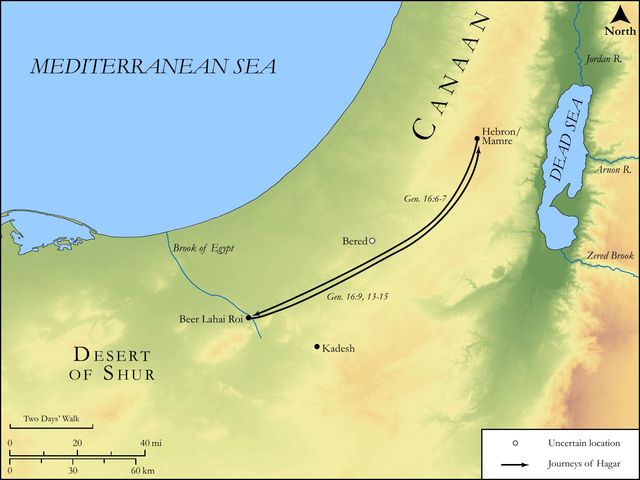
The practice of a barren wife giving her maidservant to her husband to bear children was a recognized custom among the patriarchs, as when Rachel gave her handmaid Bilhah to Jacob. However, the resulting social dynamics, particularly the maidservant's elevated status upon conception, often led to conflict, as seen between Sarai and Hagar. Hagar's flight into the wilderness was a common response for those fleeing harsh conditions, but it was fraught with danger, especially for a pregnant woman. The "way to Shur" was a known caravan route leading from Canaan towards Egypt, suggesting Hagar's intention to return to her homeland or seek refuge there. Her location "by a fountain of water" highlights the critical importance of water sources for survival in the arid wilderness, making this a strategic and life-sustaining, yet still vulnerable, location.
Key Themes
ShowHideGenesis 16:7 contributes significantly to several overarching themes within the book of Genesis and the broader biblical narrative. It powerfully illustrates God's sovereignty and providence, demonstrating that even amidst human sin and suffering, His divine plan is at work, intervening directly in individual lives. The encounter also highlights God's compassion for the lowly and vulnerable, extending His care beyond the immediate covenant family of Abram to a fleeing maidservant. Furthermore, it introduces the significant theme of divine revelation and theophany, as "the angel of the LORD" appears and speaks with divine authority, foreshadowing Hagar's later declaration of God as "El Roi," "the God who sees me" Genesis 16:13. This verse also subtly underscores the theme of God's omnipresence and omniscience, as He knows Hagar's exact location and desperate state, even in the vast wilderness.
Exposition and Analysis
ShowHideKey Word Analysis
ShowHideFrom an unused root meaning "to despatch as a deputy," this term signifies a messenger. When combined with "the LORD," it often denotes a unique divine messenger, specifically an angel of God. In many Old Testament contexts, this figure acts and speaks with the authority of God Himself, leading many theologians to interpret these appearances as theophanies (manifestations of God) or Christophanies (pre-incarnate appearances of Jesus Christ). The presence of this specific "angel" elevates the encounter to one of profound divine significance.
This is the personal, covenant name of God, often transliterated as Yahweh, meaning "the Self-Existent One" or "the Eternal One." Its use here, in conjunction with "angel," emphasizes that the messenger is not merely a created being but is directly associated with or is a manifestation of the sovereign, covenant-keeping God of Israel. This highlights the divine authority and personal involvement in Hagar's situation.
A primitive root meaning "to come forth to, i.e., appear or exist; transitively, to attain, i.e., find or acquire." The active voice here, "found her," is crucial. It indicates a deliberate, proactive pursuit and discovery by the angel of the LORD, rather than Hagar stumbling upon a divine presence. This emphasizes God's initiative, compassion, and precise knowledge of Hagar's whereabouts and desperate state.
Verse Breakdown
ShowHide"And the angel of the LORD found her"
This opening clause immediately establishes the divine initiative. It is not Hagar seeking God, but God, through His messenger, actively seeking out Hagar. The specific title "the angel of the LORD" is highly significant, often indicating a direct manifestation of God Himself, underscoring the divine authority and personal involvement in this encounter. The verb "found" (matsa') implies a deliberate act of discovery, highlighting God's omnipresence and His compassionate pursuit of the distressed.
"by a fountain of water in the wilderness"
This phrase precisely locates Hagar in a place of extreme vulnerability yet also crucial sustenance. The "wilderness" (midbar) signifies a desolate, dangerous, and isolated region, emphasizing Hagar's desperate plight. However, her presence "by a fountain of water" (ayin mayim) indicates a life-sustaining oasis, a point of survival in an otherwise barren landscape. This detail underscores God's intimate knowledge of her exact circumstances and His providential care in meeting her at a place where her most immediate physical need could be addressed.
"by the fountain in the way to Shur"
This further specifies Hagar's location, identifying the particular fountain as one situated on a known route. The "way to Shur" (derek Shur) was a desert road leading from Canaan towards Egypt, suggesting Hagar's intention to flee back to her homeland or to seek refuge there. This detail not only confirms God's precise knowledge of her physical journey but also hints at her emotional and spiritual journey—running away from an unbearable situation, yet being met by God on her path of escape.
Literary Devices
ShowHideThe verse employs several significant literary devices. Theophany (or Christophany as many Christian theologians interpret "the angel of the LORD") is central, as the divine presence actively intervenes in human affairs, signifying God's direct engagement rather than a passive observation. The setting itself is rich in symbolism: the wilderness represents Hagar's emotional and physical desolation, her feeling of abandonment and despair. Conversely, the fountain of water symbolizes life, sustenance, and divine provision in the midst of barrenness, serving as an oasis of hope and a place where God chooses to reveal Himself. The repetition of "by the fountain" emphasizes its critical importance and God's precise knowledge of her location. The narrative also exhibits divine irony; Hagar flees a harsh situation, believing herself alone, only to be found by the very God who sees and cares for her, demonstrating that human attempts to escape often lead them directly into God's providential care.
Theological and Thematic Connections
ShowHideThis passage profoundly illustrates God's active pursuit of the lost and vulnerable, demonstrating that His compassion extends far beyond the covenant family to all who are suffering and overlooked. It highlights His omnipresence and omniscience, as He knows Hagar's exact location and desperate state, even when she feels utterly alone and forgotten. The appearance of "the angel of the LORD" is a significant theological motif, often interpreted as a direct manifestation of God Himself, underscoring the divine nature of the intervention and God's personal involvement in human affairs. This encounter lays the groundwork for Hagar's later naming of God as "El Roi," "the God who sees," solidifying the theme of God's attentive and responsive nature to human suffering.
Reflection and Application
ShowHideGenesis 16:7 offers profound comfort and a powerful reminder of God's intimate awareness of our struggles, even in our most isolated and desperate "wilderness" experiences. When we feel forgotten, abandoned, or overwhelmed by life's harsh realities, this verse assures us that God sees us, knows our exact location, and actively intervenes in our lives. Hagar's encounter teaches us that even when we are running from difficult situations or making choices born of despair, God's providential care is unwavering. He meets us at our point of need, often in unexpected ways and at the precise moment of greatest vulnerability, offering guidance, hope, and a path forward where there seems to be none. This passage invites us to trust in God's compassionate pursuit, knowing that He is the "God Who Sees" our suffering and responds with active love and provision, echoing the comfort found in Psalm 34:18, which declares, "The LORD is nigh unto them that are of a broken heart; and saveth such as be of a contrite spirit."
Questions for Reflection
ShowHideFAQ
ShowHideWho is "the angel of the LORD" in this verse?
ShowHideThe phrase "the angel of the LORD" (Hebrew: mal'akh Yahweh) refers to a unique divine messenger in the Old Testament. This figure often speaks and acts with the authority of God Himself, and in some instances, receives worship, suggesting a direct manifestation of God. Many Christian theologians interpret these appearances as Christophanies, meaning pre-incarnate appearances of Jesus Christ, demonstrating God's direct and personal involvement in human history before His incarnation. This encounter with Hagar is one of the earliest and most significant such appearances.
Why did God intervene for Hagar, a non-Israelite servant?
ShowHideGod's intervention for Hagar powerfully demonstrates His universal compassion and providential care for all humanity, not exclusively for those within the covenant line of Abraham. It highlights His character as a God who sees and cares for the lowly, the suffering, and the vulnerable, regardless of their social status, ethnicity, or religious affiliation. This act of mercy underscores that God's justice and compassion extend to all people, revealing His boundless love and concern for every individual, as seen in His concern for the inhabitants of Nineveh in Jonah 4:11.
What is the significance of Hagar being found "by a fountain of water in the wilderness"?
ShowHideThe "fountain of water" in the desolate wilderness signifies a vital, life-sustaining oasis, representing a place of refuge and sustenance in an otherwise dangerous and barren landscape. Hagar's location there emphasizes her precarious position and vulnerability, but also highlights God's precise knowledge of her needs and His ability to meet them even in the most desperate circumstances. It underscores that God meets us exactly where we are, providing for our needs and offering hope and provision even in the most desolate environments. This imagery foreshadows the "living water" that Christ offers to those who thirst, as described in John 4:10-14.
Christ-Centered Fulfillment
ShowHideThe encounter between Hagar and "the angel of the LORD" in Genesis 16:7 finds profound Christ-centered fulfillment. If "the angel of the LORD" is indeed a pre-incarnate appearance of Jesus Christ, then this passage reveals Christ as the compassionate God who actively seeks out the lost, the distressed, and the lowly. Just as He found Hagar in her wilderness of despair, so too does Christ, in His incarnate ministry, seek and save those who are lost, broken, and outcast, declaring that "the Son of Man came to seek and to save the lost" Luke 19:10. He is the ultimate "El Roi," the God who truly sees our suffering and enters into it, ultimately offering living water to all who thirst ([John 4:10-14 "Jesus Offers Living Water"]; [John 7:37-38 "Rivers of Living Water"]). Christ embodies the divine compassion and providential care shown to Hagar, demonstrating God's unwavering commitment to rescue and redeem humanity through His personal presence, His sacrificial death on the cross, and His ongoing intercession for His people Hebrews 7:25.