


Exodus 15:22
Bible text: King James Version (1769 Blayney text) · Public domain
Bible text: King James Version with Strong's numbers · Public domain
Bible text: Berean Standard Bible · Public domain
Bible text: American Standard Version (1901) · Public domain
Bible text: World English Bible, Messianic edition · Public domain
Bible text: Geneva Bible (1599) · Public domain
Bible text: Young's Literal Translation · Public domain
- וַיַּסַּעvai·ya·Sa'and he led outH5265Conj-w ¦ V-Hiphil-ConsecImperf-3msVerb Hiphil Consecutive Imperfect 3rd Singular Masculineוַandיַּסַּעhe led out
- מֹשֶׁהmo·ShehMosesH4872N-proper-mNoun Proper Masculine
- אֶת'et<obj.>H853DirObjMParticle Object Indicator
- יִשְׂרָאֵלYis·ra·'ElIsraelH3478N-properNoun Proper Location
- מִיַּםmi·yamfrom [the] sea ofH3220Prep-m ¦ N-mscNoun Singular Masculine Constructמִfromיַּם[the] sea of
- סוּףSufreed[s]H5488N-msNoun Title Singular Masculine Absolute
- וַיֵּצְאוּvai·ye·tze·'Uand they went outH3318Conj-w ¦ V-Qal-ConsecImperf-3mpVerb Qal Consecutive Imperfect 3rd Plural Masculineוַandיֵּצְאוּthey went out
- אֶל'elintoH413PrepPreposition
- מִדְבַּרmid·bar[the] wilderness ofH4057N-mscNoun Singular Masculine Construct
- שׁוּרShurShurH7793N-properNoun Proper Location
- וַיֵּלְכוּvai·ye·le·Khuand they wentH1980Conj-w ¦ V-Qal-ConsecImperf-3mpVerb Qal Consecutive Imperfect 3rd Plural Masculineוַandיֵּלְכוּthey went
- שְׁלֹשֶׁתshe·lo·shetthreeH7969Adj-cscAdjective Numerical Singular common gender Construct
- יָמִיםya·MimdaysH3117N-mpNoun Plural Masculine Absolute
- בַּמִּדְבָּרba·mid·Barin the wildernessH4057Prep-b ¦ N-msNoun Singular Masculine Absoluteבַּin theמִּדְבָּרwilderness
- וְלֹאve·lo'and notH3808Conj-w ¦ NegParticle Negativeוְandלֹאnot
- מָצְאוּMa·tze·'uthey foundH4672V-Qal-Perf-3cpVerb Qal Perfect 3rd Plural common gender
- מָיִםMa·yimwaterH4325N-mpNoun Plural Masculine Absolute
English is a literal word-by-word gloss of the Hebrew, not the KJV's wording. Why?
This is the original text the KJV's translators worked from — each Hebrew word with its own literal English meaning in this verse, prepared by scholars at Tyndale House, Cambridge. The KJV translates whole sentences, not word by word, so its wording differs: one Hebrew word can become several English words, and the KJV may choose “the LORD” where the gloss reads “Yahweh”. Both are faithful — they answer different questions. For the KJV's own rendering, switch to the KJV text.
Details
See on the biblical-era maps

Study this verse
Public-domain commentary
Matthew Henry
From his Commentary on the Whole Bible. Henry comments on passages, not single verses — this entry covers Exodus 15:22–27. His three-level outline is real structure in the source text, so it is rendered as structure.
It should seem, it was with some difficulty that Moses prevailed with Israel to leave that triumphant shore on which they sang the foregoing song. They were so taken up with the sight, or with the song, or with the spoiling of the dead bodies, that they cared not to go forward, but Moses with much ado brought them from the Red Sea into a wilderness. The pleasures of our way to Canaan must not retard our progress, but quicken it, though we have a wilderness before us. Now here we are told,
I.That in the wilderness of Shur they had no water, Exo 15:22.
This was a sore trial to the young travellers, and a diminution to their joy; thus God would train them up to difficulties. David, in a dry and thirsty land where no water is, reaches forth towards God, Psa 63:1.
II.That at Marah they had water, but it was bitter, so that though they had been three days without water they could not drink it, because it was extremely unpleasant to the taste or was likely to be prejudicial to their health, or was so brackish that it rather increased their thirst than quenched it, Exo 15:23. Note, God can embitter that to us from which we promise ourselves most satisfaction, and often does so in the wilderness of this world, that our wants and disappointments in the creature may drive us to the Creator, in whose favour alone true comfort is to be had. Now in this distress,
1.The people fretted and quarrelled with Moses, as if he had done ill by them. What shall we drink? is all their clamour, Exo 15:24. Note, The greatest joys and hopes are soon turned into the greatest griefs and fears with those that live by sense only, and not by faith.
2.Moses prayed: He cried unto the Lord, Exo 15:25. The complaints which they brought to him he brought to God, on whom, notwithstanding his elevation, Moses owned a constant dependence. Note, It is the greatest relief of the cares of magistrates and ministers, when those under their charge make them uneasy, that they may have recourse to God by prayer: he is the guide of the church's guides and to him, as the Chief Shepherd, the under-shepherds must upon all occasions apply.
3.God provided graciously for them. He directed Moses to a tree, which he cast into the waters, in consequence of which, all of a sudden, they were made sweet. Some think this wood had a peculiar virtue in it for this purpose, because it is said, God showed him the tree. God is to be acknowledged, not only in the creating of things useful for man, but in discovering their usefulness. Or perhaps this was only a sign, and not at all a means, of the cure, any more than the brazen serpent, or Elisha's casting one cruse full of salt into the waters of Jericho. Some make this tree typical of the cross of Christ, which sweetens the bitter waters of affliction to all the faithful, and enables them to rejoice in tribulation. The Jews' tradition is that the wood of this tree was itself bitter, yet it sweetened the waters of Marah; the bitterness of Christ's sufferings and death alters the property of ours.
4.Upon this occasion, God came upon terms with them, and plainly told them, now that they had got clear of the Egyptians, and had entered into the wilderness, that they were upon their good behaviour, and that according as they carried themselves so it would be well or ill with them: There he made a statute and an ordinance, and settled matters with them. There he proved them, that is, there he put them upon the trial, admitted them as probationers for his favour. In short, he tells them, Exo 15:26,
(1.)What he expected from them, and that was, in one word, obedience. They must diligently hearken to his voice, and give ear to his commandments, that they might know their duty, and not transgress through ignorance; and they must take care in every thing to do that which was right in God's sight, and to keep all his statutes. They must not think, now that they were delivered from their bondage in Egypt, that they had no lord over them, but were their own masters; no, therefore they must look upon themselves as God's servants, because he had loosed their bonds, Psa 116:16; Luk 1:74, Luk 1:75.
(2.)What they might then expect from him: I will put none of these diseases upon thee, that is, "I will not bring upon thee any of the plagues of Egypt." This intimates that, if they were rebellious and disobedient, the very plagues which they had seen inflicted upon their enemies should be brought upon them; so it is threatened, Deu 28:60. God's judgments upon Egypt, as they were mercies to Israel, opening the way to their deliverance, so they were warnings to Israel, and designed to awe them into obedience. Let not the Israelites think, because God had thus highly honoured them in the great things he had done for them, and had proclaimed them to all the world his favourites, that therefore he would connive at their sins and let them do as they would. No, God is no respecter of persons; a rebellious Israelite shall fare no better than a rebellious Egyptian; and so they found, to their cost, before the got to Canaan. "But, if thou wilt be obedient, thou shalt be safe and happy;" the threatening is implied only, but the promise is expressed: "I am the Lord that healeth thee, and will take care of thy comfort wherever thou goest." Note, God is the great physician. If we be kept well, it is he that keeps us; if we be made well, it is he that restores us; he is our life, and the length of our days.
III.That at Elim they had good water, and enough of it, Exo 15:27.
Though God may, for a time, order his people to encamp by the waters of Marah, yet that shall not always be their lot. See how changeable our condition is in this world, from better to worse, from worse to better. Let us therefore learn both how to be abased and how to abound, to rejoice as though we rejoiced not when we are full, and to weep as though we wept not when we are emptied. Here were twelve wells for their supply, one for every tribe, that they might not strive for water, as their fathers had sometimes done; and, for their pleasure, there were seventy palm-trees, under the shadow of which their great men might repose themselves. Note, God can find places of refreshment for his people even in the wilderness of this world, wells in the valley of Baca, lest they should faint in their mind with perpetual fatigue: yet, whatever our delights may be in the land of our pilgrimage, we must remember that we do but encamp by them for a time, that here we have no continuing city.
Continue studying Exodus 15:22 across the web’s major study libraries — every link below opens this exact verse, chapter, or book on the destination site.
Read & Compare
 BibleGatewayThis verse in more than 200 translations and 70 languages.
 Bible.comThe YouVersion reader — hundreds of translations, reading plans, and highlights.
 ESV.orgCrossway's official English Standard Version reader.
 NET BibleThe NET translation with 60,000+ translators' notes on every rendering decision.
 STEP BibleTyndale House's free study tool — original text, vocabulary, and scholarly resources.
 BibliaLogos Bible Software's free web reader.
 USCCBThe New American Bible (Revised Edition) with the U.S. bishops' study notes.
Commentaries
 BibleHub CommentariesDozens of classic commentaries on this verse, gathered on one page.
 StudyLightMore than 100 commentary sets — the largest collection on the web.
 BibleRefPlain-English commentary on what this verse means, verse by verse.
 Enduring WordDavid Guzik's free commentary on this chapter, widely used by Bible teachers.
 Bible Study ToolsVerse commentary alongside Greek and Hebrew study aids.
Original Language & Research
- BibleHub InterlinearThe verse word by word — original language, transliteration, and English.
- BibleHub LexiconEvery word's original-language definition and Strong's entry.
 Blue Letter BibleDeep-study tools — Strong's numbers, concordance, and word studies.
 SefariaThe Hebrew text with Rashi and centuries of Jewish commentary.
Sermons, Hymns & Audio


TrulyRandomVerse is not affiliated with these sites and doesn’t control their content. They’re linked because they’re genuinely useful.
Summary
Exodus 15:22 marks an immediate and stark transition for the newly liberated Israelites, shifting abruptly from the euphoria of the Red Sea deliverance and the triumphant Song of Moses to the harsh realities of the wilderness. Led by Moses, they journeyed into the desolate wilderness of Shur, where, after only three days, they encountered a critical test of their faith and endurance: the complete absence of water, underscoring their profound vulnerability and absolute dependence on God's provision in this new and challenging phase of their journey.
Context
ShowHideLiterary Context
This verse immediately follows the climactic events of the Red Sea crossing and the subsequent Song of Moses and Miriam, a powerful hymn of praise celebrating God's miraculous deliverance from Pharaoh's army. The narrative shifts abruptly from a moment of profound national triumph and spiritual exhilaration to the immediate onset of hardship. The abrupt transition from the "sea" (as referenced in Exodus 15:21) to the "wilderness of Shur" (Exodus 15:22) highlights the cyclical nature of divine provision followed by human testing, setting the stage for a series of trials that would define Israel's journey through the desert. This verse initiates a new phase where the focus moves from external threats (Pharaoh) to internal challenges of faith, trust, and obedience, establishing a pattern that will characterize much of the book of Exodus.
Historical & Cultural Context
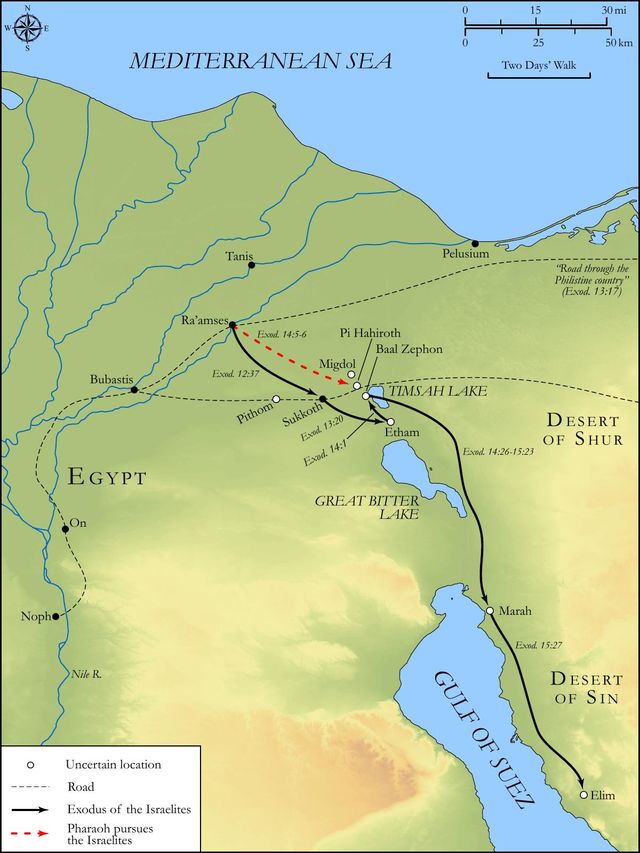
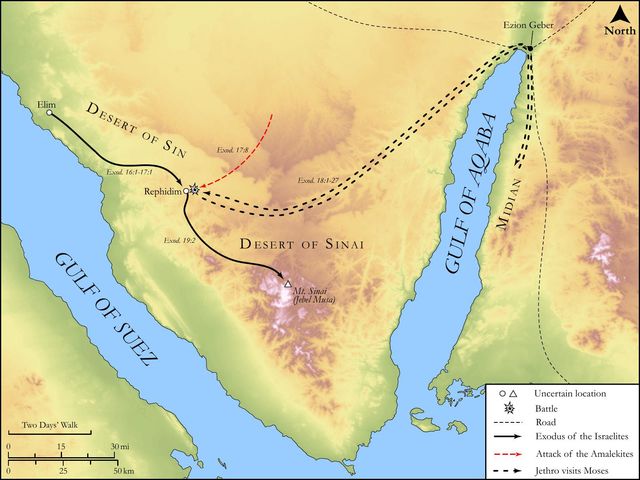
The "wilderness of Shur" (also known as the wilderness of Etham in Numbers 33:8) refers to the desert region immediately east of the Suez Canal, forming part of the Sinai Peninsula. This area was known for its arid, inhospitable conditions, characterized by vast stretches of sand, rocky terrain, and extremely scarce water sources. For a multitude numbering potentially in the millions, including women, children, and livestock, the lack of water was not merely an inconvenience but an immediate existential threat. Wilderness travel, especially for large groups, necessitated careful planning around water sources, making the three-day journey without finding water a critical and deeply concerning development that would have quickly depleted any reserves carried from the Red Sea. This immediate challenge underscores the complete reliance of the Israelites on divine guidance and miraculous provision in an environment utterly unsuited for sustaining such a large population.
Key Themes
ShowHideExodus 15:22 contributes significantly to several major theological and narrative themes within the book of Exodus and the broader Pentateuch. Primarily, it introduces the theme of divine testing and proving, where God leads His people into challenging circumstances to reveal their hearts and teach them dependence. This is a recurring motif throughout the wilderness wanderings, as seen in Deuteronomy 8:2-3. It also highlights the theme of God's faithful provision, even in the direst circumstances, setting the stage for subsequent miracles like the manna and water from the rock. Furthermore, it underscores the persistent theme of Israel's murmuring and lack of trust, which will be a constant struggle against God's leadership and provision, beginning immediately after a great deliverance and continuing through passages like Exodus 16.
Exposition and Analysis
ShowHideKey Word Analysis
ShowHideThis term (H4057, מִדְבָּר) is often translated as "desert" but carries a broader meaning of an uncultivated, uninhabited, or sparsely inhabited region. It is not necessarily barren but is a place where human civilization is absent, making it a challenging environment. Theologically, the midbâr in Israel's narrative is consistently portrayed as a place of divine testing, purification, and formation, where God strips away human self-sufficiency to teach absolute dependence on Him. It is a crucible for faith, where Israel learns to hear God's voice and receive His provision.
The verb "went" (H3212, יָלַךְ) signifies movement, often a purposeful journey. Here, it describes both Moses "bringing" (H5265, nâçaʻ' - to pull up, start a journey) Israel and Israel themselves "going out" (H3318, yâtsâʼ' - to go out) and "going" (H3212, yâlak' - to walk). This repetition emphasizes the physical progression of the vast multitude into the desolate region. The act of "going" into the wilderness, rather than around it, highlights God's deliberate leading of His people into a place of trial, a necessary step in their spiritual formation.
The word "water" (H4325, מַיִם) is presented in its dual form, conveying the abundance or totality of water, but here, it is conspicuously absent ("found no water"). Water is the most fundamental necessity for life, especially in an arid desert environment. Its complete lack immediately brings the multitude to a point of existential crisis, highlighting their extreme vulnerability and setting the stage for an immediate test of faith and dependence on God for their very survival.
Verse Breakdown
ShowHide"So Moses brought Israel from the Red sea"
This opening clause establishes Moses' continued, divinely appointed leadership immediately following the miraculous Red Sea deliverance. It signifies the transition from a moment of dramatic salvation to the ongoing journey of the redeemed people, with Moses serving as God's chosen instrument of guidance. The "Red Sea" here functions as a powerful symbol of their recent salvation and the decisive boundary crossed from slavery to freedom.
"and they went out into the wilderness of Shur"
This phrase marks the new geographical and environmental reality for the Israelites. The "wilderness of Shur" is not merely a location but a descriptor of the harsh, challenging conditions they would face. It signifies the beginning of their long sojourn in the desert, a place intentionally designed by God for their spiritual formation, testing, and the revelation of His covenant relationship with them.
"and they went three days in the wilderness"
The specific mention of "three days" is significant. It indicates a relatively short but critical period during which any initial supplies of water carried from the Red Sea would have been depleted, making their need immediate and urgent. This detail highlights the swift onset of hardship after their triumphant liberation, underscoring that trials can follow spiritual highs very quickly, bringing God's people to the end of their own resources.
"and found no water"
This is the climax of the verse, articulating the dire predicament. The complete absence of water, the most basic necessity for survival for such a large multitude in a desert environment, immediately brings them to a point of profound crisis. It sets the stage for the subsequent murmuring and God's miraculous provision, demonstrating their utter dependence on divine intervention for their very existence.
Literary Devices
ShowHideExodus 15:22 employs several potent literary devices to convey its message. Juxtaposition is immediately evident, placing the triumphant celebration of the Red Sea deliverance (Exodus 15:1-21) in stark contrast with the immediate hardship of the waterless wilderness. This abrupt shift highlights the reality that spiritual victory does not exempt one from subsequent trials; indeed, it often ushers in new forms of testing. The "wilderness of Shur" functions as Symbolism, representing not merely a geographical location but a testing ground for faith, a crucible where God strips away human self-reliance to cultivate absolute dependence on Him. The journey of "three days" without water serves as Foreshadowing, hinting at the numerous trials, periods of murmuring, and cycles of divine provision that will characterize Israel's forty-year wilderness wandering, where their faith will be repeatedly tested by a lack of provisions and their persistent need for divine sustenance.
Theological and Thematic Connections
ShowHideExodus 15:22 profoundly illustrates the theological truth that divine deliverance is often followed by immediate testing, designed not to punish but to purify and deepen faith. God's leading of Israel into a waterless wilderness, despite His omnipotence, reveals His pedagogical intent: to teach His people absolute dependence on Him for every necessity. This passage underscores the theme of God's sovereignty even over hardship, demonstrating that He orchestrates circumstances, including trials, to reveal His character as Provider and Sustainer. It sets the stage for the unfolding narrative of God's miraculous provisions (manna, quail, water from the rock) and Israel's recurring struggles with trust and obedience, establishing a pattern that resonates throughout biblical history, emphasizing that true freedom involves learning to walk in complete reliance on the delivering God.
Reflection and Application
ShowHideExodus 15:22 offers a timeless and sobering reminder that even after experiencing profound spiritual highs and miraculous interventions, life's journey inevitably leads through periods of "wilderness." These are not accidental detours but divinely ordained seasons designed to test our faith, expose our areas of dependence, and deepen our reliance on God. Just as Israel quickly moved from the jubilation of the Red Sea to the urgent need for water, we too can find ourselves in situations where resources seem scarce, the path is unclear, and our human limitations are starkly revealed. In these "dry places," God calls us to look beyond our immediate circumstances and trust in His unfailing provision and guidance. Our wilderness experiences are not meant to break us, but to build our character, refine our trust, and teach us that true sustenance comes from Him alone. They are essential for our spiritual growth, preparing us for the next stage of our journey with a deeper understanding of His faithfulness and our profound need for Him.
Questions for Reflection
ShowHideFAQ
ShowHideWhy did God lead Israel into a waterless wilderness immediately after such a great victory?
ShowHideGod's immediate leading of Israel into the wilderness, where they quickly "found no water," was a deliberate act of divine pedagogy. It was designed to test their faith, teach them absolute dependence on Him, and reveal His character as their sole Provider and Sustainer. The wilderness was not merely a geographical location but a spiritual classroom where God intended to strip away their reliance on human strength and Egyptian memories, preparing them to be a people who lived by His word and trusted in His miraculous provision. This pattern of testing after deliverance is a recurring theme in Scripture, ensuring that God's people learn to walk by faith, not by sight. It demonstrates that God's plan for His people involves both triumphant deliverance and formative trials.
What is the significance of the "three days" without water?
ShowHideThe mention of "three days" is significant because it highlights the immediate and critical nature of the Israelites' need. While they might have carried some water from the Red Sea, a multitude of that size would quickly deplete such supplies in the desert heat. The three-day period brings them to the brink of crisis, emphasizing their acute vulnerability and the urgency of their situation. This swift onset of hardship sets the stage for God's immediate intervention at Marah (Exodus 15:23-25), demonstrating that God is intimately aware of their needs and responds promptly to their cries, even when they respond with murmuring. It underscores that God allows trials to bring His people to the end of their own resources, so they might learn to rely solely on Him and experience His miraculous provision.
Christ-Centered Fulfillment
ShowHideExodus 15:22, depicting Israel's immediate transition from the triumphant Red Sea deliverance to the waterless wilderness, finds profound Christ-centered fulfillment in several ways. Just as Israel was led into a place of testing, Jesus Himself was led by the Spirit into the wilderness to be tempted, enduring a forty-day fast that brought Him to a point of extreme physical need, yet He overcame every temptation by relying on the Word of God, declaring that man does not live on bread alone, but on every word that comes from the mouth of God. This foreshadows Christ as the ultimate faithful Israelite, who perfectly trusts God in the midst of deprivation and fulfills the very obedience Israel failed to maintain. Furthermore, the desperate need for water in the wilderness points to Jesus as the ultimate source of living water. He declared, "If anyone thirsts, let him come to me and drink," and promised that those who believe in Him would have rivers of living water flowing from within them. He is the one who satisfies our deepest spiritual thirst, leading us through the wilderness experiences of life, providing not just physical sustenance but eternal life. The trials in the wilderness also highlight humanity's inherent inability to sustain itself, a need perfectly met by Christ, who is our true manna from heaven and our spiritual rock from whom living water flows. He is the faithful leader who brings His people through every trial, ultimately leading them to the promised rest and eternal sustenance found only in Him.