


Genesis 25:18
Bible text: King James Version (1769 Blayney text) · Public domain
Bible text: Berean Standard Bible · Public domain
Bible text: American Standard Version (1901) · Public domain
Bible text: World English Bible, Messianic edition · Public domain
Bible text: Geneva Bible (1599) · Public domain
Bible text: Young's Literal Translation · Public domain
- וַיִּשְׁכְּנוּvai·yish·ke·Nuand they dweltH7931Conj-w ¦ V-Qal-ConsecImperf-3mpVerb Qal Consecutive Imperfect 3rd Plural Masculineוַandיִּשְׁכְּנוּthey dwelt
- מֵחֲוִילָהme·cha·vi·Lahfrom HavilahH2341Prep-m ¦ N-properNoun Proper LocationמֵfromחֲוִילָהHavilah
- עַד'adtoH5704PrepPreposition
- שׁוּרShurShurH7793N-properNoun Proper Location
- אֲשֶׁר'a·SherwhichH834RelParticle Relative
- עַל'al[is] onH5921PrepPreposition
- פְּנֵיpe·Nei[the] face ofH6440N-mpcNoun Plural Masculine Construct
- מִצְרַיִםmitz·Ra·yimEgyptH4714N-properNoun Proper Location
- בֹּאֲכָהbo·'a·Khahgoing youH935V-Qal-Inf ¦ 2msVerb Qal Infinitive Constructבֹּאֲgoingכָהyou
- אַשּׁוּרָה'a·Shu·rahAsshur towardsH804N-proper ¦ SfxNoun Proper LocationאַשּׁוּרָAsshurהtowards
- עַל'alonH5921PrepPreposition
- פְּנֵיpe·Nei[the] face ofH6440N-mpcNoun Plural Masculine Construct
- כָלkholallH3605N-mscNoun Singular Masculine Construct
- אֶחָיו'e·Chavhis relativesH251N-mpc ¦ 3msNoun Plural Masculine Constructאֶחָיrelativesוhis
- נָפָלna·Falhe fellH5307V-Qal-Perf-3msVerb Qal Perfect 3rd Singular Masculine
English is a literal word-by-word gloss of the Hebrew, not the KJV's wording. Why?
This is the original text the KJV's translators worked from — each Hebrew word with its own literal English meaning in this verse, prepared by scholars at Tyndale House, Cambridge. The KJV translates whole sentences, not word by word, so its wording differs: one Hebrew word can become several English words, and the KJV may choose “the LORD” where the gloss reads “Yahweh”. Both are faithful — they answer different questions. For the KJV's own rendering, switch to the KJV text.
Details
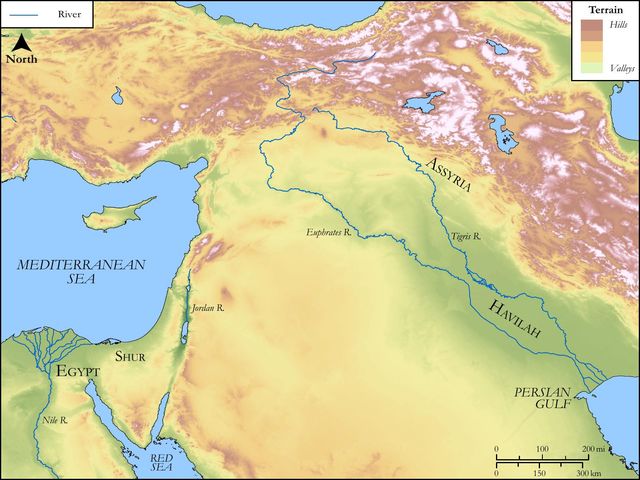
See on the biblical-era maps


Study this verse
Public-domain commentary
Matthew Henry
From his Commentary on the Whole Bible. Henry comments on passages, not single verses — this entry covers Genesis 25:11–18.
Immediately after the account of Abraham's death, Moses begins the story of Isaac (Gen 25:11), and tells us where he dwelt and how remarkably God blessed him. Note, The blessing of Abraham did not die with him, but survived to all the children of the promise. But he presently digresses from the story of Isaac, to give a short account of Ishmael, forasmuch as he also was a son of Abraham, and God had made some promises concerning him, which it was requisite we should know the accomplishment of. Observe here what is said, 1. Concerning his children. He had twelve sons, twelve princes they are called (Gen 25:16), heads of families, which in process of time became nations, distinct tribes, numerous and very considerable. They peopled a very large continent, that lay between Egypt and Assyria, called Arabia. The names of his twelve sons are recorded. Midian and Kedar we often read of in scripture. And some very good expositors have taken notice of the signification of those three names which are put together (Gen 25:14), as containing good advice to us all, Mishma, Dumah, and Massa, that is, hear, keep silence, and bear; we have them together in the same order, Jam 1:19, Be swift to hear, slow to speak, slow to wrath. The posterity of Ishmael had not only tents in the fields, wherein they grew rich in times of peace; but they had towns and castles (Gen 25:16), wherein they fortified themselves in time of war. Now the number and strength of this family were the fruit of the promise made to Hagar concerning Ishmael (Gen 16:10), and to Abraham, Gen 17:20 and Gen 21:13. Note, Many that are strangers to the covenants of promise are yet blessed with outward prosperity for the sake of their godly ancestors. Wealth and riches shall be in their house. 2. Concerning himself. Here is an account of his age: He lived 137 years (Gen 25:17) which is recorded to show the efficacy of Abraham's prayer for him (Gen 17:18), O that Ishmael might live before thee! Here is also an account of his death; he too was gathered to his people; but it is not said that he was full of days, though he lived to so great an age: he was not so weary of the world, nor so willing to leave it, as his good father was. Those words, he fell in the presence of all his brethren, whether they mean, as we take them, he died, or, as others, his lot fell, are designed to show the fulfilling of that word to Hagar (Gen 16:12), He shall dwell in the presence of all his brethren, that is, he shall flourish and be eminent among them, and shall hold his own to the last. Or he died with his friends about him, which is comfortable.
Continue studying Genesis 25:18 across the web’s major study libraries — every link below opens this exact verse, chapter, or book on the destination site.
Read & Compare
 BibleGatewayThis verse in more than 200 translations and 70 languages.
 Bible.comThe YouVersion reader — hundreds of translations, reading plans, and highlights.
 ESV.orgCrossway's official English Standard Version reader.
 NET BibleThe NET translation with 60,000+ translators' notes on every rendering decision.
 STEP BibleTyndale House's free study tool — original text, vocabulary, and scholarly resources.
 BibliaLogos Bible Software's free web reader.
 USCCBThe New American Bible (Revised Edition) with the U.S. bishops' study notes.
Commentaries
 BibleHub CommentariesDozens of classic commentaries on this verse, gathered on one page.
 StudyLightMore than 100 commentary sets — the largest collection on the web.
 BibleRefPlain-English commentary on what this verse means, verse by verse.
 Enduring WordDavid Guzik's free commentary on this chapter, widely used by Bible teachers.
 Bible Study ToolsVerse commentary alongside Greek and Hebrew study aids.
Original Language & Research
- BibleHub InterlinearThe verse word by word — original language, transliteration, and English.
- BibleHub LexiconEvery word's original-language definition and Strong's entry.
 Blue Letter BibleDeep-study tools — Strong's numbers, concordance, and word studies.
 SefariaThe Hebrew text with Rashi and centuries of Jewish commentary.
Sermons, Hymns & Audio


TrulyRandomVerse is not affiliated with these sites and doesn’t control their content. They’re linked because they’re genuinely useful.
Summary
concludes the account of Ishmael, Abraham's son through Hagar, by detailing the expansive geographical spread of his descendants and recording his death. This verse powerfully illustrates God's unwavering faithfulness in fulfilling His promises to bless Ishmael and make him a great nation, while also hinting at a significant nuance regarding his relationship with his kin at the end of his life, aligning with earlier divine pronouncements.
Context
ShowHideLiterary Context
Genesis 25:18 serves as the concluding verse of the "generations of Ishmael" (Hebrew: toledot Yishma'el), which begins in Genesis 25:12. This genealogical section, typical of the book of Genesis, provides a concise summary of Ishmael's twelve sons, who became tribal chiefs and nations, establishing their significant presence east and south of Canaan. The preceding verses (Genesis 25:13-16) list these sons, while Genesis 25:17 records Ishmael's age at death. Thus, Genesis 25:18 provides a geographical and relational summary, emphasizing the fulfillment of God's promises concerning Ishmael's numerous progeny and the circumstances of his passing, thereby closing his narrative arc within the larger Abrahamic saga before the focus shifts fully to Isaac's lineage.
Historical & Cultural Context
The geographical markers "Havilah unto Shur, that is before Egypt, as thou goest toward Assyria" delineate a vast territory stretching from the Arabian Peninsula (Havilah, often associated with regions rich in gold and aromatic resins, as seen in Genesis 2:11 and 1 Samuel 15:7) across the Sinai Peninsula (Shur, a wilderness region bordering Egypt, frequently mentioned in the Exodus narrative, e.g., Exodus 15:22) towards Assyria (a powerful empire that would later subdue the kingdoms round about, Israel among them). This expansive description reflects the reality of nomadic and semi-nomadic peoples, whose influence and trade routes often spanned vast distances. The Ishmaelites, as desert dwellers and traders, would have been a significant presence in these regions, interacting with and sometimes conflicting with other peoples, including the emerging Israelite nation. The mention of his death "in the presence of all his brethren" is culturally significant, indicating a patriarchal end, often implying a peaceful passing surrounded by one's family and descendants, a sign of a fulfilled life.
Key Themes
ShowHideThis verse contributes to several overarching themes in Genesis. Foremost is the theme of Divine Faithfulness to promises, as God had vowed to Abraham that Ishmael would become a "great nation" (Genesis 17:20) and that He would "make a nation of him" (Genesis 21:13). The extensive geographical description of Ishmaelite settlement directly affirms this fulfillment. Another key theme is Familial Relationships and Reconciliation, particularly in light of the earlier prophecy that Ishmael would "dwell in the presence of all his brethren" (Genesis 16:12), often interpreted as a life of conflict. However, the context of his death, especially following the joint burial of Abraham by Isaac and Ishmael in Genesis 25:9, suggests a more nuanced, possibly reconciled, relationship at the end of his life. This highlights the theme of God's Sovereignty over Human Destinies, even those marked by early strife, guiding them towards a divinely appointed end. Lastly, the verse underscores the Historical Veracity of Scripture, grounding the narrative in identifiable geographical and cultural realities.
Exposition and Analysis
ShowHideGenesis 25:18 provides a succinct yet profound summary of Ishmael's legacy, focusing on the two primary aspects of his life: the proliferation of his descendants and the circumstances of his death.
Key Word Analysis
ShowHideThis verb signifies to reside, permanently stay, or have habitation. Its use here emphasizes the settled and established nature of Ishmael's descendants across a vast geographical expanse, indicating not merely temporary encampments but a lasting presence and the formation of distinct peoples and nations. This word reinforces the fulfillment of God's promise for Ishmael to become a "great nation."
While the primary meaning is "to fall," in this context, it unequivocally means "to die." The inclusion of Ishmael's death serves as a final marker of his life's completion, a common feature in biblical genealogies. It signifies the end of his earthly journey and the passing of the patriarchal mantle to his twelve sons, who would continue his lineage and establish the nations attributed to him.
Literally "face," this plural noun is used in a wide variety of applications, including "before," "in the sight of," or "in the presence of." Its use here, "in the presence of all his brethren," is particularly significant. It echoes the prophecy from Genesis 16:12, where Ishmael would "dwell in the presence of all his brethren." While often interpreted as conflict, in the context of his death, it implies a peaceful passing, surrounded by his family, including his numerous descendants, and potentially even in a state of reconciliation with Isaac's line, signifying a unified family gathering at the patriarch's end.
Verse Breakdown
ShowHide"And they dwelt from Havilah unto Shur"
This clause describes the geographical extent of Ishmael's descendants. "They" refers to Ishmael's progeny, the twelve tribal nations listed in the preceding verses. "Havilah" and "Shur" mark the eastern and western boundaries, respectively, of their primary dwelling areas. Havilah is generally located in the Arabian Peninsula, while Shur is a desert region bordering Egypt, indicating a broad sweep of territory across the northern Arabian Desert and Sinai.
"that is before Egypt, as thou goest toward Assyria"
This phrase further clarifies and expands upon the geographical description. "Before Egypt" precisely locates Shur as the wilderness area immediately to the east of Egypt. The addition "as thou goest toward Assyria" indicates that their influence and movement extended northward and eastward from Sinai, towards Assyria, encompassing a vast and significant portion of the lands east of Canaan. This extensive domain underscores the fulfillment of God's promise to make Ishmael a great nation.
"and he died in the presence of all his brethren"
This concluding statement marks the end of Ishmael's life. The phrase "in the presence of all his brethren" (Hebrew: 'al-pene kol-echaw) is highly significant. It implies that Ishmael's death was witnessed or acknowledged by his entire extended family, including his own numerous sons and potentially even Isaac's family (given their joint burial of Abraham in Genesis 25:9). This suggests a peaceful and communal end, contrasting with earlier prophecies that might have implied a life of perpetual conflict. It points to a measure of reconciliation and familial unity at the close of his life.
Literary Devices
ShowHideThe verse employs several significant literary devices. Geography as Narrative Device is prominent, as the detailed description of "Havilah unto Shur, that is before Egypt, as thou goest toward Assyria" is not merely descriptive but serves to underscore the Fulfillment of Prophecy regarding Ishmael's numerous descendants and their establishment as a great nation. This expansive geographical scope visually represents the divine promise brought to fruition. Furthermore, the phrase "in the presence of all his brethren" acts as a subtle form of Allusion or Intertextuality, directly echoing the prophecy concerning Ishmael in Genesis 16:12. The re-use of this phrase, particularly in the context of his death, suggests a nuanced Reinterpretation or Resolution of the earlier prophecy, transforming a potential life of conflict into a peaceful, communal passing. This shift highlights the themes of Reconciliation and Familial Unity, implying that despite early strife, Ishmael found a measure of peace and acceptance among his kin at the end of his days.
Theological and Thematic Connections
ShowHideGenesis 25:18 profoundly illustrates God's meticulous and comprehensive faithfulness, extending His promises even beyond the primary covenant line established through Isaac. The detailed account of Ishmael's widespread descendants underscores that God's word, once spoken, will always come to pass, regardless of human expectations or perceived limitations. This verse also offers a powerful theological statement on the nature of reconciliation and God's sovereign ability to bring peace to fractured relationships. The subtle reinterpretation of Ishmael dwelling "in the presence of all his brethren" from a contentious existence to a peaceful, communal death highlights God's redemptive work even within complex family dynamics, demonstrating that His ultimate desire is for unity and blessing. It reminds us that God's plan is vast, encompassing all peoples, and His grace is not confined to a single lineage but extends broadly across humanity, setting the stage for the universal scope of salvation.
Reflection and Application
ShowHideGenesis 25:18 offers profound lessons for contemporary believers. It serves as a powerful reminder of God's unwavering faithfulness, even to those outside the immediate covenant line, encouraging us to trust in His comprehensive and meticulous providence for all people. The vast geographical spread of Ishmael's descendants underscores the global scope of God's plan, reminding us that His kingdom encompasses all nations and that His promises are meticulously fulfilled. Furthermore, the poignant detail of Ishmael dying "in the presence of all his brethren" offers a subtle yet potent message about the possibility of reconciliation and peace within families and communities, even after periods of estrangement. It challenges us to actively pursue unity and forgiveness, trusting that God can bring healing to broken relationships and that His redemptive work extends to every corner of human experience. This verse calls us to embrace a broad vision of God's work in the world, recognizing His hand in the lives of all people, and to seek reconciliation in our own spheres of influence.
Questions for Reflection
ShowHideFAQ
ShowHideWhat is the significance of the geographical description of Ishmael's dwelling?
ShowHideThe description "from Havilah unto Shur, that is before Egypt, as thou goest toward Assyria" is highly significant because it delineates the vast and influential territory settled by Ishmael's descendants. This expansive domain confirms the precise fulfillment of God's promise to Abraham that Ishmael would become a "great nation" (Genesis 17:20). It establishes the Ishmaelites as a significant and widespread presence among the nations east and south of Canaan, providing crucial historical and cultural context for their future interactions with other peoples, including the Israelites, and highlighting the historical veracity of the biblical narrative.
How does Ishmael's death "in the presence of all his brethren" relate to earlier prophecies about him?
ShowHideThis phrase directly echoes the prophecy in Genesis 16:12 that Ishmael would "dwell in the presence of all his brethren," which is often interpreted as a life of conflict or opposition. However, in Genesis 25:18, particularly when read in conjunction with Isaac and Ishmael coming together to bury their father Abraham (Genesis 25:9), it suggests a more peaceful and reconciled end. It implies Ishmael died surrounded by his family and potentially in a state of unity with Isaac's lineage, highlighting God's ability to bring peace and resolution even in relationships marked by early strife and misunderstanding.
Why is God's faithfulness to Ishmael important, given the Abrahamic covenant was primarily through Isaac?
ShowHideGod's faithfulness to Ishmael, despite Isaac being the son through whom the primary Abrahamic covenant would be fulfilled, is profoundly important. It demonstrates the breadth of God's grace, His unwavering commitment to all His promises, and His comprehensive sovereignty over all humanity. It shows that God's plan is not limited to one exclusive lineage but encompasses a wider scope of blessing and care, illustrating His universal providence. This reinforces the truth that God meticulously keeps His word, even in what might seem like secondary promises, thereby strengthening trust in His primary covenant promises and revealing His character as a God who is faithful in all things.
Christ-Centered Fulfillment
ShowHideWhile Genesis 25:18 directly concerns Ishmael's historical legacy, it points to Christ in several profound ways, revealing the expansive nature of God's redemptive plan. The divine faithfulness displayed in meticulously fulfilling promises to Ishmael, even outside the primary covenant line of Isaac, powerfully foreshadows God's boundless grace in Christ, extending salvation not only to the descendants of Abraham through Isaac but to all nations (Gentiles) who believe, as prophesied in Galatians 3:8. The subtle theme of reconciliation hinted at in Ishmael's death "in the presence of all his brethren" finds its ultimate and glorious fulfillment in Christ, who, through His atoning sacrifice, breaks down every dividing wall of hostility—whether between Jew and Gentile, or any other fractured human relationship—bringing peace and unity through His cross (Ephesians 2:14-16). In Christ, all who believe, regardless of their earthly lineage or past estrangements, are brought into the very presence of God as beloved children and into a unified family of God, fulfilling the divine desire for a reconciled and unified humanity under the ultimate Patriarch, Jesus Christ, the Son of God (Colossians 1:20).