


Genesis 10:7
Bible text: King James Version (1769 Blayney text) · Public domain
Bible text: Berean Standard Bible · Public domain
Bible text: American Standard Version (1901) · Public domain
Bible text: World English Bible, Messianic edition · Public domain
Bible text: Geneva Bible (1599) · Public domain
Bible text: Young's Literal Translation · Public domain
- וּבְנֵיu·ve·Neiand [the] sons ofH1121Conj-w ¦ N-mpcNoun Plural Masculine Constructוּandבְנֵי[the] sons of
- כוּשׁKhushCushH3568N-proper-mNoun Proper Masculine
- סְבָאse·Va'[were] SebaH5434N-proper-mNoun Proper Masculine
- וַחֲוִילָהva·cha·vi·Lahand HavilahH2341Conj-w ¦ N-proper-mNoun Proper MasculineוַandחֲוִילָהHavilah
- וְסַבְתָּהve·sav·Tahand SabtahH5454Conj-w ¦ N-proper-mNoun Proper MasculineוְandסַבְתָּהSabtah
- וְרַעְמָהve·ra'·Mahand RaamahH7484Conj-w ¦ N-proper-mNoun Proper MasculineוְandרַעְמָהRaamah
- וְסַבְתְּכָאve·sav·te·Kha'and SabtecaH5455Conj-w ¦ N-proper-mNoun Proper MasculineוְandסַבְתְּכָאSabteca
- וּבְנֵיu·ve·Neiand [the] sons ofH1121Conj-w ¦ N-mpcNoun Plural Masculine Constructוּandבְנֵי[the] sons of
- רַעְמָהra'·MahRaamahH7484N-proper-mNoun Proper Masculine
- שְׁבָאshe·Va'[were] ShebaH7614N-proper-mNoun Proper Masculine
- וּדְדָןu·de·Danand DedanH1719Conj-w ¦ N-proper-mNoun Proper MasculineוּandדְדָןDedan
English is a literal word-by-word gloss of the Hebrew, not the KJV's wording. Why?
This is the original text the KJV's translators worked from — each Hebrew word with its own literal English meaning in this verse, prepared by scholars at Tyndale House, Cambridge. The KJV translates whole sentences, not word by word, so its wording differs: one Hebrew word can become several English words, and the KJV may choose “the LORD” where the gloss reads “Yahweh”. Both are faithful — they answer different questions. For the KJV's own rendering, switch to the KJV text.
Details
See on the biblical-era maps


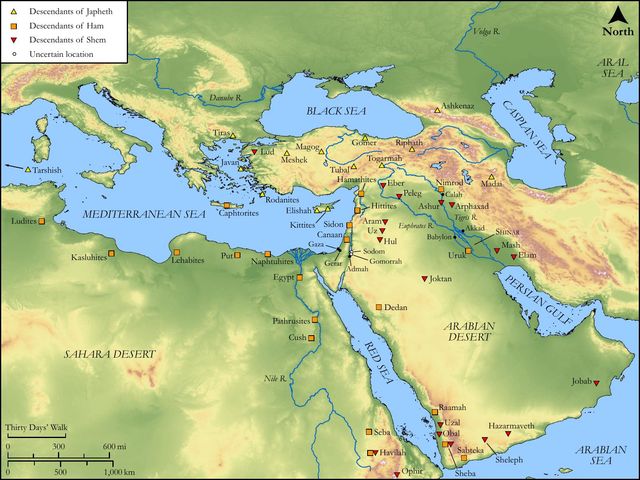
Study this verse
Public-domain commentary
Matthew Henry
From his Commentary on the Whole Bible. Henry comments on passages, not single verses — this entry covers Genesis 10:6–14. His three-level outline is real structure in the source text, so it is rendered as structure.
That which is observable and improvable in these verses is the account here given of Nimrod, Gen 10:8-10. He is here represented as a great man in his day: He began to be a mighty one in the earth, that is, whereas those that went before him were content to stand upon the same level with their neighbours, and though every man bore rule in his own house yet no man pretended any further, Nimrod's aspiring mind could not rest here; he was resolved to tower above his neighbours, not only to be eminent among them, but to lord it over them. The same spirit that actuated the giants before the flood (who became mighty men, and men of renown, Gen 6:4), now revived in him, so soon was that tremendous judgment which the pride and tyranny of those mighty men brought upon the world forgotten. Note, There are some in whom ambition and affectation of dominion seem to be bred in the bone; such there have been and will be, notwithstanding the wrath of God often revealed from heaven against them. Nothing on this side hell will humble and break the proud spirits of some men, in this like Lucifer, Isa 14:14, Isa 14:15. Now,
I.Nimrod was a great hunter; with this he began, and for this became famous to a proverb. Every great hunter is, in remembrance of him, called a Nimrod.
1.Some think he did good with his hunting, served his country by ridding it of the wild beasts which infested it, and so insinuated himself into the affections of his neighbours, and got to be their prince. Those that exercise authority either are, or at least would be called, benefactors, Luk 22:25.
2.Others think that under pretence of hunting he gathered men under his command, in pursuit of another game he had to play, which was to make himself master of the country and to bring them into subjection. He was a mighty hunter, that is, he was a violent invader of his neighbours' rights and properties, and a persecutor of innocent men, carrying all before him, and endeavouring to make all his own by force and violence. He thought himself a mighty prince, but before the Lord (that is, in God's account) he was but a mighty hunter. Note, Great conquerors are but great hunters. Alexander and Caesar would not make such a figure in scripture-history as they do in common history; the former is represented in prophecy but as a he-goat pushing, Dan 8:5. Nimrod was a mighty hunter against the Lord, so the Septuagint; that is,
(1.)He set up idolatry, as Jeroboam did, for the confirming of his usurped dominion. That he might set up a new government, he set up a new religion upon the ruin of the primitive constitution of both. Babel was the mother of harlots. Or,
(2.)He carried on his oppression and violence in defiance of God himself, daring Heaven with his impieties, as if he and his huntsmen could out-brave the Almighty, and were a match for the Lord of hosts and all his armies. As if it were a small thing to weary men, he thinks to weary my God also, Isa 7:13.
II.Nimrod was a great ruler:
The beginning of his kingdom was Babel, Gen 10:10. Some way or other, by arts or arms, he got into power, either being chosen to it or forcing his way to it; and so laid the foundations of a monarchy, which was afterwards a head of gold, and the terror of the mighty, and bade fair to be universal. It does not appear that he had any right to rule by birth; but either his fitness for government recommended him, as some think, to an election, or by power and policy he advanced gradually, and perhaps insensibly, into the throne. See the antiquity of civil government, and particularly that form of it which lodges the sovereignty in a single person. If Nimrod and his neighbours began, other nations soon learned to incorporate under one head for their common safety and welfare, which, however it began, proved so great a blessing to the world that things were reckoned to go ill indeed when there was no king in Israel.
III.Nimrod was a great builder.
Probably he was architect in the building of Babel, and there he began his kingdom; but, when his project to rule all the sons of Noah was baffled by the confusion of tongues, out of that land he went forth into Assyria (so the margin reads it, Gen 10:11) and built Nineveh, etc., that, having built these cities, he might command them and rule over them. Observe, in Nimrod, the nature of ambition.
1.It is boundless. Much would have more, and still cries, Give, give.
2.It is restless. Nimrod, when he had four cities under his command, could not be content till he had four more.
3.It is expensive. Nimrod will rather be at the charge of rearing cities than not have the honour of ruling them. The spirit of building is the common effect of a spirit of pride.
4.It is daring, and will stick at nothing. Nimrod's name signifies rebellion, which (if indeed he did abuse his power to the oppression of his neighbours) teaches us that tyrants to men are rebels to God, and their rebellion is as the sin of witchcraft.
Historical interpretation
Four Centuries of Reception
8 surviving comments on this verse. Each one is dated, so this reads as a timeline rather than a list.
Select a marker to jump to its quote. Markers stagger vertically where authors wrote within a few decades of each other.
Concerning Nimrod, Moses said, “He was a mighty hunter before the Lord,” because, according to the will of the Lord, it was he who fought with each of these nations and chased them out from there, so that they would go out and settle in the regions that had been set apart for them by God. “Therefore it is said, like Nimrod a mighty hunter before the Lord.” One used to bless a chief or a ruler by saying, “May you be like Nimrod, a mighty hunter who was victorious in the battles of the Lord.”
Then sacred Scripture goes on from this point to tell of the children born to the sons in these words: “Now, Ham became the father of Cush”; and further, “Now, Cush became the father of Nebrod (Nimrod), who began to be a giant on earth. He was a giant hunter before the Lord.” While some people say the phrase “before the Lord” means being in opposition to God, I on the contrary do not think sacred Scripture is implying this. Rather, it implies that [Nimrod] was strong and brave. But the phrase “before the Lord” means created by him, receiving from him God’s blessing. Or it may mean that God was on the point of arousing our wonder through him by creating such a remarkable creature and displaying him before us on the earth. Nimrod too, however, in his turn in imitation of his forebear did not take due advantage of his natural preeminence but hit upon another form of servitude in endeavoring to become ruler and king. You see, there would not ever be a king unless there were people being ruled. But in that case freedom is seen for what it really is, whereas slavery is the most galling obstacle to conditions of freedom, when all the more power is exercised over free people. See what ambition is guilty of. Observe bodily strength not keeping to its limits but constantly lusting after more and clutching for glory. You see, the orders [Nimrod] gave were not those of a leader. Rather, he even builds cities with a view to ruling over the enemy.
A Nimrod, who goes round the world, made rough
With deep ravines and wooden crags, and strives
To waylay some by fraud and secret wiles,
To vanquish others by his giant arms
And spread his deadly triumphs far and wide.
(Verse 7) The sons of Chus are Saba, Aevila, Sabatha, Regma, and Sabathaca. Saba is the progenitor of the Sabaei, of whom Virgil speaks (II Georgics).
The golden wand is from the Sabaeans. And elsewhere (Book I of the Aeneid).
. . . . . and a hundred altars warm with Sabean incense. The Evili, Getulians, are connected in the more remote part of the desert of Africa. Sabatha, from which the Sabatheni, who are now called Astabari, are derived. However, Regma and Sabathaca gradually lost their ancient names, and what they now have in place of the old names is unknown.
(Verse 7.) The sons of Regma are Saba and Dadan. Saba is spelled with a Sin (), but above it with a Samech (), from which we said they are called Sabaeans. Now Saba is interpreted as Arabia, for in the seventy-first psalm, where we have, 'The kings of the Arabians and Saba will offer gifts,' it is written in Hebrew, 'The kings of Saba and Saba,' the first name with Sin, the second with Samech. Dadan is a nation of Ethiopia in the western region.
“And Chus [Cush] begat Nimrod. This man began to be powerful in the earth.” And after a little while, it says, “And the beginning of his kingdom was Babel and Arach and Achad and Chalanne in the land of Senaar [Shinar].” Nimrod, son of Chus, was the first to seize despotic rule over the people, which men were not yet accustomed to; and he reigned in Babylon, which was called Babel, because the languages of those building the tower were thrown into confusion there. For Babel signifies confusion. Then he also reigned in Arach, that is, in Edissa; and in Achad, which is now called Nisibis; and in Chalanne, which was later called Seleucia after king Seleucus when its name had been changed and which is now in actual fact called Ctesiphon.
The sons of Cush: Seba, and Havilah, and Sabta, and Raamah and Sabteca. Seba from whom came the Sabeans. As Virgil says: "The incense-bearing branch belongs to the Sabeans. The air is scented with Sabean frankincense." Havilah from whom came the Getuli, living in the remote part of Africa adjacent to the desert. Sabta from whom came the Sabtaeni, now called the Astabori. Raamah and Sabteca gradually lost their ancient names; and what they are now called is unknown. However, from the vision of Tyre mentioned by Ezekiel, where he says the merchants of Sheba and Raamah, or as the LXX interpreters said, Regma, were your traders, it seems that these people also made their nation, and since Sheba is mentioned, it indicates that its region is neighboring to this province.
The sons of Seba: Raamah and Dedan. This Seba is written with the letter Sin, but above it was written with Samech, from which we said the Sabeans were named. Therefore, Seba is now interpreted as Arabia. In the seventieth psalm, where we have "The kings of Arabia and Sheba will offer gifts" (Psalm 71:10), in Hebrew it is written "The kings of Seba and Sheba," the first name with Sin and the second with Samech (which is similar to our letter S). Dedan is a nation of Ethiopia in the western region.
Continue studying Genesis 10:7 across the web’s major study libraries — every link below opens this exact verse, chapter, or book on the destination site.
Read & Compare
 BibleGatewayThis verse in more than 200 translations and 70 languages.
 Bible.comThe YouVersion reader — hundreds of translations, reading plans, and highlights.
 ESV.orgCrossway's official English Standard Version reader.
 NET BibleThe NET translation with 60,000+ translators' notes on every rendering decision.
 STEP BibleTyndale House's free study tool — original text, vocabulary, and scholarly resources.
 BibliaLogos Bible Software's free web reader.
 USCCBThe New American Bible (Revised Edition) with the U.S. bishops' study notes.
Commentaries
 BibleHub CommentariesDozens of classic commentaries on this verse, gathered on one page.
 StudyLightMore than 100 commentary sets — the largest collection on the web.
 BibleRefPlain-English commentary on what this verse means, verse by verse.
 Enduring WordDavid Guzik's free commentary on this chapter, widely used by Bible teachers.
 Bible Study ToolsVerse commentary alongside Greek and Hebrew study aids.
Original Language & Research
- BibleHub InterlinearThe verse word by word — original language, transliteration, and English.
- BibleHub LexiconEvery word's original-language definition and Strong's entry.
 Blue Letter BibleDeep-study tools — Strong's numbers, concordance, and word studies.
 SefariaThe Hebrew text with Rashi and centuries of Jewish commentary.
Sermons, Hymns & Audio


TrulyRandomVerse is not affiliated with these sites and doesn’t control their content. They’re linked because they’re genuinely useful.
Summary
Genesis 10:7 is a crucial verse within the "Table of Nations," meticulously detailing a specific branch of humanity's post-Flood lineage. It enumerates the direct sons of Cush, a son of Ham, and then further specifies two prominent grandsons through Cush's son, Raamah, thereby tracing the origins of significant ancient peoples and their geographical distribution, underscoring the early fulfillment of God's command to fill the earth.
Context
ShowHideLiterary Context
This verse is an integral part of Genesis chapter 10, often referred to as the "Table of Nations." This comprehensive genealogical record meticulously outlines the origins and initial distribution of the various peoples and nations that emerged from Noah's three sons: Shem, Ham, and Japheth. Following the post-Flood command to be fruitful and multiply and fill the earth, this chapter vividly demonstrates how the earth began to be repopulated and how distinct ethnic groups formed. Genesis 10:7 specifically focuses on the descendants of Cush, who is introduced as a son of Ham in Genesis 10:6. The preceding verses list the Japhetic and Hamitic lines, with the Hamitic line (including Cush) detailed before the Shemitic line, which will eventually lead to Abraham.
Historical & Cultural Context
The "Table of Nations" reflects Israel's understanding of ethnography and geography. Genealogies were not merely lists of names but served as foundational documents for establishing identity, land claims, and relationships between peoples. The names listed in Genesis 10:7 correspond to regions and tribes that were known to the ancient Israelites, particularly those in Northeast Africa (Ethiopia/Nubia) and the Arabian Peninsula. The mention of trading nations like Sheba and Dedan highlights the burgeoning commercial networks of the nations, even in their earliest stages, suggesting a sophisticated awareness of geopolitical realities. The meticulous detail underscores the Bible's commitment to recording historical origins, providing a framework for understanding the diverse peoples with whom Israel would later interact.
Key Themes
ShowHideGenesis 10:7 contributes significantly to several overarching themes within Genesis and the broader biblical narrative. Foremost is the theme of Divine Sovereignty and Providence, demonstrating God's active hand in the formation and distribution of nations, fulfilling His original mandate for humanity to fill the earth (Genesis 1:28). It also highlights the Unity and Diversity of Humanity, affirming a common ancestry for all peoples from Noah's family, while simultaneously celebrating the rich tapestry of ethnic and cultural differentiation as part of God's design. This verse, as part of the "Table of Nations," also serves as a Foundation for Redemptive History, establishing the global context into which God's particular covenant with Abraham and his descendants will later be introduced, ultimately leading to a blessing for "all the families of the earth" (Genesis 12:3).
Exposition and Analysis
ShowHideGenesis 10:7 functions as a precise genealogical entry, tracing the early branches of the Hamitic line through Cush. This verse is not merely a list of names; it serves as a foundational historical and geographical document, indicating the ancestral heads of distinct tribal groups or nations that would later inhabit specific regions. The meticulous preservation of these family histories underscores the Bible's commitment to detailing the origins of humanity and the divine order in the formation and distribution of nations across the globe, fulfilling God's initial command for humanity to fill the earth.
Key Word Analysis
ShowHideThis term (H1121) is derived from a root meaning "to build," signifying a son as a "builder of the family name." In this context, it denotes direct male offspring, but its broader semantic range also encompasses descendants, members of a group, or even those sharing a common quality. Here, it emphasizes the foundational role of these individuals in establishing new family lines and, by extension, distinct peoples and nations, thereby expanding humanity and fulfilling the creation mandate.
This name (H3568) is likely of foreign origin and identifies a son of Ham, whose descendants are generally associated with ancient Ethiopia or Nubia, a region south of Egypt. The mention of Cush here establishes a significant geographical and ethnic marker, indicating the spread of Hamitic peoples into Northeast Africa and parts of the Arabian Peninsula, forming a vast sphere of influence that would interact with later biblical narratives.
This name (H7614) is of foreign origin and refers to one of the grandsons of Cush through Raamah. Sheba is a particularly prominent name in later biblical and extra-biblical texts, associated with a wealthy trading kingdom in the Arabian Peninsula, renowned for its spices, gold, and precious stones. Its inclusion here establishes its ancient lineage directly from Noah through Ham and Cush, underscoring its prominence from very early times and its integral place within the broader tapestry of nations.
Verse Breakdown
ShowHide"And the sons of Cush;"
This opening clause establishes the primary lineage being traced. Cush, as one of Ham's sons, is the progenitor of the subsequent list of names, indicating the direct descendants who will form distinct branches of this family line. This highlights the structured and hierarchical nature of the genealogical record.
"Seba, and Havilah, and Sabtah, and Raamah, and Sabtecha:"
This segment enumerates the five direct sons of Cush. These names are not merely individuals but represent the ancestral heads of distinct tribal groups or nations. Scholars often associate these names with regions and peoples primarily in the Arabian Peninsula, particularly along its southern and eastern coasts, and possibly extending into parts of Africa, indicating the geographical dispersion of Cush's progeny.
"and the sons of Raamah;"
This clause introduces a sub-lineage, specifying that the subsequent names are not direct sons of Cush, but rather grandsons through Raamah, one of Cush's sons. This demonstrates the depth and detail of the "Table of Nations," tracing not only immediate offspring but also subsequent generations that became significant entities.
"Sheba, and Dedan."
This concluding clause names the two sons of Raamah. Sheba and Dedan are particularly well-known in later biblical and extra-biblical texts as powerful trading nations in the Arabian Peninsula. Sheba is famously associated with the Queen of Sheba's visit to King Solomon, while Dedan was also a significant commercial center. Their inclusion here establishes their ancient lineage directly from Noah through Ham and Cush, underscoring their prominence from very early times.
Literary Devices
ShowHideThe primary literary device at play in Genesis 10:7, and indeed the entire "Table of Nations," is Genealogy. This is a literary form found throughout Scripture, serving to establish lineage, identity, and historical claims. In this context, it functions as a comprehensive record of the origins and dispersion of humanity after the Flood. The meticulous listing of names also employs Enumeration, providing a detailed, almost encyclopedic, account of the emerging peoples. Furthermore, the verse implicitly uses Metonymy, where the name of the patriarch (e.g., "Cush") stands for the people or nation descended from him. This device efficiently conveys the vast scope of human proliferation from a single family into diverse nations, fulfilling God's command to "fill the earth."
Theological and Thematic Connections
ShowHideGenesis 10:7, as part of the "Table of Nations," profoundly illustrates God's sovereign plan for humanity's expansion and diversification. It reminds us that every nation and people group has a common origin in God's creation and His providential ordering of history. Far from being a mere historical record, it sets the stage for God's redemptive narrative, demonstrating His interest in all peoples and laying the groundwork for the eventual call of Abraham, through whom all the families of the earth would be blessed. This foundational understanding of human origins counters any notion of racial superiority or inferiority, affirming the inherent dignity of every human being as created in God's image and descended from a common ancestor.
Reflection and Application
ShowHideThough an ancient genealogy, Genesis 10:7 offers enduring truths for contemporary reflection and application. It profoundly reminds us of the shared origin of all humanity, fostering an understanding of our fundamental interconnectedness and the inherent dignity of every people group. Recognizing God's sovereign hand in the formation and distribution of nations from the very beginning encourages us to appreciate the rich tapestry of human ethnicity and culture as part of His intentional design. This perspective should inspire us to live in peace and mutual respect, recognizing that all peoples, regardless of their historical or geographical origins, are part of God's creation and recipients of His providential care. It challenges us to embrace a global vision for the gospel, understanding that God desires to redeem people from every tribe and tongue, just as He oversaw their initial dispersion.
Questions for Reflection
ShowHideFAQ
ShowHideWhat is the significance of the "Table of Nations" in Genesis 10?
ShowHideThe "Table of Nations" in Genesis chapter 10 is profoundly significant as it provides a comprehensive genealogical record of how the earth was repopulated after the Flood through Noah's three sons—Shem, Ham, and Japheth. It demonstrates the fulfillment of God's command to "be fruitful and multiply, and fill the earth" (Genesis 9:1), establishing the common ancestry of all humanity and laying the historical and geographical foundation for the diverse nations and peoples that would emerge. It underscores God's sovereignty over human history and the distribution of peoples across the globe, providing a universal backdrop for the particular redemptive history that will unfold through Israel.
Are the names listed in Genesis 10:7 historically verifiable?
ShowHideWhile direct archaeological verification for every specific individual name from such an ancient period is challenging, many of the names listed in Genesis 10:7 and the broader "Table of Nations" correspond to known ancient peoples, regions, and cities mentioned in later historical and extra-biblical sources. For example, Cush is widely identified with ancient Ethiopia/Nubia, and Sheba and Dedan are well-attested as significant trading kingdoms in the Arabian Peninsula, as the queen of Sheba's visit to Solomon and Ezekiel's merchants of Sheba and Dedan also show. This suggests the biblical record is rooted in genuine historical and geographical understanding of the peoples of the earth, providing a credible framework for the early history of humanity.
Christ-Centered Fulfillment
ShowHideWhile Genesis 10:7 primarily details the early dispersion of nations, its Christ-centered fulfillment lies in the ultimate ingathering of all peoples under the banner of the Messiah. The division of humanity into diverse nations, though a consequence of sin and the Tower of Babel (Genesis 11:1-9), is ultimately redeemed and transcended in Christ. He came not just for one nation, but to reconcile all peoples to God, breaking down the dividing walls of hostility between Jew and Gentile (Ephesians 2:14). The Abrahamic covenant, initiated after this dispersion, promises that "in you all the families of the earth shall be blessed" (Genesis 12:3), a promise fully realized in Jesus Christ, who gathers believers from every tribe, tongue, people, and nation into His one body, the Church (Galatians 3:28). This culminates in the glorious vision of a redeemed multitude from every nation, standing before the throne and the Lamb, worshipping Him eternally (Revelation 7:9-10). Thus, the genealogical dispersion of Genesis 10:7 points forward to the spiritual re-gathering and unity found in Christ.