


Ezekiel 27:15
Bible text: King James Version (1769 Blayney text) · Public domain
Bible text: King James Version with Strong's numbers · Public domain
Bible text: Berean Standard Bible · Public domain
Bible text: American Standard Version (1901) · Public domain
Bible text: World English Bible, Messianic edition · Public domain
Bible text: Geneva Bible (1599) · Public domain
Bible text: Young's Literal Translation · Public domain
- בְּנֵיbe·Nei[the] people ofH1121N-mpcNoun Plural Masculine Construct
- דְדָןde·DanDedanH1719N-properNoun Proper Location
- רֹכְלַיִךְro·khe·La·yikh[were] your tradersH7402V-Qal-Prtcpl-mp ¦ 2fsVerb Qal Participle Plural Masculine Constructרֹכְלַיִ[were] tradersךְyour
- אִיִּים'i·YimislandsH339N-mpNoun Plural Masculine Absolute
- רַבִּיםra·BimmanyH7227Adj-mpAdjective Plural Masculine Absolute
- סְחֹרַתse·cho·Rat[were] [the] merchandise ofH5506N-fscNoun Singular Feminine Construct
- יָדֵךְya·Dekhyour handH3027N-csc ¦ 2fsNoun Singular common gender Constructיָדֵhandךְyour
- קַרְנוֹתkar·Nothorns ofH7161N-fpcNoun Plural Feminine Construct
- שֵׁןshenivoryH8127N-fsNoun Singular Feminine Absolute
- וְהָבְנִיםve·hov·nimand ebonyH1894Conj-w ¦ N-mpNoun Plural Masculine Absoluteוְandהָבְנִיםebony
- הֵשִׁיבוּhe·Shi·vuthey broughtH7725V-Hiphil-Perf-3cpVerb Hiphil Perfect 3rd Plural common gender
- אֶשְׁכָּרֵךְ'esh·ka·Rekhyour tributeH814N-msc ¦ 2fsNoun Singular Masculine Constructאֶשְׁכָּרֵtributeךְyour
English is a literal word-by-word gloss of the Hebrew, not the KJV's wording. Why?
This is the original text the KJV's translators worked from — each Hebrew word with its own literal English meaning in this verse, prepared by scholars at Tyndale House, Cambridge. The KJV translates whole sentences, not word by word, so its wording differs: one Hebrew word can become several English words, and the KJV may choose “the LORD” where the gloss reads “Yahweh”. Both are faithful — they answer different questions. For the KJV's own rendering, switch to the KJV text.
Details
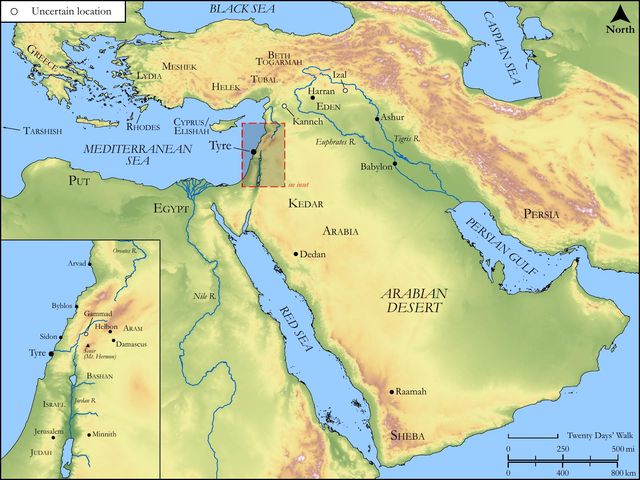
See on the biblical-era map
Study this verse
Public-domain commentary
Matthew Henry
From his Commentary on the Whole Bible. Henry comments on passages, not single verses — this entry covers Ezekiel 27:1–25. His four-level outline is real structure in the source text, so it is rendered as structure.
Here, I. The prophet is ordered to take up a lamentation for Tyrus, Eze 27:2. It was yet in the height of its prosperity, and there appeared not the least symptom of its decay; yet the prophet must lament it, because its prosperity is its snare, is the cause of its pride and security, which will make its fall the more grievous. Even those that live at ease are to be lamented if they be not preparing for trouble. He must lament it because its ruin is hastening on apace; it is sure, it is near; and though the prophet foretel it, and justify God in it, yet he must lament it. Note, We ought to mourn for the miseries of other nations, as well as for our own, out of an affection for mankind in general; it is a part of the honour we owe to all men to bewail their calamities, even those which they have brought upon themselves by their own folly.
II.He is directed what to say, and to say it in the name of the Lord Jehovah, a name not unknown in Tyre, and which shall be better known, Eze 26:6.
1.He must upbraid Tyre with her pride: O Tyrus! thou hast said, I am of perfect beauty (Eze 27:3), of universal beauty (so the word is), every way accomplished, and therefore every where admired. Zion, that had the beauty of holiness, is called indeed the perfection of beauty (Psa 50:2); that is the beauty of the Lord. But Tyre, because well-built and well-filled with money and trade, will set up for a perfect beauty. Note, It is the folly of the children of this world to value themselves on the pomp and pleasure they live in, to call themselves beauties for the sake of them, and, if in these they excel others, to think themselves perfect. But God takes notice of the vain conceits men have of themselves in their prosperity when the mind is lifted up with the condition, and often, for the humbling of the spirit, finds a way to bring down the estate. Let none reckon themselves beautified any further than they are sanctified, nor say that they are of perfect beauty till they come to heaven.
2.He must upbraid Tyre with her prosperity, which was the matter of her pride. In elegies it is usual to insert encomiums of those whose fall we lament; the prophet, accordingly, praises Tyre for all that she had that was praiseworthy. He has nothing to say of her religion, her piety, her charity, her being a refuge to the distressed or using her interest to do good offices among her neighbours; but she lived great, and had a great trade, and all the trading part of mankind made court to her. The prophet must describe her height and magnificence, that God may be the more glorified in her fall, as the God who looks upon every one that is proud and abases him, hides the proud in the dust together, and binds their faces in secret, Job 40:12.
(1.)The city of Tyre was advantageously situated, at the entry of the sea (Eze 27:3), having many commodious harbours each way, not as cities seated on rivers, which the shipping can come but one way to. It stood at the east end of the Mediterranean, very convenient for trade by land into all the Levant parts; so that she became a merchant of the people for many isles. Lying between Greece and Asia, it became the great emporium, or mart-town, the rendezvous of merchants from all parts: They borders are in the heart of the seas, Eze 27:4. It was surrounded with water, which was a great advantage to its trade; it was the darling of the sea, laid in its bosom, in its heart. Note, It is a great convenience, upon many accounts, to live in an island: seas are the most ancient land-mark, not which our fathers have set, but the God of our fathers, and which cannot be removed as other land-marks may, nor so easily got over. The people so situated may the more easily dwell alone, if they please, as not reckoned among the nations, and yet, if they please, may the more easily traffic abroad and keep a correspondence with the nations. We therefore of this island must own that he who determines the bounds of men's habitations has determined well for us.
(2.)It was curiously built, according as the fashion then was; and, being a city on a hill, it made a glorious show and tempted the ships that sailed by into her ports (Eze 27:4): They builders have perfected thy beauty; they have so improved in architecture that nothing appears in the buildings of Tyre that can be found fault with; and yet it wants that perfection of beauty into which the Lord does and will build up his Jerusalem.
(3.)It had its haven replenished with abundance of gallant ships, Isa 33:21. The ship-carpenters did their part, as well as the house-carpenters theirs. The Tyrians are thought to be the first that invented the art of navigation; at least they improved it, and brought it to as great a perfection perhaps as it could be without the loadstone.
[1.]They made the boards, or planks, for the hulk of the ship, of fir-trees fetched from Senir, a mount in the land of Israel, joined with Hermon, Sol 4:8. Planks of fir were smooth and light, but not so lasting as our English oak.
[2.]They had cedars from Lebanon, another mountain of Israel, for their masts, Eze 27:5.
[3.]They had oaks from Bashan (Isa 2:13), to make oars of; for it is probable that their ships were mostly galleys, that go with oars. The people of Israel built few ships for themselves, but they furnished the Tyrians with timber for shipping. Thus one country uses what another produced, and so they are serviceable one to another, and cannot say to each other, I have no need of thee.
[4.]Such magnificence did they affect in building their ships that they made the very benches of ivory, which they fetched from the isles of Chittim, from Italy or Greece, and had workmen from the Ashurites or Assyrians to make them, so rich would they have their state-rooms in their ships to be.
[5.]So very prodigal were they that they made their sails of fine linen fetched from Egypt, and that embroidered too, Eze 27:7. Or it may be meant of their flags (which they hoisted to notify what city they belonged to), which were very costly. The word signifies a banner as well as a sail.
[6.]They hung those rooms on ship-board with blue and purple, the richest cloths and richest colours they could get from the isles they traded with. For though Tyre was itself famous for purple, which is therefore called the Tyrian dye, yet they must have that which was far-fetched.
(4.)These gallant ships were well-manned, by men of great ingenuity and industry. The pilots and masters of the ships, that had command in their fleets, were of their own city, such as they could put a confidence in (Eze 27:8): Thy wise men, O Tyrus! that were in thee, were thy pilots. But, for common sailors, they had men from other countries; The inhabitants of Arvad and Zidon were thy mariners. These came from cities hear them; Zidon was sister to Tyre, not two leagues off, to the northward; there they bred able seamen, which it is the interest of the maritime powers to support and give all the countenance they can to. They sent to Gebal in Syria for calkers, or strengtheners of the clefts or chinks, to stop them when the ships come home, after long voyages, to be repaired. To do this they had the ancients and wise men (Eze 27:9); for there is more need of wisdom and prudence to repair what has gone to decay than to build anew. In public matters there is occasion for the ancients and wise men to be the repairers of the breaches and the restorers of paths to dwell in. Nay, all the countries they traded with were at their service, and were willing to send men into their pay, to put their youths apprentice in Tyre, or to put them on board their fleets; so that all the ships in the sea with their mariners were ready to occupy thy merchandise. Those that give good wages shall have hands at command.
(5.)Their city was guarded by a military force that was very considerable, Eze 27:10, Eze 27:11. The Tyrians were themselves wholly given to trade; but it was necessary that they should have a good army on foot, and therefore they took those of other states into their pay, such as were fittest for service, though they had them from afar (which perhaps was their policy), from Persia, Lud, and Phut. These bore their arms when there was occasion, and in time of peace hung up the shield and buckler in the armoury, as it were to proclaim peace, and let the world know that they had at present no need of them, but they were ready to be taken down whenever there was occasion for them. Their walls were guarded by the man of Arvad; their towers were garrisoned by the Gammadim, robust men, that had a great deal of strength in their arms; yet the vulgar Latin renders it pygmies, men no longer than one's arm. They hung their shields upon the walls in their magazines or places of arms; or hung them out upon the walls of the city, that none might dare to approach them, seeing how well provided they were with all things necessary for their own defence. "Thus they set forth thy comeliness (Eze 27:10), and made they beauty perfect," Eze 27:11. It contributed as much as any thing to the glory of Tyre that it had those of all the surrounding nations in its service, except the land of Israel (though it lay next them), which furnished them with timber, but we do not find that it furnished them with men; that would have trenched upon the liberty and dignity of the Jewish nation, Ch2 2:17, Ch2 2:18. It was also the glory of Tyre that it had such a militia, so fit for service, and in constant pay, and such an armoury, like that in the tower of David, where hung the shields of mighty men, Sol 4:4. It is observable that there and here the armouries are said to be furnished with shields and helmets, defensive arms, not with swords and spears, offensive, though it is probable that there were such, to intimate that the military force of a people must be intended only for their own protection and not to invade and annoy their neighbours, to secure their own right, not to encroach upon the rights of others.
(6.)They had a vast trade and a correspondence with all parts of the known world. Some nations they dealt with in one commodity and some in another, according as either its products or its manufactures were, and the fruits of nature or art were, with which it was blessed. This is very much enlarged upon here, as that which was the principal glory of Tyre, and which supported all the rest. We do not find any where in scripture so many nations named together as are here; so that this chapter, some think, gives much light to the first account we have of the settlement of the nations after the flood, Gen. 10. The critics have abundance of work here to find out the several places and nations spoken of. Concerning many of them their conjectures are different and they leave us in the dark and at much uncertainty; it is well that it is not material. Modern surveys come short of explaining the ancient geography. And therefore we will not amuse ourselves here with a particular enquiry either concerning the traders or the goods they traded in. We leave it to the critical expositors, and observe that only which is improvable.
[1.]We have reason to think that Ezekiel knew little, of his own knowledge, concerning the trade of Tyre. He was a priest, carried away captive far enough from the neighbourhood of Tyre, we may suppose when he was young, and there he had been eleven years. And yet he speaks of the particular merchandises of Tyre as nicely as if he had been comptroller of the custom-house there, by which it appears that he was divinely inspired in what he spoke and wrote. It is God that saith this, Eze 27:3.
[2.]This account of the trade of Tyre intimates to us that God's eye is upon men, and that he takes cognizance of what they do when they are employed in their worldly business, not only when they are at church, praying and hearing, but when they are in their markets and fairs, and upon the exchange, buying and selling, which is a good reason why we should in all our dealings keep a conscience void of offence, and have our eye always upon him whose eye is always upon us.
[3.]We may here observe the wisdom of God, and his goodness, as the common Father of mankind, in making one country to abound in one commodity and another in another, and all more or less serviceable either to the necessity or to the comfort or ornament of human life. Non omis fert omnia tellus - One land does not supply all the varieties of produce. Providence dispenses its gifts variously, some to each, and all to none, that there may be a mutual commerce among those whom God has made of one blood, though they are made to dwell on all the face of the earth, Act 17:26. Let every nations therefore thank God for the productions of its country; though they be not so rich as those of others, yet there is use for them in the public service of the world.
[4.]See what a blessing trade and merchandise are to mankind, especially when followed in the fear of God, and with a regard not only to private advantage, but to a common benefit. The earth is full of God's riches, Psa 104:24. There is a multitude of all kinds of riches in it (as it is here, Eze 27:12), gathered off its surface and dug out of its bowels. The earth is also full of the fruits of men's ingenuity and industry, according as their genius leads them. Now by exchange and barter these are made more extensively useful; thus what can be spared is helped off, and what is wanted is fetched in, in lieu of it, from the most distant countries. Those that are not tradesmen themselves have reason to thank God for tradesmen and merchants, by whom the productions of other countries are brought to our hands, as those of our own are by our husbandmen.
[5.]Besides the necessaries that are here traded in, see what abundance of things are here mentioned that only serve to please fancy, and are made valuable only by men's humour and custom; and yet God allows us to use them, and trade in them, and part with those things for them which we can spare that are of an intrinsic worth much beyond them. Here are horns of ivory and ebony (Eze 27:15), that are brought for a present, exposed to sale, and offered in exchange, or (as some think) presented to the city, or the great men of it, to obtain their favour. Here are emeralds, coral, and agate (Eze 27:16), all precious stones, and gold (Eze 27:22), which the world could better be without than iron and common stones. Here are, to please the taste and smell, the chief of all spices (Eze 27:22), cassia and calamus (Eze 27:19), and, for ornament, purple, broidered work, and fine linen (Eze 27:16), precious clothes for chariots (Eze 27:20), blue clothes (which Tyre was famous for), broidered work, and chests of rich apparel, bound with rich cords, and made of cedar, a sweet wood to perfume the garments kept in them, Eze 27:24. Upon the review of this invoice, or bill of parcels, we may justly say, What a great many things are here that we have no need of, and can live very comfortably without!
[6.]It is observable that Judah and the land of Israel were merchants in Tyre too; in a way of trade they were allowed to converse with the heathen. But they traded mostly in wheat, a substantial commodity, and necessary, wheat of Minnith and Pannag, two countries in Canaan famous for the best wheat, as some think. The whole land indeed was a land of wheat (Deu 8:8); it had the fat of kidneys of wheat, Deu 32:14. Tyre was maintained by corn fetched from the land of Israel. They traded likewise in honey, and oil, and balm, or rosin; all useful things, and not serving to pride or luxury. And the land which these were the staple commodities of was that which was the glory of all lands, which God reserved for his peculiar people, not those that traded in spices and precious stones; and the Israel of God must reckon themselves well provided for if they have food convenient; for those that are acquainted with the delights of the children of God will not set their hearts on the delights of the sons and daughters of men, or the treasures of kings and provinces. We find indeed that the New Testament Babylon trades in such things as Tyre traded in, Rev 18:12, Rev 18:13. For, notwithstanding its pretensions to sanctity, it is a mere worldly interest.
[7.]Though Tyre was a city of great merchandise, and they got abundance by buying and selling, importing commodities from one place and exporting them to another, yet manufacture-trades were not neglected. The wares of their own making, and a multitude of such wares, are here spoken of, Eze 27:16, Eze 27:18. It is the wisdom of a nation to encourage art and industry, and not to bear hard upon the handicraft-tradesmen; for it contributes much to the wealth and honour of a nation to send abroad wares of their own making, which may bring them in the multitude of all riches.
[8.]All this made Tyrus very great and very proud: The ships of Tarshish did sing of thee in they market (Eze 27:25); thou wast admired and cried up by all the nations that had dealings with thee; for thou wast replenished in wealth and number of people, wast beautified, and made very glorious, in the midst of the seas. Those that grow very rich are cried up as very glorious; for riches are glorious things in the eyes of carnal people, Gen 31:1.
Historical interpretation
Historical reception
3 surviving comments on this verse. Each one is dated, so this reads as a timeline rather than a list.
(Verse 35, 36, and following) And I will bring you into a desert of peoples, and there I will judge you face to face. Just as I contended with your fathers in the desert of the land of Egypt, so I will judge you, says the Lord. And I will subject you to my scepter, and I will bring you into the bonds of the covenant, and I will choose from among you the transgressors and the wicked: from their place of residence I will bring them out, and they will not enter the land of Israel, and you will know that I am the Lord. Thus says the Lord: I will do for you who are in Babylon, and now serve idols, what I did for your ancestors in Egypt. I will lead you into the desert of the peoples, and there I will judge you face to face, just as I contended with them in judgment when they came out of Egypt. And after I have judged you, I will subject you to my scepter and rule, and I will make a covenant with you and bring you into your land with the bonds of love, so that bound by my love, you will never be able to depart from me. But I will choose from among you the transgressors and the wicked, who persist in the hardness of their hearts in evil deeds, not for possession, but for rejection. And I will indeed bring them out of the land of their dwelling, so that when they are brought out, they will not enter the land of Israel; but they will perish in various regions. And by the distinction between good and evil, you shall know that I am the Lord, who judges all things. The rest of the discourse hastens, and we briefly go through each point, in order to provide only the meaning to the readers.
(Vers. 15, 16.) Many islands have traded with your merchandise: they have exchanged ivory and ebony for your price. Your merchant, Syrus, because of the multitude of your works, has presented pearls, purple, embroidered garments, fine linen, silk, and scarlet in your market. LXX: They have multiplied your merchandise with islands: you were repaying your wages with elephant tusks and those who were being brought in. Your business has been purchased by many of your customers: They traded in aphec, stacten, and polymita from Tharsis and Ramoth and Chodchod in your market. The Hebrew text differs greatly from the Septuagint edition in this particular passage; therefore, a few things must be said according to each. So that we don't get too caught up in Tyrian merchandise, let's move on to the remaining prophecies. The sons of Dadan, Tyrian merchants, have multiplied their business in many islands, so that they traded elephant tusks with those who came for their commerce, and they had men in the markets because of the multitude of trade. But they had in Aphech what is added in Theodotion's edition to the Seventy: for which Symmachus translates, 'polymita.' Also, Stacte, for which all others interpret 'purple,' which is called Argaman in Hebrew: and varieties from Tharsis, for which in Hebrew it is called Bus, which is translated by all as 'byssus.' However, Tharsis is not found anywhere in this place. And they gave 'ramoth' and 'chodchod' in your markets; which is found thus in Hebrew, except that instead of 'ramoth,' Aquila interprets it as 'silk,' or 'fine.' All the interpreters indeed have accurately translated it in the way it is placed in Hebrew (). Therefore, according to the Septuagint, the sons of the Rhodians, the merchants of Tyre, increased his trade from many islands: according to the Hebrew (text), after the sons of Dadan, his merchants also enlarged their trade with the islands of various nations, bringing ivory from India and precious black lignum vitae, and exchanged (them) with other Tyrian goods. Syrus was also a Tyrian trader: for which reason in Hebrew it is written Aram (), in place of which the Seventy interpreters have rendered it Adam, and Res and Daleth, as above, being deceived by the similarity. However, to this day the innate ardor for trading remains in the Syrians, who with a desire for profit travel throughout the world, and have such a madness for commerce that, now that the Roman world has been conquered, they seek riches among swords and the deaths of the unfortunate, and flee poverty with dangers. There are such types of men in Tyre who trade in multicolored fabrics, purple, and embroidered cloth. They also offer linen and silk, and present precious goods in their market. Regarding purple, which everyone has interpreted, the Septuagint translates it as 'stacten,' which means 'drop.' However, I have not been able to find the meaning of 'chodchod' up until now. The Hebrews say that all precious goods are signified by this name, or that it is a certain type of precious merchandise that the Roman language does not mention, or simply a common term used by sellers. But from many islands, to move on to the mystical sense, which are beaten by the salty and bitter waves of this world, merchants of Dedan bring ivory teeth, promising the whiteness of eloquence; about whom it is written: Out of ivory palaces, from which the daughters of kings have delighted you in your glory (Ps. LIV, 9). But they are not white, nor do they imitate the bride, of whom it is said: Who is this that comes up from the wilderness, leaning upon her beloved (Cant. VIII, 5)? But the Ethiopians of black color, who cannot change their blackness, as Jeremiah says: Can the Ethiopian change his skin, or the leopard his spots? (Jer. XIII, 21) . And also the Syrian, that is, Aram, which means high, and swells with pride, is a merchant of Tyre, and in the multitude of the works of the Tyrians carries the knowledge of false names, promising many varieties, and the sweet smell of the best ointment, and the purple of royal dignity, and the chequered work of dialectic art, and fine linen, for which the Septuagint have rendered Tharsis, being devoted to the works of the earth: and silk, for which in Hebrew it is written, Ramoth, which means vision of death. For all earthly works hasten towards destruction; and chodchod, whatever that is which is understood, proposing it in the markets of Tyre. But among these goods which are said to be brought by its merchants and islands, either the region of India should be understood, or that of the Idumaeans and vast solitude, as some estimate, and it signifies a connection, so that we may recognize the likeness of divine teachings in heretics.
(Verse 27, 29 onwards) Therefore speak to the house of Israel, son of man, and tell them: Thus says the Lord God: Moreover, your fathers have blasphemed against me and have treated me with contempt, even as they spurned me. And I brought them into the land that I had lifted my hand to give them ((Vulgate adds: that land)): they saw every high hill and every leafy tree, and there they offered their sacrifices and presented there the irritation of their offerings, and they placed there the fragrance of their sweetness, and they poured out their ((Vulgate is silent on this)) libations there. And I said to them, 'What is the high place to which you are going?' And its name was called the High Place until this day. Therefore speak to the house of Israel, son of man, and say to them, 'Thus says the Lord God: As for your fathers, they have provoked Me to anger by their iniquities, by the fact that they have fallen away from Me. So I brought them into the land that I had lifted My hand in an oath to give them.' They saw every high hill and every leafy tree, and there they offered their sacrifices. They also presented there the provocation of their gifts, and they set there their pleasing aroma, and they poured out there their drink offerings. And I said to them: What is abbana, because you enter there? And they called its name abbana until this day. I wanted, he said, to scatter them in the wilderness, and to give them not good precepts, so that they would sacrifice to idols what they should have offered to me, and consecrate all their first-fruits to them by fire, so that I might kill them and destroy them. But when he says, I wanted, he shows that he did not do what he wanted. And that which follows: 'And they shall know that I am the Lord,' is not found in the Septuagint. For it did not seem fitting to them to know after their destruction that he himself is the Lord. But you, son of man, speak again to them, that is, to the elders of the house of Israel, who have come to inquire of you: Your fathers, from whom you have descended, have also blasphemed against me and held me in contempt; after I brought them into the land which I had given them to possess, they turned against me to provoke me. For when they saw every high hill and leafy tree, they would sacrifice on the mountains and in the groves and thickets, and offer victims to the idols, and pour out libations. And when I saw this, I said to them: What is this, Bama? for it is called high: or why do you enter into such a place which you have chosen for yourselves in all the hills, so that even today these places are called Bamoth, and the ancient error retains its original name? Regarding Bama, which we translate as excelsum, there is an error in the Septuagint edition, where it is written as ἀββανὰ, which does not resonate in the Hebrew language. Bama can mean 'in which' if the two syllables are divided into two words, but in the present context, that sense does not fit. However, wherever it is written in the Books of Kings and Chronicles: 'The people still sacrificed and offered incense on the high places,' Bama in the singular and Bamoth in the plural mean 'high places.'
Continue studying Ezekiel 27:15 across the web’s major study libraries — every link below opens this exact verse, chapter, or book on the destination site.
Read & Compare
 BibleGatewayThis verse in more than 200 translations and 70 languages.
 Bible.comThe YouVersion reader — hundreds of translations, reading plans, and highlights.
 ESV.orgCrossway's official English Standard Version reader.
 NET BibleThe NET translation with 60,000+ translators' notes on every rendering decision.
 STEP BibleTyndale House's free study tool — original text, vocabulary, and scholarly resources.
 BibliaLogos Bible Software's free web reader.
 USCCBThe New American Bible (Revised Edition) with the U.S. bishops' study notes.
Commentaries
 BibleHub CommentariesDozens of classic commentaries on this verse, gathered on one page.
 StudyLightMore than 100 commentary sets — the largest collection on the web.
 BibleRefPlain-English commentary on what this verse means, verse by verse.
 Enduring WordDavid Guzik's free commentary on this chapter, widely used by Bible teachers.
 Bible Study ToolsVerse commentary alongside Greek and Hebrew study aids.
Original Language & Research
- BibleHub InterlinearThe verse word by word — original language, transliteration, and English.
- BibleHub LexiconEvery word's original-language definition and Strong's entry.
 Blue Letter BibleDeep-study tools — Strong's numbers, concordance, and word studies.
 SefariaThe Hebrew text with Rashi and centuries of Jewish commentary.
Sermons, Hymns & Audio


TrulyRandomVerse is not affiliated with these sites and doesn’t control their content. They’re linked because they’re genuinely useful.
Summary
Ezekiel 27:15, a vivid stroke in the elaborate prophetic lament over Tyre, meticulously details the exotic commodities flowing into the opulent Phoenician city-state. This verse specifically identifies Dedan and numerous "isles" or coastlands as pivotal trade partners, supplying highly prized "horns of ivory and ebony." It profoundly illustrates the vast commercial reach and luxurious nature of Tyre's economic empire, setting the theological stage for the subsequent divine judgment against its pride and self-sufficiency, which stemmed from such immense material wealth.
Context
ShowHideLiterary Context
Ezekiel 27 is a profound and elaborate funeral dirge, or lamentation, over the city of Tyre, presented metaphorically as a magnificent, yet ultimately doomed, merchant ship. This chapter is an integral part of a larger prophetic oracle against Tyre found in Ezekiel 26-28. Following the initial declaration of Tyre's impending destruction in Ezekiel 26, chapter 27 provides an exhaustive and detailed inventory of Tyre's global trade network, meticulously listing its numerous partners and the specific goods they exchanged. Verse 15 fits seamlessly into this comprehensive catalog, highlighting the contributions of specific regions to Tyre's immense wealth before its inevitable, divinely ordained downfall. The meticulous detail serves not only to underscore the magnitude of Tyre's prosperity but also to emphasize the depth and completeness of its prophesied ruin.
Historical & Cultural Context
Tyre was a dominant Phoenician city-state, renowned as an unparalleled maritime power and commercial hub among the nations. Strategically located on the eastern Mediterranean coast, its advanced seafaring capabilities and extensive port infrastructure allowed it to establish a vast trade empire that stretched across the known world. During the period of Ezekiel's prophecy (the early 6th century BCE), Tyre was at the zenith of its power, yet simultaneously facing the rising geopolitical threat of the Neo-Babylonian Empire under Nebuchadnezzar. Dedan, mentioned in the verse, was an important oasis city in northern Arabia (modern Al-Ula), strategically positioned on major overland trade routes, particularly for the lucrative incense trade and goods from the Arabian Peninsula and Africa. The "isles" or coastlands (Hebrew: ʼîy) refer broadly to the numerous coastal regions, islands, and distant lands throughout the Mediterranean and beyond that engaged in extensive commerce with Tyre, showcasing the city's extraordinary reach and influence over a vast network of suppliers and markets.
Key Themes
ShowHideThis verse, nestled within the grand lament, contributes significantly to several overarching theological and narrative themes. Firstly, it vividly emphasizes Tyre's immense wealth and global commercial dominance, portraying a city that accumulated vast riches through its extensive trade routes and diverse luxury imports. This material prosperity forms the backdrop for the city's spiritual condition. Secondly, it subtly introduces and reinforces the theme of pride and self-sufficiency, as Tyre's unparalleled prosperity led to an inflated sense of its own power, invincibility, and even divine status, a hubris explicitly condemned in Ezekiel 28:2. Finally, the detailed description of Tyre's material glory serves as a stark and poignant contrast to the impending divine judgment and destruction prophesied against it, underscoring the transient nature of all worldly power and the ultimate, unchallengeable sovereignty of God over all nations and their destinies, a recurring motif throughout Ezekiel's prophecies against foreign nations.
Exposition and Analysis
ShowHideKey Word Analysis
ShowHideOf uncertain derivation; Dedan, the name of two Cushites and of their territory. In this context, Dedan refers to an ancient Arabian city or region, located in the northern Hejaz, which was a significant trading hub. It served as a crucial intermediary for overland caravan routes, connecting goods from the Arabian Peninsula, and potentially Africa, to Tyre's maritime networks, highlighting the comprehensive nature of Tyre's commercial reach.
From אָוָה; properly, a habitable spot (as desirable); dry land, a coast, an island. While often translated as "isles" or "islands," the Hebrew term ʼîy has a broader semantic range, encompassing maritime regions, coastlands, and distant lands accessible by sea. This expands the scope of Tyre's trade partners beyond mere islands to include all its coastal trading partners and territories across the Mediterranean and possibly beyond, emphasizing the vastness and diversity of its commercial empire.
Only in plural, from an unused root meaning to be hard; ebony. This refers to a dense, dark, and highly valued wood, typically imported from distant tropical regions like India or Africa. Its mention alongside ivory signifies the extreme luxury and exotic nature of the goods that flowed into Tyre, underscoring the city's opulence and its ability to acquire the rarest and most expensive commodities from around the world, indicative of its elite status.
Verse Breakdown
ShowHide"The men of Dedan [were] thy merchants"
This initial clause precisely identifies Dedan, a prominent Arabian trading hub, as a significant and direct partner in Tyre's vast commercial network. The "men of Dedan" functioned as active merchants, implying a direct and established trade relationship, likely facilitated through overland caravan routes that connected to Tyre's extensive maritime commerce. This highlights the intercontinental reach of Tyre's economic influence.
"many isles [were] the merchandise of thine hand"
This phrase significantly broadens the scope of Tyre's trade, indicating that numerous coastal regions, islands, and distant maritime lands (the "isles" or ʼîy) were not merely passive suppliers but active sources of goods that Tyre acquired, controlled, and distributed. The phrase "merchandise of thine hand" powerfully emphasizes Tyre's active agency, immense power, and dominant control over these intricate global trade flows, asserting its preeminent position as the central hub of ancient commerce.
"they brought thee [for] a present horns of ivory and ebony"
This concluding clause specifies the nature of the luxury goods supplied by these distant partners, revealing the opulence of Tyre's imports. "Horns of ivory" refers to elephant tusks, a highly prized material in that day for intricate carving and lavish ornamentation, likely sourced from Africa or India. "Ebony" denotes the dark, hard, and exceptionally valuable wood, also an exotic import. The term "present" (ʼeshkâr) here likely signifies a valuable offering or tribute, suggesting the deference or significant commercial dealings these regions had with Tyre, providing it with the most exquisite and expensive commodities as a testament to its supreme economic power.
Literary Devices
ShowHideThe verse employs several literary devices to paint a vivid and compelling picture of Tyre's commercial might and opulence. Metonymy is evident in "the men of Dedan," where the people represent the entire trading entity or region of Dedan, symbolizing its economic contribution. The phrase "merchandise of thine hand" employs synecdoche, as "hand" stands for Tyre's comprehensive agency, power, and control over its vast trade network. The detailed listing of "horns of ivory and ebony" serves as potent imagery, evoking a sense of exotic luxury, immense wealth, and global reach, contributing to the overall hyperbole of Tyre's described grandeur, which is then dramatically contrasted with its impending destruction. The entire chapter, of which this verse is an integral part, functions as an extended allegory, portraying Tyre as a magnificent merchant ship destined for a catastrophic shipwreck, symbolizing its rise, ultimate pride, and inevitable fall.
Theological and Thematic Connections
ShowHideEzekiel 27:15, by meticulously cataloging Tyre's opulent trade, underscores a profound biblical truth: the fleeting nature of worldly wealth and the inherent peril of pride derived from material prosperity. Tyre's extensive network and acquisition of luxury goods like ivory and ebony highlight a civilization that found its identity, security, and even its perceived invincibility in its economic prowess. However, this self-reliance and hubris ultimately led to its catastrophic downfall, serving as a powerful prophetic warning against trusting in riches rather than in the sovereign God. The detailed description of Tyre's material glory stands in stark contrast to the divine judgment that awaits, demonstrating God's ultimate sovereignty over all earthly kingdoms and His unwavering commitment to humbling the proud and exalting the humble.
Reflection and Application
ShowHideEzekiel 27:15, powerfully embedded within the lament over Tyre, offers profound and timeless insights for contemporary life. It challenges us to deeply examine the true sources of our security, identity, and confidence. While economic success, global influence, and the accumulation of resources can be impressive human achievements, this passage serves as a stark reminder that all earthly power, wealth, and influence are fundamentally transient and ultimately subject to God's sovereign will. The relentless pursuit of luxury and the accumulation of riches, when divorced from a humble recognition of divine provision and a submission to God's purposes, can foster a dangerous pride that blinds us to our true spiritual needs and eternal realities. We are called to steward our resources wisely, remembering that true security and lasting value are found not in material possessions or fleeting human achievements, but in an abiding relationship with God and in seeking His kingdom first. The eventual downfall of Tyre compels us to critically consider what foundations we are building our lives upon and whether our ultimate confidence rests in perishable worldly treasures or in the unchanging character and eternal promises of God.
Questions for Reflection
ShowHideFAQ
ShowHideWhat was the significance of "horns of ivory and ebony" as trade goods?
ShowHide"Horns of ivory" refers to elephant tusks, a highly coveted and exceptionally valuable material in that day, used for carving intricate objects, luxurious furniture inlays, and other elite decorative items. Ebony was a rare, dense, and dark wood, prized for its beauty, durability, and exotic origin, used in fine carpentry, musical instruments, and decorative arts. The mention of these specific goods in Ezekiel 27:15 highlights the extreme luxury and exotic nature of Tyre's imports. They symbolize the city's immense wealth, its global reach in acquiring the rarest and most expensive commodities from distant lands (likely Africa and India), and the opulent lifestyle of its elite, showcasing its status as a world economic power.
How does Dedan fit into Tyre's vast trade network?
ShowHideDedan (identified with modern Al-Ula in Saudi Arabia) was a significant oasis city in northern Arabia, strategically located on major overland caravan routes that connected the Arabian Peninsula with the Levant. While Tyre was predominantly a maritime power, its comprehensive trade network extended inland through crucial partnerships with cities like Dedan. Dedan likely served as a vital intermediary, bringing goods from the Arabian Peninsula, such as incense, spices, and possibly even African goods transported overland, to Tyre's coastal ports for further distribution by sea. This connection illustrates the comprehensive and integrated nature of Tyre's commerce, which masterfully combined both sea and land routes to amass its unparalleled wealth, as meticulously detailed throughout Ezekiel 27.
Christ-Centered Fulfillment
ShowHideWhile Ezekiel 27:15 directly describes the material wealth and extensive commercial networks of ancient Tyre, its ultimate theological fulfillment points profoundly to Christ and the nature of His eternal kingdom. The lament over Tyre's catastrophic fall, brought about by its excessive pride in its earthly riches and self-sufficiency, serves as a powerful prophetic foreshadowing of the transient nature of all worldly kingdoms and the ultimate, enduring triumph of God's eternal kingdom, which is definitively established through Christ. Tyre's relentless pursuit of exotic goods and its hubristic reliance on its own economic prowess stand in stark contrast to the true and imperishable "riches" found in Christ, who, though infinitely rich in His divine glory, for our sake became poor, so that we through His poverty might become truly rich in spiritual blessings and eternal life (2 Corinthians 8:9). The "merchandise" of Tyre, acquired through human effort and fleeting earthly connections, ultimately perishes in the face of divine judgment, whereas the spiritual blessings, imperishable inheritance, and eternal life offered by Christ are of infinite and enduring value (1 Peter 1:3-4). Christ, as the true Temple and the ultimate source of all wisdom and true prosperity, offers a spiritual abundance that far surpasses the fleeting glory of any earthly kingdom or commercial empire. His sacrificial death and glorious resurrection overcome the very pride and self-reliance that led to Tyre's downfall, inviting humanity into a transformative relationship where true security, lasting treasure, and eternal satisfaction are found not in "horns of ivory and ebony," but in the person and work of the Lamb of God who takes away the sin of the world.