


Genesis 10:6
Bible text: King James Version (1769 Blayney text) · Public domain
Bible text: Berean Standard Bible · Public domain
Bible text: American Standard Version (1901) · Public domain
Bible text: World English Bible, Messianic edition · Public domain
Bible text: Geneva Bible (1599) · Public domain
Bible text: Young's Literal Translation · Public domain
- וּבְנֵיu·ve·Neiand [the] sons ofH1121Conj-w ¦ N-mpcNoun Plural Masculine Constructוּandבְנֵי[the] sons of
- חָםChamHamH2526N-proper-mNoun Proper Masculine
- כּוּשׁkush[were] CushH3568N-proper-mNoun Proper Masculine
- וּמִצְרַיִםu·mitz·Ra·yimand MizraimH4714Conj-w ¦ N-proper-mNoun Proper MasculineוּandמִצְרַיִםMizraim
- וּפוּטu·Futand PutH6316Conj-w ¦ N-proper-mNoun Proper MasculineוּandפוּטPut
- וּכְנָעַןu·khe·Na·'anand CanaanH3667Conj-w ¦ N-proper-mNoun Proper MasculineוּandכְנָעַןCanaan
English is a literal word-by-word gloss of the Hebrew, not the KJV's wording. Why?
This is the original text the KJV's translators worked from — each Hebrew word with its own literal English meaning in this verse, prepared by scholars at Tyndale House, Cambridge. The KJV translates whole sentences, not word by word, so its wording differs: one Hebrew word can become several English words, and the KJV may choose “the LORD” where the gloss reads “Yahweh”. Both are faithful — they answer different questions. For the KJV's own rendering, switch to the KJV text.
Details
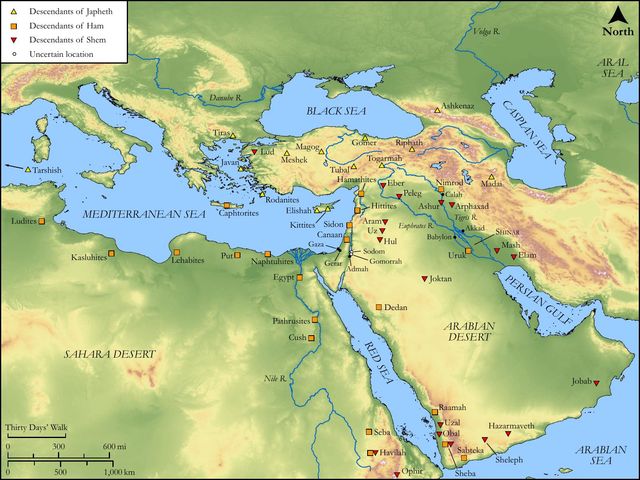
See on the biblical-era maps


Study this verse
Public-domain commentary
Matthew Henry
From his Commentary on the Whole Bible. Henry comments on passages, not single verses — this entry covers Genesis 10:6–14. His three-level outline is real structure in the source text, so it is rendered as structure.
That which is observable and improvable in these verses is the account here given of Nimrod, Gen 10:8-10. He is here represented as a great man in his day: He began to be a mighty one in the earth, that is, whereas those that went before him were content to stand upon the same level with their neighbours, and though every man bore rule in his own house yet no man pretended any further, Nimrod's aspiring mind could not rest here; he was resolved to tower above his neighbours, not only to be eminent among them, but to lord it over them. The same spirit that actuated the giants before the flood (who became mighty men, and men of renown, Gen 6:4), now revived in him, so soon was that tremendous judgment which the pride and tyranny of those mighty men brought upon the world forgotten. Note, There are some in whom ambition and affectation of dominion seem to be bred in the bone; such there have been and will be, notwithstanding the wrath of God often revealed from heaven against them. Nothing on this side hell will humble and break the proud spirits of some men, in this like Lucifer, Isa 14:14, Isa 14:15. Now,
I.Nimrod was a great hunter; with this he began, and for this became famous to a proverb. Every great hunter is, in remembrance of him, called a Nimrod.
1.Some think he did good with his hunting, served his country by ridding it of the wild beasts which infested it, and so insinuated himself into the affections of his neighbours, and got to be their prince. Those that exercise authority either are, or at least would be called, benefactors, Luk 22:25.
2.Others think that under pretence of hunting he gathered men under his command, in pursuit of another game he had to play, which was to make himself master of the country and to bring them into subjection. He was a mighty hunter, that is, he was a violent invader of his neighbours' rights and properties, and a persecutor of innocent men, carrying all before him, and endeavouring to make all his own by force and violence. He thought himself a mighty prince, but before the Lord (that is, in God's account) he was but a mighty hunter. Note, Great conquerors are but great hunters. Alexander and Caesar would not make such a figure in scripture-history as they do in common history; the former is represented in prophecy but as a he-goat pushing, Dan 8:5. Nimrod was a mighty hunter against the Lord, so the Septuagint; that is,
(1.)He set up idolatry, as Jeroboam did, for the confirming of his usurped dominion. That he might set up a new government, he set up a new religion upon the ruin of the primitive constitution of both. Babel was the mother of harlots. Or,
(2.)He carried on his oppression and violence in defiance of God himself, daring Heaven with his impieties, as if he and his huntsmen could out-brave the Almighty, and were a match for the Lord of hosts and all his armies. As if it were a small thing to weary men, he thinks to weary my God also, Isa 7:13.
II.Nimrod was a great ruler:
The beginning of his kingdom was Babel, Gen 10:10. Some way or other, by arts or arms, he got into power, either being chosen to it or forcing his way to it; and so laid the foundations of a monarchy, which was afterwards a head of gold, and the terror of the mighty, and bade fair to be universal. It does not appear that he had any right to rule by birth; but either his fitness for government recommended him, as some think, to an election, or by power and policy he advanced gradually, and perhaps insensibly, into the throne. See the antiquity of civil government, and particularly that form of it which lodges the sovereignty in a single person. If Nimrod and his neighbours began, other nations soon learned to incorporate under one head for their common safety and welfare, which, however it began, proved so great a blessing to the world that things were reckoned to go ill indeed when there was no king in Israel.
III.Nimrod was a great builder.
Probably he was architect in the building of Babel, and there he began his kingdom; but, when his project to rule all the sons of Noah was baffled by the confusion of tongues, out of that land he went forth into Assyria (so the margin reads it, Gen 10:11) and built Nineveh, etc., that, having built these cities, he might command them and rule over them. Observe, in Nimrod, the nature of ambition.
1.It is boundless. Much would have more, and still cries, Give, give.
2.It is restless. Nimrod, when he had four cities under his command, could not be content till he had four more.
3.It is expensive. Nimrod will rather be at the charge of rearing cities than not have the honour of ruling them. The spirit of building is the common effect of a spirit of pride.
4.It is daring, and will stick at nothing. Nimrod's name signifies rebellion, which (if indeed he did abuse his power to the oppression of his neighbours) teaches us that tyrants to men are rebels to God, and their rebellion is as the sin of witchcraft.
Historical interpretation
Four Centuries of Reception
6 surviving comments on this verse. Each one is dated, so this reads as a timeline rather than a list.
Select a marker to jump to its quote. Markers stagger vertically where authors wrote within a few decades of each other.
Concerning Nimrod, Moses said, “He was a mighty hunter before the Lord,” because, according to the will of the Lord, it was he who fought with each of these nations and chased them out from there, so that they would go out and settle in the regions that had been set apart for them by God. “Therefore it is said, like Nimrod a mighty hunter before the Lord.” One used to bless a chief or a ruler by saying, “May you be like Nimrod, a mighty hunter who was victorious in the battles of the Lord.”
Then sacred Scripture goes on from this point to tell of the children born to the sons in these words: “Now, Ham became the father of Cush”; and further, “Now, Cush became the father of Nebrod (Nimrod), who began to be a giant on earth. He was a giant hunter before the Lord.” While some people say the phrase “before the Lord” means being in opposition to God, I on the contrary do not think sacred Scripture is implying this. Rather, it implies that [Nimrod] was strong and brave. But the phrase “before the Lord” means created by him, receiving from him God’s blessing. Or it may mean that God was on the point of arousing our wonder through him by creating such a remarkable creature and displaying him before us on the earth. Nimrod too, however, in his turn in imitation of his forebear did not take due advantage of his natural preeminence but hit upon another form of servitude in endeavoring to become ruler and king. You see, there would not ever be a king unless there were people being ruled. But in that case freedom is seen for what it really is, whereas slavery is the most galling obstacle to conditions of freedom, when all the more power is exercised over free people. See what ambition is guilty of. Observe bodily strength not keeping to its limits but constantly lusting after more and clutching for glory. You see, the orders [Nimrod] gave were not those of a leader. Rather, he even builds cities with a view to ruling over the enemy.
A Nimrod, who goes round the world, made rough
With deep ravines and wooden crags, and strives
To waylay some by fraud and secret wiles,
To vanquish others by his giant arms
And spread his deadly triumphs far and wide.
(Verse 6) The sons of Ham: Cush, Egypt, Put, and Canaan. Cush, even to this day, is called Ethiopia by the Hebrews; Egypt is called Mizraim, and Put is called Libya. From Put, the river of Mauritania is called as such, and the entire region surrounding it is known as the Putian region. Many Greek and Latin writers attest to this. However, it is not the place or time to discuss why the ancient name of Libya has remained only in a certain part of the region, and the rest of the land is called Africa. Furthermore, Canaan obtained the land, which the Jews subsequently possessed, after driving out the Canaanites.
“And Chus [Cush] begat Nimrod. This man began to be powerful in the earth.” And after a little while, it says, “And the beginning of his kingdom was Babel and Arach and Achad and Chalanne in the land of Senaar [Shinar].” Nimrod, son of Chus, was the first to seize despotic rule over the people, which men were not yet accustomed to; and he reigned in Babylon, which was called Babel, because the languages of those building the tower were thrown into confusion there. For Babel signifies confusion. Then he also reigned in Arach, that is, in Edissa; and in Achad, which is now called Nisibis; and in Chalanne, which was later called Seleucia after king Seleucus when its name had been changed and which is now in actual fact called Ctesiphon.
The sons of Ham: Cush, and Mizraim, and Phut and Canaan. Cush is today called Ethiopia by the Hebrews, Mizraim is Egypt, Phut is Libya, from whom even to this day a river in Mauretania is called Phut, and the whole region around it is called Phutensis. Moreover, Canaan possessed the land which the Jews subsequently took over by expelling the Canaanites.
Continue studying Genesis 10:6 across the web’s major study libraries — every link below opens this exact verse, chapter, or book on the destination site.
Read & Compare
 BibleGatewayThis verse in more than 200 translations and 70 languages.
 Bible.comThe YouVersion reader — hundreds of translations, reading plans, and highlights.
 ESV.orgCrossway's official English Standard Version reader.
 NET BibleThe NET translation with 60,000+ translators' notes on every rendering decision.
 STEP BibleTyndale House's free study tool — original text, vocabulary, and scholarly resources.
 BibliaLogos Bible Software's free web reader.
 USCCBThe New American Bible (Revised Edition) with the U.S. bishops' study notes.
Commentaries
 BibleHub CommentariesDozens of classic commentaries on this verse, gathered on one page.
 StudyLightMore than 100 commentary sets — the largest collection on the web.
 BibleRefPlain-English commentary on what this verse means, verse by verse.
 Enduring WordDavid Guzik's free commentary on this chapter, widely used by Bible teachers.
 Bible Study ToolsVerse commentary alongside Greek and Hebrew study aids.
Original Language & Research
- BibleHub InterlinearThe verse word by word — original language, transliteration, and English.
- BibleHub LexiconEvery word's original-language definition and Strong's entry.
 Blue Letter BibleDeep-study tools — Strong's numbers, concordance, and word studies.
 SefariaThe Hebrew text with Rashi and centuries of Jewish commentary.
Sermons, Hymns & Audio


TrulyRandomVerse is not affiliated with these sites and doesn’t control their content. They’re linked because they’re genuinely useful.
Summary
Genesis 10:6 commences the detailed enumeration of Ham's four sons—Cush, Mizraim, Phut, and Canaan—who subsequently became the progenitors of significant ancient nations and distinct geographical regions. This verse forms a foundational segment of the "Table of Nations," illustrating the rapid repopulation of the post-diluvian earth and God's sovereign orchestration of human dispersion and the formation of diverse peoples.
Context
ShowHideLiterary Context
Genesis chapter 10, often referred to as the "Table of Nations," serves as a pivotal genealogical and geographical record within the book of Genesis. It meticulously chronicles the descendants of Noah's three sons—Shem, Ham, and Japheth—who were responsible for repopulating the entire earth following the universal flood. This chapter follows the account of the flood's aftermath and Noah's covenant with God in Genesis 9, particularly the divine command to "be fruitful and multiply, and fill the earth" (Genesis 9:1). Verse 6 specifically initiates the lineage of Ham, placing it between the Japhethite and Shemite genealogies, thereby setting the stage for the identification of key nations and their geographical locations, many of whom would later interact with the nascent nation of Israel. The subsequent narrative in Genesis 11 will then explain the linguistic diversification and further dispersion of these peoples at Babel.
Historical & Cultural Context
The "Table of Nations" reflects Israel's understanding of world ethnography and geography, categorizing peoples based on perceived familial relationships and geographical proximity. In this context, the names listed are not merely individuals but often represent the eponymous founders of nations, tribes, or regions. Ham's descendants, particularly Cush (Ethiopia/Nubia), Mizraim (Egypt), and Canaan, represent significant historical powers and geographical areas that were well-known to the ancient Israelites. Egypt, for instance, was a dominant regional power, and Canaan was the very land promised to Abraham and his descendants, making its origins of immense importance. The listing of these groups establishes a biblical framework for understanding the origins of the diverse peoples surrounding Israel, providing a theological rather than purely anthropological account of human diversification after the flood.
Key Themes
ShowHideThis verse and the broader "Table of Nations" contribute to several overarching themes in Genesis. Firstly, it underscores the theme of God's faithfulness to His covenant promises, particularly the command to "be fruitful and multiply" (Genesis 9:7), as humanity rapidly repopulates the earth. Secondly, it highlights the unity of humanity's origin from a single family (Noah's), despite the subsequent diversification into distinct nations and languages, a concept foundational to biblical anthropology. Thirdly, it sets the geographical and ethnic stage for future redemptive history, especially the narrative of Abraham and the nation of Israel. The inclusion of Canaan, who was cursed by Noah in Genesis 9:25, foreshadows the later conflicts and the divine mandate for Israel to dispossess the Canaanites from the Promised Land, linking this genealogical record directly to the unfolding of God's redemptive plan.
Exposition and Analysis
ShowHideKey Word Analysis
ShowHideDerived from a root meaning "to build," this term signifies not only direct male offspring but also the idea of building up a family name, lineage, or nation. In this context, it emphasizes the foundational role of Ham's immediate descendants in establishing the subsequent peoples and territories.
Meaning "hot" (perhaps alluding to a tropical habitat), Ham is one of Noah's three sons and the progenitor of peoples primarily associated with Africa, Egypt and the land of Canaan. His name here introduces the specific branch of Noah's family that would give rise to significant nations.
Meaning "humiliated," Canaan is listed as Ham's youngest son. His inclusion is particularly significant due to Noah's curse upon him in Genesis 9:25, which foretells his servitude. This name therefore carries a theological weight beyond mere identification, foreshadowing future divine judgment and the historical destiny of the people descended from him.
Verse Breakdown
ShowHide"And the sons of Ham;"
This introductory clause clearly identifies the specific branch of Noah's family tree being enumerated. It signals a shift from the Japhethite lineage (verses 2-5) to the descendants of Ham, establishing the paternal line from which the subsequent names originate. The use of "sons" implies not just immediate offspring but also the future nations that would spring from them.
"Cush, and Mizraim, and Phut, and Canaan."
This is a direct enumeration of Ham's four primary sons. Each name represents both an individual and the eponymous founder of a major ancient nation or geographical region: Cush (associated with Ethiopia/Nubia), Mizraim (Egypt), Phut (Libya/North Africa), and Canaan (the land that would become Israel's inheritance). The listing highlights the initial diversification of humanity into distinct peoples and their respective territories, laying the groundwork for the geographical and ethnic landscape described in Scripture.
Literary Devices
ShowHideGenesis 10:6 primarily employs Enumeration, systematically listing the four sons of Ham. This precise cataloging is characteristic of Genealogy, a pervasive literary device in Genesis that serves to establish lineage, trace the development of humanity, and connect individuals to broader historical and theological narratives. Furthermore, the verse utilizes Eponymous Naming, where the names of individuals (Cush, Mizraim, Phut, Canaan) simultaneously function as the names of the nations or regions they founded. This device compresses historical and geographical information, allowing the text to convey a vast amount of data concisely, linking personal origins to national identities and destinies. The straightforward presentation underscores the factual and historical intent of the "Table of Nations" within the biblical framework.
Theological and Thematic Connections
ShowHideGenesis 10:6, as part of the "Table of Nations," profoundly underscores the biblical truth of humanity's common origin from Noah's family, emphasizing the fundamental unity of all peoples despite their subsequent diversification into distinct nations and cultures. This detailed genealogical record demonstrates God's meticulous oversight in the spread, development, and geographical distribution of human societies from the earliest times, showcasing His sovereign hand guiding the course of history. It also serves as a crucial foundation for understanding the subsequent unfolding of God's redemptive plan, particularly as it relates to the nation of Israel and the peoples with whom they would interact, setting the stage for the fulfillment of divine promises and judgments.
Reflection and Application
ShowHideUnderstanding Genesis 10:6 and the broader "Table of Nations" offers profound insights for believers today, fostering a worldview that recognizes and values the shared human heritage of all people. It underscores that every individual, regardless of ethnicity, nationality, or cultural background, descends from a common ancestor, promoting a deep sense of respect, empathy, and understanding across diverse communities. This passage also serves as a powerful reminder of God's sovereign hand actively guiding the course of human history, from the initial dispersion of nations to the rise and fall of empires, assuring us that His divine plan is always unfolding according to His perfect will. Furthermore, recognizing the origins of these ancient peoples provides crucial context for appreciating the historical depth and geographical setting of God's unfolding redemptive narrative, particularly as it relates to the nation of Israel and the eventual arrival of the Messiah, who would unite people from every tribe and tongue.
Questions for Reflection
ShowHideFAQ
ShowHideWhy is Genesis 10 called the "Table of Nations"?
ShowHideGenesis 10 is called the "Table of Nations" because it meticulously lists the descendants of Noah's three sons—Shem, Ham, and Japheth—who became the progenitors of the various nations and peoples that populated the earth after the global flood. It provides a comprehensive genealogical and geographical overview of the world as known to the ancient Israelites, detailing the origins and spread of humanity from a single family, fulfilling God's command to "be fruitful and multiply and fill the earth" (Genesis 9:1).
Are the names in Genesis 10:6 individuals or nations?
ShowHideWhile the names Cush, Mizraim, Phut, and Canaan are presented as individuals (sons of Ham), they also represent the eponymous founders of the nations and geographical regions that bore their names. In biblical usage, a progenitor's name often serves as a shorthand for the people or land descended from them. For instance, "Mizraim" is the standard Hebrew name for Egypt, indicating that the individual Mizraim was the ancestor of the Egyptian people. This dual meaning highlights the organic growth of nations from family units.
What is the significance of Ham's lineage in the biblical narrative?
ShowHideHam's lineage is profoundly significant because it includes the progenitors of many powerful and influential nations that frequently interacted with ancient Israel, such as Egypt (Mizraim) and the various Canaanite tribes. It also sets the stage for the fulfillment of Noah's curse on Canaan (Genesis 9:25), which has profound implications for the subsequent history of Israel's conquest of the Promised Land. The listing of these nations provides essential geographical and historical context for understanding the conflicts, alliances, and divine judgments that unfold throughout the Old Testament, particularly as God works through His chosen people, Israel.
Christ-Centered Fulfillment
ShowHideWhile Genesis 10:6 details the dispersion and diversification of humanity after the flood, it implicitly points to the ultimate gathering and reconciliation found in Christ. The scattering of nations, which later led to the confusion of languages at Babel (Genesis 11:1-9), finds its counterpoint in the New Testament's vision of a unified humanity in Christ. As the New Adam, Jesus transcends all ethnic and national divisions, breaking down the dividing wall of hostility between different peoples and bringing together people from "every tribe and language and people and nation" (Revelation 7:9) into one new humanity under His headship. The Great Commission, which commands believers to make disciples of all nations, directly addresses the diverse peoples originating from this "Table of Nations," demonstrating God's redemptive plan to draw all humanity back to Himself through His Son, culminating in a kingdom where all are united in worship and fellowship.