


Genesis 16:12
Bible text: King James Version (1769 Blayney text) · Public domain
Bible text: Berean Standard Bible · Public domain
Bible text: American Standard Version (1901) · Public domain
Bible text: World English Bible, Messianic edition · Public domain
Bible text: Geneva Bible (1599) · Public domain
Bible text: Young's Literal Translation · Public domain
- וְהוּאve·Hu'and heH1931Conj-w ¦ Pro-3msPronoun Personal 3rd Singular Masculineוְandהוּאhe
- יִהְיֶהyih·Yehhe will beH1961V-Qal-Imperf-3msVerb Qal Imperfect 3rd Singular Masculine
- פֶּרֶאPe·re'a wild donkey ofH6501N-mscNoun Singular Masculine Construct
- אָדָם'a·Dama manH120N-msNoun Singular Masculine Absolute
- יָדוֹya·Dohis handH3027N-csc ¦ 3msNoun Singular common gender Constructיָדhandוֹhis
- בַכֹּלva·Kol[will be] on <the> everyoneH3605Prep-b ¦ N-msNoun Singular Masculine Absoluteבַ[will be] on <the>כֹּלeveryone
- וְיַדve·Yadand [the] hand ofH3027Conj-w ¦ N-cscNoun Singular common gender Constructוְandיַד[the] hand of
- כֹּלkoleveryoneH3605N-msNoun Singular Masculine Absolute
- בּוֹbo[will be] on <the> himPrep-b ¦ 3msSuffix Personal 3rd Singular Masculineבּ[will be] on <the>וֹhim
- וְעַלve·'aland onH5921Conj-w ¦ PrepPrepositionוְandעַלon
- פְּנֵיpe·Nei[the] face ofH6440N-mpcNoun Plural Masculine Construct
- כָלkholallH3605N-mscNoun Singular Masculine Construct
- אֶחָיו'e·Chavhis brothersH251N-mpc ¦ 3msNoun Plural Masculine Constructאֶחָיbrothersוhis
- יִשְׁכֹּןyish·Konhe will dwellH7931V-Qal-Imperf-3msVerb Qal Imperfect 3rd Singular Masculine
English is a literal word-by-word gloss of the Hebrew, not the KJV's wording. Why?
This is the original text the KJV's translators worked from — each Hebrew word with its own literal English meaning in this verse, prepared by scholars at Tyndale House, Cambridge. The KJV translates whole sentences, not word by word, so its wording differs: one Hebrew word can become several English words, and the KJV may choose “the LORD” where the gloss reads “Yahweh”. Both are faithful — they answer different questions. For the KJV's own rendering, switch to the KJV text.
Details
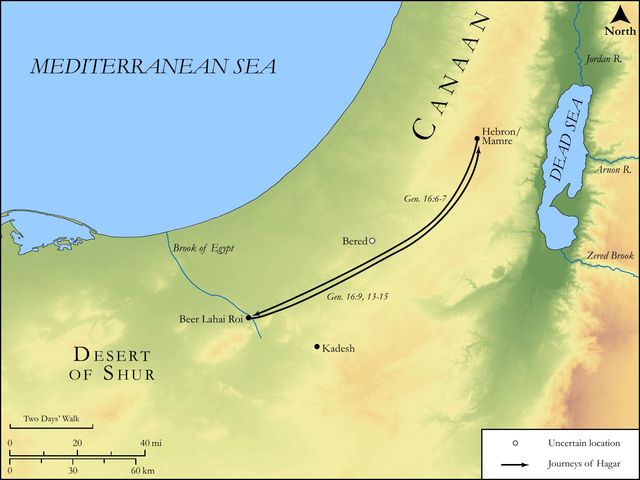
See on the biblical-era maps


Study this verse
Public-domain commentary
Matthew Henry
From his Commentary on the Whole Bible. Henry comments on passages, not single verses — this entry covers Genesis 16:10–14. His four-level outline is real structure in the source text, so it is rendered as structure.
We may suppose that the angel having given Hagar that good counsel (Gen 16:9) to return to her mistress she immediately promised to do so, and was setting her face homeward; and then the angel went on to encourage her with an assurance of the mercy God had in store for her and her seed: for God will meet those with mercy that are returning to their duty. I said, I will confess, and thou forgavest, Psa 32:5. Here is,
I.A prediction concerning her posterity given her for her comfort in her present distress.
Notice is taken of her condition: Behold, thou art with child; and therefore this is not a fit place for thee to be in. Note, It is a great comfort to women with child to think that they are under the particular cognizance and care of the divine Providence. God graciously considers their case and suits supports to it. Now,
1.The angel assures her of a safe delivery, and that of a son, which Abram desired. This fright and ramble of hers might have destroyed her hope of an offspring; but God dealt not with her according to her folly: Thou shalt bear a son. She was saved in child-bearing, not only by providence, but by promise.
2.He names her child, which was an honour both to her and it: Call him Ishmael, God will hear; and the reason is, because the Lord has heard; he has, and therefore he will. Note, The experience we have had of God's seasonable kindness to us in distress would encourage us to hope for similar help in similar exigencies, Psa 10:17. He has heard thy affliction, Gen 16:11. Note, Even where there is little cry of devotion, the God of pity sometimes graciously hears the cry of affliction. Tears speak as well as prayers. This speaks comfort to the afflicted, that God not only sees what their afflictions are, but hears what they say. Note, further, Seasonable succours, in a day of affliction, ought always to be remembered with thankfulness to God. Such a time, in such a strait, the Lord heard the voice of my affliction, and helped me. See Deu 26:7; Psa 31:22.
3.He promises her a numerous offspring, (Gen 16:10): I will multiply thy seed exceedingly, Heb. multiplying, I will multiply it, that is, multiply it in every age, so as to perpetuate it. It is supposed that the Turks at this day descend from Ishmael; and they are a great people. This was in pursuance of the promise made to Abram: I will make thy seed as the dust of the earth, Gen 13:16. Note, Many that are children of godly parents have, for their sakes, a very large share of outward common blessings, though, like Ishmael, they are not taken into covenant: many are multiplied that are not sanctified.
4.He gives a character of the child she should bear, which, however it may seem to us, perhaps was not very disagreeable to her (Gen 16:12): He will be a wild man; a wild ass of a man (so the word is), rude, and bold, and fearing no man - untamed, untractable living at large, and impatient of service and restraint. Note, The children of the bondwoman, who are out of covenant with God, are, as they were born, like the wild ass's colt; it is grace that reclaims men, civilizes them, and makes them wise, and good for something. It is foretold,
(1.)That he should live in strife, and in a state of war: His hand against every man - this is his sin; and every man's hand against him - this is his punishment. Note, Those that have turbulent spirits have commonly troublesome lives; those that are provoking, vexatious, and injurious to others, must expect to be repaid in their own coin. He that has his hand and tongue against every man shall have every man's hand and tongue against him, and he has no reason to complain of it. And yet,
(2.)That he should live in safety, and hold his own against all the world: He shall dwell in the presence of all his brethren; though threatened and insulted by all his neighbours, yet he shall keep his ground, and for Abram's sake, more than his own, shall be able to make his part good with them. Accordingly we read (Gen 25:18), that he died, as he lived, in the presence of all his brethren. Note, Many that are much exposed by their own imprudence are yet strangely preserved by the divine Providence, so much better is God to them than they deserve, when they not only forfeit their lives by sin, but hazard them.
II.Hagar's pious reflection upon this gracious appearance of God to her, Gen 16:13, Gen 16:14. Observe in what she said,
1.Her awful adoration of God's omniscience and providence, with application of it to herself: She called the name of the Lord that spoke unto her, that is, thus she made confession of his name, this she said to his praise, Thou God seest me: this should be, with her, his name for ever, and this his memorial, by which she will know him and remember him while she lives, Thou God seest me. Note,
(1.)The God with whom we have to do is a seeing God, and all-seeing God. God is (as the ancients express it) all eye.
(2.)We ought to acknowledge this with application to ourselves. He that sees all sees me, as David (Psa 139:1), O Lord, thou hast searched me, and known me.
(3.)A believing regard to God, as a God that sees us, will be of great use to us in our returns to him. It is a proper word for a penitent: - [1.] "Thou seest my sin and folly." I have sinned before thee, says the prodigal; in thy sight, says David. [2.] "Thou seest my sorrow and affliction;" this Hagar especially refers to. When we have brought ourselves into distress by our own folly, yet God has not forsaken us. [3.] "Thou seest the sincerity and seriousness of my return and repentance. Thou seest my secret mournings for sin, and secret motions towards thee." [4.] "Thou seest me, if in any instance I depart from thee," Psa 44:20, Psa 44:21. This thought should always restrain us from sin and excite us to duty: Thou God seest me.
2.Her humble admiration of God's favour to her: "Have I here also looked after him that seeth me? Have I here seen the back parts of him that seeth me?" so it might be read, for the word is much the same with that, Exo 33:23. She saw not face to face, but as through a glass darkly, Co1 13:12. Probably she knew not who it was that talked with her, till he was departing (as Jdg 6:21, Jdg 6:22; Jdg 13:21), and then she looked after him, with a reflection like that of the two disciples, Luk 24:31, Luk 24:32. Or, Have I here seen him that sees me? Note,
(1.)The communion which holy souls have with God consists in their having an eye of faith towards him, as a God that has an eye of favour towards them. The intercourse is kept up by the eye.
(2.)The privilege of our communion with God is to be looked upon with wonder and admiration,
[1.]Considering what we are who are admitted to this favour. "Have I? I that am so mean, I that am so vile?" Sa2 7:18.
[2.]Considering the place where we are thus favoured - "here also? Not only in Abram's tent and at his altar, but here also, in this wilderness? Here, where I never expected it, where I was out of the way of my duty? Lord, how is it?" Joh 14:22. Some make the answer to this question to be negative, and so look upon it as a penitent reflection; "Have I here also, in my distress and affliction, looked after God? No, I was a careless and unmindful of him as ever I used to be; and yet he has thus visited and regarded me:" for God often anticipates us with his favours, and is found of those that seek him not, Isa 65:1.
III.The name which this gave to the place:
Beer-lahai-roi, The well of him that liveth and seeth me, Gen 16:14. It is probable that Hagar put this name upon it; and it was retained long after, in perpetuam rei memoriam - a lasting memorial of this event. This was a place where the God of glory manifested the special cognizance and care he took of a poor woman in distress. Note,
1.He that is all-seeing is ever-living; he lives and sees us.
2.Those that are graciously admitted into communion with God, and receive seasonable comforts from him, should tell others what he has done for their souls, that they also may be encouraged to seek him and trust in him.
3.God's gracious manifestations of himself to us are to be had in everlasting remembrance by us, and should never be forgotten.
Historical interpretation
Three Centuries of Reception
3 surviving comments on this verse. Each one is dated, so this reads as a timeline rather than a list.
Select a marker to jump to its quote. Markers stagger vertically where authors wrote within a few decades of each other.
There are a number of differences that distinguish a man who is studious, sophisticated and urbane from a man who is none of these things. We say then of this latter type that by comparison with one who is a city person and a man of science, he is a simpleton, a rustic or “man of the country,” and that by comparison with an educated and cultivated individual, he is uneducated or at least of low education. The fruit engendered by virtue is a style of life conformed to laws. So the person who does not live as a citizen according to the laws of the “city of the living God,” of the heavenly city, is a man of the country. For, since he is not able to live up to the constitution of this city, he lives in the country and not yet in the city. And it is well that the text says not only that he is “of the country” but also that he is “a man,” for a share in the Word of God is not yet given to one who is just beginning. This will not happen until he has made some progress—for those whom Scripture called “godly” are those into whom the Word of God has entered. It is then that he will be a citizen of the heavenly city. Appropriately of such people, in fact, the wise Paul writes these words in the epistle to the Hebrews: “To the mountain of Zion and to the city of the living God, the heavenly Jerusalem.” For it is there that they will be inscribed. The Savior indeed says, “Nevertheless do not rejoice in this, that the spirits are subject to you; but rejoice that your names are written in heaven.” This is certainly not to be taken in the sense that these names composed of syllables are literally written in heaven. But these are names relative to virtue, and as such they have in heaven an inscription that will perpetuate their memory. Such are the people who are inscribed in heaven, but those who are of contrary mind, who are concerned only with earthly things, have not managed to do more than inscribe their names on earthly things. Jeremiah rightly says in their regard: “Those who turn away from thee shall be written in the earth.”
(Verse 12) This will be a rustic man. His hand will be against everyone, and everyone's hand against him, and he will dwell against the face of all his brothers. In Hebrew, Phara () is written for rustic, which means onager. It signifies that his descendants will dwell in the wilderness, that is, the wandering Saracens, in uncertain lands, who attack and are attacked by all the nations to which the desert is adjacent.
He will be a wild man, his hand against everyone, and everyone's hand against him, and he will dwell opposite all his brothers. His offspring will inhabit the desert, that is, the wandering Saracens with uncertain dwellings, who attack all the nations bordering the desert and are attacked by all: but this was in ancient times. Now, however, his hand is against everyone, and everyone's hand is against him to such an extent that they oppress all of Africa in its length, as well as the greater part of Asia and some of Europe, being despised and opposed by all. But when it says: He will pitch his tents; it shows the ancient custom of the people, who always used to dwell in tents, not in houses.
Continue studying Genesis 16:12 across the web’s major study libraries — every link below opens this exact verse, chapter, or book on the destination site.
Read & Compare
 BibleGatewayThis verse in more than 200 translations and 70 languages.
 Bible.comThe YouVersion reader — hundreds of translations, reading plans, and highlights.
 ESV.orgCrossway's official English Standard Version reader.
 NET BibleThe NET translation with 60,000+ translators' notes on every rendering decision.
 STEP BibleTyndale House's free study tool — original text, vocabulary, and scholarly resources.
 BibliaLogos Bible Software's free web reader.
 USCCBThe New American Bible (Revised Edition) with the U.S. bishops' study notes.
Commentaries
 BibleHub CommentariesDozens of classic commentaries on this verse, gathered on one page.
 StudyLightMore than 100 commentary sets — the largest collection on the web.
 BibleRefPlain-English commentary on what this verse means, verse by verse.
 Enduring WordDavid Guzik's free commentary on this chapter, widely used by Bible teachers.
 Bible Study ToolsVerse commentary alongside Greek and Hebrew study aids.
Original Language & Research
- BibleHub InterlinearThe verse word by word — original language, transliteration, and English.
- BibleHub LexiconEvery word's original-language definition and Strong's entry.
 Blue Letter BibleDeep-study tools — Strong's numbers, concordance, and word studies.
 SefariaThe Hebrew text with Rashi and centuries of Jewish commentary.
Sermons, Hymns & Audio


TrulyRandomVerse is not affiliated with these sites and doesn’t control their content. They’re linked because they’re genuinely useful.
Summary
Genesis 16:12 delivers a profound prophetic declaration concerning Ishmael, the unborn son of Abram and Hagar. This divine pronouncement, conveyed by the Angel of the Lord, foretells Ishmael's distinct character as a "wild man," destined for a life marked by independence and conflict, yet paradoxically, he and his descendants will maintain a close, enduring proximity to his Abrahamic kin. This verse underscores God's sovereign knowledge of future events and the intricate, often challenging, relationships that would emerge from the patriarchal narrative.
Context
ShowHideLiterary Context
Genesis 16:12 is the climax of the Angel of the Lord's encounter with Hagar in the wilderness. This encounter follows Hagar's flight from Sarai's harsh treatment after Hagar conceived a child by Abram, a desperate attempt to fulfill God's promise of an heir through human means. The preceding verses detail Hagar's distress and God's compassionate intervention, instructing her to return to Sarai and revealing the name and future of her son, Ishmael, whose name means "God hears" Genesis 16:11. This specific verse, therefore, serves as a pivotal prophetic summary of Ishmael's nature and destiny, setting the stage for the complex relationship between his descendants and the covenant line of Isaac. It is a divine commentary on the consequences of human impatience and God's unwavering, though sometimes surprising, involvement in all human affairs.
Historical & Cultural Context
The prophecy concerning Ishmael reflects and predicts the lifestyle of nomadic peoples, particularly those inhabiting the desert regions. The imagery of a "wild man" or "wild ass" resonates with the independent, often untamed existence of Bedouin tribes, who were known for their self-reliance, mobility, and readiness to defend their territory and way of life against outsiders. Such groups frequently engaged in skirmishes or raids, making the description "his hand against every man, and every man's hand against him" a fitting portrayal of the challenging and often contentious nature of tribal interactions in a resource-scarce environment. The concept of "dwelling in the presence of all his brethren" also aligns with the historical reality of various Abrahamic descendants (Israelites, Edomites, Moabites, Ammonites, and Ishmaelites) inhabiting adjacent or overlapping territories, leading to both kinship and conflict, as seen later in the biblical narrative and extra-biblical history.
Key Themes
ShowHideThis verse contributes significantly to several overarching themes within Genesis and the broader biblical narrative. Firstly, it highlights Divine Sovereignty and Foreknowledge, demonstrating God's complete knowledge of future events and the destinies of individuals and nations, even before their birth. Secondly, it explores the Consequences of Human Action, particularly the complexities arising from Abram and Sarai's decision to act outside of God's perfect timing for the promised heir, leading to the birth of Ishmael and the subsequent long-standing tensions between his lineage and Isaac's. Thirdly, it introduces the theme of Coexistence and Conflict, portraying a future where related peoples, despite their shared ancestry, would live in perpetual contention yet remain geographically proximate. This sets a precedent for understanding the intricate and often fraught relationships between different peoples throughout history, including the descendants of Jacob and Esau, as detailed in Genesis 27. Finally, it subtly reinforces God's Compassion and Provision, as He does not abandon Hagar or her son, but rather acknowledges Ishmael's future and promises to make him a great nation, as seen in Genesis 21:13.
Exposition and Analysis
ShowHideKey Word Analysis
ShowHideMeaning "the onager" or "wild ass." This term powerfully conveys an untamed, free, and independent spirit. It speaks to a nomadic, self-sufficient, and often solitary existence in the wilderness, characteristic of the Bedouin tribes traditionally associated with Ishmael's descendants. It highlights a disposition of freedom and resistance to subjugation, not necessarily a derogatory label but a descriptive one.
Meaning "a human being" (an individual or the species, mankind, etc.). When combined with pere', it forms the phrase "wild man," emphasizing Ishmael's human nature imbued with the characteristics of the wild ass—unbridled, independent, and resistant to control. It grounds the prophecy in a specific individual while extending its implications to his descendants.
Meaning "a hand (the open one (indicating power, means, direction, etc.))." In the phrase "his hand will be against every man," 'hand' signifies power, action, and agency. It denotes a proactive stance of conflict and self-assertion, indicating that Ishmael's life and that of his descendants would be characterized by a strong, perhaps aggressive, disposition and a challenging existence marked by a need to defend one's territory and way of life.
Meaning "the face (as the part that turns); used in a great variety of applications (literally and figuratively); also (with prepositional prefix) as a preposition (before, etc.)." The phrase "in the presence of" (Hebrew: al-pene) implies both geographical proximity and a continued, albeit often contentious, interaction. It suggests that despite conflict, Ishmael's descendants would remain visible and adjacent to their relatives, underscoring a shared lineage and a divinely ordained proximity.
Meaning "to reside or permanently stay (literally or figuratively)." This verb emphasizes the settled, enduring nature of Ishmael's presence among his brethren. Despite his "wild" nature and propensity for conflict, he and his descendants would not be completely isolated but would establish a lasting habitation in close proximity to their relatives, fulfilling the prophecy of their continued interaction.
Meaning "a brother (used in the widest sense of literal relationship and metaphorical affinity or resemblance)." This term highlights the familial connection between Ishmael and the other descendants of Abraham (Isaac, Lot, Esau). Despite the predicted conflict, the underlying bond of kinship remains, making the "hand against every man" aspect even more poignant as it describes conflict within a broader family context.
Verse Breakdown
ShowHide"And he will be a wild man"
This opening clause immediately establishes Ishmael's inherent character. The Hebrew term pere' (wild ass) powerfully conveys an untamed, free, and independent spirit. It signifies a disposition that resists domestication or subjugation, suggesting a nomadic, self-sufficient existence in the wilderness. This is not necessarily a derogatory label but a descriptive prophecy of his independent and resilient nature.
"his hand [will be] against every man, and every man's hand against him"
This is a vivid and stark depiction of a life of conflict and contention. The phrase "hand against" implies active opposition, aggression, and self-defense. It suggests a perpetual state of struggle, where Ishmael and his descendants would be both aggressors and targets, fiercely guarding their freedom and way of life against all who might challenge it. This reflects a challenging existence marked by the need for constant vigilance and defense.
"and he shall dwell in the presence of all his brethren"
Despite the predicted conflict and independence, this final clause reveals a surprising element of coexistence. The phrase "in the presence of" (Hebrew: al-pene) denotes both geographical proximity and a continued, visible interaction. It means Ishmael and his descendants would settle and remain adjacent to their Abrahamic relatives (descendants of Isaac, Lot, and Esau), maintaining a shared, albeit often contentious, space. This aspect finds literal fulfillment later in the biblical narrative, as seen in Genesis 25:18, where Ishmael's descendants are described as settling "in the presence of all his brethren." This coexistence, despite conflict, underscores a shared lineage and a divinely ordained proximity.
Literary Devices
ShowHideGenesis 16:12 employs several potent literary devices to convey its prophetic message. The most prominent is Metaphor, specifically the use of "wild man" (Hebrew: pere') to describe Ishmael. This metaphor of the "wild ass" immediately evokes images of untamed freedom, fierce independence, and resistance to control, vividly portraying Ishmael's character and the future disposition of his descendants. The phrase "his hand against every man, and every man's hand against him" is a powerful example of Antithesis and Chiasmus, creating a balanced yet confrontational structure that emphasizes mutual opposition and perpetual conflict. The repetition of "hand" and the reversal of subject and object ("his hand against every man, and every man's hand against him") highlight the reciprocal nature of this contention. Finally, the entire verse functions as a Prophecy, a divine declaration of future events and character, demonstrating God's Omniscience and control over human destiny, even in circumstances born of human error.
Theological and Thematic Connections
ShowHideGenesis 16:12 is a profound theological statement, revealing God's intricate involvement in human history and His sovereign knowledge of individual and national destinies. It highlights that even when human impatience or error leads to unforeseen consequences, God's plan is not thwarted, but rather incorporates these realities into His overarching design. The prophecy concerning Ishmael underscores that God's compassion extends beyond the direct covenant line, acknowledging and providing for those who are overlooked or seem outside the primary narrative of redemption. It also serves as a foundational text for understanding the complex and often contentious relationships between the nations round about, particularly those with a shared Abrahamic heritage, demonstrating that proximity does not always equate to peace, yet a shared lineage often persists.
Reflection and Application
ShowHideGenesis 16:12 offers profound insights for contemporary reflection, reminding us of God's sovereign knowledge and declaration of the fundamental character traits of individuals and peoples. It provides a divine framework for understanding historical and ongoing dynamics between different groups, particularly those with shared ancestry but divergent paths. Even in situations born of human impatience or distress, God's plan and foreknowledge remain steadfast, demonstrating His sovereignty over all circumstances. The prophecy of Ishmael's contentious yet co-existing relationship with his "brethren" serves as a timeless reminder of complex family and national dynamics, where proximity does not always equate to peace, yet a shared lineage or history often persists. It prompts us to consider how divine truth can illuminate the origins of human conflict and the enduring nature of specific identities and relationships. This verse challenges us to look beyond immediate circumstances and recognize the long-term implications of choices, while also trusting in God's overarching wisdom and control, even when outcomes appear difficult.
Questions for Reflection
ShowHideFAQ
ShowHideWhat does "wild man" mean in this context?
ShowHideThe KJV translation of "wild man" comes from the Hebrew word pere' (H6501), which literally means "wild ass" or "wild donkey." This term conveys a sense of wildness, untamed spirit, and freedom, characteristic of nomadic desert dwellers. It describes an independent, self-sufficient, and perhaps resistant nature, rather than necessarily being a derogatory label. It speaks to a disposition that resists domestication or subjugation.
Does "his hand against every man, and every man's hand against him" imply Ishmael was inherently evil?
ShowHideNot necessarily. This phrase describes a life of conflict, self-reliance, and a challenging existence, suggesting a strong and independent disposition. It points to a perpetual state of contention and a need to defend one's way of life, common for nomadic peoples in harsh environments, rather than an inherent moral evil. It reflects a difficult, combative reality where Ishmael and his descendants would be both aggressive and defensive in their interactions. This is a descriptive prophecy of their way of life, not a moral condemnation.
How did Ishmael's descendants "dwell in the presence of all his brethren"?
ShowHideThis prophecy was literally fulfilled as Ishmael's descendants settled in areas adjacent to the lands occupied by the descendants of Isaac and other Abrahamic relatives. Genesis 25:18 states that they "settled from Havilah to Shur, which is opposite Egypt, as you go toward Assyria," indicating their proximity to the Israelites and other related peoples in the Arabian Peninsula and surrounding regions. Historically, various Arab tribes, often associated with Ishmael's lineage, maintained a presence in the lands surrounding Israel, leading to a complex history of both trade and conflict, thus fulfilling the prophecy of their continuous, albeit often contentious, coexistence.
Christ-Centered Fulfillment
ShowHideWhile Genesis 16:12 directly concerns the lineage of Ishmael, its ultimate fulfillment points to Christ in several profound ways. The prophecy of Ishmael's inherent "wildness" and perpetual conflict with his "brethren" vividly illustrates the deep-seated brokenness and propensity for division within humanity, a condition that only Christ can truly reconcile. Ishmael's life, marked by contention despite shared ancestry, underscores the universal human need for a divine peacemaker. Jesus, the ultimate "Lamb of God" John 1:29, breaks down "the dividing wall of hostility" Ephesians 2:14 through His atoning sacrifice, offering true peace and reconciliation not only between individuals but also between diverse peoples. Furthermore, God's sovereign care for Hagar and Ishmael, even outside the direct covenant line of Isaac, foreshadows the universal scope of God's redemptive plan in Christ, extending salvation to all nations and peoples, Jew and Gentile alike Galatians 3:28. In Christ, the ultimate "wildness" of human rebellion is tamed by grace, and true spiritual brotherhood, transcending earthly conflicts and lineages, is established through faith in Him, uniting all who believe into one family of God Romans 10:12.