


Romans 10:12
Bible text: King James Version (1769 Blayney text) · Public domain
Bible text: King James Version with Strong's numbers · Public domain
Bible text: Berean Standard Bible · Public domain
Bible text: American Standard Version (1901) · Public domain
Bible text: World English Bible, Messianic edition · Public domain
Bible text: Geneva Bible (1599) · Public domain
Bible text: Young's Literal Translation · Public domain
- οὐouNotG3756PRT-NNegative Particle Negative
- γάρgarforG1063CONJConjunction
- ἐστινestinthere isG1510V-PAI-3SVerb Present Active Indicative 3rd Singular
- διαστολὴdiastolēdifferenceG1293N-NSFNoun Nominative Singular Feminine
- ἸουδαίουIoudaiouJewG2453N-GSM-PGNoun Genitive Singular Masculine Person Gentilic
- τεtebetweenG5037CONJConjunction
- καὶkaiandG2532CONJConjunction
- Ἕλληνος·HellēnosGreekG1672N-GSM-LGNoun Genitive Singular Masculine Location Gentilic
- ὁho<the>G3588T-NSMDefinite article Nominative Singular Masculine
- γὰρgarforG1063CONJConjunction
- αὐτὸςautosthe sameG846P-NSMPersonal pronoun Nominative Singular Masculine
- κύριοςkuriosLordG2962N-NSM-TNoun Nominative Singular Masculine Title
- πάντωνpantōnof allG3956A-GPMAdjective Genitive Plural Masculine
- πλουτῶνploutōnis richG4147V-PAP-NSMVerb Present Active Participle Nominative Singular Masculine
- εἰςeistowardG1519PREPPreposition
- πάνταςpantasallG3956A-APMAdjective Accusative Plural Masculine
- τοὺςtousthoseG3588T-APMDefinite article Accusative Plural Masculine
- ἐπικαλουμένουςepikaloumenouscallingG1941V-PMP-APMVerb Present Middle Participle Accusative Plural Masculine
- αὐτόνautonHimG846P-ASMPersonal pronoun Accusative Singular Masculine
English is a literal word-by-word gloss of the Greek, not the KJV's wording. Why?
This is the original text the KJV's translators worked from — each Greek word with its own literal English meaning in this verse, prepared by scholars at Tyndale House, Cambridge. The KJV translates whole sentences, not word by word, so its wording differs: one Greek word can become several English words, and the KJV may choose “charity” where the gloss reads “love”. Both are faithful — they answer different questions. For the KJV's own rendering, switch to the KJV text.
Details
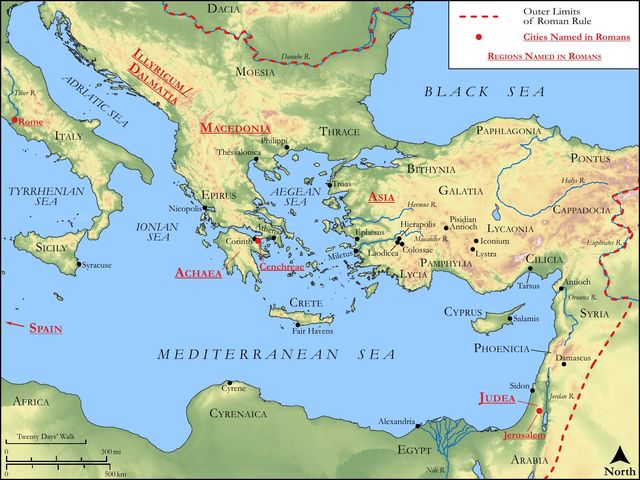
See on the biblical-era maps

Study this verse
Public-domain commentary
Matthew Henry
From his Commentary on the Whole Bible. Henry comments on passages, not single verses — this entry covers Romans 10:12–21. His four-level outline is real structure in the source text, so it is rendered as structure.
The first words express the design of the apostle through these verses, that there is no difference between Jews and Gentiles, but they stand upon the same level in point of acceptance with God. In Jesus Christ there is neither Greek nor Jews, Col 3:11. God doth not save any nor reject any because they are Jews, nor because they are Greeks, but doth equally accept both upon gospel terms: There is no difference. For the proof of this he urges two arguments: -
I.That God is the same to all:
The same Lord over all is rich unto all. There is not one God to the Jews who is more kind, and another to the Gentiles who is less kind; but he is the same to all, a common father to all mankind. When he proclaimed his name, The Lord, the Lord god, gracious and merciful, he thereby signified not only what he was to the Jews, but what he is and will be to all his creatures that seek unto him: not only good, but rich, plenteous in goodness: he hath wherewith to supply them all, and he is free and ready to give out to them; he is both able and willing: not only rich, but rich unto us, liberal and bountiful in dispensing his favours to all that call upon him. Something must be done by us, that we may reap of this bounty; and it is as little as can be, we must call upon him. He will for this be enquired of (Eze 36:37), and surely that which is not worth the asking is not worth the having. We have nothing to do but to draw out by prayer, as there is occasion.
II.That the promise is the same to all (Rom 10:13):
Whoever shall call - one as well as another, without exception. This extent, this undifferencing extent, of the promise both to Jews and Gentiles he thinks should not be surprising, for it was foretold by the prophet, Joe 2:32. Calling upon the name of the Lord is here put for all practical religion. What is the life of a Christian but a life of prayer? It implies a sense of our dependence on him, an entire dedication of ourselves to him, and a believing expectation of our all from him. He that thus calls upon him shall be saved. It is but ask and have; what would we have more? for the further illustration of this he observes,
1.How necessary it was that the gospel should be preached to the Gentiles, Rom 10:14, Rom 10:15. This was what the Jews were so angry with Paul for, that he was the apostle of the Gentiles, and preached the gospel to them. Now he shows how needful it was to bring them within the reach of the forementioned promise, an interest in which they should not envy to any of their fellow-creatures.
(1.)They cannot call on him in whom they have not believed. Except they believe that he is God, they will not call upon him by prayer; to what purpose should they? The grace of faith is absolutely necessary to the duty of prayer; we cannot pray aright, nor pray to acceptation, without it. He that comes to God by prayer must believe, Heb 11:6. Till they believed the true God, they were calling upon idols, O Baal, hear us.
(2.)They cannot believe in him of whom they have not heard. some way or other the divine revelation must be made known to us, before we can receive it and assent to it; it is not born with us. In hearing is included reading, which is tantamount, and by which many are brought to believe (Joh 20:31): These things are written that you may believe. But hearing only is mentioned, as the more ordinary and natural way of receiving information.
(3.)They cannot hear without a preacher; how should they? Somebody must tell them what they are to believe. Preachers and hearers are correlates; it is a blessed thing when they mutually rejoice in each other - the hearers in the skill and faithfulness of the preacher, and the preacher in the willingness and obedience of the hearers.
(4.)They cannot preach except they be sent, except they be both commissioned and in some measure qualified for their preaching work. How shall a man act as an ambassador, unless he have both his credentials and his instructions from the prince that sends him? This proves that to the regular ministry there must be a regular mission and ordination. It is God's prerogative to send ministers; he is the Lord of the harvest, and therefore to him we must pray that he would send forth labourers, Mat 9:38. He only can qualify men for, and incline them to, the work of the ministry. But the competency of that qualification, and the sincerity of that inclination, must not be left to the judgment of every man for himself: the nature of the thing will by no means admit this; but, for the preservation of due order in the church, this must needs be referred and submitted to the judgment of a competent number of those who are themselves in that office and of approved wisdom and experience in it, who, as in all other callings, are presumed the most able judges, and who are empowered to set apart such as they find so qualified and inclined to this work of the ministry, that by this preservation of the succession the name of Christ may endure for ever and his throne as the days of heaven. And those that are thus set apart, not only may, but must preach, as those that are sent.
2.How welcome the gospel ought to be to those to whom it was preached, because it showed the way to salvation, Rom 10:15. For this he quotes Isa 52:7. The like passage we have, Nah 1:15, which, if it point at the glad tidings of the deliverance of Israel out of Babylon in the type, yet looks further to the gospel, the good news of our salvation by Jesus Christ. Observe,
(1.)What the gospel is: It is the gospel of peace; it is the word of reconciliation between God and man. On earth peace, Luk 2:14. Or, peace is put in general for all good; so it is explained here; it is glad tidings of good things. The things of the gospel are good things indeed, the best things; tidings concerning them are the most joyful tidings, the best news that ever came from heaven to earth.
(2.)What the work of ministers is: To preach this gospel, to bring these glad tidings; to evangelize peace (so the original is), to evangelize good things. Every good preacher is in this sense an evangelist: he is not only a messenger to carry the news, but an ambassador to treat; and the first gospel preachers were angels, Luk 2:13, etc.
(3.)How acceptable they should therefore be to the children of men for their work's sake: How beautiful are the feet, that is, how welcome are they! Mary Magdalene expressed her love to Christ by kissing his feet, and afterwards by holding him by the feet, Mat 28:9. And, when Christ was sending forth his disciples, he washed their feet. Those that preach the gospel of peace should see to it that their feet (their life and conversation) be beautiful: the holiness of ministers' lives is the beauty of their feet. How beautiful! namely, in the eyes of those that hear them. Those that welcome the message cannot but love the messengers. See Th1 5:12, Th1 5:13.
3.He answers an objection against all this, which might be taken from the little success which the gospel had in many places (Rom 10:16): But they have not all obeyed the gospel. All the Jews have not, all the Gentiles have not; far the greater part of both remain in unbelief and disobedience. Observe, The gospel is given us not only to be known and believed, but to be obeyed. It is not a system of notions, but a rule of practice. This little success of the word was likewise foretold by the prophet (Isa 53:1): Who hath believed our report? Very few have, few to what one would think should have believed it, considering how faithful a report it is and how well worthy of all acceptation, - very few to the many that persist in unbelief. It is no strange thing, but it is a very sad and uncomfortable thing, for the ministers of Christ to bring the report of the gospel, and not to be believed in it. Under such a melancholy consideration it is good for us to go to God and make our complaint to him. Lord, who hath believed, etc. In answer to this,
(1.)He shows that the word preached is the ordinary means of working faith (Rom 10:17): So then, ara - however; though many that hear do not believe, yet those that believe have first heard. Faith cometh by hearing. It is the summary of what he had said before, Rom 10:14. The beginning, progress, and strength of faith, are by hearing. The word of God is therefore called the word of faith: it begets and nourishes faith. God gives faith, but it is by the word as the instrument. Hearing (that hearing which works faith) is by the word of God. It is not hearing the enticing words of man's wisdom, but hearing the word of God, that will befriend faith, and hearing it as the word of God. See Th1 2:13.
(2.)That those who would not believe the report of the gospel, yet, having heard it, were thereby left inexcusable, and may thank themselves for their own ruin, Rom 10:18, to the end.
[1.]The Gentiles have heard it (Rom 10:18): Have they not heard? Yes, more or less, they have either heard the gospel, or at least heard of it. Their sound went into all the earth; not only a confused sound, but their words (more distinct and intelligible notices of these things) are gone unto the ends of the world. The commission which the apostles received runs thus: Go you into all the world - preach to every creature - disciple all nations; and they did with indefatigable industry and wonderful success pursue that commission. See the extent of Paul's province, Rom 15:19. To this remote island of Britain, one of the utmost corners of the world, not only the sound, but the words, of the gospel came within a few years after Christ's ascension. It was in order to this that the gift of tongues was at the very first poured so plentifully upon the apostles, Acts 2. In the expression here he plainly alludes to Psa 19:4, which speaks of the notices which the visible works of God in the creation give to all the world of the power and Godhead of the Creator. As under the Old Testament God provided for the publishing of the work of creation by the sun, moon, and stars, so now for the publishing of the work of redemption to all the world by the preaching of gospel ministers, who are therefore called stars.
[2.]The Jews have heard it too, Rom 10:19-21. For this he appeals to two passages of the Old Testament, to show how inexcusable they are too. Did not Israel know that the Gentiles were to be called in? They might have known it from Moses and Isaiah.
First, One is taken from Deu 32:21, I will provoke you to jealousy. The Jews not only had the offer, but saw the Gentiles accepting it and benefitted by that acceptance, witness their vexation at the event. They had the refusal: To you first, Act 3:26. In all places where the apostles came still the Jews had the first offer, and the Gentiles had but their leavings. If one would not, another would. Now this provoked them to jealousy. They, as the elder brother in the parable (Lu. 15) envied the reception and entertainment of the prodigal Gentiles upon their repentance. The Gentiles are here called no people, and a foolish nation, that is, not the professing people of God. How much soever there be of the wit and wisdom of the world, those that are not the people of God are, and in the end will be found to be, a foolish people. Such was the state of the Gentile world, who yet were made the people of God, and Christ to them the wisdom of God. What a provocation it was to the Jews to see the Gentiles taken into favour we may see, Act 13:45; Act 17:5, Act 17:13, and especially Act 22:22. It was an instance of the great wickedness of the Jews that they were thus enraged; and this in Deuteronomy is the matter of a threatening. God often makes people's sin their punishment. A man needs no greater plague than to be left to the impetuous rage of his own lusts.
Secondly, Another is taken from Isa 65:1, Isa 65:2, which is very full, and in it Esaias is very bold - bold indeed, to speak so plainly of the rejection of his own countrymen. Those that will be found faithful have need to be very bold. Those that are resolved to please God must not be afraid to displease any man. Now Esaias speaks boldly and plainly,
a.Of the preventing grace and favour of God in the reception and entertainment of the Gentiles (Rom 10:20): I was found of those that sought me not. The prescribed method is, Seek and find; this is a rule for us, not a rule for God, who is often found of those that do not seek. His grace is his own, distinguishing grace his own, and he dispenses it in a way of sovereignty, gives of withholds it at pleasure - anticipates us with the blessings, the riches choicest blessings, of his goodness. Thus he manifested himself to the Gentiles, by sending the light of the gospel among them, when they were so far from seeking him and asking after him that they were following after lying vanities, and serving dumb idols. Was not this our own particular case? Did not God begin in love, and manifest himself to us when we did not ask after him? And was not that a time of love indeed, to be often remembered with a great deal of thankfulness?
b.Of the obstinacy and perverseness of Israel, notwithstanding the fair offers and affectionate invitations they had, Rom 10:21. Observe,
(a.)God's great goodness to them: All day long I have stretched forth my hands. [a.] His offers: I have stretched forth my hands, offering them life and salvation with the greatest sincerity and seriousness that can be, with all possible expressions of earnestness and importunity, showing them the happiness tendered, setting it before them with the greatest evidence, reasoning the case with them. Stretching forth the hands is the gesture of those that require audience (Act 26:1), or desire acceptance, Pro 1:24. Christ was crucified with his hands stretched out. Stretched forth my hands as offering reconciliation - come let us shake hands and be friends; and our duty is to give the hand to him, Ch2 30:8. [b.] His patience in making these offers: All day long. The patience of God towards provoking sinners is admirable. He waits to be gracious. The time of God's patience is here called a day, lightsome as a day and fit for work and business, but limited as a day, and a night at the end of it. he bears long, but he will not bear always.
(b.)Their great badness to him. They were a disobedient gainsaying people. One word in the Hebrew, in Isaiah, is here well explained by two; not only disobedient to the call, not yielding to it, but gainsaying, and quarrelling with it, which is much worse. Many that will not accept of a good proposal will yet acknowledge that they have nothing to say against it: but the Jews who believed not rested not there, but contradicted and blasphemed. God's patience with them was a very great aggravation of their disobedience, and rendered it the more exceedingly sinful; as their disobedience advanced the honour of God's patience and rendered it the more exceedingly gracious. It is a wonder of mercy in God that his goodness is not overcome by man's badness; and it is a wonder of wickedness in man that his badness is not overcome by God's goodness.
Historical interpretation
Historical reception
4 surviving comments on this verse. Each one is dated, so this reads as a timeline rather than a list.
Select a marker to jump to its quote. Markers stagger vertically where authors wrote within a few decades of each other.
Paul says that in general everyone is lumped together because of unbelief or else exalted together because of their belief, because apart from Christ there is no salvation in God’s presence, only punishment or death. For neither the privileges of their ancestors nor the law can do the Jews any good if they do not accept the merit and promise made to them. Neither do the Gentiles have anything to boast about in the flesh, if they do not believe in Christ.…Paul says that God bestows his riches not on those who believe but on those who call upon him, so that after believing the mind will not cease to ask God for what it has been taught to ask the Lord for.
Christ finds his wealth in the salvation of our souls.
"For the Scripture saith," he proceeds, "Whosoever believeth on Him, shall not be ashamed. For there is no difference between the Jew and the Greek; for the same Lord over all is rich unto all that call upon Him. For whosoever shall call upon the Name of the Lord shall be saved."
You see how he produces witnesses, whether to the faith, or to the confession of it. For the words, "Every one that believeth," point out the faith. But the words, "Whosoever shall call upon," set forth confession. Then again to proclaim the universality of the grace, and to lay their boasting low, what he had before demonstrated at length, he here briefly recalls to their memory, showing again that there is no difference between the Jew and the uncircumcised. "For there is," he says, "no difference between the Jew and the Greek." And what he had said about the Father, when he was arguing this point, that he says here about the Son. For as before he said in asserting this, "Is He the God of the Jews only? Is He not of the Gentiles also? Yes, of the Gentiles also: seeing it is one God":-So he says here also, "For the same Lord over all is rich unto all (and upon all)." You see how he sets Him forth as exceedingly desiring our salvation, since He even reckons this to be riches to Himself; so that they are not even now to despair, or fancy that, provided they would repent, they were unpardonable. For He who considereth it as riches to Himself to save us, will not cease to be rich. Since even this is riches, the fact of the gift being shed forth unto all.
There is one Lord of all, who abounds in mercy and possesses salvation, with which he is generous to all.
Continue studying Romans 10:12 across the web’s major study libraries — every link below opens this exact verse, chapter, or book on the destination site.
Read & Compare
 BibleGatewayThis verse in more than 200 translations and 70 languages.
 Bible.comThe YouVersion reader — hundreds of translations, reading plans, and highlights.
 ESV.orgCrossway's official English Standard Version reader.
 NET BibleThe NET translation with 60,000+ translators' notes on every rendering decision.
 STEP BibleTyndale House's free study tool — original text, vocabulary, and scholarly resources.
 BibliaLogos Bible Software's free web reader.
 USCCBThe New American Bible (Revised Edition) with the U.S. bishops' study notes.
Commentaries
 BibleHub CommentariesDozens of classic commentaries on this verse, gathered on one page.
 StudyLightMore than 100 commentary sets — the largest collection on the web.
 BibleRefPlain-English commentary on what this verse means, verse by verse.
 Enduring WordDavid Guzik's free commentary on this chapter, widely used by Bible teachers.
 Bible Study ToolsVerse commentary alongside Greek and Hebrew study aids.
Original Language & Research
- BibleHub InterlinearThe verse word by word — original language, transliteration, and English.
- BibleHub LexiconEvery word's original-language definition and Strong's entry.
 Blue Letter BibleDeep-study tools — Strong's numbers, concordance, and word studies.
 CNTR CollationThe earliest Greek manuscripts of this verse, collated letter by letter.
Sermons, Hymns & Audio


TrulyRandomVerse is not affiliated with these sites and doesn’t control their content. They’re linked because they’re genuinely useful.
Summary
Romans 10:12 powerfully articulates the universal accessibility of salvation through faith in Jesus Christ, dismantling all ethnic and social distinctions. Paul declares that there is no preferential treatment between Jew and Greek in God's eyes, because the same sovereign Lord extends His boundless grace and provision to all who sincerely call upon Him for salvation, demonstrating His impartial love and abundant generosity to humanity.
Context
ShowHideLiterary Context
Romans 10:12 is situated within Paul's profound discourse in Romans 9-11, where he grapples with the theological tension between God's faithfulness to Israel and the inclusion of Gentiles in His redemptive plan. Chapters 9 and 10 contrast Israel's pursuit of righteousness through adherence to the Law with the righteousness that comes through faith in Christ, which is now available to all. Paul expresses deep sorrow over Israel's spiritual blindness and their failure to embrace Christ as the culmination of the Law for righteousness (Romans 9:30-32). He then emphasizes that Christ is indeed the "end of the law for righteousness to everyone who believes" (Romans 10:4). Verse 12 serves as a crucial theological bridge, explicitly stating the removal of ethnic barriers to salvation, flowing directly from the preceding verses that establish faith as the sole means of righteousness, regardless of one's background.
Historical & Cultural Context
In the first century Roman world, the distinction between Jew and Gentile (represented by "Greek") was profound, deeply rooted in religious, cultural, and historical identity. Jews saw themselves as God's chosen people, set apart by the Law, circumcision, and covenant. Gentiles, particularly Greeks, represented the broader pagan world. This verse directly confronts this deeply entrenched divide, which was a significant point of contention and misunderstanding within the early Christian communities, especially in a diverse city like Rome. Paul's declaration of "no difference" was revolutionary, challenging centuries of social and religious stratification and asserting a radical equality within the new community of believers in Christ. It underscored the fact that God's redemptive work was not confined to one ethnic group but was breaking down the very barriers that had defined human societies.
Key Themes
ShowHideThis verse contributes significantly to several overarching themes in Romans and Paul's theology. Foremost is the Universality of Salvation, asserting that God's saving grace is not exclusive to any single nation or people group but is freely offered to all humanity. This theme is foundational to the gospel message and is powerfully echoed in passages like Galatians 3:28 and Colossians 3:11. Another key theme is God's Impartiality or lack of favoritism, demonstrated by His equal treatment of all who seek Him, regardless of their background. This aligns with Peter's realization in Acts 10:34-35. The verse also highlights the Sovereignty and Sufficiency of Christ's Lordship, as "the same Lord over all" is the source of this universal provision. Finally, it reinforces the theme of Salvation by Faith, emphasizing that the condition for receiving God's riches is to "call upon him," a simple yet profound act of trust and reliance on God, further elaborated in Romans 10:13.
Exposition and Analysis
ShowHideKey Word Analysis
ShowHideMeaning a "variation," "distinction," or "separation." Paul's emphatic declaration that there is "no difference" (οὐ διαστολή, ou diastolḗ) underscores the absolute removal of any basis for discrimination or preferential treatment in God's plan of salvation based on ethnic or cultural identity. It signifies that the previous covenantal distinctions between Jew and Gentile, which defined their relationship to God, are now rendered irrelevant for access to salvation in Christ.
Meaning "supreme in authority," "controller," or "Master." This term, when applied to Jesus, signifies His divine authority and sovereignty. The phrase "the same Lord over all" asserts Christ's universal dominion, not just over Israel but over all humanity. It implies His singular authority as the one and only means of salvation, and that His Lordship transcends all human divisions.
Meaning "to be (or become) wealthy" (literally or figuratively). When applied to God, as here, it speaks of His boundless generosity, immense resources, and overflowing grace. God's "riches" are not merely material, but encompass spiritual blessings, forgiveness, righteousness, eternal life, and every good gift provided through Christ. The present tense "is rich" emphasizes God's continuous and inexhaustible supply.
Verse Breakdown
ShowHide"For there is no difference between the Jew and the Greek:"
This opening clause serves as a powerful declaration of equality in God's redemptive economy. "Jew" represents those who were historically God's chosen people, recipients of the Law and the covenants. "Greek" functions as a synecdoche for all Gentiles, representing the broader non-Jewish world. Paul asserts that in the matter of salvation, God makes no distinction based on ethnic origin, religious heritage, or cultural background. The access to God's grace is equally available to both groups, dismantling centuries of division and privilege.
"for the same Lord over all"
This phrase provides the theological basis for the preceding statement of equality. The "same Lord" refers to Jesus Christ, whose authority and dominion extend universally, "over all" people, regardless of their nationality or status. His singular Lordship means there is one standard, one mediator, and one source of salvation for everyone. This reinforces the idea that God's impartiality stems from the singular nature of His divine authority and redemptive plan.
"is rich unto all that call upon him."
This final clause specifies the boundless nature of God's provision and the simple condition for receiving it. The Lord's "riches" denote His abundant grace, mercy, forgiveness, and every spiritual blessing. This immeasurable generosity is extended "unto all" people, reinforcing the universality. The crucial condition is "that call upon him," signifying an act of faith, repentance, and humble reliance on God for salvation. This "calling" is not merely an utterance but an expression of genuine trust and dependence, making salvation accessible to anyone who sincerely seeks it.
Literary Devices
ShowHideRomans 10:12 employs several potent literary devices to convey its transformative message. Antithesis is central, starkly contrasting "Jew" and "Greek" to highlight the radical equality established in Christ. This opposition underscores the revolutionary nature of God's universal grace, breaking down deeply ingrained social and religious barriers. The phrase "no difference" uses emphatic negation to leave no room for misunderstanding or lingering prejudice regarding God's impartial love. Furthermore, the description of the Lord as "rich unto all" utilizes hyperbole and metaphor to convey the immeasurable and overflowing nature of God's grace and provision. This imagery evokes a sense of divine abundance, emphasizing that God's resources for salvation are limitless and freely given to all who seek Him, far surpassing any human expectation or merit.
Theological and Thematic Connections
ShowHideThis verse is a cornerstone of Pauline theology, articulating the profound truth of God's impartial love and the universal scope of His salvific plan. It underscores that the new covenant in Christ transcends the ethnic and legal distinctions of the old covenant, establishing a new humanity united in Him. The emphasis on "calling upon" the Lord highlights the personal nature of faith and the direct access afforded to every individual, regardless of their background, through Christ's atoning work. This truth dismantles any notion of national or racial superiority in the eyes of God, asserting that the ground at the foot of the cross is level for all. It speaks to the very heart of the gospel: God's grace is freely given, and salvation is by faith alone, for all who believe.
Reflection and Application
ShowHideRomans 10:12 is a liberating and unifying truth that calls believers to profound reflection and practical application. It shatters any lingering prejudices or elitism, reminding us that God's love and offer of salvation extend to every single person on earth, irrespective of their ethnicity, social standing, or past. This truth should ignite a passionate desire within us to share the gospel indiscriminately, knowing that the "riches" of God's grace are available to "all that call upon him." It also serves as a powerful call to unity within the body of Christ, urging us to embrace and celebrate the diversity of backgrounds, cultures, and experiences among fellow believers, recognizing that we are all equally valued and loved by the same Lord. Our shared identity in Christ transcends all earthly distinctions, fostering a community where love, acceptance, and mutual respect prevail.
Questions for Reflection
ShowHideFAQ
ShowHideWhy does Paul specifically mention "Jew and Greek" as the primary distinction being overcome?
ShowHidePaul's specific mention of "Jew and Greek" (G1672 Héllēn) is highly significant because this represented the most fundamental and deeply entrenched divide in the first-century world, particularly in the context of salvation history. Jews were God's chosen people, set apart by the Law and covenant, while "Greek" was a common term used to encompass the broader Gentile world, representing all non-Jews. For centuries, the Jewish people had a unique relationship with God, and the idea that Gentiles could be equally included in salvation without first becoming proselytes to Judaism was a revolutionary concept. Paul's declaration in Romans 10:12 directly addresses this historical and theological barrier, emphasizing that in Christ, God's saving grace is extended impartially to all humanity, transcending these former distinctions. This was a core tenet of the gospel Paul preached, as seen throughout his letters, particularly in Ephesians 2:11-22.
Christ-Centered Fulfillment
ShowHideRomans 10:12 finds its ultimate and profound fulfillment in Jesus Christ. He is the "same Lord over all" who, through His life, death, and resurrection, broke down the dividing wall of hostility between Jew and Gentile, creating one new humanity in Himself (Ephesians 2:14-16). Before Christ, the Law created a distinction; now, Christ is the "end of the law for righteousness to everyone who believes" (Romans 10:4). His sacrifice on the cross was not for one nation but for the sins of the whole world (1 John 2:2). Therefore, the "riches" God bestows upon "all that call upon him" are the immeasurable spiritual blessings secured by Christ's finished work: righteousness, forgiveness, adoption, and eternal life. In Him, there is truly "no difference," for Christ is "all, and in all" (Colossians 3:11), making the way to God accessible to anyone, anywhere, who believes in His name and calls upon Him as Lord (John 14:6).