


Job 11:12
Bible text: King James Version (1769 Blayney text) · Public domain
Bible text: Berean Standard Bible · Public domain
Bible text: American Standard Version (1901) · Public domain
Bible text: World English Bible, Messianic edition · Public domain
Bible text: Geneva Bible (1599) · Public domain
Bible text: Young's Literal Translation · Public domain
- וְאִישׁve·'Ishand a personH376Conj-w ¦ N-msNoun Singular Masculine Absoluteוְandאִישׁa person
- נָבוּבNa·vuvhollowH5014V-Qal-PassPrtcpl-msVerb Qal Participle Passive Singular Masculine Absolute
- יִלָּבֵבyi·la·Vevhe will become intelligentH3823V-Niphal-Imperf-3msVerb Niphal Imperfect 3rd Singular Masculine
- וְעַיִרve·'A·yirand a male donkey ofH5895Conj-w ¦ N-mscNoun Singular Masculine Constructוְandעַיִרa male donkey of
- פֶּרֶאPe·re'a wild donkeyH6501N-msNoun Singular Masculine Absolute
- אָדָם'a·Dama human beingH120N-msNoun Singular Masculine Absolute
- יִוָּלֵדyi·va·Ledit will be bornH3205V-Niphal-Imperf-3msVerb Niphal Imperfect 3rd Singular Masculine
English is a literal word-by-word gloss of the Hebrew, not the KJV's wording. Why?
This is the original text the KJV's translators worked from — each Hebrew word with its own literal English meaning in this verse, prepared by scholars at Tyndale House, Cambridge. The KJV translates whole sentences, not word by word, so its wording differs: one Hebrew word can become several English words, and the KJV may choose “the LORD” where the gloss reads “Yahweh”. Both are faithful — they answer different questions. For the KJV's own rendering, switch to the KJV text.
Details
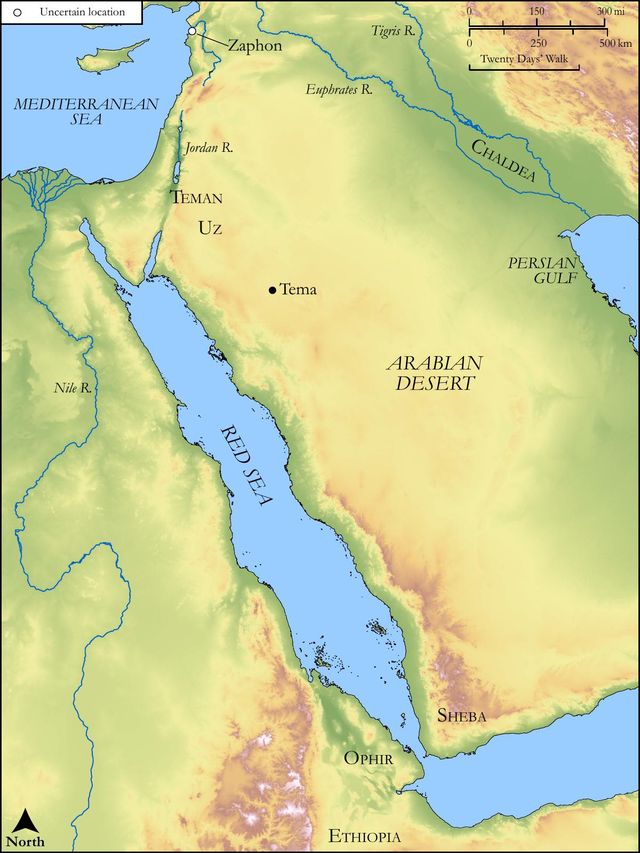
See on the biblical-era map
Study this verse
Public-domain commentary
Matthew Henry
From his Commentary on the Whole Bible. Henry comments on passages, not single verses — this entry covers Job 11:7–12. His three-level outline is real structure in the source text, so it is rendered as structure.
Zophar here speaks very good things concerning God and his greatness and glory, concerning man and his vanity and folly: these two compared together, and duly considered, will have a powerful influence upon our submission to all the dispensations of the divine Providence.
I.See here what God is, and let him be adored.
1.He is an incomprehensible Being, infinite and immense, whose nature and perfections our finite understandings cannot possibly form any adequate conceptions of, and whose counsels and actings we cannot therefore, without the greatest presumption, pass a judgment upon. We that are so little acquainted with the divine nature are incompetent judges of the divine providence; and, when we censure the dispensations of it, we talk of things that we do not understand. We cannot find out God; how dare we then find fault with him? Zophar here shows,
(1.)That God's nature infinitely exceeds the capacities of our understandings: "Canst thou find out God, find him out to perfection? No, What canst thou do? What canst thou know?" Job 11:7, Job 11:8. Thou, a poor, weak, short-sighted creature, a worm of the earth, that art but of yesterday? Thou, though ever so inquisitive after him, ever so desirous and industrious to find him out, yet darest thou attempt the search, or canst thou hope to speed in it? We may, by searching find God (Act 17:27), but we cannot find him out in any thing he is pleased to conceal; we may apprehend him, but we cannot comprehend him; we may know that he is, but cannot know what he is. The eye can see the ocean but not see over it. We may, by a humble, diligent, and believing search, find out something of God, but cannot find him out to perfection; we may know, but cannot know fully, what God is, nor find out his work from the beginning to the end, Ecc 3:11. Note, God is unsearchable. The ages of his eternity cannot be numbered, nor the spaces of his immensity measured; the depths of his wisdom cannot be fathomed, nor the reaches of his power bounded; the brightness of his glory can never be described, nor the treasures of his goodness reckoned up. This is a good reason why we should always speak of God with humility and caution and never prescribe to him nor quarrel with him, why we should be thankful for what he has revealed of himself and long to be where we shall see him as he is, Co1 13:9, Co1 13:10.
(2.)That it infinitely exceeds the limits of the whole creation: It is higher than heaven (so some read it), deeper than hell, the great abyss, longer than the earth, and broader than the sea, many parts of which are to this day undiscovered, and more were then. It is quite out of our reach to comprehend God's nature. Such knowledge is too wonderful for us, Psa 139:6. We cannot fathom God's designs, nor find out the reasons of his proceedings. His judgments are a great deep. Paul attributes such immeasurable dimensions to the divine love as Zophar here attributes to the divine wisdom, and yet recommends it to our acquaintance. Eph 3:18, Eph 3:19, That you may know the breadth, and length, and depth, and height, of the love of Christ.
2.God is a sovereign Lord (Job 11:10): If he cut off by death (margin, If he make a change, for death is a change; if he make a change in nations, in families, in the posture of our affairs), - if he shut up in prison, or in the net of affliction (Psa 66:11), - if he seize any creature as a hunter his prey, he will gather it (so bishop Patrick) and who shall force him to restore? or if he gather together, as tares for the fire, or if he gather to himself man's spirit and breath (Job 34:14), then who can hinder him? Who can either arrest the sentence or oppose the execution? Who can control his power or arraign his wisdom and justice? If he that made all out of nothing think fit to reduce all to nothing, or to their first chaos again, - if he that separated between light and darkness, dry land and sea, at first, please to gather them together again, - if he that made unmakes, who can turn him away, alter his mind or stay his hand, impede or impeach his proceedings?
3.God is a strict and just observer of the children of men (Job 11:11): He knows vain men. We know little of him, but he knows us perfectly: He sees wickedness also, not to approve it (Hab 1:13), but to animadvert upon it.
(1.)He observes vain men. Such all are (every man, at his best estate, is altogether vanity), and he considers it in his dealings with them. He knows what the projects and hopes of vain men are, and can blast and defeat them, the workings of their foolish fancies; he sits in heaven, and laughs at them. He takes knowledge of the vanity of men (that is, their little sins; so some) their vain thoughts and vain words, and unsteadiness in that which is good.
(2.)He observes bad men: He sees gross wickedness also, though committed ever so secretly and ever so artfully palliated and disguised. All the wickedness of the wicked is naked and open before the all-seeing eye of God: Will he not then consider it? Yes, certainly he will, and will reckon for it, though for a time he seem to keep silence.
II.See here what man is, and let him be humbled, Job 11:12.
God sees this concerning vain man that he would be wise, would be thought so, though he is born like a wild ass's colt, so sottish and foolish, unteachable and untameable. See what man is.
1.He is a vain creature - empty; so the word is. God made him full, but he emptied himself, impoverished himself, and now he is raca, a creature that has nothing in him.
2.He is a foolish creature, has become like the beasts that perish (Psa 49:20, Psa 73:22), an idiot, born like an ass, the most stupid animal, an ass's colt, not yet brought to any service. If ever he come to be good for any thing, it is owing to the grace of Christ, who once, in the day of his triumph, served himself by an ass's colt.
3.He is a wilful ungovernable creature. An ass's colt may be made good for something, but the wild ass's colt will never be reclaimed, nor regards the crying of the driver. See Job 39:5-7. Man thinks himself as much at liberty, and his own master, as the wild ass's colt does, that is used to the wilderness (Jer 2:24), eager to gratify his own appetites and passions.
4.Yet he is a proud creature and self-conceited. He would be wise, would he thought so, values himself upon the honour of wisdom, though he will not submit to the laws of wisdom. He would be wise, that is, he reaches after forbidden wisdom, and, like his first parents, aiming to be wise above what is written, loses the tree of life for the tree of knowledge. Now is such a creature as this fit to contend with God or call him to an account? Did we but better know God and ourselves, we should better know how to conduct ourselves towards God.
Historical interpretation
Two Centuries of Reception
2 surviving comments on this verse. Each one is dated, so this reads as a timeline rather than a list.
Select a marker to jump to its quote. Markers stagger vertically where authors wrote within a few decades of each other.
Zophar is right in saying, “Like an ass of the desert.” The ass does not stop braying. There is no difference, he says, between our words and those incomprehensible sounds that an ass produces at random and foolishly. We criticize everything, with regard to everything, and we put the blame on everything. Again they exhort Job to take care of his life. But that is useless. That is why Job had said, “If I am righteous, I cannot lift up my head.” What is the use of that? Job says, I am righteous, but in his judgment, I am impure.
22. For it is the end of vanity, whereas it mangles the heart by sin, to render it bold by the offence, so that, forgetful of its guiltiness, the soul which feels no sorrow to have lost its innocency, blinded by a righteous retribution, should at the same time part with humility also; and it very often happens, that, enslaving itself to unlawful desires, it rids itself of the yoke of the fear of the Lord; and as if henceforth at liberty for the commission of wickedness, it strives to put in execution all that self-indulgence prompts. Hence when the vain man is said to be exalted in pride, therefore it is brought in,
And thinketh himself free born like a wild ass’s colt.
23. For by ‘a wild ass’s colt’ is set forth every kind of wild animals, which being left free to the motions of nature, are not held by the reins of persons ruling them. For the fields leave animals in a state of liberty both to roam where they list, and to rest when they are wearied; and though man is immeasurably superior to insensate beasts, yet that is very often not allowed to man, which is granted to brute creatures. For those animals, which are never kept for any other end, assuredly never have their movements held in under the bands of discipline; but man, who is being brought to a life hereafter, must of necessity be held in all his movements under the controlling hand of discipline, and like a tame animal render service, bound with reins, and live restricted by eternal appointments. He then that seeks to put in practice in unrestrained liberty all the things that he has a desire for, what else is this but that he longs to be like the wild ass's colt, that the reins of discipline may not hold him in, but that he may boldly run at large through the forest of desires?
24. But oftentimes Divine mercy breaks by the encounter of sudden adversity those, whom it sees going into the unruliness of lawless freedom, that being crushed they may learn with what damnable exaltation they had been swoln, that being now tamed by the experience of the scourge, they may like tame animals yield the mind’s neck to the reins of the commandments, and go along the ways of the present life at the ruler's beck. With these reins he knew well that he was bound, who said, I am as a beast before Thee, and I am continually with Thee. [Ps. 72, 22] Whence too that raging persecutor, when he was brought away from the field of unbelieving self-indulgence to the house of faith, being pricked by the spurs of his ruler, heard the words, It is hard for thee to kick against the pricks. [Acts 9, 5] It remains then, if we would not henceforth be like the wild ass's colt, that in all that we desire we first look out for the token of the interior appointment, so that our mind in all that it strives at may be held in by the bridle of the Supreme control, and may fulfil its wishes the more effectually to the obtaining of life, by the very same act, whereby even against its will it treads under foot the aims and objects of its own life. Zophar delivered many forcible sayings, but he is not conscious that he is addressing them to a better than himself; whence he still further subjoins in words of upbraiding.
Continue studying Job 11:12 across the web’s major study libraries — every link below opens this exact verse, chapter, or book on the destination site.
Read & Compare
 BibleGatewayThis verse in more than 200 translations and 70 languages.
 Bible.comThe YouVersion reader — hundreds of translations, reading plans, and highlights.
 ESV.orgCrossway's official English Standard Version reader.
 NET BibleThe NET translation with 60,000+ translators' notes on every rendering decision.
 STEP BibleTyndale House's free study tool — original text, vocabulary, and scholarly resources.
 BibliaLogos Bible Software's free web reader.
 USCCBThe New American Bible (Revised Edition) with the U.S. bishops' study notes.
Commentaries
 BibleHub CommentariesDozens of classic commentaries on this verse, gathered on one page.
 StudyLightMore than 100 commentary sets — the largest collection on the web.
 BibleRefPlain-English commentary on what this verse means, verse by verse.
 Enduring WordDavid Guzik's free commentary on this chapter, widely used by Bible teachers.
 Bible Study ToolsVerse commentary alongside Greek and Hebrew study aids.
Original Language & Research
- BibleHub InterlinearThe verse word by word — original language, transliteration, and English.
- BibleHub LexiconEvery word's original-language definition and Strong's entry.
 Blue Letter BibleDeep-study tools — Strong's numbers, concordance, and word studies.
 SefariaThe Hebrew text with Rashi and centuries of Jewish commentary.
Sermons, Hymns & Audio


TrulyRandomVerse is not affiliated with these sites and doesn’t control their content. They’re linked because they’re genuinely useful.
Summary
Job 11:12, a pronouncement from Zophar the Naamathite, encapsulates his rigid theological perspective on human nature and divine wisdom. He asserts that humanity, despite being inherently untamed and ignorant from birth—likened to a wild ass's colt—presumptuously aspires to wisdom. This verse functions as a direct and harsh indictment against Job, implying that his protests of innocence and questioning of God's justice are rooted in his own limited, flawed, and arrogant human understanding.
Context
ShowHideLiterary Context
This verse is deeply embedded within Zophar's first and arguably most aggressive speech to Job, detailed in Job 11. Zophar, one of Job's three friends, operates from a strict retribution theology, positing that Job's immense suffering must be a direct consequence of unconfessed sin. His speech follows Job's impassioned defense and lament in Job 9-10, where Job expresses his profound desire to present his case before God, asserting his blamelessness and wrestling with the apparent injustice of his plight. Zophar responds with unyielding condemnation, even suggesting that Job's suffering is less than he truly deserves (Job 11:6). He views Job's attempts to understand or challenge God as foolish and futile, culminating in the severe indictment of human nature found in Job 11:12. It is crucial to remember that Zophar's perspective, along with that of the other friends, is ultimately corrected and rebuked by God Himself in Job 42:7, highlighting the limitations and errors of human judgment when attempting to fully grasp divine ways.
Historical & Cultural Context
The Book of Job is a masterpiece of the wisdom books, which frequently grappled with profound questions concerning suffering, divine justice, and the intricate relationship between human understanding and divine wisdom. In this cultural milieu, wisdom (חָכְמָה, ḥokmah) was esteemed as a paramount virtue, often perceived as a divine gift or an attribute of God. The "wild ass" (פֶּרֶא, pereʾ) was a familiar animal in the land of Uz, widely recognized for its untamed nature, stubbornness, and fierce independence, making it notoriously resistant to domestication or training. This imagery would have immediately resonated with an ancient audience, conveying an innate sense of wildness, a lack of discipline, and inherent ignorance. Zophar's argument reflects a prevalent, albeit rigid, cultural belief system that divine justice was always immediate, transparent, and perfectly proportional to human actions. This system often struggled to accommodate the complexities of innocent suffering or the mysterious aspects of God's sovereignty, a tension that the Book of Job masterfully explores and ultimately transcends.
Key Themes
ShowHideJob 11:12 directly contributes to the overarching theme of human folly versus divine wisdom. Zophar employs this verse to underscore humanity's inherent limitations and untamed nature, creating a stark contrast with God's incomprehensible and unchallengeable wisdom and justice. This ties into the broader theme of the limits of human understanding when attempting to fully comprehend God's intricate ways, a point that even Job himself acknowledges in moments of profound humility (Job 42:3). Furthermore, the verse highlights the theme of human presumption, particularly the arrogance of those, like Zophar and his friends, who claim to possess complete understanding of God's plans and thus feel justified in judging others accordingly. While Zophar's application of this truth to Job is ultimately flawed, the underlying idea of humanity's innate wildness and its profound need for divine instruction resonates with other biblical teachings concerning the human condition and the necessity of a transformed heart (Jeremiah 17:9).
Exposition and Analysis
ShowHideKey Word Analysis
ShowHideThe KJV phrase "vain man" translates the Hebrew combination of nāḇûḇ (H5014) and ʾîš (H376). The root nâbab (נָבַב) means "to pierce," implying a hollowness or emptiness, and figuratively, "foolish" or "vain." It suggests a fundamental lack of substance, understanding, or moral integrity. When combined with ʼîysh (אִישׁ), which refers to "a man as an individual or a male person," Zophar uses this term to characterize humanity as inherently devoid of true wisdom, emphasizing a fundamental emptiness or intellectual superficiality that contradicts any claim to profound insight or spiritual maturity. This emptiness is not merely a lack of knowledge but an innate defect that prevents man from truly grasping divine truths.
This vivid and potent metaphor combines ʻayir (עַיִר, H5895), meaning "young ass" or "colt," with pereʼ (פֶּרֶא, H6501), meaning "wild ass" or "onager." The wild ass was notorious for its untamed, stubborn, and fiercely independent nature, famously difficult to domesticate or train. The image of a "wild ass's colt" thus powerfully conveys an innate, untamed wildness, a lack of discipline from birth, and an inherent resistance to instruction or wisdom. It suggests a creature that is naturally foolish, undisciplined, and incapable of true discernment or submission without external, transformative intervention.
Verse Breakdown
ShowHide"For vain man would be wise"
This clause presents a stark and critical observation. The "vain man"—characterized by emptiness, hollowness, and inherent folly—nonetheless "would be wise," signifying a deep-seated desire, aspiration, or even a presumptuous claim to possess wisdom. Zophar implies a profound human arrogance or self-deception, where an inherently flawed and ignorant being nonetheless seeks or believes himself to have attained a wisdom that is fundamentally beyond his natural capacity. This aspiration, in Zophar's view, is futile and presumptuous, given humanity's true, fallen nature.
"though man be born [like] a wild ass's colt"
This second clause provides the justification and vivid imagery for the first, using a powerful simile (the KJV adds "like" for clarity, though it's implied in the Hebrew). It asserts that humanity's natural state from the moment of birth is akin to that of an untamed, undisciplined, and inherently foolish wild ass's colt. This imagery emphasizes an innate, deeply ingrained ignorance and stubbornness, suggesting that true wisdom is not a natural endowment of humanity but something alien to its fallen nature. The implication is that for such a creature to aspire to wisdom is not only absurd but also demonstrates a profound lack of self-awareness.
Literary Devices
ShowHideZophar's statement in Job 11:12 is replete with literary devices that amplify his accusatory and condemnatory message. The most prominent is Simile (often interpreted as a strong Metaphor with the implied "like"), comparing man's innate nature to a "wild ass's colt." This comparison is highly effective, immediately conjuring vivid images of stubbornness, untamed wildness, and an inherent lack of discipline, thereby powerfully portraying humanity's intrinsic folly and resistance to instruction. There is also a significant element of Irony in Zophar's pronouncement. While he condemns Job for presuming wisdom, Zophar himself speaks with an air of absolute certainty and claims to possess divine insight, a stance that the broader narrative of Job ultimately reveals to be deeply flawed and presumptuous. His rigid, simplistic theology is itself a form of "vain wisdom." Finally, Zophar employs Hyperbole to emphasize his point. While humanity certainly has limitations and a propensity for folly, likening every person from birth to an utterly untamed and foolish animal is an exaggeration designed to humble Job and underscore the vast, unbridgeable chasm Zophar perceives between human and divine understanding.
Theological and Thematic Connections
ShowHideZophar's statement, though ultimately flawed in its specific application to Job, touches upon a profound and enduring biblical truth about the human condition: humanity's inherent limitations, its fallen nature, and its propensity for folly apart from divine revelation and transformative grace. This stands in sharp contrast to God's infinite, unsearchable wisdom and underscores the absolute necessity of humility when approaching divine mysteries. True wisdom is not something humanity can attain by natural striving, intellectual prowess, or self-reliance alone; rather, it is a divine gift that begins with a proper, reverent relationship with God. The Bible consistently teaches that human wisdom, when divorced from God, is often foolishness in His eyes, and that genuine understanding, discernment, and spiritual insight flow from a humble reverence for the Creator.
Reflection and Application
ShowHideJob 11:12, despite its origin in Zophar's misguided and judgmental accusation, offers a powerful and enduring lesson on the nature of true humility and wisdom. It challenges us to confront our own inherent limitations and the often-unrecognized arrogance that can subtly accompany our intellectual pursuits, spiritual understandings, or even our attempts to interpret God's ways. We are profoundly reminded that our natural inclinations, left unchecked and apart from divine guidance, can lead us astray, making us resistant to truth and prone to self-deception. Instead of relying on our own "wisdom"—which, like the wild ass's colt, can be untamed, undisciplined, and stubbornly resistant to correction—we are called to cultivate a posture of profound humility before God. This involves recognizing that genuine insight, spiritual maturity, and true understanding are not innate human endowments but are cultivated through a surrendered heart, a diligent pursuit of His revealed will, and a dependence on His Spirit. This verse serves as a potent caution against quick judgment of others and a vital call to self-awareness regarding our own capacity for folly and our desperate need for divine wisdom.
Questions for Reflection
ShowHideFAQ
ShowHideWhat does the phrase "wild ass's colt" truly signify about humanity in this verse?
ShowHideThe phrase "wild ass's colt" (עַיִר פֶּרֶא, ʿayir pereʾ) is a powerful metaphor used by Zophar to describe humanity's innate nature. It signifies that from birth, mankind is inherently untamed, undisciplined, stubborn, and resistant to instruction, much like a wild animal that cannot be easily domesticated or trained. This imagery emphasizes a deep-seated ignorance and a natural inclination towards folly, contrasting sharply with any claim or aspiration to true wisdom. It paints a picture of humanity as naturally unteachable and wild, rather than inherently wise or discerning, highlighting a profound need for external, divine intervention to achieve genuine understanding.
Is Zophar's statement in Job 11:12 entirely incorrect or flawed?
ShowHideWhile Zophar's application of this statement to Job is ultimately deemed flawed and unjust by God Himself (Job 42:7), the underlying truth about humanity's inherent limitations, its fallen nature, and its propensity for folly is remarkably consistent with broader biblical teaching. The Bible frequently speaks of humanity's sinful condition, its tendency towards rebellion, and its inability to fully comprehend God's ways apart from divine revelation and grace (e.g., Romans 3:10-12). Zophar's error lies not in observing a general truth about human nature, but in his rigid, simplistic theology that equated suffering directly with specific sin and in his arrogant presumption that he fully understood God's intricate justice and Job's unique situation. The verse highlights a general human condition, but Zophar misapplies it as a specific, condemning accusation against Job's righteousness.
Christ-Centered Fulfillment
ShowHideJob 11:12, though originating from a flawed accuser and a limited theological framework, points to a profound truth about the human condition that finds its ultimate answer and transformative power in Jesus Christ. Zophar's assertion that "vain man would be wise, though man be born [like] a wild ass's colt" powerfully highlights humanity's innate folly, its untamed nature, and its inherent resistance to divine wisdom—a spiritual condition that the New Testament describes as being "dead in trespasses and sins" (Ephesians 2:1). This intrinsic wildness and rebellion against divine truth is precisely what Jesus came to redeem and transform. While humanity naturally aspires to wisdom and self-justification, true wisdom is not found in human intellect or self-effort, but is perfectly personified in Christ, "in whom are hidden all the treasures of wisdom and knowledge" (Colossians 2:3). He is the very embodiment of divine wisdom, contrasting sharply with the "foolishness" of the cross, which paradoxically saves those who believe (1 Corinthians 1:18-25). Through His perfect life, atoning death, and glorious resurrection, Christ offers not merely intellectual wisdom but a radical, spiritual transformation of the "wild ass's colt" nature into a new creation (2 Corinthians 5:17). This new birth enables believers to walk in true wisdom and humility, no longer trusting in their own vain understanding but in the profound, saving wisdom of God revealed in Him.