


Genesis 25:17
Bible text: King James Version (1769 Blayney text) · Public domain
Bible text: King James Version with Strong's numbers · Public domain
Bible text: Berean Standard Bible · Public domain
Bible text: American Standard Version (1901) · Public domain
Bible text: World English Bible, Messianic edition · Public domain
Bible text: Geneva Bible (1599) · Public domain
Bible text: Young's Literal Translation · Public domain
- וְאֵלֶּהve·'E·lehand theseH428Conj-w ¦ PrtParticle Demonstrativeוְandאֵלֶּהthese
- שְׁנֵיshe·Nei[are] [the] years ofH8141N-mpcNoun Plural Masculine Construct
- חַיֵּיchai·Yei[the] life ofH2416N-mpcNoun Plural Masculine Construct
- יִשְׁמָעֵאלyish·ma·'ElIshmaelH3458N-proper-mNoun Proper Masculine
- מְאַתme·'Atone hundredH3967Adj-fscAdjective Numerical Singular Feminine Construct
- שָׁנָהsha·Nahyear[s]H8141N-fsNoun Singular Feminine Absolute
- וּשְׁלֹשִׁיםu·she·lo·Shimand thirtyH7970Conj-w ¦ Adj-mpAdjective Numerical Plural Masculine Absoluteוּandשְׁלֹשִׁיםthirty
- שָׁנָהsha·Nahyear[s]H8141N-fsNoun Singular Feminine Absolute
- וְשֶׁבַעve·She·va'and sevenH7651Conj-w ¦ Adj-csAdjective Numerical Singular common gender Absoluteוְandשֶׁבַעseven
- שָׁנִיםsha·NimyearsH8141N-mpNoun Plural Masculine Absolute
- וַיִּגְוַעvai·yig·Va'and he expiredH1478Conj-w ¦ V-Qal-ConsecImperf-3msVerb Qal Consecutive Imperfect 3rd Singular Masculineוַandיִּגְוַעhe expired
- וַיָּמָתvai·Ya·motand he diedH4191Conj-w ¦ V-Qal-ConsecImperf-3msVerb Qal Consecutive Imperfect 3rd Singular Masculineוַandיָּמָתhe died
- וַיֵּאָסֶףvai·ye·'A·sefand he was gatheredH622Conj-w ¦ V-Niphal-ConsecImperf-3msVerb Niphal Consecutive Imperfect 3rd Singular Masculineוַandיֵּאָסֶףhe was gathered
- אֶל'eltoH413PrepPreposition
- עַמָּיו'a·Mavhis kinspeople<s>H5971N-mpc ¦ 3msNoun Plural Masculine Constructעַמָּיkinspeople<s>וhis
English is a literal word-by-word gloss of the Hebrew, not the KJV's wording. Why?
This is the original text the KJV's translators worked from — each Hebrew word with its own literal English meaning in this verse, prepared by scholars at Tyndale House, Cambridge. The KJV translates whole sentences, not word by word, so its wording differs: one Hebrew word can become several English words, and the KJV may choose “the LORD” where the gloss reads “Yahweh”. Both are faithful — they answer different questions. For the KJV's own rendering, switch to the KJV text.
Details
See on the biblical-era maps


Study this verse
Public-domain commentary
Matthew Henry
From his Commentary on the Whole Bible. Henry comments on passages, not single verses — this entry covers Genesis 25:11–18.
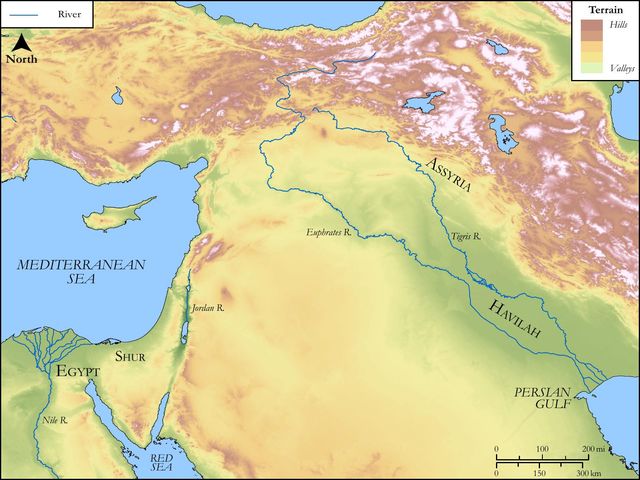
Immediately after the account of Abraham's death, Moses begins the story of Isaac (Gen 25:11), and tells us where he dwelt and how remarkably God blessed him. Note, The blessing of Abraham did not die with him, but survived to all the children of the promise. But he presently digresses from the story of Isaac, to give a short account of Ishmael, forasmuch as he also was a son of Abraham, and God had made some promises concerning him, which it was requisite we should know the accomplishment of. Observe here what is said, 1. Concerning his children. He had twelve sons, twelve princes they are called (Gen 25:16), heads of families, which in process of time became nations, distinct tribes, numerous and very considerable. They peopled a very large continent, that lay between Egypt and Assyria, called Arabia. The names of his twelve sons are recorded. Midian and Kedar we often read of in scripture. And some very good expositors have taken notice of the signification of those three names which are put together (Gen 25:14), as containing good advice to us all, Mishma, Dumah, and Massa, that is, hear, keep silence, and bear; we have them together in the same order, Jam 1:19, Be swift to hear, slow to speak, slow to wrath. The posterity of Ishmael had not only tents in the fields, wherein they grew rich in times of peace; but they had towns and castles (Gen 25:16), wherein they fortified themselves in time of war. Now the number and strength of this family were the fruit of the promise made to Hagar concerning Ishmael (Gen 16:10), and to Abraham, Gen 17:20 and Gen 21:13. Note, Many that are strangers to the covenants of promise are yet blessed with outward prosperity for the sake of their godly ancestors. Wealth and riches shall be in their house. 2. Concerning himself. Here is an account of his age: He lived 137 years (Gen 25:17) which is recorded to show the efficacy of Abraham's prayer for him (Gen 17:18), O that Ishmael might live before thee! Here is also an account of his death; he too was gathered to his people; but it is not said that he was full of days, though he lived to so great an age: he was not so weary of the world, nor so willing to leave it, as his good father was. Those words, he fell in the presence of all his brethren, whether they mean, as we take them, he died, or, as others, his lot fell, are designed to show the fulfilling of that word to Hagar (Gen 16:12), He shall dwell in the presence of all his brethren, that is, he shall flourish and be eminent among them, and shall hold his own to the last. Or he died with his friends about him, which is comfortable.
Continue studying Genesis 25:17 across the web’s major study libraries — every link below opens this exact verse, chapter, or book on the destination site.
Read & Compare
 BibleGatewayThis verse in more than 200 translations and 70 languages.
 Bible.comThe YouVersion reader — hundreds of translations, reading plans, and highlights.
 ESV.orgCrossway's official English Standard Version reader.
 NET BibleThe NET translation with 60,000+ translators' notes on every rendering decision.
 STEP BibleTyndale House's free study tool — original text, vocabulary, and scholarly resources.
 BibliaLogos Bible Software's free web reader.
 USCCBThe New American Bible (Revised Edition) with the U.S. bishops' study notes.
Commentaries
 BibleHub CommentariesDozens of classic commentaries on this verse, gathered on one page.
 StudyLightMore than 100 commentary sets — the largest collection on the web.
 BibleRefPlain-English commentary on what this verse means, verse by verse.
 Enduring WordDavid Guzik's free commentary on this chapter, widely used by Bible teachers.
 Bible Study ToolsVerse commentary alongside Greek and Hebrew study aids.
Original Language & Research
- BibleHub InterlinearThe verse word by word — original language, transliteration, and English.
- BibleHub LexiconEvery word's original-language definition and Strong's entry.
 Blue Letter BibleDeep-study tools — Strong's numbers, concordance, and word studies.
 SefariaThe Hebrew text with Rashi and centuries of Jewish commentary.
Sermons, Hymns & Audio


TrulyRandomVerse is not affiliated with these sites and doesn’t control their content. They’re linked because they’re genuinely useful.
Summary
Genesis 25:17 meticulously records the death of Ishmael at the advanced age of 137 years, stating that he "gave up the ghost and died; and was gathered unto his people." This pivotal verse marks the end of the life of Abraham's firstborn son, underscoring God's unwavering faithfulness in fulfilling His promises of longevity and prosperity even to those outside the direct covenant line of Isaac, while simultaneously marking a significant transition in the unfolding patriarchal history.
Context
ShowHideLiterary Context
Genesis 25:17 serves as the concluding statement to the brief but significant account of Ishmael's life, immediately following the detailed genealogy of his twelve sons (Genesis 25:12-16). This placement highlights the fulfillment of God's promise to Abraham that Ishmael would become the father of twelve princes and a great nation (Genesis 17:20). The verse also directly follows the death of Abraham (Genesis 25:7-8), establishing a chronological progression in the patriarchal narrative. By recording Ishmael's death, the text effectively closes one chapter of Abraham's extended family, allowing the narrative to fully pivot and concentrate on the lineage of Isaac, through whom the primary covenant promises would be perpetuated.
Historical & Cultural Context
In Scripture, longevity is regarded as a sign of divine favor and blessing, a concept deeply embedded in Hebrew thought. The precise mention of Ishmael's age, 137 years, places him among the long-lived patriarchs, though his lifespan is notably shorter than Abraham's 175 years but still substantial. The phrase "gathered unto his people" is a significant cultural and theological idiom for death in Scripture, implying a peaceful passing and a joining with one's ancestors in the realm of the departed. This concept reflects a worldview where family and lineage extended beyond physical life, providing a sense of continuity and belonging even in death.
Key Themes
ShowHideThis verse contributes to several overarching themes within Genesis and the broader biblical narrative. Firstly, it powerfully reinforces the theme of God's unwavering faithfulness to His promises, demonstrating that even promises made concerning Ishmael, who was not the covenant heir, were meticulously fulfilled (see Genesis 17:20 and Genesis 21:13). Secondly, it highlights the universality of mortality, reminding readers that even those blessed with long lives eventually face death, a truth echoed throughout Scripture. Lastly, the phrase "gathered unto his people" introduces an early biblical glimpse into the ancient understanding of death as a transition, rather than an absolute end, hinting at a collective realm of the departed, which would later be more fully developed in concepts like Sheol.
Exposition and Analysis
ShowHideGenesis 25:17 succinctly details the end of Ishmael's life, emphasizing both his advanced age and the manner of his passing.
Key Word Analysis
ShowHideMeaning "alive; hence, raw (flesh); fresh (plant, water, year), strong; also (as noun, especially in the feminine singular and masculine plural) life (or living thing), whether literally or figuratively." In this context, "life" refers to Ishmael's physical existence and the duration of his earthly journey. The mention of his "years of life" emphasizes the completion of his divinely allotted time, a period marked by God's sustaining hand.
A primitive root meaning "to breathe out, i.e. (by implication) expire; die, be dead, give up the ghost, perish." This idiom vividly describes the act of dying, the final exhalation that marks the cessation of physical life. Its use here, alongside "and died," underscores the definitive and irreversible nature of Ishmael's physical demise.
Meaning "a people (as a congregated unit); specifically, a tribe (as those of Israel); hence (collectively) troops or attendants; figuratively, a flock." In the phrase "gathered unto his people," 'am refers to the collective body of his ancestors or kin who have already passed away. It suggests a spiritual reunion or joining with the departed community, emphasizing a sense of belonging and continuity beyond the grave.
Verse Breakdown
ShowHide"And these [are] the years of the life of Ishmael, an hundred and thirty and seven years:"
This clause precisely states Ishmael's lifespan. The specific mention of 137 years signifies a full and long life by ancient standards, indicating God's blessing and faithfulness to His promise that Ishmael would become the father of a great nation, a promise that implicitly included a long life for its progenitor. This numerical detail also serves as a chronological marker within the patriarchal narratives.
"and he gave up the ghost and died;"
This phrase is a common Hebrew idiom for the act of expiring. "Gave up the ghost" (Hebrew: gâvaʻ) literally means "to breathe out" or "to expire," while "died" (Hebrew: mûwth) confirms the physical cessation of life. The combination emphasizes the finality and reality of his physical demise, signifying the departure of the life-breath or spirit from the body, a universal human experience.
"and was gathered unto his people."
This profound and recurring biblical idiom (Hebrew: ne'esaf el-'ammav) describes a peaceful, natural death in old age. It suggests more than just burial in a family tomb; it implies a spiritual joining or reunion with one's ancestors in the realm of the departed, often understood as Sheol (the grave or the collective abode of the dead). For Ishmael, it signifies his peaceful integration into the collective history of his forefathers, providing a sense of rest and belonging beyond physical life.
Literary Devices
ShowHideThe verse employs several significant literary devices. The use of Idiom is prominent, particularly in the phrases "gave up the ghost" and "was gathered unto his people." These are not literal descriptions but well-understood Hebrew expressions for the act of dying and passing into the afterlife, conveying a sense of finality and spiritual transition. The precise enumeration of Ishmael's age ("an hundred and thirty and seven years") functions as a Chronological Marker, anchoring the narrative in a specific timeline and contributing to the historical realism of the patriarchal accounts. Furthermore, the recurring phrase "gathered unto his people" (also used for Abraham, Isaac, and Jacob) serves as a Theological Motif, suggesting a consistent ancient Israelite understanding of death as a transition to a collective realm of the departed, hinting at a continuity of existence beyond the physical body and subtly foreshadowing the concept of a communal destiny for God's people.
Theological and Thematic Connections
ShowHideIshmael's death, as recorded in Genesis 25:17, serves as a profound testament to God's unwavering faithfulness. Despite the complex circumstances of Ishmael's birth and his separation from Isaac, God meticulously fulfilled every promise He made concerning him, demonstrating His character of reliability and grace even to those outside the direct covenant line of promise. This narrative also powerfully underscores the universal reality of human mortality, reminding us that all flesh is grass, and even those blessed with long lives and prosperity eventually face death. The phrase "gathered unto his people" offers an early, nuanced glimpse into the ancient Israelite understanding of death, suggesting a transition to a collective realm of the departed, hinting at a continuity of existence and a sense of belonging beyond the physical grave.
Reflection and Application
ShowHideThe record of Ishmael's death in Genesis 25:17 offers several profound reflections for contemporary believers. Firstly, it serves as a stark reminder of the universal reality of human mortality; our days are numbered, and life on earth is finite. This truth should compel us to live with intentionality, seeking to honor God with the time and gifts He has given us, recognizing the brevity of our earthly pilgrimage. More significantly, Ishmael's story is a powerful testament to God's unwavering faithfulness. Even for one whose life was marked by complexities and separation from the direct covenant line, God's promises were meticulously fulfilled. This offers immense comfort and reassurance: if God is faithful to His word concerning Ishmael, how much more will He be faithful to those who are in Christ, the heir of all promises? This deepens our trust in His character and His unfailing love. Furthermore, the gentle biblical portrayal of death as being "gathered unto his people" can offer a peaceful perspective on passing, suggesting a transition into rest and reunion, providing solace and hope for believers facing loss, knowing that death is not an ultimate end but a transition to a greater fellowship.
Questions for Reflection
ShowHideFAQ
ShowHideWhat does "gathered unto his people" mean in the Bible?
ShowHideThe phrase "gathered unto his people" (Hebrew: ne'esaf el-'ammav) is a common biblical idiom for death, particularly a peaceful one in old age. It signifies more than just a physical burial in a family tomb. Theologically, it suggests a spiritual reunion with one's ancestors or kin in the realm of the departed, often understood as Sheol (the grave or the collective abode of the dead). It implies a sense of continuity, rest, and belonging beyond physical life, rather than a violent or isolated end, reflecting an early understanding of an afterlife where the deceased join a collective assembly of their forefathers. This idiom is used for other patriarchs like Abraham in Genesis 25:8 and Isaac in Genesis 35:29.
Does God's blessing on Ishmael diminish the significance of the covenant with Isaac?
ShowHideNo, God's blessing on Ishmael does not diminish the unique and distinct significance of His covenant with Isaac. While God promised to make Ishmael a great nation and bless him, demonstrating His general benevolence and faithfulness (as seen in Genesis 17:20), the specific, redemptive covenant promises concerning the land, the innumerable descendants, and the coming Messiah were exclusively established and perpetuated through Isaac's lineage. God explicitly stated to Abraham, "But My covenant I will establish with Isaac, whom Sarah will bear to you at this time next year" (Genesis 17:21). Ishmael's blessing operates distinctly from the specific covenant line that ultimately leads to Christ, highlighting God's sovereign choice in His redemptive plan.
Christ-Centered Fulfillment
ShowHideWhile Ishmael is not in the direct messianic lineage, the account of his death, particularly God's faithfulness in fulfilling His promises to him, points to Christ in profound ways. God's unwavering commitment to His word, even to those outside the immediate covenant of grace, foreshadows His ultimate and perfect faithfulness in sending Christ to redeem all who believe, regardless of their earthly lineage or past (see Romans 15:8). The promise of a "great nation" for Ishmael, though fulfilled physically through his descendants, finds its spiritual and ultimate fulfillment in the vast, multi-ethnic "great multitude that no one could number, from every nation, from all tribes and peoples and languages," who are gathered in Christ, forming the true spiritual Israel (as depicted in Revelation 7:9). Furthermore, the ancient concept of being "gathered unto his people" finds its ultimate and glorious fulfillment in the Christian hope of being gathered with Christ and all the saints in the heavenly kingdom. Through Christ's victory over death, believers are assured of a true, eternal rest and reunion, not merely with earthly ancestors, but with the Lord Himself and the entire family of God, where death is swallowed up in victory and sorrow is no more (see John 14:1-3 and 1 Thessalonians 4:16-17).