


Genesis 35:29
Bible text: King James Version (1769 Blayney text) · Public domain
Bible text: King James Version with Strong's numbers · Public domain
Bible text: Berean Standard Bible · Public domain
Bible text: American Standard Version (1901) · Public domain
Bible text: World English Bible, Messianic edition · Public domain
Bible text: Geneva Bible (1599) · Public domain
Bible text: Young's Literal Translation · Public domain
- וַיִּגְוַעvai·yig·Va'and he expiredH1478Conj-w ¦ V-Qal-ConsecImperf-3msVerb Qal Consecutive Imperfect 3rd Singular Masculineוַandיִּגְוַעhe expired
- יִצְחָקyitz·ChakIsaacH3327N-proper-mNoun Proper Masculine
- וַיָּמָתvai·Ya·motand he diedH4191Conj-w ¦ V-Qal-ConsecImperf-3msVerb Qal Consecutive Imperfect 3rd Singular Masculineוַandיָּמָתhe died
- וַיֵּאָסֶףvai·ye·'A·sefand he was gatheredH622Conj-w ¦ V-Niphal-ConsecImperf-3msVerb Niphal Consecutive Imperfect 3rd Singular Masculineוַandיֵּאָסֶףhe was gathered
- אֶל'eltoH413PrepPreposition
- עַמָּיו'a·Mavhis people<s>H5971N-mpc ¦ 3msNoun Plural Masculine Constructעַמָּיpeople<s>וhis
- זָקֵןza·Kenan old [man]H2205Adj-msAdjective Singular Masculine Absolute
- וּשְׂבַעu·se·Va'and satisfied ofH7649Conj-w ¦ Adj-mscAdjective Singular Masculine Constructוּandשְׂבַעsatisfied of
- יָמִיםya·MimdaysH3117N-mpNoun Plural Masculine Absolute
- וַיִּקְבְּרוּvai·yik·be·Ruand they buriedH6912Conj-w ¦ V-Qal-ConsecImperf-3mpVerb Qal Consecutive Imperfect 3rd Plural Masculineוַandיִּקְבְּרוּthey buried
- אֹתוֹ'o·To<obj.> himH853DirObjM ¦ 3msParticle Object Indicatorאֹת<obj.>וֹhim
- עֵשָׂו'e·SavEsauH6215N-proper-mNoun Proper Masculine
- וְיַעֲקֹבve·ya·'a·Koand JacobH3290Conj-w ¦ N-proper-mNoun Proper MasculineוְandיַעֲקֹבJacob
- בָּנָיוba·Navhis sonsH1121N-mpc ¦ 3msNoun Plural Masculine Constructבָּנָיsonsוhis
English is a literal word-by-word gloss of the Hebrew, not the KJV's wording. Why?
This is the original text the KJV's translators worked from — each Hebrew word with its own literal English meaning in this verse, prepared by scholars at Tyndale House, Cambridge. The KJV translates whole sentences, not word by word, so its wording differs: one Hebrew word can become several English words, and the KJV may choose “the LORD” where the gloss reads “Yahweh”. Both are faithful — they answer different questions. For the KJV's own rendering, switch to the KJV text.
Details
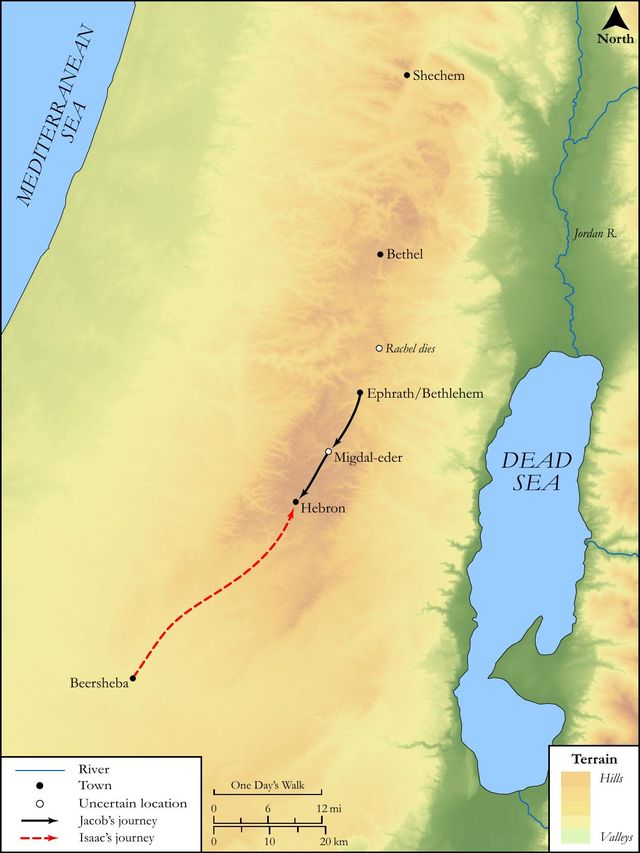
See on the biblical-era maps


Study this verse
Public-domain commentary
Matthew Henry
From his Commentary on the Whole Bible. Henry comments on passages, not single verses — this entry covers Genesis 35:21–29.
Here is, 1. Jacob's removal, Gen 35:21. He also, as his fathers, sojourned in the land of promise as in a strange country, and was not long in a place. Immediately after the story of Rachel's death he is here called Israel (Gen 35:21, Gen 35:22), and not often so afterwards: the Jews say, "The historian does him this honour here because he bore that affliction with such admirable patience and submission to Providence." Note, Those are Israel's indeed, princes with God, that support the government of their own passions. He that has this rule over his own spirit is better than the mighty. Israel, a prince with God, yet dwells in tents; the city is reserved for him in the other world. 2. The sin of Reuben. A piece of abominable wickedness it was that he was guilty of (Gen 35:22), that very sin which the apostle says (Co1 5:1) is not so much as named among the Gentiles, that one should have his father's wife. It is said to have been when Israel dwelt in that land; as if he were then absent from his family, which might be the unhappy occasion of these disorders. Though perhaps Bilhah was the greater criminal, and it is probable was abandoned by Jacob for it, yet Reuben's crime was so provoking that, for it, he lost his birthright and blessing, Gen 49:4. The first-born is not always the best, nor the most promising. This was Reuben's sin, but it was Jacob's affliction; and what a sore affliction it was is intimated in a little compass, and Israel heard it. No more is said - that is enough; he heard it with the utmost grief and shame, horror and displeasure. Reuben thought to conceal it, that his father should never hear of it; but those that promise themselves secresy in sin are generally disappointed; a bird of the air carries the voice. 3. A complete list of the sons of Jacob, now that Benjamin the youngest was born. This is the first time we have the names of these heads of the twelve tribes together; afterwards we find them very often spoken of and enumerated, even to the end of the Bible, Rev 7:4; Rev 21:12. 4. The visit which Jacob made to his father Isaac at Hebron. We may suppose he had visited him before since his return, for he sorely longed after his father's house; but never, till now, brought his family to settle with him, or near him, Gen 35:27. Probably he did this now upon the death of Rebekah, by which Isaac was left solitary, and not disposed to marry again. 5. The age and death of Isaac are here recorded, though it appears, by computation, that he died not till many years after Joseph was sold into Egypt, and much about the time that he was preferred there. Isaac, a mild quiet man, lived the longest of all the patriarches, for he was 180 years old; Abraham was but 175. Isaac lived about forty years after he had made his will, Gen 27:2. We shall not die an hour the sooner, but abundantly the better, for our timely setting our heart and house in order. Particular notice is taken of the amicable agreement of Esau and Jacob, in solemnizing their father's funeral (Gen 35:29), to show how wonderfully God had changed Esau's mind since he vowed his brother's murder immediately after his father's death, Gen 27:41. Note, God has many ways of preventing bad men from doing the mischief they intended; he can either tie their hands or turn their hearts.
Continue studying Genesis 35:29 across the web’s major study libraries — every link below opens this exact verse, chapter, or book on the destination site.
Read & Compare
 BibleGatewayThis verse in more than 200 translations and 70 languages.
 Bible.comThe YouVersion reader — hundreds of translations, reading plans, and highlights.
 ESV.orgCrossway's official English Standard Version reader.
 NET BibleThe NET translation with 60,000+ translators' notes on every rendering decision.
 STEP BibleTyndale House's free study tool — original text, vocabulary, and scholarly resources.
 BibliaLogos Bible Software's free web reader.
 USCCBThe New American Bible (Revised Edition) with the U.S. bishops' study notes.
Commentaries
 BibleHub CommentariesDozens of classic commentaries on this verse, gathered on one page.
 StudyLightMore than 100 commentary sets — the largest collection on the web.
 BibleRefPlain-English commentary on what this verse means, verse by verse.
 Enduring WordDavid Guzik's free commentary on this chapter, widely used by Bible teachers.
 Bible Study ToolsVerse commentary alongside Greek and Hebrew study aids.
Original Language & Research
- BibleHub InterlinearThe verse word by word — original language, transliteration, and English.
- BibleHub LexiconEvery word's original-language definition and Strong's entry.
 Blue Letter BibleDeep-study tools — Strong's numbers, concordance, and word studies.
 SefariaThe Hebrew text with Rashi and centuries of Jewish commentary.
Sermons, Hymns & Audio


TrulyRandomVerse is not affiliated with these sites and doesn’t control their content. They’re linked because they’re genuinely useful.
Summary
Genesis 35:29 records the peaceful passing of Isaac, the second patriarch, at the venerable age of 180 years. This pivotal verse not only marks the end of a significant era in the patriarchal narrative but also powerfully illustrates God's enduring faithfulness in granting Isaac a complete and blessed life. Furthermore, it highlights a profound moment of reconciliation as his estranged sons, Esau and Jacob, unite in shared filial duty to bury their father, solidifying the lineage through Jacob as the divine narrative progresses toward the formation of the nation of Israel.
Context
ShowHideLiterary Context
Genesis 35:29 concludes a significant chapter that details Jacob's return to Bethel, his purification of his household from foreign gods, the renewal of God's covenant promises to him (including the renaming to Israel), and the tragic death of Rachel during childbirth. Immediately preceding Isaac's death, the narrative lists the twelve sons of Jacob, establishing the foundational lineage for the future tribes of Israel. The placement of Isaac's death here, after Jacob's return and the reconciliation with Esau (recounted in Genesis 33), suggests that Isaac lived to see the initial stages of the covenant people taking shape and the healing of his family's deepest rifts. His passing serves as a quiet transition, closing the chapter on the second patriarch while setting the stage for the stories of Jacob's sons and the descent into Egypt.
Historical & Cultural Context
Among the patriarchs, a long life, especially one that ended peacefully and "full of days," was considered a profound blessing and a sign of divine favor. Patriarchal burial sites, such as the Cave of Machpelah in Hebron, held immense significance, serving as a tangible link to ancestral promises and lineage. The act of sons burying their father was a sacred duty, signifying respect, continuity, and the peaceful transfer of family leadership. The fact that Esau and Jacob, despite their long-standing animosity and the profound deception surrounding the birthright and blessing (Genesis 27), came together to bury their father speaks volumes about the enduring cultural importance of filial piety and the power of shared grief to bridge deep divides. Isaac's age of 180 made him the longest-lived of the three primary patriarchs (Abraham lived to 175, Jacob to 147), further emphasizing the blessed nature of his life.
Key Themes
ShowHideThis verse contributes to several overarching themes in Genesis. It underscores Divine Faithfulness to the covenant promises made to Abraham and reiterated to Isaac, as God grants him a full and blessed life, ensuring the continuation of the promised lineage. The phrase "gathered unto his people" reinforces the theme of Lineage and Continuity, highlighting the importance of ancestral ties and the ongoing nature of God's redemptive plan through generations. Most powerfully, the joint burial by Esau and Jacob speaks to the theme of Reconciliation and Forgiveness, demonstrating that even profound familial brokenness, as seen in the rivalry between the brothers (Genesis 27:41), can be healed through divine intervention and human choice, culminating in a moment of shared purpose and respect. This reconciliation foreshadows the broader work of unity that God would accomplish through His chosen people.
Exposition and Analysis
ShowHideGenesis 35:29 provides a concise yet profound account of Isaac's death, marking a significant transition in the patriarchal narrative.
Key Word Analysis
ShowHideThis primitive root means "to breathe out, i.e. (by implication) expire; die, be dead." In ancient thought, the breath was often associated with life itself, and its departure signified death. The phrase "gave up the ghost" is an archaic English rendering that vividly conveys this concept of life's cessation, emphasizing a natural and peaceful end rather than a violent one.
This root means "to gather for any purpose; hence, to receive, take away, i.e. remove." When used in the context of death, as in "gathered unto his people," it signifies a peaceful passing and inclusion among one's deceased ancestors. It implies a natural, non-violent death and a spiritual reunion with one's lineage beyond the grave, underscoring the continuity of family and heritage.
From a root meaning "satiated (in a pleasant or disagreeable sense)," here it means "satisfied with." When paired with "days" (Hebrew, yôwm'), as in "full of days," it forms a significant idiom. It describes a life that has reached its complete and divinely appointed measure, not merely a long life, but one that is satisfying, complete, and blessed by God, indicating that the individual experienced all that life had to offer and departed without regret or unfulfilled desires.
Verse Breakdown
ShowHide"And Isaac gave up the ghost, and died"
This phrase directly states Isaac's death, using two synonymous expressions to emphasize the finality of his earthly life. "Gave up the ghost" (as discussed above) is an ancient idiom for dying, conveying the departure of life's essence. The repetition underscores the solemnity and certainty of the event.
"and was gathered unto his people"
This significant biblical idiom (also used for Abraham in Genesis 25:8) indicates a peaceful and natural death, implying a reunion with deceased ancestors in the afterlife. It speaks to a continuity of lineage and a sense of belonging even beyond physical existence, contrasting with those who die violently or are cut off from their kin.
"[being] old and full of days"
This is a powerful Hebrew idiom (zaqen v'sava yamim). "Old" (Hebrew, zâqên') refers to his advanced age of 180. "Full of days" (Hebrew, sâbêaʻ_ _yôwm') signifies a life that was not only long but also complete, satisfied, and blessed by God. It implies that Isaac had experienced all that God intended for his life and departed in peace and contentment, a mark of divine favor in the Old Testament.
"and his sons Esau and Jacob buried him"
This is perhaps the most poignant detail. Despite decades of bitter rivalry and estrangement (Genesis 27 and Genesis 32, Genesis 33 for their reunion), Esau and Jacob unite in this final act of filial duty. Their shared grief and respect for their father transcend their past conflicts, highlighting a profound moment of reconciliation and demonstrating the enduring power of family bonds, even those severely fractured. This act mirrors Abraham's burial by Isaac and Ishmael (Genesis 25:9), setting a precedent for estranged brothers uniting in a moment of shared sorrow.
Literary Devices
ShowHideThe verse employs several powerful Literary Devices. The phrase "gave up the ghost" is an Idiom, an archaic expression for dying, vividly portraying the cessation of life. The description "old and full of days" is another significant Idiom, conveying not just longevity but a life completed and blessed by God, suggesting a sense of divine contentment and fulfillment. The phrase "gathered unto his people" is a profound Euphemism for death, softening the harshness of the reality while simultaneously implying a spiritual reunion with ancestors, underscoring the importance of lineage and continuity. Finally, the joint burial by Esau and Jacob serves as a powerful instance of Symbolism and Juxtaposition. It symbolizes reconciliation and the healing of deep familial wounds, juxtaposing their past animosity with their present unity in filial duty. This act of shared grief and purpose highlights the transformative power of forgiveness and the enduring bond of family, even in the face of profound historical conflict.
Theological and Thematic Connections
ShowHideIsaac's peaceful death, described as being "old and full of days" and "gathered unto his people," profoundly underscores God's unwavering faithfulness to His covenant promises. His longevity and blessed end confirm that God upheld His word to Abraham, ensuring the continuation of the promised lineage through Isaac to Jacob. This moment also highlights the universal reality of death within the context of God's sovereign plan, where each generation fulfills its role in the unfolding redemptive history. Most significantly, the joint burial by Esau and Jacob serves as a powerful testament to the possibility of reconciliation and the healing of deep-seated familial wounds, demonstrating that even after decades of bitterness and separation, unity can emerge through shared purpose and grief, reflecting a divine capacity for restoration.
Reflection and Application
ShowHideIsaac's death serves as a profound reminder of the natural cycle of life and death, yet within the comforting framework of God's enduring faithfulness across generations. His peaceful passing, described as being "full of days," offers a comforting image of a life well-lived and completed under divine blessing, encouraging us to seek a life of contentment and purpose, trusting in God's provision for our days. This narrative invites us to reflect on what it means to live a "full" life—not necessarily one devoid of hardship, but one lived in faithful obedience and trust in God, culminating in a peaceful end. Furthermore, the powerful image of Esau and Jacob burying their father together provides a timeless lesson on the possibility of healing fractured relationships. It underscores that even in sorrow, unity can emerge, and that forgiveness and reconciliation are vital for familial and communal well-being, demonstrating that no relationship is beyond the reach of healing and restoration when hearts are open to it.
Questions for Reflection
ShowHideFAQ
ShowHideWhat does "gave up the ghost" mean in modern English?
ShowHide"Gave up the ghost" is an archaic idiom from the King James Version of the Bible that simply means "died." It reflects an older understanding of death as the departure of the spirit or breath from the body. It emphasizes a natural and peaceful cessation of life.
Does "gathered unto his people" imply a specific afterlife location?
ShowHideThe phrase "gathered unto his people" (or "gathered to his ancestors") primarily signifies a peaceful, natural death within one's lineage and heritage. While it suggests a reunion with deceased family members, it does not explicitly define a specific location or detailed nature of the afterlife. It emphasizes the manner of death and inclusion among one's departed kin rather than a theological description of heaven or hell. It points to a continuity of existence beyond the physical, a joining with those who have gone before.
Christ-Centered Fulfillment
ShowHideIsaac's life and death, particularly his role as a recipient of the Abrahamic covenant and a link in the patriarchal lineage, find their ultimate fulfillment in Jesus Christ. The promise of a great nation and a blessing to all families of the earth, first given to Abraham and reiterated to Isaac, culminates in Christ, through whom all nations are blessed (Galatians 3:8). Isaac's peaceful passing, "full of days," underscores God's faithfulness to His promises, ensuring the continuation of the line that would eventually lead to the Messiah, the true "seed" of Abraham (Galatians 3:16). Furthermore, the poignant reconciliation between Esau and Jacob at Isaac's burial powerfully foreshadows the far greater reconciliation offered through Christ. He is the ultimate peacemaker who breaks down the dividing wall of hostility between Jew and Gentile (Ephesians 2:14), uniting all who believe into one new humanity, fulfilling the covenant promises made to Isaac and his forefathers by bringing together a spiritual family from every tribe, tongue, people, and nation (Revelation 7:9). Thus, Isaac's story, marked by divine promise and familial reconciliation, points forward to the comprehensive redemption and unity found in Christ.