


Genesis 49:31
Bible text: King James Version (1769 Blayney text) · Public domain
Bible text: Berean Standard Bible · Public domain
Bible text: American Standard Version (1901) · Public domain
Bible text: World English Bible, Messianic edition · Public domain
Bible text: Geneva Bible (1599) · Public domain
Bible text: Young's Literal Translation · Public domain
- שָׁמָּהSha·mahthere <towards>H8033Adv ¦ SfxAdverbשָׁמָּthereה<towards>
- קָבְרוּka·ve·Rupeople buriedH6912V-Qal-Perf-3cpVerb Qal Perfect 3rd Plural common gender
- אֶת'et<obj.>H853DirObjMParticle Object Indicator
- אַבְרָהָם'av·ra·HamAbrahamH85N-proper-mNoun Proper Masculine
- וְאֵתve·'Etand <obj.>H853Conj-w ¦ DirObjMParticle Object Indicatorוְandאֵת<obj.>
- שָׂרָהsa·RahSarahH8283N-proper-fNoun Proper Feminine
- אִשְׁתּוֹ'ish·Tohis wifeH802N-fsc ¦ 3msNoun Singular Feminine Constructאִשְׁתּwifeוֹhis
- שָׁמָּהSha·mahthere <towards>H8033Adv ¦ SfxAdverbשָׁמָּthereה<towards>
- קָבְרוּka·ve·Rupeople buriedH6912V-Qal-Perf-3cpVerb Qal Perfect 3rd Plural common gender
- אֶת'et<obj.>H853DirObjMParticle Object Indicator
- יִצְחָקyitz·ChakIsaacH3327N-proper-mNoun Proper Masculine
- וְאֵתve·'Etand <obj.>H853Conj-w ¦ DirObjMParticle Object Indicatorוְandאֵת<obj.>
- רִבְקָהriv·KahRebekahH7259N-proper-fNoun Proper Feminine
- אִשְׁתּוֹ'ish·Tohis wifeH802N-fsc ¦ 3msNoun Singular Feminine Constructאִשְׁתּwifeוֹhis
- וְשָׁמָּהve·Sha·mahand there <towards>H8033Conj-w ¦ Adv ¦ SfxAdverbוְandשָׁמָּthereה<towards>
- קָבַרְתִּיka·Var·tiI buriedH6912V-Qal-Perf-1csVerb Qal Perfect 1st Singular common gender
- אֶת'et<obj.>H853DirObjMParticle Object Indicator
- לֵאָהle·'AhLeahH3812N-proper-fNoun Proper Feminine
English is a literal word-by-word gloss of the Hebrew, not the KJV's wording. Why?
This is the original text the KJV's translators worked from — each Hebrew word with its own literal English meaning in this verse, prepared by scholars at Tyndale House, Cambridge. The KJV translates whole sentences, not word by word, so its wording differs: one Hebrew word can become several English words, and the KJV may choose “the LORD” where the gloss reads “Yahweh”. Both are faithful — they answer different questions. For the KJV's own rendering, switch to the KJV text.
Details
See on the biblical-era maps


Study this verse
Public-domain commentary
Matthew Henry
From his Commentary on the Whole Bible. Henry comments on passages, not single verses — this entry covers Genesis 49:28–33. His two-level outline is real structure in the source text, so it is rendered as structure.
Here is, I. The summing up of the blessings of Jacob's sons, Gen 49:28. Though Reuben, Simeon, and Levi were put under the marks of their father's displeasure, yet he is said to bless them every one according to his blessing; for none of them were rejected as Esau was. Note, Whatever rebukes of God's word or providence we are under at any time, yet, as long as we have an interest in God's covenant, a place and a name among his people, and good hopes of a share in the heavenly Canaan, we must account ourselves blessed.
II.The solemn charge Jacob gave them concerning his burial, which is a repetition of what he had before given to Joseph.
See how he speaks of death, now that he is dying: I am to be gathered unto my people, Gen 49:29. Note, It is good to represent death to ourselves under the most desirable images, that the terror of it may be taken off. Though it separates us from our children and our people in this world, it gathers us to our fathers and to our people in the other world. Perhaps Jacob uses this expression concerning death as a reason why his sons should bury him in Canaan; for, says he, "I am to be gathered unto my people, my soul must go to the spirits of just men made perfect: and therefore bury me with my fathers, Abraham and Isaac, and their wives," Gen 49:31. Observe,
1.His heart was very much upon it, not so much from a natural affection to his native soil as from a principle of faith in the promise of God, that Canaan should be the inheritance of his seed in due time. Thus he would keep up in his sons a remembrance of the promised land, and not only would have their acquaintance with it renewed by a journey thither on that occasion, but their desire towards it and their expectation of it preserved.
2.He is very particular in describing the place both by the situation of it and by the purchase Abraham had made of it for a burying-place, Gen 49:30, Gen 49:32. He was afraid lest his sons, after seventeen years' sojourning in Egypt, had forgotten Canaan, and even the burying-place of their ancestors there, or lest the Canaanites should dispute his title to it; and therefore he specifies it thus largely, and the purchase of it, even when he lies a-dying, not only to prevent mistakes, but to show how mindful he was of that country. Note, It is, and should be, a great pleasure to dying saints to fix their thoughts upon the heavenly Canaan, and the rest they hope for there after death.
III.The death of Jacob, Gen 49:33.
When he had finished both his blessing and his charge (both which are included in the commanding of his sons), and so had finished his testimony, he addressed himself to his dying work.
1.He put himself into a posture for dying; having before seated himself upon the bed-side, to bless his sons (the spirit of prophecy bringing fresh oil to his expiring lamp, Dan 10:19), when that work was done, he gathered up his feet into the bed, that he might lie along, not only as one patiently submitting to the stroke, but as one cheerfully composing himself to rest, now that he was weary. I will lay me down, and sleep.
2.He freely resigned his spirit into the hand of God, the Father of spirits: He yielded up the ghost.
3.His separated soul went to the assembly of the souls of the faithful, which, after they are delivered from the burden of the flesh, are in joy and felicity: he was gathered to his people. Note, If God's people be our people, death will gather us to them.
Continue studying Genesis 49:31 across the web’s major study libraries — every link below opens this exact verse, chapter, or book on the destination site.
Read & Compare
 BibleGatewayThis verse in more than 200 translations and 70 languages.
 Bible.comThe YouVersion reader — hundreds of translations, reading plans, and highlights.
 ESV.orgCrossway's official English Standard Version reader.
 NET BibleThe NET translation with 60,000+ translators' notes on every rendering decision.
 STEP BibleTyndale House's free study tool — original text, vocabulary, and scholarly resources.
 BibliaLogos Bible Software's free web reader.
 USCCBThe New American Bible (Revised Edition) with the U.S. bishops' study notes.
Commentaries
 BibleHub CommentariesDozens of classic commentaries on this verse, gathered on one page.
 StudyLightMore than 100 commentary sets — the largest collection on the web.
 BibleRefPlain-English commentary on what this verse means, verse by verse.
 Enduring WordDavid Guzik's free commentary on this chapter, widely used by Bible teachers.
 Bible Study ToolsVerse commentary alongside Greek and Hebrew study aids.
Original Language & Research
- BibleHub InterlinearThe verse word by word — original language, transliteration, and English.
- BibleHub LexiconEvery word's original-language definition and Strong's entry.
 Blue Letter BibleDeep-study tools — Strong's numbers, concordance, and word studies.
 SefariaThe Hebrew text with Rashi and centuries of Jewish commentary.
Sermons, Hymns & Audio


TrulyRandomVerse is not affiliated with these sites and doesn’t control their content. They’re linked because they’re genuinely useful.
Summary
Genesis 49:31, delivered as part of Jacob's final instructions to his sons, meticulously lists the revered occupants of the ancestral burial site at the Cave of Machpelah: Abraham and Sarah, Isaac and Rebekah, and Leah. This verse serves as a profound affirmation of the patriarchal lineage, underscoring their deep connection to the promised land, their unwavering faith in God's covenant promises, and the divinely ordained continuity through which those promises would ultimately find their fulfillment.
Context
ShowHideLiterary Context
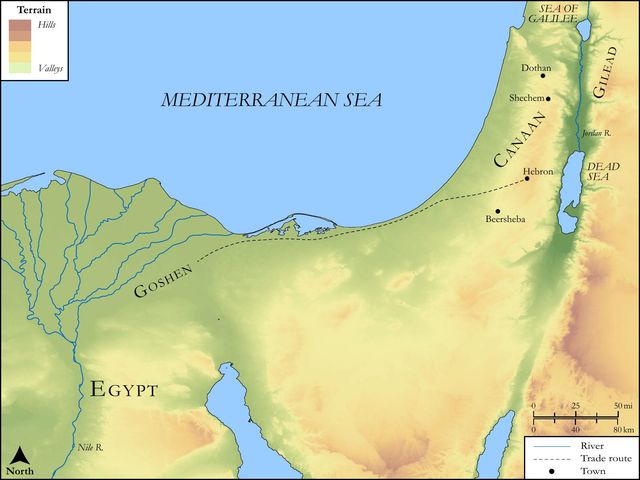
Genesis 49:31 is embedded within Jacob's final discourse and prophetic blessings to his twelve sons, delivered just before his death in Egypt. Having lived his last seventeen years in the land of Goshen, Jacob's paramount concern was not to be interred in foreign soil but to be reunited with his ancestors in the Cave of Machpelah in Canaan. This verse functions as a crucial historical and theological anchor, reminding his sons, and the reader, of the esteemed individuals already laid to rest in this sacred family tomb. It reinforces the solemnity and significance of Jacob's dying wish, articulated in Genesis 49:29-30, to be buried "with my fathers in the cave that is in the field of Ephron the Hittite." The subsequent narrative in Genesis 50:1-14 details the elaborate fulfillment of this request, bringing the patriarchal narrative full circle as Jacob, like Abraham and Isaac before him, is gathered to his people in the promised land.
Historical & Cultural Context
Among the patriarchs, burial practices were deeply significant, reflecting not only respect for the deceased but also a profound connection to family, land, and identity. Ancestral tombs were not merely graves but tangible links to one's heritage and future hope. The Cave of Machpelah, purchased by Abraham in Genesis 23 as a permanent burial ground, represented the patriarchs' first tangible claim to the promised land, long before the Israelites possessed it fully. The act of burial "with one's fathers" (or "gathered to his people") implied a continuation of familial and covenantal ties even in death, signifying a shared destiny and a belief in a future beyond the grave. For Jacob, whose life was marked by sojourning and separation, the desire to be buried in Machpelah underscored his deep spiritual conviction that Canaan was the land of promise, the ultimate resting place tied to God's covenant with his forefathers.
Key Themes
ShowHideThis verse powerfully contributes to several overarching themes within Genesis and the broader Pentateuch. Foremost is the theme of Covenant and Promise, particularly God's promise of land and descendants to Abraham (Genesis 12:1-3). The repeated burials in Machpelah serve as physical markers of the unfolding covenant, demonstrating God's faithfulness across generations, even when the full realization of the land promise was distant. The theme of Lineage and Continuity is also central, as the verse meticulously lists the patriarchal and matriarchal figures, emphasizing the unbroken chain of God's chosen family through whom the covenant would be passed down. Finally, the verse subtly highlights the theme of Faith and Hope, as the patriarchs' insistence on burial in Canaan, despite dying in foreign lands or facing uncertainty, reflects their enduring trust in God's future fulfillment of His promises, including the ultimate inheritance of the land and the resurrection of the dead.
Exposition and Analysis
ShowHideThe verse meticulously lists the esteemed residents of the Cave of Machpelah, a burial site of immense significance to the patriarchal family. Jacob, on his deathbed, recounts who is interred there, emphasizing the lineage and the sacredness of the promised land.
Key Word Analysis
ShowHideFrom the primitive root H6912, meaning "to inter." This word, repeated three times in the verse, highlights the physical act of interment, which in that day was a profoundly significant ritual. It signifies the final resting place, the gathering of the deceased to their ancestors, and in this context, the physical connection of the patriarchs to the promised land, even in death. The act of burial here is not merely a disposal of a body but an act of faith and a claim to the land.
Meaning "laughter (i.e., mockery)." Isaac's name, given by God, recalls the laughter of his parents, Abraham and Sarah, at the seemingly impossible promise of his birth in their old age (Genesis 17:17 and Genesis 18:12). His inclusion in the burial list underscores his pivotal role as the son of promise, the direct heir through whom the Abrahamic covenant was continued and solidified, bridging the first and third generations of patriarchs.
Meaning "weary." Leah's name and life were often associated with weariness, particularly in her struggle for Jacob's affection compared to Rachel (Genesis 29:31-35). Her specific mention by Jacob, "and there I buried Leah," is deeply poignant. It signifies her significant status as a matriarch of the covenant line, the mother of six of Jacob's sons, including Judah, from whom the messianic line would emerge. Her burial alongside the other patriarchs and matriarchs in Machpelah, distinct from Rachel's separate burial near Bethlehem (Genesis 35:19), highlights her enduring importance in Jacob's final thoughts and the divine plan.
Verse Breakdown
ShowHide"There they buried Abraham and Sarah his wife;"
This clause establishes the foundational occupants of the Cave of Machpelah. Abraham, the recipient of God's covenant promises, and Sarah, the matriarch through whom the promised seed came, represent the beginning of the chosen lineage. Their burial here, in a plot Abraham purchased as a permanent possession (Genesis 23:19-20), signifies the first tangible claim to the promised land and the enduring nature of God's covenant.
"there they buried Isaac and Rebekah his wife;"
This clause continues the lineage, highlighting the second generation of the covenant family. Isaac, the son of promise, and Rebekah, his divinely chosen wife, represent the continuity and transfer of God's blessings and promises. Their interment alongside Abraham and Sarah reinforces the generational succession of the covenant and the sacredness of the burial site as the resting place for the heirs of the promise.
"and there I buried Leah."
This final clause is particularly personal and poignant. Jacob, speaking in the first person ("I buried"), emphasizes his direct involvement in Leah's burial. Unlike Rachel, who was buried separately near Bethlehem due to her death in childbirth (Genesis 35:19), Leah was laid to rest in the ancestral tomb. This act underscores Leah's significant, though complex, role as a matriarch and mother of key tribal founders (including Judah, from whom the Messiah would come), securing her place within the foundational covenant family at Machpelah.
Literary Devices
ShowHideThe verse employs several significant literary devices to convey its profound meaning. Repetition is prominently used with the Hebrew word sham (שָׁם), meaning "there," appearing three times ("There they buried Abraham... there they buried Isaac... and there I buried Leah"). This Emphasis on "there" powerfully underscores the singular importance and designated nature of the Cave of Machpelah as the sacred, ancestral resting place. It draws the reader's attention to the physical location as a tangible link to God's covenant promises concerning the land. Furthermore, the verse utilizes Enumeration, meticulously listing the pairs of patriarchs and matriarchs, followed by Leah. This precise listing reinforces the theme of Lineage and the unbroken chain of the covenant family, establishing a clear historical record of those who are gathered in this foundational tomb. The shift to the first person "I buried Leah" also introduces a moment of Personal Reflection and poignancy from Jacob, highlighting his unique relationship and final act of devotion towards Leah.
Theological and Thematic Connections
ShowHideGenesis 49:31 serves as a powerful theological statement, anchoring the unfolding narrative of God's covenant with Abraham in a tangible, physical location. The meticulous listing of the patriarchs and matriarchs buried in the Cave of Machpelah underscores the unbroken continuity of God's covenant promises through successive generations, from Abraham to Jacob. This burial site transcends a mere plot of land; it becomes a physical testament to the enduring nature of God's faithfulness to His chosen line, a sacred space that embodies the hope of the promised land and the future of the nation of Israel. The patriarchs' insistence on burial in Canaan, even when they died elsewhere, reflects a profound faith that transcended their earthly lives, believing in God's faithfulness to His promises, even when the full realization of those promises was yet to come.
Reflection and Application
ShowHideGenesis 49:31 serves as a profound reminder of the enduring significance of heritage and the unwavering nature of God's promises. Just as the patriarchs held onto the promise of the land even in death, demonstrating a faith that looked beyond their immediate circumstances, believers today are called to find comfort and hope in God's unchanging character and His ultimate faithfulness to His word. This verse prompts us to reflect on our own spiritual heritage, recognizing that we are part of a larger story of faith, built upon the faithfulness of those who came before us, and sustained by the faithfulness of God Himself. While the physical location of our burial may not hold the same covenantal significance as Machpelah, this passage directs our hope toward our ultimate resting place: the promise of eternal life and resurrection for those who trust in God's covenant through Christ. It reminds us that our true home is not of this world, but with God, and that our earthly journey is a pilgrimage towards a greater, heavenly inheritance.
Questions for Reflection
ShowHideFAQ
ShowHideWhy is the Cave of Machpelah so important?
ShowHideThe Cave of Machpelah holds immense significance as the burial site purchased by Abraham from Ephron the Hittite in Genesis 23 as a permanent possession in the land of Canaan. It represents the patriarchs' first tangible claim to the promised land, long before the nation of Israel fully inherited it. As the resting place for Abraham, Sarah, Isaac, Rebekah, and Leah, it serves as a physical anchor for God's covenant promises regarding the land and their descendants. It symbolizes the continuity of the covenant line, the enduring hope in God's faithfulness, and the deep spiritual connection of the patriarchs to the land that God had promised to their offspring.
Why does Jacob specifically mention burying Leah, but not Rachel?
ShowHideJacob's specific mention of burying Leah ("and there I buried Leah") is deeply poignant because Rachel, his beloved wife, was buried separately near Bethlehem (Genesis 35:19) after dying in childbirth. By emphasizing Leah's burial in Machpelah, Jacob highlights her status as a matriarch of the covenant line, buried alongside Abraham, Sarah, Isaac, and Rebekah. This distinction underscores Leah's significant, albeit often overshadowed, role in the patriarchal family. Despite Jacob's greater affection for Rachel, Leah was the mother of six of his sons, including Judah, from whom the messianic line would eventually come. Jacob's personal statement, "I buried Leah," may reflect a complex bond and a desire for her to be part of the sacred ancestral resting place, solidifying her integral position within the covenant family.
Christ-Centered Fulfillment
ShowHideThe patriarchs' deep longing to be buried in the promised land, exemplified by Jacob's final instructions regarding Machpelah, points forward to a greater hope and a more profound fulfillment in Christ. Their faith in God's promise of the land, though partially realized in the physical inheritance of Canaan, ultimately prefigures the spiritual inheritance of all believers in Christ—a new heaven and a new earth where righteousness dwells (2 Peter 3:13). The physical resting place in Machpelah, a symbol of God's faithfulness to a specific lineage, finds its ultimate reality in Christ, who is the true "seed" of Abraham (Galatians 3:16) and the one through whom all God's promises find their "Yes" and "Amen" (2 Corinthians 1:20). Moreover, the patriarchs' hope for a future in the land, even beyond death, subtly anticipates the resurrection life secured by Christ, who conquered death and the grave (1 Corinthians 15:20-22) and offers eternal life in the true promised land, the heavenly kingdom prepared for His people (John 14:2-3). Thus, the Cave of Machpelah, a testament to earthly hope, ultimately directs our gaze to the spiritual and eternal hope found in the resurrected Christ.