


Genesis 50:13
- וַיִּשְׂאוּvai·yis·'Uand they carriedH5375Conj-w ¦ V-Qal-ConsecImperf-3mpVerb Qal Consecutive Imperfect 3rd Plural Masculineוַandיִּשְׂאוּthey carried
- אֹתוֹ'o·To<obj.> himH853DirObjM ¦ 3msParticle Object Indicatorאֹת<obj.>וֹhim
- בָנָיוva·Navhis sonsH1121N-mpc ¦ 3msNoun Plural Masculine Constructבָנָיsonsוhis
- אַרְצָה'Ar·tzah[the] land of towardsH776N-fsc ¦ SfxNoun Singular Feminine Constructאַרְצָ[the] land ofהtowards
- כְּנַעַןke·Na·'anCanaanH3667N-properNoun Proper Location
- וַיִּקְבְּרוּvai·yik·be·Ruand they buriedH6912Conj-w ¦ V-Qal-ConsecImperf-3mpVerb Qal Consecutive Imperfect 3rd Plural Masculineוַandיִּקְבְּרוּthey buried
- אֹתוֹ'o·To<obj.> himH853DirObjM ¦ 3msParticle Object Indicatorאֹת<obj.>וֹhim
- בִּמְעָרַתbim·'a·Ratin [the] cave ofH4631Prep-b ¦ N-fscNoun Singular Feminine Constructבִּinמְעָרַת[the] cave of
- שְׂדֵהse·Deh[the] field ofH7704N-mscNoun Singular Masculine Construct
- הַמַּכְפֵּלָהha·makh·pe·Lah<the> MachpelahH4375Art ¦ N-properNoun Proper Locationהַ<the>מַּכְפֵּלָהMachpelah
- אֲשֶׁר'a·SherwhichH834RelParticle Relative
- קָנָהka·Nahhe had boughtH7069V-Qal-Perf-3msVerb Qal Perfect 3rd Singular Masculine
- אַבְרָהָם'av·ra·HamAbrahamH85N-proper-mNoun Proper Masculine
- אֶת'et<obj.>H853DirObjMParticle Object Indicator
- הַשָּׂדֶהha·sa·Dehthe fieldH7704Art ¦ N-msNoun Singular Masculine Absoluteהַtheשָּׂדֶהfield
- לַאֲחֻזַּתla·'a·chu·zatto a possession ofH272Prep-l ¦ N-fscNoun Singular Feminine Constructלַtoאֲחֻזַּתa possession of
- קֶבֶרKe·vera burial siteH6913N-msNoun Singular Masculine Absolute
- מֵאֵתme·'Etfrom withH854Prep-m ¦ PrepPrepositionמֵfromאֵתwith
- עֶפְרֹן'ef·RonEphronH6085N-proper-mNoun Proper Masculine
- הַחִתִּיha·chi·Tithe HittiteH2850Art ¦ N-msNoun Gentilic Singular Masculine AbsoluteהַtheחִתִּיHittite
- עַל'alonH5921PrepPreposition
- פְּנֵיpe·Nei[the] face ofH6440N-mpcNoun Plural Masculine Construct
- מַמְרֵאmam·Re'MamreH4471N-properNoun Proper Location
English is a literal word-by-word gloss of the Hebrew, not the KJV's wording. Why?
This is the original text the KJV's translators worked from — each Hebrew word with its own literal English meaning in this verse, prepared by scholars at Tyndale House, Cambridge. The KJV translates whole sentences, not word by word, so its wording differs: one Hebrew word can become several English words, and the KJV may choose “the LORD” where the gloss reads “Yahweh”. Both are faithful — they answer different questions. For the KJV's own rendering, switch to the KJV text.
Details
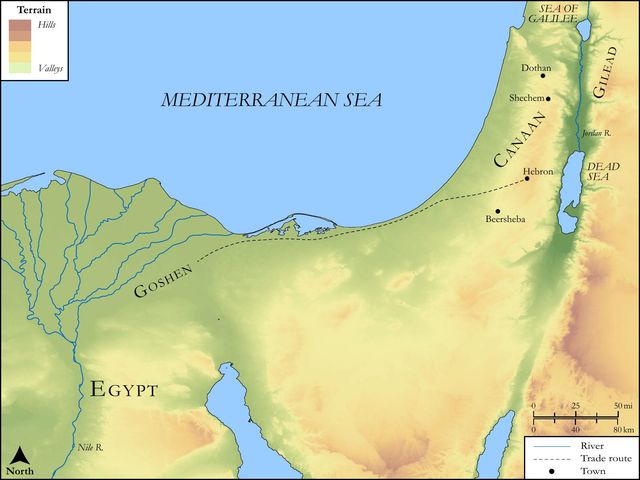
See on the biblical-era map


Study this verse
Public-domain commentary
Matthew Henry
From his Commentary on the Whole Bible. Henry comments on passages, not single verses — this entry covers Genesis 50:7–14.
We have here an account of Jacob's funeral. Of the funerals of the kings of Judah, usually, no more is said than this, They were buried with their fathers in the city of David: but the funeral of the patriarch Jacob is more largely and fully described, to show how much better God was to him than he expected (he had spoken more than once of dying for grief, and going to the grave bereaved of his children, but, behold, he dies in honour, and is followed to the grave by all his children), and also because his orders concerning his burial were given and observed in faith, and in expectation both of the earthly and of the heavenly Canaan. Now, 1. It was a stately funeral. He was attended to the grave, not only by his own family, but by the courtiers, and all the great men of the kingdom, who, in token of their gratitude to Joseph, showed this respect to his father for his sake, and did him honour at his death. Though the Egyptians had had an antipathy to the Hebrews, and had looked upon them with disdain (Gen 43:32), yet now, that they were better acquainted with them, they began to have a respect for them. Good old Jacob had conducted himself so well among them as to gain universal esteem. Note, Professors of religion should endeavour, by wisdom and love, to remove the prejudices which many may have conceived against them because they do not know them. There went abundance of chariots and horsemen, not only to attend them a little way, but to go through with them. Note, The decent solemnities of funerals, according to a man's situation, are very commendable; and we must not say of them, To what purpose is this waste? See Act 8:2; Luk 7:12. 2. It was a sorrowful funeral (Gen 50:10, Gen 50:11); standers-by took notice of it as a grievous mourning. Note, The death of good men is a great loss to any place, and ought to be greatly lamented. Stephen dies a martyr, and yet devout men make great lamentations for him. The solemn mourning for Jacob gave a name to the place, Abel-Mizraim, the mourning of the Egyptians, which served for a testimony against the next generation of the Egyptians, who oppressed the posterity of this Jacob to whom their ancestors showed such respect.
Continue studying Genesis 50:13 across the web’s major study libraries — every link below opens this exact verse, chapter, or book on the destination site.
Read & Compare
 BibleGatewayThis verse in more than 200 translations and 70 languages.
 Bible.comThe YouVersion reader — hundreds of translations, reading plans, and highlights.
 ESV.orgCrossway's official English Standard Version reader.
 NET BibleThe NET translation with 60,000+ translators' notes on every rendering decision.
 STEP BibleTyndale House's free study tool — original text, vocabulary, and scholarly resources.
 BibliaLogos Bible Software's free web reader.
 USCCBThe New American Bible (Revised Edition) with the U.S. bishops' study notes.
Commentaries
 BibleHub CommentariesDozens of classic commentaries on this verse, gathered on one page.
 StudyLightMore than 100 commentary sets — the largest collection on the web.
 BibleRefPlain-English commentary on what this verse means, verse by verse.
 Enduring WordDavid Guzik's free commentary on this chapter, widely used by Bible teachers.
 Bible Study ToolsVerse commentary alongside Greek and Hebrew study aids.
Original Language & Research
- BibleHub InterlinearThe verse word by word — original language, transliteration, and English.
- BibleHub LexiconEvery word's original-language definition and Strong's entry.
 Blue Letter BibleDeep-study tools — Strong's numbers, concordance, and word studies.
 SefariaThe Hebrew text with Rashi and centuries of Jewish commentary.
Sermons, Hymns & Audio


TrulyRandomVerse is not affiliated with these sites and doesn’t control their content. They’re linked because they’re genuinely useful.
Summary
Genesis 50:13 meticulously records the solemn fulfillment of Jacob's dying wish: his burial in the ancestral tomb at the Cave of Machpelah in Canaan. This dutiful act, carried out by his sons, particularly Joseph, not only signifies profound familial respect and adherence to patriarchal instructions but also powerfully reaffirms their unwavering faith in God's covenant promises concerning the land, underscoring the enduring legacy and spiritual heritage of the patriarchs.
Context
ShowHideLiterary Context
This verse serves as the narrative climax of Jacob's earthly journey and the immediate aftermath of his death, as described in Genesis 49:33. Prior to his passing, Jacob had extracted a solemn oath from his sons, especially Joseph, to transport his body from Egypt and inter him alongside his forefathers in the land of Canaan (Genesis 47:29-31 and Genesis 49:29-32). The preceding verses (Genesis 50:1-12) detail the extensive mourning period in Egypt and the grand procession that journeyed from Egypt to Canaan for the burial. This elaborate funeral, involving both Jacob's family and Egyptian dignitaries, underscores the immense honor bestowed upon Jacob and the profound commitment of his sons to fulfill his final, covenantally significant request. The journey itself highlights the geographical and emotional distance between their temporary residence in Egypt and their ultimate spiritual home in the Promised Land.
Historical & Cultural Context
In the ancient Near East, burial practices were deeply significant, often reflecting social status, familial ties, and religious beliefs. The desire for ancestral burial, particularly in one's homeland, was paramount, signifying a connection to one's heritage and a hope for continuity. Jacob's insistence on being buried in Canaan, despite the prosperity and comfort he enjoyed in Egypt, was a powerful cultural statement. It aligned with the practice of interring family members together, as seen with Abraham, Sarah, Isaac, Rebekah, and Leah already resting in Machpelah. The involvement of Egyptian officials in the funeral procession (as mentioned in Genesis 50:7-9) speaks to Joseph's high standing in Egypt and the diplomatic relations between the Hebrews and the Egyptians at that time, lending an extraordinary level of prestige and solemnity to the event.
Key Themes
ShowHideGenesis 50:13 contributes significantly to several overarching themes in the book of Genesis. Foremost among them is the Covenant Promise of Land, as Jacob's burial in Machpelah powerfully reasserts the patriarchs' claim to Canaan, even while the vast majority of their descendants reside elsewhere. This act reinforces the theme of God's Faithfulness to His word, demonstrating that despite delays and detours, His promises will ultimately be fulfilled. The verse also highlights the theme of Familial Loyalty and Obedience, as Jacob's sons dutifully carry out his specific, arduous request, showcasing the strong bonds and reverence within the patriarchal family. Finally, it underscores the theme of Hope Beyond Present Circumstances, as Jacob's focus on his eternal resting place in Canaan, rather than his comfortable life in Egypt, models a faith that looks beyond the immediate to God's ultimate plan and future inheritance.
Exposition and Analysis
ShowHideKey Word Analysis
ShowHideFrom בָּנָה (banah), meaning 'to build,' this term highlights the role of sons as builders and perpetuators of the family name and legacy. In this context, it emphasizes the familial duty and continuity of the patriarchal line, as Jacob's male descendants are responsible for ensuring his final wishes are honored and the family's covenantal connection to the land is maintained.
A primitive root meaning 'to lift,' 'to bear,' or 'to take away,' this verb conveys the physical act of transporting Jacob's body. The use of this word implies a solemn and respectful undertaking, signifying the great honor and reverence shown to Jacob, rather than a mere logistical transfer. It underscores the personal involvement and effort of his sons in fulfilling this sacred duty.
A feminine passive participle from אָחַז (achaz), meaning 'to seize' or 'to hold,' this term refers to something seized or held, specifically land. Its use here emphasizes the legal and permanent nature of Abraham's acquisition of the burial plot. This was not a temporary lease but a rightful, owned piece of the Promised Land, serving as a tangible and enduring claim to the future inheritance promised by God.
Verse Breakdown
ShowHide"For his sons carried him into the land of Canaan,"
This initial clause establishes the dutiful action taken by Jacob's sons, fulfilling his explicit dying wish. The journey from Egypt to Canaan was a significant undertaking, underscoring the deep respect and honor accorded to the patriarch. The phrase "land of Canaan" immediately connects the act to the covenant promises made to Abraham, Isaac, and Jacob concerning their future inheritance.
"and buried him in the cave of the field of Machpelah,"
This part specifies the precise location of Jacob's interment. The "cave of the field of Machpelah" is not just any burial site; it is a historically and theologically significant place. The act of burial itself signifies the finality of Jacob's earthly life and his joining with his ancestors.
"which Abraham bought with the field for a possession of a buryingplace of Ephron the Hittite, before Mamre."
This concluding clause provides crucial historical context, linking Jacob's burial directly to Abraham's initial acquisition of the land. It meticulously details the legal transaction, emphasizing that Abraham purchased this specific plot from Ephron the Hittite, "for a possession of a buryingplace." This detail reinforces the legitimacy and permanence of the patriarchs' claim to a piece of the Promised Land, even if only for burial. The mention of "before Mamre" further situates the location geographically, near a significant patriarchal dwelling place.
Literary Devices
ShowHideGenesis 50:13 employs several literary devices to convey its profound meaning. The most prominent is Symbolism, where the Cave of Machpelah itself functions as a powerful symbol. It is not merely a burial site but represents the tangible firstfruits of the Promised Land, a physical anchor for the covenant promises made to Abraham and his descendants. Jacob's burial there is an act of Affirmation, reinforcing the patriarchs' unwavering faith in God's promise of the land, even when they live as sojourners. The detailed recounting of Abraham's purchase of the field (Genesis 23) serves as Allusion or Intertextuality, linking this final act of Jacob's life directly to the foundational covenant established with Abraham, emphasizing continuity across generations. Furthermore, the entire narrative arc of Jacob's journey to Egypt and his return in death for burial in Canaan can be seen as a form of Foreshadowing, hinting at the future return of the Israelites from Egypt to inherit the land promised to their forefathers.
Theological and Thematic Connections
ShowHideJacob's deliberate choice to be buried in Canaan, rather than in the prosperous land of Egypt, serves as a powerful testament to his unwavering faith in God's covenant promises. This act transcends a mere personal preference; it is a profound declaration of trust in God's long-term plan for his descendants to inherit the land of Canaan (Genesis 12:7). It underscores the theological truth that God's promises are sure and will be fulfilled, even if their complete realization spans generations and involves periods of waiting or exile. The continuity of burials in Machpelah—Abraham, Sarah, Isaac, Rebekah, Leah, and now Jacob—creates a tangible link across generations, emphasizing the unbroken line of God's chosen family and the enduring nature of His covenant faithfulness.
Reflection and Application
ShowHideGenesis 50:13 offers profound lessons for believers today, primarily centered on faith, legacy, and obedience. The sons' arduous journey and meticulous fulfillment of Jacob's dying wish highlight the importance of honoring our elders, respecting their final requests, and valuing the spiritual and familial heritage passed down through generations. This act of obedience demonstrates a deep commitment to family bonds and ancestral ties, a principle that remains vital in contemporary society. More significantly, Jacob's insistence on burial in Canaan, despite his comfortable life in Egypt, serves as a powerful model of faith that looks beyond immediate circumstances and earthly comforts to God's ultimate promises. It encourages us to cultivate a long-term vision rooted in divine truth, prioritizing eternal inheritance over temporal security. For us, this means aligning our lives with God's will and promises, understanding that our true home and ultimate hope are found not in this world, but in the eternal kingdom of God, a spiritual "Promised Land" that transcends physical locations.
Questions for Reflection
ShowHideFAQ
ShowHideWhy was it so important for Jacob to be buried in Canaan and not Egypt?
ShowHideJacob's insistence on being buried in Canaan, far from the prosperity and comfort of Egypt, was a profound act of faith. It demonstrated his unwavering belief in God's covenant promise to Abraham, Isaac, and himself, that their descendants would inherit the land of Canaan (Genesis 15:18). His burial there was a symbolic claim to the Promised Land, even in death, and a testament to his trust in God's future fulfillment of that promise, rather than in the temporary security and allure of Egypt. It was a declaration of his spiritual allegiance to God's covenant, rather than to the most powerful empire of his day.
What is the significance of the Cave of Machpelah?
ShowHideThe Cave of Machpelah is profoundly significant because it was the first piece of the Promised Land legally acquired by Abraham (Genesis 23:16-20). It served as the burial place for Abraham, Sarah, Isaac, Rebekah, Leah, and now Jacob, making it a tangible link to the patriarchs and a symbol of the continuity of God's covenant with His chosen family. It represented a permanent, physical claim to the land promised by God, reinforcing the legitimacy of their future inheritance and serving as a constant reminder of God's faithfulness across generations.
Christ-Centered Fulfillment
ShowHideJacob's burial in the Promised Land, in the very plot bought by Abraham, serves as a profound prefigurement of the ultimate fulfillment of God's promises in Christ. Just as Jacob's physical resting place in Canaan signified a future inheritance for his descendants, so too does Christ's death and resurrection secure for believers an eternal spiritual inheritance in the heavenly "Promised Land" (Hebrews 11:13-16). The patriarchs' longing for a better country, evidenced by their desire to be buried in Canaan, finds its ultimate satisfaction in Christ, who is the true "possession" and the fulfillment of all God's covenant promises. Through His atoning work, Christ grants believers not just a plot of land, but eternal life and a place in God's eternal kingdom (John 14:2-3). Our spiritual inheritance in Christ is far greater than any earthly territory, for He has made us "heirs of God and joint heirs with Christ" (Romans 8:17), guaranteeing us a place in the new heavens and new earth, the ultimate and everlasting fulfillment of all God's promises (Revelation 21:1-4).