


Genesis 50:14
Bible text: King James Version (1769 Blayney text) · Public domain
Bible text: Berean Standard Bible · Public domain
Bible text: American Standard Version (1901) · Public domain
Bible text: World English Bible, Messianic edition · Public domain
Bible text: Geneva Bible (1599) · Public domain
Bible text: Young's Literal Translation · Public domain
- וַיָּשָׁבvai·Ya·shovand he went backH7725Conj-w ¦ V-Qal-ConsecImperf-3msVerb Qal Consecutive Imperfect 3rd Singular Masculineוַandיָּשָׁבhe went back
- יוֹסֵףyo·SefJosephH3130N-proper-mNoun Proper Masculine
- מִצְרַיְמָהmitz·Ray·mahEgypt towardsH4714N-proper ¦ SfxNoun Proper LocationמִצְרַיְמָEgyptהtowards
- הוּאhu'heH1931Pro-3msPronoun Personal 3rd Singular Masculine
- וְאֶחָיוve·'e·Chavand his brothersH251Conj-w ¦ N-mpc ¦ 3msNoun Plural Masculine Constructוְandאֶחָיbrothersוhis
- וְכָלve·kholand allH3605Conj-w ¦ N-msNoun Singular Masculine Absoluteוְandכָלall
- הָעֹלִיםha·'o·Limthose [who] had gone upH5927Art ¦ V-Qal-Prtcpl-mpVerb Qal Participle Plural Masculine Absoluteהָthoseעֹלִים[who] had gone up
- אִתּוֹ'i·Towith himH854Prep ¦ 3msPrepositionאִתּwithוֹhim
- לִקְבֹּרlik·Borto buryH6912Prep-l ¦ V-Qal-InfVerb Qal Infinitive Constructלִtoקְבֹּרbury
- אֶת'et<obj.>H853DirObjMParticle Object Indicator
- אָבִיו'a·Vivhis fatherH1N-msc ¦ 3msNoun Singular Masculine Constructאָבִיfatherוhis
- אַחֲרֵי'a·cha·ReiafterH310Adj-mpcAdjective Numerical Plural Masculine Construct
- קָבְרוֹka·ve·Rohe had buriedH6912V-Qal-Inf ¦ 3msVerb Qal Infinitive Constructקָבְרhad buriedוֹhe
- אֶת'et<obj.>H853DirObjMParticle Object Indicator
- אָבִיו'a·Vivhis fatherH1N-msc ¦ 3msNoun Singular Masculine Constructאָבִיfatherוhis
English is a literal word-by-word gloss of the Hebrew, not the KJV's wording. Why?
This is the original text the KJV's translators worked from — each Hebrew word with its own literal English meaning in this verse, prepared by scholars at Tyndale House, Cambridge. The KJV translates whole sentences, not word by word, so its wording differs: one Hebrew word can become several English words, and the KJV may choose “the LORD” where the gloss reads “Yahweh”. Both are faithful — they answer different questions. For the KJV's own rendering, switch to the KJV text.
Details
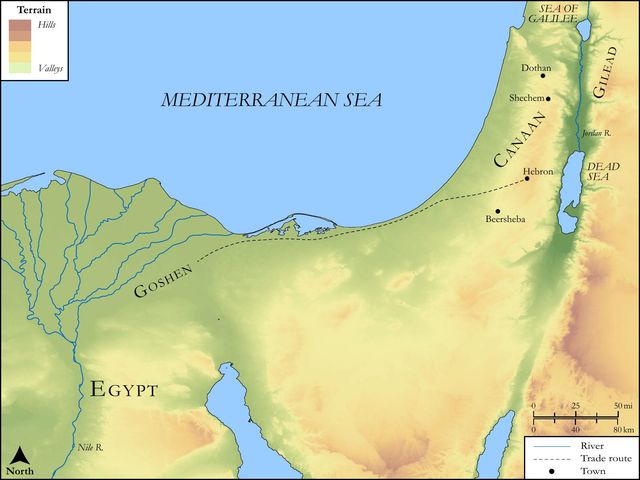
See on the biblical-era maps


Study this verse
Public-domain commentary
Matthew Henry
From his Commentary on the Whole Bible. Henry comments on passages, not single verses — this entry covers Genesis 50:7–14.
We have here an account of Jacob's funeral. Of the funerals of the kings of Judah, usually, no more is said than this, They were buried with their fathers in the city of David: but the funeral of the patriarch Jacob is more largely and fully described, to show how much better God was to him than he expected (he had spoken more than once of dying for grief, and going to the grave bereaved of his children, but, behold, he dies in honour, and is followed to the grave by all his children), and also because his orders concerning his burial were given and observed in faith, and in expectation both of the earthly and of the heavenly Canaan. Now, 1. It was a stately funeral. He was attended to the grave, not only by his own family, but by the courtiers, and all the great men of the kingdom, who, in token of their gratitude to Joseph, showed this respect to his father for his sake, and did him honour at his death. Though the Egyptians had had an antipathy to the Hebrews, and had looked upon them with disdain (Gen 43:32), yet now, that they were better acquainted with them, they began to have a respect for them. Good old Jacob had conducted himself so well among them as to gain universal esteem. Note, Professors of religion should endeavour, by wisdom and love, to remove the prejudices which many may have conceived against them because they do not know them. There went abundance of chariots and horsemen, not only to attend them a little way, but to go through with them. Note, The decent solemnities of funerals, according to a man's situation, are very commendable; and we must not say of them, To what purpose is this waste? See Act 8:2; Luk 7:12. 2. It was a sorrowful funeral (Gen 50:10, Gen 50:11); standers-by took notice of it as a grievous mourning. Note, The death of good men is a great loss to any place, and ought to be greatly lamented. Stephen dies a martyr, and yet devout men make great lamentations for him. The solemn mourning for Jacob gave a name to the place, Abel-Mizraim, the mourning of the Egyptians, which served for a testimony against the next generation of the Egyptians, who oppressed the posterity of this Jacob to whom their ancestors showed such respect.
Continue studying Genesis 50:14 across the web’s major study libraries — every link below opens this exact verse, chapter, or book on the destination site.
Read & Compare
 BibleGatewayThis verse in more than 200 translations and 70 languages.
 Bible.comThe YouVersion reader — hundreds of translations, reading plans, and highlights.
 ESV.orgCrossway's official English Standard Version reader.
 NET BibleThe NET translation with 60,000+ translators' notes on every rendering decision.
 STEP BibleTyndale House's free study tool — original text, vocabulary, and scholarly resources.
 BibliaLogos Bible Software's free web reader.
 USCCBThe New American Bible (Revised Edition) with the U.S. bishops' study notes.
Commentaries
 BibleHub CommentariesDozens of classic commentaries on this verse, gathered on one page.
 StudyLightMore than 100 commentary sets — the largest collection on the web.
 BibleRefPlain-English commentary on what this verse means, verse by verse.
 Enduring WordDavid Guzik's free commentary on this chapter, widely used by Bible teachers.
 Bible Study ToolsVerse commentary alongside Greek and Hebrew study aids.
Original Language & Research
- BibleHub InterlinearThe verse word by word — original language, transliteration, and English.
- BibleHub LexiconEvery word's original-language definition and Strong's entry.
 Blue Letter BibleDeep-study tools — Strong's numbers, concordance, and word studies.
 SefariaThe Hebrew text with Rashi and centuries of Jewish commentary.
Sermons, Hymns & Audio


TrulyRandomVerse is not affiliated with these sites and doesn’t control their content. They’re linked because they’re genuinely useful.
Summary
Genesis 50:14 succinctly records Joseph's return to Egypt, accompanied by his brothers and the entire funeral entourage, immediately after the solemn burial of his father, Jacob, in the land of Canaan. This pivotal verse marks the completion of a profound familial duty, underscoring Joseph's unwavering filial devotion, the enduring reconciliation and unity within Jacob's family, and their continued residence in Egypt as a crucial phase in God's sovereign plan for the burgeoning nation of Israel.
Context
ShowHideLiterary Context
This verse serves as the concluding statement to the elaborate narrative of Jacob's death and burial, which spans from Genesis 49:29 through Genesis 50:13. Following Jacob's final blessings and prophecies for his sons in Genesis 49, his death in Genesis 49:33 sets the stage for Joseph's immediate and meticulous arrangements for the embalming and funeral. The detailed account of the journey to Canaan, the mourning at Goren Atad (Genesis 50:10-11), and the burial in the cave of Machpelah (Genesis 50:13) highlights the immense respect accorded to Jacob and the fulfillment of his dying wish. Verse 14, therefore, closes this significant episode, transitioning the narrative back to Egypt and setting up the subsequent interaction between Joseph and his brothers regarding their fear of retribution (Genesis 50:15-21).
Historical & Cultural Context
The funeral procession described prior to this verse was an extraordinary event, reflecting both Egyptian and Canaanite customs. Embalming, as performed for Jacob (Genesis 50:2-3), was a distinctly Egyptian practice, indicative of Joseph's high status and the honor bestowed upon his father. The large retinue of Pharaoh's servants, elders of his house, and all the elders of the land of Egypt, along with chariots and horsemen (Genesis 50:7-9), underscores the political and social prominence of Joseph. The journey from Egypt to Canaan for burial was a considerable undertaking, demonstrating the deep respect for ancestral burial grounds, a respect already shown when Abraham bought Machpelah for a buryingplace. The cave of Machpelah, near Mamre, was a revered family tomb, purchased by Abraham (Genesis 23:1-20) and already containing Sarah, Abraham, Isaac, Rebekah, and Leah. Joseph's commitment to burying Jacob there, despite the distance, exemplifies the strong filial piety and covenantal significance placed on land and lineage within Hebrew culture.
Key Themes
ShowHideGenesis 50:14 contributes to several overarching themes in the Book of Genesis. Firstly, it reinforces the theme of Filial Piety and Covenantal Faithfulness, as Joseph meticulously honors his father's dying wish, demonstrating unwavering commitment to family and the ancestral land. Secondly, it highlights Reconciliation and Family Unity, as "he, and his brethren" return together, signifying the enduring healing of their fractured relationships, a testament to God's redemptive work in their lives after years of estrangement and betrayal (Genesis 45:4-8). Thirdly, the return to Egypt underscores the theme of Divine Providence and God's Sovereign Plan. Despite the emotional and logistical demands of the burial, the family's return to Egypt confirms their continued temporary dwelling there, a necessary phase for their growth into a great nation as foretold to Abraham in the covenant promises (Genesis 15:13-14). Finally, it subtly points to Joseph's Continued Leadership and Provision for his family, as he remains the central figure ensuring their welfare in a foreign land.
Exposition and Analysis
ShowHideKey Word Analysis
ShowHideDerived from a root meaning "let him add," Joseph (H3130) is the central figure, whose name reflects themes of increase and divine provision. Here, his presence signifies leadership and the fulfillment of family duty, highlighting his ongoing role as the one through whom God's purposes for Israel are being advanced in Egypt.
This primitive root (H7725) means "to turn back (hence, away) transitively or intransitively, literally or figuratively." In this context, it denotes a literal physical return, emphasizing the completion of the specific task of burial and the resumption of their established life in Egypt. The word often carries connotations of repentance or restoration in other contexts, but here it simply marks a decisive change of direction back to a prior state or location.
A primitive word (H1) meaning "father," used literally here. The repetition of "his father" (Jacob) emphasizes the profound filial duty and the personal significance of this act for Joseph. It highlights the patriarchal structure of the family and the deep respect for the deceased patriarch, whose wishes were paramount.
Verse Breakdown
ShowHide"And Joseph returned into Egypt,"
This opening clause establishes the primary subject and action: Joseph's decisive return journey. It signifies the successful completion of the arduous task of burying Jacob in Canaan and his resumption of his life and responsibilities in Egypt. The emphasis is on Joseph's leadership in this entire undertaking.
"he, and his brethren, and all that went up with him to bury his father,"
This phrase details the composition of the returning party. The inclusion of "his brethren" is highly significant, underscoring the complete reconciliation and unity within the family. They are no longer estranged but are now a cohesive unit, journeying together under Joseph's leadership. "All that went up with him" refers to the extensive Egyptian entourage that accompanied the funeral procession, reflecting Joseph's high status and the respect accorded to Jacob.
"after he had buried his father."
This concluding phrase acts as a temporal marker, confirming that the return occurred immediately following the completion of the burial. The repetition of "his father" (Jacob) and the act of "buried" (H6912, qâbar') serves to emphasize the thoroughness and finality of Joseph's fulfillment of Jacob's dying wish. It highlights Joseph's unwavering commitment to filial piety and the successful execution of this sacred duty.
Literary Devices
ShowHideThe verse employs Repetition ("after he had buried his father") to emphasize the completion and finality of the burial task, underscoring Joseph's meticulous fulfillment of his filial duty. This repetition also provides a sense of closure to the long narrative of Jacob's death and funeral. The Synecdoche "all that went up with him" represents the entire large and diverse funeral procession, illustrating the scale and significance of the event. The simple, declarative sentence structure contributes to the Conciseness and directness of the narrative, moving the story forward efficiently while still conveying profound meaning about Joseph's character and the family's situation.
Theological and Thematic Connections
ShowHideGenesis 50:14, though seemingly a simple statement of travel, is deeply embedded in the theological tapestry of Genesis. It powerfully illustrates the principle of filial piety and the sacredness of family bonds, as Joseph meticulously honors his father's final wishes, even across significant geographical and cultural divides. More profoundly, it highlights the theme of divine providence and God's faithfulness to His covenant promises. The return to Egypt, rather than settling in Canaan, reaffirms that God's plan for the nascent nation of Israel was to grow and multiply in a foreign land before their eventual exodus, as foretold to Abraham. This temporary sojourn was crucial for their development into a distinct people, protected and provided for by Joseph, whom God had strategically placed in power. The enduring unity of Joseph and his brothers, journeying together, serves as a powerful testament to the transformative power of forgiveness and reconciliation, a divine work that healed deep familial wounds.
Reflection and Application
ShowHideGenesis 50:14, a seemingly mundane detail of travel, offers profound lessons for contemporary believers. Joseph's unwavering dedication to fulfilling his father's dying wish, despite his immense responsibilities and the logistical challenges, serves as a powerful model of commitment and integrity. It calls us to reflect on our own faithfulness in keeping promises, especially to family, and in honoring those who have poured into our lives. The image of Joseph and his brothers returning together, united after years of bitter division, is a poignant reminder of the redemptive power of forgiveness and the importance of pursuing reconciliation in our own relationships. It challenges us to lay aside past hurts and embrace the healing that God offers, fostering unity within our families and communities. Furthermore, this verse subtly reinforces the truth that God's sovereign plan is at work even in the ordinary comings and goings of life. Just as Joseph's return to Egypt was part of a larger divine purpose for Israel, so too are our daily movements and decisions woven into God's grand design, guiding us toward His ultimate purposes, as Joseph himself declared, "You intended to harm me, but God intended it for good" (Genesis 50:20).
Questions for Reflection
ShowHideFAQ
ShowHideWhy did Joseph and his family return to Egypt after burying Jacob in Canaan?
ShowHideJoseph and his family returned to Egypt because it was their established place of residence and the center of Joseph's significant administrative responsibilities in Pharaoh's court. Their journey to Canaan was solely to fulfill Jacob's specific dying wish to be buried in the ancestral tomb, the cave of Machpelah, alongside Abraham, Sarah, Isaac, Rebekah, and Leah (Genesis 49:29-31). Egypt was the divinely appointed location for the nascent Israelite nation to grow and multiply, as part of God's covenant plan revealed to Abraham (Genesis 15:13-14), before their eventual Exodus and inheritance of the Promised Land.
What does this verse tell us about Joseph's character?
ShowHideThis verse powerfully highlights several facets of Joseph's exemplary character. His meticulous fulfillment of his father's final, demanding request, despite his high status and responsibilities in Egypt, underscores his profound filial piety and unwavering devotion. It demonstrates his integrity and commitment to promises, even those requiring significant effort and travel. Furthermore, his leadership in orchestrating such a grand procession and his subsequent return with his entire family implicitly show his continued role as a protector and provider for his brethren, solidifying his reconciled and compassionate leadership over Jacob's household.
Christ-Centered Fulfillment
ShowHideJoseph's return to Egypt after fulfilling his sacred duty to his father subtly prefigures the redemptive trajectory of Christ. Just as Joseph, a type of savior to his family who preserved them from famine and death, returned to his place of authority in Egypt to continue providing for and protecting his people, so too Christ, after accomplishing the ultimate work of redemption through His death and resurrection, ascended to His rightful place of authority at the right hand of the Father (Acts 1:9-11). From there, the resurrected Christ continues to intercede for His Church (Romans 8:34), to send the Holy Spirit (John 16:7), and to sovereignly rule over all creation, ensuring the spiritual sustenance and ultimate inheritance of His redeemed people (Ephesians 1:20-23). The temporary dwelling of Israel in Egypt, overseen by Joseph, also serves as an earthly shadow of the believer's temporary sojourn on earth, guided and sustained by Christ, before entering the promised eternal rest and true home in the new heavens and new earth, secured by His sacrifice and resurrection (Hebrews 11:13-16 and Revelation 21:1-4).