


Genesis 49:29
- וַיְצַוvay·Tzavand he commandedH6680Conj-w ¦ V-Piel-ConsecImperf-3msVerb Piel Consecutive Imperfect 3rd Singular Masculineוַandיְצַוhe commanded
- אוֹתָם'o·Tam<obj.> themH853DirObjM ¦ 3mpParticle Object Indicatorאוֹתָ<obj.>םthem
- וַיֹּאמֶרvai·Yo·merand he saidH559Conj-w ¦ V-Qal-ConsecImperf-3msVerb Qal Consecutive Imperfect 3rd Singular Masculineוַandיֹּאמֶרhe said
- אֲלֵהֶם'a·le·Hemto themH413Prep ¦ 3mpPrepositionאֲלֵtoהֶםthem
- אֲנִי'a·NiIH589Pro-1csPronoun Personal 1st Singular common gender
- נֶאֱסָףne·'e·Saf[am] about to be gatheredH622V-Niphal-Prtcpl-msVerb Niphal Participle Singular Masculine Absolute
- אֶל'eltoH413PrepPreposition
- עַמִּי'a·Mimy peopleH5971N-msc ¦ 1csNoun Singular Masculine Constructעַמִּpeopleיmy
- קִבְרוּkiv·RuburyH6912V-Qal-Imp-2mpVerb Qal Imperative 2nd Plural Masculine
- אֹתִי'o·Ti<obj.> meH853DirObjM ¦ 1csParticle Object Indicatorאֹתִ<obj.>יme
- אֶל'elwithH413PrepPreposition
- אֲבֹתָי'a·vo·Taimy fathersH1N-fpc ¦ 1csNoun Plural Feminine Constructאֲבֹתָfathersיmy
- אֶל'elintoH413PrepPreposition
- הַמְּעָרָהha·me·'a·Rahthe caveH4631Art ¦ N-fsNoun Singular Feminine Absoluteהַtheמְּעָרָהcave
- אֲשֶׁר'a·SherwhichH834RelParticle Relative
- בִּשְׂדֵהbis·Deh[is] in [the] field ofH7704Prep-b ¦ N-mscNoun Singular Masculine Constructבִּ[is] inשְׂדֵה[the] field of
- עֶפְרוֹןef·RonEphronH6085N-proper-mNoun Proper Masculine
- הַחִתִּיHa·chi·Tithe HittiteH2850Art ¦ N-msNoun Gentilic Singular Masculine AbsoluteהַtheחִתִּיHittite
English is a literal word-by-word gloss of the Hebrew, not the KJV's wording. Why?
This is the original text the KJV's translators worked from — each Hebrew word with its own literal English meaning in this verse, prepared by scholars at Tyndale House, Cambridge. The KJV translates whole sentences, not word by word, so its wording differs: one Hebrew word can become several English words, and the KJV may choose “the LORD” where the gloss reads “Yahweh”. Both are faithful — they answer different questions. For the KJV's own rendering, switch to the KJV text.
Details
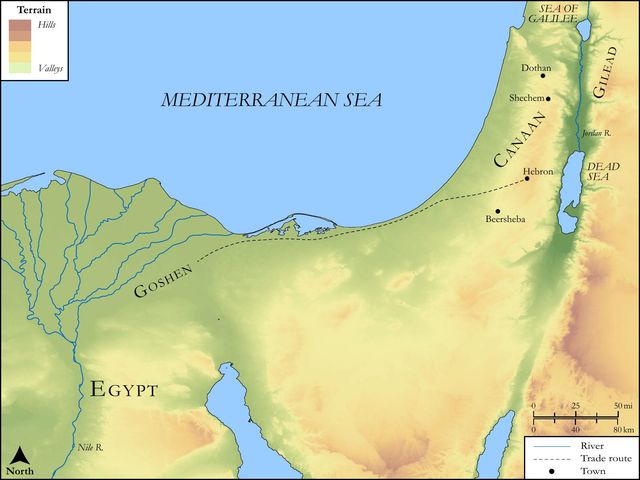
See on the biblical-era map


Study this verse
Public-domain commentary
Matthew Henry
From his Commentary on the Whole Bible. Henry comments on passages, not single verses — this entry covers Genesis 49:28–33. His two-level outline is real structure in the source text, so it is rendered as structure.
Here is, I. The summing up of the blessings of Jacob's sons, Gen 49:28. Though Reuben, Simeon, and Levi were put under the marks of their father's displeasure, yet he is said to bless them every one according to his blessing; for none of them were rejected as Esau was. Note, Whatever rebukes of God's word or providence we are under at any time, yet, as long as we have an interest in God's covenant, a place and a name among his people, and good hopes of a share in the heavenly Canaan, we must account ourselves blessed.
II.The solemn charge Jacob gave them concerning his burial, which is a repetition of what he had before given to Joseph.
See how he speaks of death, now that he is dying: I am to be gathered unto my people, Gen 49:29. Note, It is good to represent death to ourselves under the most desirable images, that the terror of it may be taken off. Though it separates us from our children and our people in this world, it gathers us to our fathers and to our people in the other world. Perhaps Jacob uses this expression concerning death as a reason why his sons should bury him in Canaan; for, says he, "I am to be gathered unto my people, my soul must go to the spirits of just men made perfect: and therefore bury me with my fathers, Abraham and Isaac, and their wives," Gen 49:31. Observe,
1.His heart was very much upon it, not so much from a natural affection to his native soil as from a principle of faith in the promise of God, that Canaan should be the inheritance of his seed in due time. Thus he would keep up in his sons a remembrance of the promised land, and not only would have their acquaintance with it renewed by a journey thither on that occasion, but their desire towards it and their expectation of it preserved.
2.He is very particular in describing the place both by the situation of it and by the purchase Abraham had made of it for a burying-place, Gen 49:30, Gen 49:32. He was afraid lest his sons, after seventeen years' sojourning in Egypt, had forgotten Canaan, and even the burying-place of their ancestors there, or lest the Canaanites should dispute his title to it; and therefore he specifies it thus largely, and the purchase of it, even when he lies a-dying, not only to prevent mistakes, but to show how mindful he was of that country. Note, It is, and should be, a great pleasure to dying saints to fix their thoughts upon the heavenly Canaan, and the rest they hope for there after death.
III.The death of Jacob, Gen 49:33.
When he had finished both his blessing and his charge (both which are included in the commanding of his sons), and so had finished his testimony, he addressed himself to his dying work.
1.He put himself into a posture for dying; having before seated himself upon the bed-side, to bless his sons (the spirit of prophecy bringing fresh oil to his expiring lamp, Dan 10:19), when that work was done, he gathered up his feet into the bed, that he might lie along, not only as one patiently submitting to the stroke, but as one cheerfully composing himself to rest, now that he was weary. I will lay me down, and sleep.
2.He freely resigned his spirit into the hand of God, the Father of spirits: He yielded up the ghost.
3.His separated soul went to the assembly of the souls of the faithful, which, after they are delivered from the burden of the flesh, are in joy and felicity: he was gathered to his people. Note, If God's people be our people, death will gather us to them.
Continue studying Genesis 49:29 across the web’s major study libraries — every link below opens this exact verse, chapter, or book on the destination site.
Read & Compare
 BibleGatewayThis verse in more than 200 translations and 70 languages.
 Bible.comThe YouVersion reader — hundreds of translations, reading plans, and highlights.
 ESV.orgCrossway's official English Standard Version reader.
 NET BibleThe NET translation with 60,000+ translators' notes on every rendering decision.
 STEP BibleTyndale House's free study tool — original text, vocabulary, and scholarly resources.
 BibliaLogos Bible Software's free web reader.
 USCCBThe New American Bible (Revised Edition) with the U.S. bishops' study notes.
Commentaries
 BibleHub CommentariesDozens of classic commentaries on this verse, gathered on one page.
 StudyLightMore than 100 commentary sets — the largest collection on the web.
 BibleRefPlain-English commentary on what this verse means, verse by verse.
 Enduring WordDavid Guzik's free commentary on this chapter, widely used by Bible teachers.
 Bible Study ToolsVerse commentary alongside Greek and Hebrew study aids.
Original Language & Research
- BibleHub InterlinearThe verse word by word — original language, transliteration, and English.
- BibleHub LexiconEvery word's original-language definition and Strong's entry.
 Blue Letter BibleDeep-study tools — Strong's numbers, concordance, and word studies.
 SefariaThe Hebrew text with Rashi and centuries of Jewish commentary.
Sermons, Hymns & Audio


TrulyRandomVerse is not affiliated with these sites and doesn’t control their content. They’re linked because they’re genuinely useful.
Summary
Genesis 49:29 records Jacob's final, solemn directive to his sons concerning his burial. From his deathbed in Egypt, he commands them to inter him with his patriarchal ancestors—Abraham, Sarah, Isaac, Rebekah, and Leah—in the sacred Cave of Machpelah in Canaan. This instruction profoundly underscores Jacob's unwavering faith in God's covenant promise of the land, his deep reverence for his family's spiritual heritage, and a foundational biblical understanding of death as a peaceful gathering to one's spiritual forebears.
Context
ShowHideLiterary Context
This verse is situated within the climactic final chapter of Jacob's life, Genesis 49. Having delivered prophetic blessings and pronouncements upon each of his twelve sons, Jacob now turns to his most personal and final instruction: his burial. This command serves as the immediate precursor to his death, detailed in Genesis 49:33, and is subsequently fulfilled by Joseph and his brothers in Genesis 50:1-14. The placement of this directive at the very end of his life highlights its profound importance to Jacob, tying his earthly existence directly to the promises of God and the lineage of faith. It echoes his earlier, fervent request to Joseph in Genesis 47:29-31.
Historical & Cultural Context
In the ancient Near East, burial practices were deeply significant, often reflecting status, family identity, and religious beliefs. Ancestral tombs, like the Cave of Machpelah, were highly valued as permanent resting places that signified continuity of lineage and a connection to the land. For the patriarchs, who were sojourners, the possession of a burial plot in Canaan was a tangible assertion of their claim to the promised land, even before its full inheritance. The mention of "Ephron the Hittite" harks back to Abraham's meticulous purchase of this land from the Hittites in Genesis 23, emphasizing the legal and historical legitimacy of the family's claim to this sacred burial site. The idiom "gathered unto my people" was a common expression for death, understood as a peaceful transition to the realm of the deceased ancestors, implying a spiritual continuity beyond the physical grave.
Key Themes
ShowHideJacob's instruction powerfully encapsulates several overarching themes found throughout the patriarchal narratives. Foremost is the Covenant Faithfulness of God, as Jacob's insistence on burial in Canaan demonstrates his unwavering belief in the divine promise of the land, despite dying in Egypt. This act also underscores the Importance of Heritage and Lineage, connecting Jacob's descendants to the historical roots of God's redemptive plan through Abraham and Isaac. The concept of being "gathered unto my people" illuminates the Biblical View of Death, presenting it not as an annihilation but as a transition and reunion. Finally, the Symbolism of the Land is prominent; Canaan is not merely a geographical location but a tangible representation of God's faithfulness, His ultimate provision, and the promised rest for His people, a theme that resonates throughout the Pentateuch and beyond, as seen in the later journey to the Promised Land.
Exposition and Analysis
ShowHideKey Word Analysis
ShowHideThis primitive root means "(intensively) to constitute, enjoin; appoint, (for-) bid, (give a) charge, (give in, send with) command(-er, -ment), send a messenger, put, (set) in order." Here, it signifies a solemn, authoritative command given by Jacob, not merely a request. It conveys the weight and binding nature of his final instructions to his sons, indicating a directive that must be faithfully executed.
A primitive root meaning "to gather for any purpose; hence, to receive, take away, i.e. remove (destroy, leave behind, put up, restore, etc.)." In this context, when combined with "unto my people," it forms a common biblical idiom for death, implying a peaceful collection or reception into the company of deceased ancestors. It suggests a spiritual transition and reunion, distinct from the physical act of burial.
From a root meaning "to be congregated," this word refers to "a people (as a congregated unit); specifically, a tribe (as those of Israel); hence (collectively) troops or attendants; figuratively, a flock." In the phrase "unto my people," it refers to the collective body of his deceased ancestors, particularly those who shared in the covenant promises, such as Abraham and Isaac. It emphasizes the communal aspect of death and the continuity of the covenant family.
Verse Breakdown
ShowHide"And he charged them, and said unto them,"
This opening phrase establishes the authoritative and deliberate nature of Jacob's words. The verb "charged" (H6680, tsâvâh') indicates a formal, binding command, not a casual request. As the dying patriarch, Jacob's words carried immense weight and were expected to be honored with utmost fidelity by his sons.
"I am to be gathered unto my people:"
This is a profound biblical idiom for death, signifying more than just the physical act of dying. The Hebrew verb "gathered" (H622, ʼâçaph') implies a peaceful transition and a spiritual reunion with the assembly of one's deceased ancestors. It suggests a belief in a conscious existence beyond the grave and a continuity of fellowship with the righteous who have passed on, as seen also in the death of Abraham.
"bury me with my fathers in the cave that [is] in the field of Ephron the Hittite,"
Following the spiritual declaration, Jacob gives precise instructions for his physical interment. "My fathers" specifically refers to Abraham and Isaac, who were already buried in the Cave of Machpelah. This cave, located in the "field of Ephron the Hittite" near Hebron, was the ancestral burial ground purchased by Abraham. It was already the resting place for Abraham, Sarah, Isaac, Rebekah, and Leah. Jacob's insistence on being buried there underscores his deep connection to his lineage and, more significantly, his unwavering faith in the covenant promise of the land of Canaan, even while he was dying in Egypt.
Literary Devices
ShowHideThe verse employs several significant literary devices. The most prominent is the Idiom "gathered unto my people," which is a euphemistic expression for death found throughout the Old Testament. This idiom conveys a sense of peaceful transition and spiritual continuity, suggesting a reunion with one's ancestors in the afterlife rather than mere cessation of existence. Furthermore, Jacob's command serves as a powerful act of Symbolism, where his desired burial place in the Cave of Machpelah in Canaan symbolizes his enduring faith in God's covenant promise of the land to his descendants. Despite being in Egypt, his final act anchors his family's future to the promised inheritance. The Repetition of this burial request (first to Joseph in Genesis 47:29-31) emphasizes its critical importance to Jacob, highlighting his deep conviction and the weight he placed upon this final testament of faith.
Theological and Thematic Connections
ShowHideJacob's deathbed command is a profound testament to his unwavering faith in God's covenant promises, particularly the promise of the land of Canaan. Despite having spent his final years in Egypt, his heart remained fixed on the ancestral land, signifying that God's word transcends immediate circumstances and human lifespans. His desire to be buried with his fathers in the Cave of Machpelah underscores the deep importance of lineage and continuity within the covenant community, demonstrating that the promises of God are generational. The idiom "gathered unto my people" also offers a comforting biblical perspective on death, portraying it not as an ultimate end but as a transition and a reunion, implying a conscious existence beyond the grave and a spiritual communion with the righteous who have gone before. This act of faith served as a powerful, tangible witness to his sons, reinforcing their identity as heirs of the promise and future inhabitants of the land.
Reflection and Application
ShowHideGenesis 49:29 offers timeless insights into the nature of faith, legacy, and the hope found in a biblical understanding of death. Jacob's final act serves as a powerful example of unwavering trust in God's promises, even when their full realization seems distant or when one's present circumstances appear to contradict them. This challenges believers today to cultivate a similar steadfast faith, anchoring our hope not in visible realities but in the unchanging word of God. Furthermore, Jacob's deep connection to his ancestral heritage and his desire to be buried with his fathers prompts us to consider the spiritual legacy we are building and passing on to future generations. What values, truths, and commitments are we modeling that will endure beyond our lifetime? Finally, the comforting concept of being "gathered unto my people" provides a profound perspective on death, transforming it from a feared ending into a hopeful transition and a reunion with the communion of saints, offering solace and assurance to those who grieve.
Questions for Reflection
ShowHideFAQ
ShowHideWhat is the meaning of "gathered unto my people"?
ShowHideThe phrase "gathered unto my people" is a significant biblical idiom for death, found frequently in the Old Testament (e.g., Genesis 25:8). It signifies a peaceful passing and a spiritual reunion with one's deceased ancestors. This idiom implies a belief in a conscious existence beyond physical death, where the soul joins the assembly of those who have gone before, distinct from the physical act of burial. It speaks to a continuity of identity and fellowship within the spiritual community of the righteous.
Why was Jacob's burial in Canaan so crucial to him?
ShowHideJacob's insistence on being buried in Canaan, specifically the Cave of Machpelah, was profoundly crucial for several reasons. Primarily, it was a powerful act of faith in God's covenant promise of the land to Abraham, Isaac, and himself (Genesis 12:7). By requesting burial there, Jacob was making a symbolic and prophetic gesture, demonstrating his unwavering belief that his descendants would one day inherit the promised land, even though they were currently sojourning in Egypt. It served as a tangible link to the covenant and a testament to future generations that the land was their divine inheritance. Furthermore, it underscored the importance of family heritage and the continuity of the covenant lineage, as the cave was already the sacred resting place of his most revered ancestors.
Christ-Centered Fulfillment
ShowHideJacob's longing to be "gathered unto his people" and buried in the promised land of Canaan finds its ultimate and most profound fulfillment in Jesus Christ. While Jacob yearned for an earthly inheritance and a reunion with his physical ancestors in a specific geographical location, Christ offers a heavenly inheritance and an eternal spiritual gathering into the very family of God. Through His death and resurrection, Jesus conquered the power of death, transforming it from a mere "gathering to one's people" into a glorious transition into His presence (Philippians 1:21-23). Believers in Christ are not merely gathered to their physical forebears but are spiritually united with Christ and brought into the true "land of promise"—the new heavens and new earth (Revelation 21:1-4). He is the ultimate heir of all promises, and in Him, the deepest human longings for a secure homeland and eternal fellowship are perfectly realized, transcending the earthly boundaries of Canaan and the limitations of physical death (Hebrews 11:16). In Christ, we are no longer strangers and foreigners but fellow citizens with the saints and members of God's household (Ephesians 2:19-20).