


Genesis 50:15
Bible text: King James Version (1769 Blayney text) · Public domain
Bible text: King James Version with Strong's numbers · Public domain
Bible text: Berean Standard Bible · Public domain
Bible text: American Standard Version (1901) · Public domain
Bible text: World English Bible, Messianic edition · Public domain
Bible text: Geneva Bible (1599) · Public domain
Bible text: Young's Literal Translation · Public domain
- וַיִּרְאוּvai·yir·'Uand they sawH7200Conj-w ¦ V-Qal-ConsecImperf-3mpVerb Qal Consecutive Imperfect 3rd Plural Masculineוַandיִּרְאוּthey saw
- אֲחֵי'a·chei[the] brothers ofH251N-mpcNoun Plural Masculine Construct
- יוֹסֵףyo·SefJosephH3130N-proper-mNoun Proper Masculine
- כִּיkithatH3588PrtParticle Conditional
- מֵתmethe had diedH4191V-Qal-Perf-3msVerb Qal Perfect 3rd Singular Masculine
- אֲבִיהֶם'a·vi·Hemtheir fatherH1N-msc ¦ 3mpNoun Singular Masculine Constructאֲבִיfatherהֶםtheir
- וַיֹּאמְרוּvai·Yo·me·Ruand they saidH559Conj-w ¦ V-Qal-ConsecImperf-3mpVerb Qal Consecutive Imperfect 3rd Plural Masculineוַandיֹּאמְרוּthey said
- לוּluifH3863ConjConjunction
- יִשְׂטְמֵנוּyis·te·Me·nuhe will bear a grudge usH7852V-Qal-Imperf-3ms ¦ 1cpVerb Qal Imperfect 3rd Singular Masculineיִשְׂטְמֵhe will bear a grudgeנוּus
- יוֹסֵףyo·SefJosephH3130N-proper-mNoun Proper Masculine
- וְהָשֵׁבve·ha·Shevand certainly <to repay>H7725Conj-w ¦ V-Hiphil-InfAbsVerb Hiphil Infinitive Absoluteוְandהָשֵׁבcertainly <to repay>
- יָשִׁיבya·Shivhe will repayH7725V-Hiphil-Imperf-3msVerb Hiphil Imperfect 3rd Singular Masculine
- לָנוּLa·nuto usPrep-l ¦ 1cpSuffix Personal 1st Plural common genderלָtoנוּus
- אֵת'et<obj.>H853DirObjMParticle Object Indicator
- כָּלkolallH3605N-mscNoun Singular Masculine Construct
- הָרָעָהha·ra·'Ahthe harmH7451Art ¦ N-fsNoun Singular Feminine Absoluteהָtheרָעָהharm
- אֲשֶׁר'a·SherwhichH834RelParticle Relative
- גָּמַלְנוּga·Mal·nuwe dealt out toH1580V-Qal-Perf-1cpVerb Qal Perfect 1st Plural common gender
- אֹתוֹ'o·To<obj.> himH853DirObjM ¦ 3msParticle Object Indicatorאֹת<obj.>וֹhim
English is a literal word-by-word gloss of the Hebrew, not the KJV's wording. Why?
This is the original text the KJV's translators worked from — each Hebrew word with its own literal English meaning in this verse, prepared by scholars at Tyndale House, Cambridge. The KJV translates whole sentences, not word by word, so its wording differs: one Hebrew word can become several English words, and the KJV may choose “the LORD” where the gloss reads “Yahweh”. Both are faithful — they answer different questions. For the KJV's own rendering, switch to the KJV text.
Details
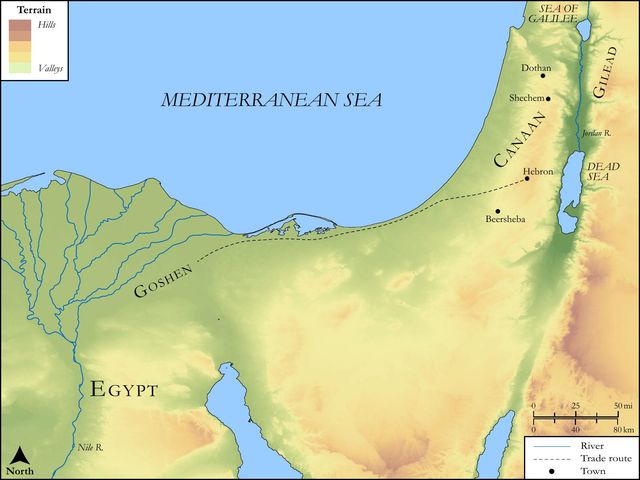
See on the biblical-era maps


Study this verse
Public-domain commentary
Matthew Henry
From his Commentary on the Whole Bible. Henry comments on passages, not single verses — this entry covers Genesis 50:15–21. His three-level outline is real structure in the source text, so it is rendered as structure.
We have here the settling of a good correspondence between Joseph and his brethren, now that their father was dead. Joseph was at court, in the royal city; his brethren were in Goshen, remote in the country; yet the keeping up of a good understanding, and a good affection, between them, would be both his honour and their interest. Note, When Providence has removed the parents by death, the best methods ought to be taken, not only for the preventing of quarrels among the children (which often happen about the dividing of the estate), but for the preserving of acquaintance and love, that unity may continue even when that centre of unity is taken away.
I.Joseph's brethren humbly make their court to him for his favour.
1.They began to be jealous of Joseph, not that he had given them any cause to be so, but the consciousness of guilt, and of their own inability in such a case to forgive and forget, made them suspicious of the sincerity and constancy of Joseph's favour (Gen 50:15): Joseph will peradventure hate us. While their father lived, they thought themselves safe under his shadow; but now that he was dead they feared the worst from Joseph. Note, A guilty conscience exposes men to continual frights, even where no fear is, and makes them suspicious of every body, as Cain, Gen 4:14. Those that would be fearless must keep themselves guiltless. If our heart reproach us not, then have we confidence both towards God and man.
2.They humbled themselves before him, confessed their fault, and begged his pardon. They did it by proxy (Gen 50:17); they did it in person, Gen 50:18. Now that the sun and moon had set, the eleven stars did homage to Joseph, for the further accomplishment of his dream. They speak of their former offence with fresh regret: Forgive the trespass. They throw themselves at Joseph's feet, and refer themselves to his mercy: We are thy servants. Thus we must bewail the sins we committed long ago, even those which we hope through grace are forgiven; and, when we pray to God for pardon, we must promise to be his servants.
3.They pleaded their relation to Jacob and to Jacob's God.
(1.)To Jacob, urging that he directed them to make this submission, rather because he questioned whether they would do their duty in humbling themselves than because he questioned whether Joseph would do his duty in forgiving them; nor could he reasonably expect Joseph's kindness to them unless they thus qualified themselves for it (Gen 50:16): Thy father did command. Thus, in humbling ourselves to Christ by faith and repentance, we may plead that it is the command of his Father, and our Father, that we do so.
(2.)To Jacob's God. They plead (Gen 50:17), We are theservants of the God of thy father; not only children of the same Jacob, but worshippers of the same Jehovah. Note, Though we must be ready to forgive all that are any way injurious to us, yet we must especially take heed of bearing malice towards any that are the servants of the God of our father: such we should always treat with a peculiar tenderness; for we and they have the same Master.
II.Joseph, with a great deal of compassion, confirms his reconciliation and affection to them; his compassion appears, Gen 50:17.
He wept when they spoke to him. These were tears of sorrow for their suspicion of him, and tears of tenderness upon their submission. In his reply,
1.He directs them to look up to God in their repentance (Gen 50:19): Am I in the place of God? He, in his great humility, thought they showed him too much respect, as if all their happiness were bound up in his favour, and said to them, in effect, as Peter to Cornelius, "Stand up, I myself also am a man. Make your peace with God, and then you will find it an easy matter to make your peace with me." Note, When we ask forgiveness of those whom we have offended we must take heed of putting them in the place of God, by dreading their wrath and soliciting their favour more than God's. "Am I in the place of God, to whom alone vengeance belongs? No, I will leave you to his mercy." Those that avenge themselves step into the place of God, Rom 12:19.
2.He extenuates their fault, from the consideration of the great good which God wonderfully brought out of it, which, though it should not make them the less sorry for their sin, yet might make him the more willing to forgive it (Gen 50:20): You thought evil (to disappoint the dreams), but God meant it unto good, in order to the fulfilling of the dreams, and the making of Joseph a greater blessing to his family than otherwise he could have been. Note, When God makes use of men's agency for the performance of his counsels, it is common for him to mean one thing and them another, even the quite contrary, but God's counsel shall stand. See Isa 10:7. Again, God often brings good out of evil, and promotes the designs of his providence even by the sins of men; not that he is the author of sin, far be it from us to think so; but his infinite wisdom so overrules events, and directs the chain of them, that, in the issue, that ends in his praise which in its own nature had a direct tendency to his dishonour; as the putting of Christ to death, Act 2:23. This does not make sin the less sinful, nor sinners the less punishable, but it redounds greatly to the glory of God's wisdom.
3.He assures them of the continuance of his kindness to them: Fear not; I will nourish you, Gen 50:21. See what an excellent spirit Joseph was of, and learn of him to render good for evil. He did not tell them they were upon their good behaviour, and he would be kind to them if he saw they conducted themselves well; no, he would not thus hold them in suspense, nor seem jealous of them, though they had been suspicious of him: He comforted them, and, to banish all their fears, he spoke kindly to them. Note, Broken spirits must be bound up and encouraged. Those we love and forgive we must not only do well for but speak kindly to.
Continue studying Genesis 50:15 across the web’s major study libraries — every link below opens this exact verse, chapter, or book on the destination site.
Read & Compare
 BibleGatewayThis verse in more than 200 translations and 70 languages.
 Bible.comThe YouVersion reader — hundreds of translations, reading plans, and highlights.
 ESV.orgCrossway's official English Standard Version reader.
 NET BibleThe NET translation with 60,000+ translators' notes on every rendering decision.
 STEP BibleTyndale House's free study tool — original text, vocabulary, and scholarly resources.
 BibliaLogos Bible Software's free web reader.
 USCCBThe New American Bible (Revised Edition) with the U.S. bishops' study notes.
Commentaries
 BibleHub CommentariesDozens of classic commentaries on this verse, gathered on one page.
 StudyLightMore than 100 commentary sets — the largest collection on the web.
 BibleRefPlain-English commentary on what this verse means, verse by verse.
 Enduring WordDavid Guzik's free commentary on this chapter, widely used by Bible teachers.
 Bible Study ToolsVerse commentary alongside Greek and Hebrew study aids.
Original Language & Research
- BibleHub InterlinearThe verse word by word — original language, transliteration, and English.
- BibleHub LexiconEvery word's original-language definition and Strong's entry.
 Blue Letter BibleDeep-study tools — Strong's numbers, concordance, and word studies.
 SefariaThe Hebrew text with Rashi and centuries of Jewish commentary.
Sermons, Hymns & Audio


TrulyRandomVerse is not affiliated with these sites and doesn’t control their content. They’re linked because they’re genuinely useful.
Summary
Following the death of their father Jacob, Joseph's brothers, burdened by profound and lingering guilt over their past betrayal, expressed deep-seated anxiety that Joseph's previously extended forgiveness was contingent upon Jacob's life. They feared that Joseph would now potentially harbor hatred towards them and, with certainty, exact retribution for the grievous evil they had inflicted upon him decades earlier, revealing their misunderstanding of Joseph's genuine, God-centered grace.
Context
ShowHideLiterary Context
Genesis 50:15 immediately follows the elaborate and extensive mourning period and burial of Jacob, the patriarch of the burgeoning nation of Israel. Chapters 47-49 detail Jacob's final years in Egypt, his blessings upon his sons, and his deathbed prophecies. Joseph's brothers had been living peacefully and prosperously in Egypt under Joseph's care for seventeen years since their reconciliation during the famine. The removal of Jacob, the unifying figure and their father, from the scene serves as a catalyst for the brothers' deep-seated fears and unresolved guilt to resurface. Their anxiety here sets the stage for Joseph's powerful reaffirmation of his forgiveness and his profound theological statement regarding God's sovereign hand in their lives, culminating in Genesis 50:19-21.
Historical & Cultural Context
Among the nations of that day, retribution for wrongs, especially within families or tribes, was a common expectation. While blood vengeance was often practiced, the concept of "requiting" evil could also extend to social or economic penalties. The brothers' actions against Joseph – conspiring to kill him, throwing him into a pit, and ultimately selling him into slavery – were heinous crimes, punishable by death or severe penalties under many ancient legal codes. Their fear reflects this cultural understanding of justice, where a wrong demanded a proportional response. Furthermore, the death of a patriarch often led to shifts in power dynamics and the settling of old scores, as the mediating influence of the elder was removed. The brothers' apprehension is thus rooted in both their personal guilt and the prevailing cultural norms regarding justice and family honor.
Key Themes
ShowHideThis verse powerfully contributes to several overarching themes within the book of Genesis and the broader biblical narrative. It highlights the pervasive theme of guilt and its psychological burden, demonstrating how past sin can continue to haunt individuals even after reconciliation. It also underscores the nature of forgiveness, particularly the challenge of receiving and trusting in its permanence, contrasting human suspicion with divine grace. Furthermore, it foreshadows the profound theme of divine providence, as Joseph's subsequent response in Genesis 50:20 reveals his understanding that God orchestrates even human evil for His redemptive purposes. This passage also touches on the theme of family reconciliation and the ongoing process of healing deep wounds within the family of Abraham, setting the stage for the formation of the twelve tribes of Israel.
Exposition and Analysis
ShowHideKey Word Analysis
ShowHideThis conditional particle signifies "if," "perhaps," or "would that!" In this context, it conveys the brothers' uncertainty and speculative fear. It's not a confirmed belief that Joseph hates them, but a hypothetical, anxious thought that underscores their deep-seated insecurity and the question mark hanging over Joseph's intentions in their minds. It reveals their inability to fully grasp the unconditional nature of Joseph's forgiveness.
This primitive root means "to lurk for," "persecute," "hate," or "oppose oneself against." The brothers' fear that Joseph would "hate" them indicates their belief that he would now harbor malicious intent and actively seek to harm them. This word choice emphasizes the depth of their perceived betrayal and their expectation of a vengeful response, reflecting their own capacity for such emotions.
While primarily meaning "to turn back" or "return," this root also carries the sense of "recompense," "render (again)," or "reward." In this context, it signifies paying back or retaliating for a wrong. The brothers' use of "certainly requite" suggests a conviction that Joseph would exact a just, yet feared, retribution for the "evil" they had done. This highlights their understanding of justice as proportional vengeance, contrasting sharply with Joseph's later demonstration of divine grace.
Verse Breakdown
ShowHide"And when Joseph's brethren saw that their father was dead,"
This clause establishes the immediate trigger for the brothers' fear. Jacob's death removed what they perceived as a protective buffer or a primary reason for Joseph to withhold retribution. For years, Jacob's presence had been a stabilizing factor, perhaps even a perceived guarantor of peace within the family. His absence immediately activated their deepest anxieties and brought their unresolved guilt to the forefront, as they no longer felt shielded by their father's authority or mediating role.
"they said, Joseph will peradventure hate us,"
This phrase reveals the brothers' internal dialogue and their speculative fear. The use of "peradventure" (perhaps) indicates their uncertainty, yet the mere possibility of Joseph's hatred was enough to provoke profound anxiety. This reflects their ongoing struggle with their conscience and their inability to fully trust the permanence and sincerity of Joseph's forgiveness, projecting their own capacity for vengeance onto him. Their fear of his hatred suggests a deeper concern about his emotional disposition towards them, beyond just punitive action.
"and will certainly requite us all the evil which we did unto him."
This concluding clause expresses their conviction regarding the consequence of Joseph's presumed hatred. The word "certainly" contrasts with "peradventure," indicating their firm belief that while Joseph's emotional state might be uncertain, his intention to "requite" (repay, retaliate, avenge) them for "all the evil" was a foregone conclusion. This demonstrates their acute awareness of the profound wickedness of their past actions—their conspiracy to kill him and ultimately selling him into slavery—and their expectation of a just, yet terrifying, retribution in accordance with human understandings of justice.
Literary Devices
ShowHideThe verse employs several powerful literary devices. Foreshadowing is evident as the brothers' fear sets the stage for Joseph's profound theological declaration in the subsequent verses, where he reveals God's sovereign hand in their lives. The contrast between "peradventure hate" and "certainly requite" creates juxtaposition, highlighting the brothers' internal conflict and the progression from uncertain emotion to certain action in their fearful anticipation. This also functions as a form of psychological realism, vividly portraying the enduring burden of guilt and the human tendency to project one's own capacity for vengeance onto others, even those who have demonstrated grace. The phrase "all the evil which we did unto him" serves as a concise summary of their past egregious actions, emphasizing the weight of their collective sin.
Theological and Thematic Connections
ShowHideGenesis 50:15 offers a poignant exploration of the human condition, particularly the persistent grip of guilt and the profound challenge of accepting true forgiveness. The brothers' fear, despite years of reconciliation and Joseph's clear demonstration of grace, underscores that receiving forgiveness can be as difficult as extending it. Their inability to fully trust Joseph's mercy reveals a projection of their own limited, human understanding of justice, which often demands retribution, onto Joseph. This human suspicion stands in stark contrast to Joseph's God-centered perspective, which sees divine purpose even in profound suffering. The passage thus sets the stage for Joseph to re-articulate a theology of divine providence, demonstrating that God can redeem even the most grievous human sin for His ultimate good.
Reflection and Application
ShowHideGenesis 50:15 provides a powerful mirror for contemporary life, especially concerning the enduring weight of past wrongs and the transformative power of genuine, God-centered forgiveness. Many individuals carry the invisible burden of guilt, even after confessing their sins and receiving forgiveness from those they've wronged or from God Himself. This verse reminds us that true freedom comes not only from offering forgiveness but, just as crucially, from accepting it fully and trusting in its permanence. It challenges us to release the need for self-punishment or the expectation of future retribution, and instead, to embrace the liberating grace offered. Joseph's subsequent response (Genesis 50:19-21) serves as a profound model of how a divine perspective can transcend human injury and transform bitterness into blessing. This narrative encourages us to cultivate a heart that freely extends forgiveness, rooted in God's character, and to receive it with a faith that trusts in its complete and lasting nature, thereby building bridges of genuine trust and reconciliation in our own relationships. Furthermore, the brothers' fear, based on human assumptions and a lack of trust, highlights the vital importance of trusting God's overarching providence, as Joseph's life is a testament to God's ability to work all things for good, even through human sin and suffering.
Questions for Reflection
ShowHideFAQ
ShowHideWhy did Joseph's brothers fear him after so many years of peace?
ShowHideThe brothers' fear stemmed from deeply ingrained and unresolved guilt over their past actions of conspiring against Joseph and selling him into slavery. While Joseph had clearly and repeatedly forgiven them, they likely projected their own capacity for vengeance and a human understanding of justice onto him. With their father Jacob, who had served as a unifying and mediating figure, now deceased, they feared Joseph's forgiveness was conditional or temporary, and that he would now feel free to exact retribution without their father's presence to restrain him. Their active conscience continued to remind them of the severity of their sin.
What does 'peradventure' mean in Genesis 50:15?
ShowHideIn the King James Version, "peradventure" is an archaic term meaning "perhaps" or "it may be." It conveys the brothers' uncertainty and apprehension about Joseph's intentions. They weren't certain he would hate them, but the mere possibility was enough to trigger profound fear and anxiety. This word indicates a speculative and fearful thought rather than a confirmed belief, highlighting their internal struggle and lack of full assurance in Joseph's continued grace.
Does this verse imply Joseph's forgiveness was conditional or insincere?
ShowHideNo, the verse does not imply that Joseph's forgiveness was conditional or insincere. Instead, it reflects the brothers' perception and fear, which were rooted in their own guilt, their limited human understanding of justice, and their inability to fully accept the permanence of Joseph's grace. Joseph's actions and words in previous chapters (Genesis 45:5) and immediately following this verse (Genesis 50:19-21) consistently demonstrate his genuine, unconditional, and God-centered forgiveness. The brothers simply struggled to fully trust in the permanence and depth of that forgiveness, a common human challenge when receiving profound grace.
Christ-Centered Fulfillment
ShowHideThe narrative of Joseph's brothers' fear and Joseph's unwavering forgiveness in Genesis 50:15 profoundly foreshadows the redemptive work of Jesus Christ. Like Joseph's brothers, humanity stands guilty before a holy God, having committed "all the evil" through sin, and justly fears divine "requital" for our rebellion. The wages of sin are death, and we, by nature, are children of wrath, deserving of judgment (Romans 6:23 and Ephesians 2:3). Yet, Christ, the ultimate Joseph, does not "hate" or "requite" us for our betrayal. Instead, through His atoning death on the cross and glorious resurrection, He freely offers complete and unconditional forgiveness, bearing the full requital for our sins in His own body (1 Peter 2:24). His grace overcomes our deepest fears and guilt, transforming our expectation of wrath into an experience of reconciliation and peace with God (Romans 5:1). This reconciliation is not based on our merit, the presence of a human mediator, or a temporary reprieve, but on His finished work and sovereign love, securing for us eternal life and an unbreakable bond with the Father (John 3:16).