


Genesis 50:16
Bible text: King James Version (1769 Blayney text) · Public domain
Bible text: Berean Standard Bible · Public domain
Bible text: American Standard Version (1901) · Public domain
Bible text: World English Bible, Messianic edition · Public domain
Bible text: Geneva Bible (1599) · Public domain
Bible text: Young's Literal Translation · Public domain
- וַיְצַוּוּvay·tza·Vuand they commandedH6680Conj-w ¦ V-Piel-ConsecImperf-3mpVerb Piel Consecutive Imperfect 3rd Plural Masculineוַandיְצַוּוּthey commanded
- אֶל'eltoH413PrepPreposition
- יוֹסֵףyo·SefJosephH3130N-proper-mNoun Proper Masculine
- לֵאמֹרle·Mor<to> sayingH559Prep-l ¦ V-Qal-InfVerb Qal Infinitive Constructלֵ<to>אמֹרsaying
- אָבִיךָ'a·Vi·khayour fatherH1N-msc ¦ 2msNoun Singular Masculine Constructאָבִיfatherךָyour
- צִוָּהtzi·Vahhe commandedH6680V-Piel-Perf-3msVerb Piel Perfect 3rd Singular Masculine
- לִפְנֵיlif·Nei<to> beforeH6440Prep-l ¦ N-mpcNoun Plural Masculine Constructלִ<to>פְנֵיbefore
- מוֹתוֹmo·Tohis deathH4194N-msc ¦ 3msNoun Singular Masculine Constructמוֹתdeathוֹhis
- לֵאמֹרle·Mor<to> sayingH559Prep-l ¦ V-Qal-InfVerb Qal Infinitive Constructלֵ<to>אמֹרsaying
English is a literal word-by-word gloss of the Hebrew, not the KJV's wording. Why?
This is the original text the KJV's translators worked from — each Hebrew word with its own literal English meaning in this verse, prepared by scholars at Tyndale House, Cambridge. The KJV translates whole sentences, not word by word, so its wording differs: one Hebrew word can become several English words, and the KJV may choose “the LORD” where the gloss reads “Yahweh”. Both are faithful — they answer different questions. For the KJV's own rendering, switch to the KJV text.
Details
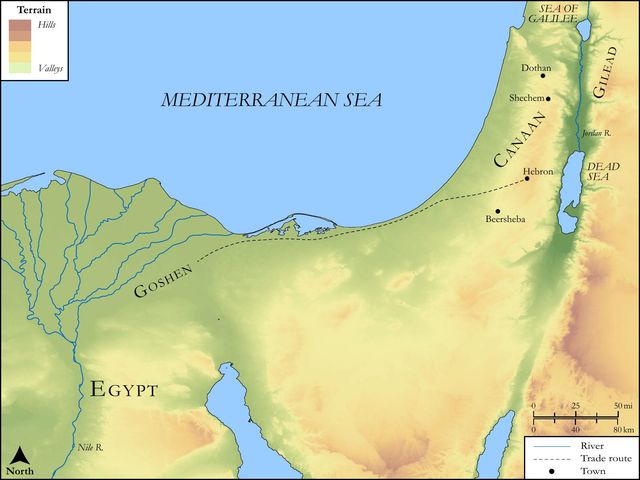
See on the biblical-era maps


Study this verse
Public-domain commentary
Matthew Henry
From his Commentary on the Whole Bible. Henry comments on passages, not single verses — this entry covers Genesis 50:15–21. His three-level outline is real structure in the source text, so it is rendered as structure.
We have here the settling of a good correspondence between Joseph and his brethren, now that their father was dead. Joseph was at court, in the royal city; his brethren were in Goshen, remote in the country; yet the keeping up of a good understanding, and a good affection, between them, would be both his honour and their interest. Note, When Providence has removed the parents by death, the best methods ought to be taken, not only for the preventing of quarrels among the children (which often happen about the dividing of the estate), but for the preserving of acquaintance and love, that unity may continue even when that centre of unity is taken away.
I.Joseph's brethren humbly make their court to him for his favour.
1.They began to be jealous of Joseph, not that he had given them any cause to be so, but the consciousness of guilt, and of their own inability in such a case to forgive and forget, made them suspicious of the sincerity and constancy of Joseph's favour (Gen 50:15): Joseph will peradventure hate us. While their father lived, they thought themselves safe under his shadow; but now that he was dead they feared the worst from Joseph. Note, A guilty conscience exposes men to continual frights, even where no fear is, and makes them suspicious of every body, as Cain, Gen 4:14. Those that would be fearless must keep themselves guiltless. If our heart reproach us not, then have we confidence both towards God and man.
2.They humbled themselves before him, confessed their fault, and begged his pardon. They did it by proxy (Gen 50:17); they did it in person, Gen 50:18. Now that the sun and moon had set, the eleven stars did homage to Joseph, for the further accomplishment of his dream. They speak of their former offence with fresh regret: Forgive the trespass. They throw themselves at Joseph's feet, and refer themselves to his mercy: We are thy servants. Thus we must bewail the sins we committed long ago, even those which we hope through grace are forgiven; and, when we pray to God for pardon, we must promise to be his servants.
3.They pleaded their relation to Jacob and to Jacob's God.
(1.)To Jacob, urging that he directed them to make this submission, rather because he questioned whether they would do their duty in humbling themselves than because he questioned whether Joseph would do his duty in forgiving them; nor could he reasonably expect Joseph's kindness to them unless they thus qualified themselves for it (Gen 50:16): Thy father did command. Thus, in humbling ourselves to Christ by faith and repentance, we may plead that it is the command of his Father, and our Father, that we do so.
(2.)To Jacob's God. They plead (Gen 50:17), We are theservants of the God of thy father; not only children of the same Jacob, but worshippers of the same Jehovah. Note, Though we must be ready to forgive all that are any way injurious to us, yet we must especially take heed of bearing malice towards any that are the servants of the God of our father: such we should always treat with a peculiar tenderness; for we and they have the same Master.
II.Joseph, with a great deal of compassion, confirms his reconciliation and affection to them; his compassion appears, Gen 50:17.
He wept when they spoke to him. These were tears of sorrow for their suspicion of him, and tears of tenderness upon their submission. In his reply,
1.He directs them to look up to God in their repentance (Gen 50:19): Am I in the place of God? He, in his great humility, thought they showed him too much respect, as if all their happiness were bound up in his favour, and said to them, in effect, as Peter to Cornelius, "Stand up, I myself also am a man. Make your peace with God, and then you will find it an easy matter to make your peace with me." Note, When we ask forgiveness of those whom we have offended we must take heed of putting them in the place of God, by dreading their wrath and soliciting their favour more than God's. "Am I in the place of God, to whom alone vengeance belongs? No, I will leave you to his mercy." Those that avenge themselves step into the place of God, Rom 12:19.
2.He extenuates their fault, from the consideration of the great good which God wonderfully brought out of it, which, though it should not make them the less sorry for their sin, yet might make him the more willing to forgive it (Gen 50:20): You thought evil (to disappoint the dreams), but God meant it unto good, in order to the fulfilling of the dreams, and the making of Joseph a greater blessing to his family than otherwise he could have been. Note, When God makes use of men's agency for the performance of his counsels, it is common for him to mean one thing and them another, even the quite contrary, but God's counsel shall stand. See Isa 10:7. Again, God often brings good out of evil, and promotes the designs of his providence even by the sins of men; not that he is the author of sin, far be it from us to think so; but his infinite wisdom so overrules events, and directs the chain of them, that, in the issue, that ends in his praise which in its own nature had a direct tendency to his dishonour; as the putting of Christ to death, Act 2:23. This does not make sin the less sinful, nor sinners the less punishable, but it redounds greatly to the glory of God's wisdom.
3.He assures them of the continuance of his kindness to them: Fear not; I will nourish you, Gen 50:21. See what an excellent spirit Joseph was of, and learn of him to render good for evil. He did not tell them they were upon their good behaviour, and he would be kind to them if he saw they conducted themselves well; no, he would not thus hold them in suspense, nor seem jealous of them, though they had been suspicious of him: He comforted them, and, to banish all their fears, he spoke kindly to them. Note, Broken spirits must be bound up and encouraged. Those we love and forgive we must not only do well for but speak kindly to.
Continue studying Genesis 50:16 across the web’s major study libraries — every link below opens this exact verse, chapter, or book on the destination site.
Read & Compare
 BibleGatewayThis verse in more than 200 translations and 70 languages.
 Bible.comThe YouVersion reader — hundreds of translations, reading plans, and highlights.
 ESV.orgCrossway's official English Standard Version reader.
 NET BibleThe NET translation with 60,000+ translators' notes on every rendering decision.
 STEP BibleTyndale House's free study tool — original text, vocabulary, and scholarly resources.
 BibliaLogos Bible Software's free web reader.
 USCCBThe New American Bible (Revised Edition) with the U.S. bishops' study notes.
Commentaries
 BibleHub CommentariesDozens of classic commentaries on this verse, gathered on one page.
 StudyLightMore than 100 commentary sets — the largest collection on the web.
 BibleRefPlain-English commentary on what this verse means, verse by verse.
 Enduring WordDavid Guzik's free commentary on this chapter, widely used by Bible teachers.
 Bible Study ToolsVerse commentary alongside Greek and Hebrew study aids.
Original Language & Research
- BibleHub InterlinearThe verse word by word — original language, transliteration, and English.
- BibleHub LexiconEvery word's original-language definition and Strong's entry.
 Blue Letter BibleDeep-study tools — Strong's numbers, concordance, and word studies.
 SefariaThe Hebrew text with Rashi and centuries of Jewish commentary.
Sermons, Hymns & Audio


TrulyRandomVerse is not affiliated with these sites and doesn’t control their content. They’re linked because they’re genuinely useful.
Summary
Genesis 50:16 captures the profound apprehension and lingering guilt of Joseph's brothers following the death of their father, Jacob. Driven by fear of retribution for their past betrayal, they dispatch a messenger to Joseph, conveying a fabricated or unrecorded command from their deceased father. This desperate plea underscores their deep-seated anxiety and sets the stage for a pivotal moment of reconciliation and the reaffirmation of God's sovereign plan amidst human sin and fear.
Context
ShowHideLiterary Context
This verse immediately follows the detailed account of Jacob's death, embalming, and elaborate funeral procession and burial in Canaan, fulfilling his final wishes as recorded in Genesis 49 and Genesis 50:1-14. Jacob's presence had served as a unifying and mediating figure within the family, particularly between Joseph and his brothers. With their father now gone, the brothers perceive the removal of this protective buffer, fearing that Joseph, now the powerful vizier of Egypt, might finally exact revenge for their heinous act of selling him into slavery years earlier (Genesis 37:28). Their decision to send a messenger, rather than directly confronting Joseph, highlights the immense psychological distance and lingering tension that still existed despite Joseph's prior demonstrations of forgiveness and provision.
Historical & Cultural Context
In the households of the patriarchs, the death of the father often marked a significant shift in family dynamics, sometimes leading to power struggles or the settling of old scores. The concept of "blood vengeance" was a recognized, though not always practiced, custom, which would have amplified the brothers' fears, especially given Joseph's immense authority in Egypt (Genesis 41:40). The act of sending a messenger was a formal and respectful way to initiate communication with a superior or someone of great power, indicating the gravity of their message and their perceived vulnerability. Furthermore, a deathbed command or "last will" of a father was considered sacred and binding, lending immense weight to their fabricated plea.
Key Themes
ShowHideGenesis 50:16 contributes to several overarching themes within the Joseph narrative and the book of Genesis. It powerfully illustrates the enduring power of guilt and the human struggle to trust genuine forgiveness, even after it has been explicitly offered. The brothers' fear highlights the theme of divine providence versus human agency, setting the stage for Joseph's profound theological declaration in Genesis 50:20, where he articulates God's sovereign hand in transforming evil intentions into redemptive outcomes. It also underscores the theme of family reconciliation and restoration, which is central to the narrative, demonstrating the final, necessary step in healing deep-seated wounds within the family of Abraham, Isaac, and Jacob.
Exposition and Analysis
ShowHideKey Word Analysis
ShowHideThis primitive word denotes a literal and immediate father, but can also extend to a figurative or remote application, such as a forefather or chief. In this context, it refers directly to Jacob, whose recent death is the catalyst for the brothers' fear. Their invocation of "Thy father" is a strategic appeal to Joseph's filial piety and respect for their deceased patriarch, leveraging the profound cultural reverence for parental authority and last wishes.
Derived from the root "to die," this word refers to natural or violent death, or concretely, the dead. The phrase "before he died" emphasizes the finality of Jacob's life and the timing of the supposed command. The brothers are using Jacob's death as the critical juncture, implying that this command was his last, solemn instruction, thus attempting to imbue it with undeniable authority and urgency.
This primitive root means "to constitute" or "enjoin," often implying an intensive, authoritative instruction. It can mean to appoint, forbid, or give a charge or commandment. The brothers' use of "did command" (a past tense form of this verb) is crucial, as they are presenting Jacob's instruction as a direct, unalterable directive, thereby attempting to bind Joseph to an obligation that predates his current position of power and their own past offenses.
Verse Breakdown
ShowHide"And they sent a messenger unto Joseph,"
This opening clause establishes the brothers' indirect approach to Joseph. The act of sending a messenger (מַלְאָךְ, mal'akh) signifies the formality, gravity, and perhaps their own fear of directly confronting Joseph. It suggests a certain distance and apprehension, rather than a confident, direct appeal.
"saying,"
This first "saying" (לֵאמֹר, lēʼmōr) introduces the content of the message delivered by the messenger. It indicates that the following words are the exact words or the substance of what the messenger was instructed to convey to Joseph.
"Thy father did command before he died,"
This is the core of the brothers' plea. By invoking Jacob ("Thy father") and framing the instruction as a deathbed command ("did command before he died"), they attempt to create an unassailable moral and familial obligation for Joseph. This statement, whether true or fabricated, is designed to appeal to Joseph's respect for his father and to override any personal desire for vengeance.
"saying,"
The repetition of "saying" (לֵאמֹר, lēʼmōr) here is a stylistic device that introduces the specific content of Jacob's supposed command, which is then detailed in the subsequent verse (Genesis 50:17). This repetition emphasizes that the following words are a direct quotation, lending further weight and urgency to the message.
Literary Devices
ShowHideThe verse employs several significant literary devices. Repetition is prominent with the double use of "saying" (לֵאמֹר, lēʼmōr). This repetition serves to heighten the dramatic tension and emphasize that the words which follow are a direct, solemn communication, underscoring the brothers' careful construction of their plea. There is also an element of Suspense, as the verse sets up the expectation of what Jacob's command actually was, leaving the reader eager to discover the content of their desperate message in the following verses. The act of sending a messenger itself can be seen as Symbolism, representing the brothers' fear and their inability to approach Joseph directly, highlighting the lingering chasm of guilt and distrust between them. Finally, there is a subtle Irony in their attempt to manipulate Joseph using their father's name, given Joseph's earlier demonstrations of divine wisdom and his profound understanding of God's sovereign plan, which ultimately transcends human schemes.
Theological and Thematic Connections
ShowHideGenesis 50:16 vividly portrays the enduring human struggle with guilt and the challenge of fully embracing and trusting genuine forgiveness. Despite Joseph's earlier acts of grace and provision, the brothers' deep-seated fear reveals how past sins can continue to haunt and distort perceptions, even in the face of reconciliation. This passage underscores the truth that true healing from sin requires not only the offering of forgiveness but also its reception and the subsequent release from self-condemnation. It sets the stage for Joseph's profound theological declaration, where he elevates God's sovereign purpose above human evil, transforming a moment of fear into a powerful testament to divine grace and the ultimate triumph of good.
Reflection and Application
ShowHideGenesis 50:16 offers profound insights into the human condition, illustrating how unresolved guilt can persist even after apparent reconciliation. The brothers' fear serves as a poignant reminder of the burden of unaddressed sin and the vital necessity of genuine forgiveness—both in seeking and extending it. True forgiveness is not merely an event but a transformative process requiring trust, open communication, and patience to fully heal relationships. This passage also subtly highlights the danger of operating out of fear rather than faith, prompting believers to trust in God's redemptive work even in the aftermath of human failings and to pursue honest reconciliation guided by love, echoing the broader biblical emphasis on the ministry of reconciliation found in passages like 2 Corinthians 5:18-20. It challenges us to consider whether our own past mistakes, even those forgiven by others, still hold us captive, preventing us from fully embracing the freedom offered by grace.
Questions for Reflection
ShowHideFAQ
ShowHideWhy were Joseph's brothers still afraid of him after all this time?
ShowHideDespite Joseph's earlier demonstrations of forgiveness and provision, their deep-seated guilt over selling him into slavery persisted. Jacob's presence had served as a buffer, and with him gone, their fear of retribution resurfaced, indicating the profound psychological impact of unaddressed sin and the difficulty of fully trusting forgiveness when burdened by guilt. Their fear stemmed from their own conscience and the assumption that Joseph would act according to human vengeance rather than divine grace, failing to fully grasp the depth of his forgiveness or God's redemptive plan. This highlights how human guilt can prevent the full acceptance of grace, even when it is abundantly offered, as seen in Joseph's earlier actions in Genesis 45:5-8.
Christ-Centered Fulfillment
ShowHideJoseph's story, culminating in his profound forgiveness and the declaration that God intended good from his brothers' evil, powerfully foreshadows the redemptive work of Christ. Like Joseph, who was rejected by his own yet became a savior for them and many others, Christ was betrayed and crucified, yet through His suffering, God accomplished the ultimate reconciliation of humanity to Himself. The fear and guilt of Joseph's brothers find their ultimate resolution in the cross, where true forgiveness and peace are offered, transforming human sin and brokenness into divine salvation and new life. Christ's sacrifice provides the perfect and complete atonement that addresses the root of all human guilt and fear, inviting us into a relationship of perfect trust and reconciliation with God, as articulated in Colossians 1:19-20. He is the ultimate "messenger" of peace, breaking down the dividing wall of hostility (Ephesians 2:14), and through His resurrection, He assures us that even death cannot thwart God's good purposes for those who believe (Romans 8:38-39).