


Genesis 50:12
Bible text: King James Version (1769 Blayney text) · Public domain
Bible text: Berean Standard Bible · Public domain
Bible text: American Standard Version (1901) · Public domain
Bible text: World English Bible, Messianic edition · Public domain
Bible text: Geneva Bible (1599) · Public domain
Bible text: Young's Literal Translation · Public domain
- וַיַּעֲשׂוּvai·ya·'a·Suand they didH6213Conj-w ¦ V-Qal-ConsecImperf-3mpVerb Qal Consecutive Imperfect 3rd Plural Masculineוַandיַּעֲשׂוּthey did
- בָנָיוva·Navhis sonsH1121N-mpc ¦ 3msNoun Plural Masculine Constructבָנָיsonsוhis
- לוֹlofor himPrep-l ¦ 3msSuffix Personal 3rd Singular Masculineלforוֹhim
- כֵּןkenthusH3651AdvAdverb
- כַּאֲשֶׁרka·'a·Sherjust asH834Prep-k ¦ RelParticle Relativeכַּjustאֲשֶׁרas
- צִוָּםtzi·Vamhe had commanded themH6680V-Piel-Perf-3ms ¦ 3mpVerb Piel Perfect 3rd Singular Masculineצִוָּhe had commandedםthem
English is a literal word-by-word gloss of the Hebrew, not the KJV's wording. Why?
This is the original text the KJV's translators worked from — each Hebrew word with its own literal English meaning in this verse, prepared by scholars at Tyndale House, Cambridge. The KJV translates whole sentences, not word by word, so its wording differs: one Hebrew word can become several English words, and the KJV may choose “the LORD” where the gloss reads “Yahweh”. Both are faithful — they answer different questions. For the KJV's own rendering, switch to the KJV text.
Details
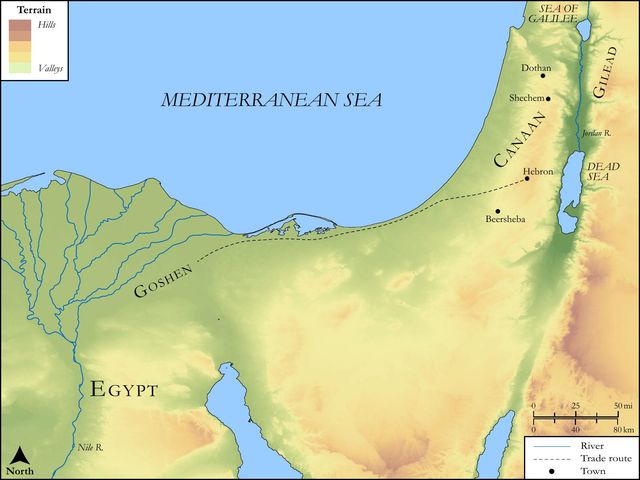
See on the biblical-era maps


Study this verse
Public-domain commentary
Matthew Henry
From his Commentary on the Whole Bible. Henry comments on passages, not single verses — this entry covers Genesis 50:7–14.
We have here an account of Jacob's funeral. Of the funerals of the kings of Judah, usually, no more is said than this, They were buried with their fathers in the city of David: but the funeral of the patriarch Jacob is more largely and fully described, to show how much better God was to him than he expected (he had spoken more than once of dying for grief, and going to the grave bereaved of his children, but, behold, he dies in honour, and is followed to the grave by all his children), and also because his orders concerning his burial were given and observed in faith, and in expectation both of the earthly and of the heavenly Canaan. Now, 1. It was a stately funeral. He was attended to the grave, not only by his own family, but by the courtiers, and all the great men of the kingdom, who, in token of their gratitude to Joseph, showed this respect to his father for his sake, and did him honour at his death. Though the Egyptians had had an antipathy to the Hebrews, and had looked upon them with disdain (Gen 43:32), yet now, that they were better acquainted with them, they began to have a respect for them. Good old Jacob had conducted himself so well among them as to gain universal esteem. Note, Professors of religion should endeavour, by wisdom and love, to remove the prejudices which many may have conceived against them because they do not know them. There went abundance of chariots and horsemen, not only to attend them a little way, but to go through with them. Note, The decent solemnities of funerals, according to a man's situation, are very commendable; and we must not say of them, To what purpose is this waste? See Act 8:2; Luk 7:12. 2. It was a sorrowful funeral (Gen 50:10, Gen 50:11); standers-by took notice of it as a grievous mourning. Note, The death of good men is a great loss to any place, and ought to be greatly lamented. Stephen dies a martyr, and yet devout men make great lamentations for him. The solemn mourning for Jacob gave a name to the place, Abel-Mizraim, the mourning of the Egyptians, which served for a testimony against the next generation of the Egyptians, who oppressed the posterity of this Jacob to whom their ancestors showed such respect.
Continue studying Genesis 50:12 across the web’s major study libraries — every link below opens this exact verse, chapter, or book on the destination site.
Read & Compare
 BibleGatewayThis verse in more than 200 translations and 70 languages.
 Bible.comThe YouVersion reader — hundreds of translations, reading plans, and highlights.
 ESV.orgCrossway's official English Standard Version reader.
 NET BibleThe NET translation with 60,000+ translators' notes on every rendering decision.
 STEP BibleTyndale House's free study tool — original text, vocabulary, and scholarly resources.
 BibliaLogos Bible Software's free web reader.
 USCCBThe New American Bible (Revised Edition) with the U.S. bishops' study notes.
Commentaries
 BibleHub CommentariesDozens of classic commentaries on this verse, gathered on one page.
 StudyLightMore than 100 commentary sets — the largest collection on the web.
 BibleRefPlain-English commentary on what this verse means, verse by verse.
 Enduring WordDavid Guzik's free commentary on this chapter, widely used by Bible teachers.
 Bible Study ToolsVerse commentary alongside Greek and Hebrew study aids.
Original Language & Research
- BibleHub InterlinearThe verse word by word — original language, transliteration, and English.
- BibleHub LexiconEvery word's original-language definition and Strong's entry.
 Blue Letter BibleDeep-study tools — Strong's numbers, concordance, and word studies.
 SefariaThe Hebrew text with Rashi and centuries of Jewish commentary.
Sermons, Hymns & Audio


TrulyRandomVerse is not affiliated with these sites and doesn’t control their content. They’re linked because they’re genuinely useful.
Summary
Genesis 50:12 succinctly records the faithful and complete execution of Jacob's final, solemn command by his sons, who meticulously carried out his wish to be interred in the land of Canaan. This act not only profoundly demonstrates filial respect, obedience, and a newfound unity among the brothers, but also serves as a powerful affirmation of their patriarch's unwavering faith in God's enduring covenant promises regarding the land and the future of Israel.
Context
ShowHideLiterary Context
Genesis 50:12 immediately follows the detailed account of Jacob's death, embalming, and the extensive mourning period in Egypt, which lasted seventy days for the Egyptians and seven days for Jacob's family. Prior to his death, Jacob (Israel) had gathered his sons to pronounce prophetic blessings and, crucially, to give explicit instructions regarding his burial. His most fervent desire, reiterated multiple times, was not to be buried in Egypt, but to be carried back to the land of Canaan and laid to rest with his ancestors in the Cave of Machpelah. This verse, therefore, acts as the culminating statement of obedience and fulfillment, bridging the patriarch's death with the subsequent grand funeral procession described in the verses that follow (Genesis 50:7-11). It sets the stage for the narrative's shift from the patriarchal stories to the impending national development of Israel in Egypt.
Historical & Cultural Context
In the households of the patriarchs, deathbed commands were considered sacred and binding, carrying immense weight and obligation. Disobeying a patriarch's final wishes was a grave offense, often viewed as a curse upon the disobedient. Embalming, as performed for Jacob and Joseph, was an Egyptian custom, reflecting their advanced mortuary practices and the high status accorded to these figures within Egyptian society. The elaborate funeral procession, involving Pharaoh's officials and a large retinue, underscores the significant respect Joseph and, by extension, his family commanded in Egypt. Jacob's insistence on burial in Canaan, despite his prosperity and status in Egypt, was a powerful cultural statement. It rejected the Egyptian worldview that emphasized burial in the land of one's life and instead affirmed a deep-seated identity tied to the ancestral land and the covenant promises.
Key Themes
ShowHideThis verse powerfully contributes to several overarching themes within Genesis and the broader Pentateuch. It highlights the theme of Filial Obedience and Respect, demonstrating the sons' adherence to the sacred duty of honoring their father's final wishes, a principle later codified in the Mosaic Law. Crucially, it underscores the theme of Covenant Faithfulness and the Promise of the Land. Jacob's desire to be buried in Canaan, and his sons' fulfillment of it, is an act of profound faith in God's promise to Abraham, Isaac, and Jacob that their descendants would inherit the land (Genesis 12:7). This act is a tangible expression of hope beyond the immediate prosperity of Egypt. Furthermore, the collective action of "his sons" in carrying out this command speaks to the theme of Family Unity and Reconciliation, suggesting a significant healing of the deep fractures that had plagued Jacob's family throughout their history, particularly evident in the story of Joseph and his brothers. This unity is vital for the nascent nation of Israel.
Exposition and Analysis
ShowHideKey Word Analysis
ShowHideFrom the root meaning "to build," this word signifies not merely male offspring but those who build and perpetuate the family name and legacy. In this context, "his sons" refers collectively to the twelve patriarchs of Israel, emphasizing their unified action as the foundational generation of the nation. Their obedience here is not just individual but corporate, representing the nascent nation's commitment to its heritage and God's promises.
This primitive root is broad in its meaning, encompassing "to do," "to make," "to accomplish," or "to perform." Here, it denotes the active and complete fulfillment of a command. The use of this verb implies not just a passive agreement but a diligent and thorough execution of Jacob's instructions, involving significant logistical effort and a journey. It highlights the intentionality and completeness of their obedience.
This verb, used intensively, means "to constitute," "to enjoin," or "to give a charge/command." It suggests a solemn, authoritative instruction, often with legal or moral weight. Jacob's "command" was not a mere request but a binding directive, underscoring the gravity of his dying wish and the sons' recognition of its imperative nature.
Verse Breakdown
ShowHide"And his sons did unto him"
This opening clause immediately establishes the subject and their action. "His sons" refers to the collective body of Jacob's twelve sons, particularly those who were present and responsible for his burial, with Joseph taking a leading role. The verb "did" (Hebrew ʻâsâh) signifies a complete and active performance, not merely a passive acknowledgment. It implies that they undertook the necessary preparations, journey, and rituals required to fulfill their father's wishes. This collective action is significant, indicating a measure of unity and shared purpose among brothers who had previously been marked by deep division and conflict.
"according as he commanded them"
This phrase clarifies the precise nature of their action: it was in exact conformity to Jacob's specific instructions. The Hebrew phrase ka'asher tzivam (כַּאֲשֶׁר צִוָּם) emphasizes the precise and unwavering obedience. Jacob's command, as detailed in Genesis 49:29-31, was to be buried in the Cave of Machpelah in Canaan, alongside Abraham, Sarah, Isaac, Rebekah, and Leah. This clause confirms that no detail was overlooked, and no deviation occurred, highlighting the sons' profound respect and commitment to their patriarch's final will.
Literary Devices
ShowHideThe conciseness of Genesis 50:12 is a powerful Literary Device. Despite the immense logistical undertaking and the emotional weight of Jacob's funeral, the narrative presents the fulfillment of his command with striking brevity. This Understatement amplifies the significance of the act, suggesting that the obedience was so complete and natural that it required no further elaboration. The simple declaration "And his sons did unto him according as he commanded them" serves as a definitive statement of resolved obligation. This narrative choice also employs Foreshadowing, subtly hinting at the future unity and collective identity that the tribes of Israel would eventually forge, even as they remained in Egypt. The unified action of the sons in this moment stands in stark contrast to their earlier disunity, marking a pivotal step in their development as a cohesive family and, ultimately, a nation.
Theological and Thematic Connections
ShowHideThe unwavering obedience of Jacob's sons to his dying command is a profound theological statement, underscoring the sacred nature of filial duty and the enduring power of covenantal faith. Their commitment to bury Jacob in Canaan, rather than in the land of their current prosperity, was not merely an act of family loyalty but a powerful affirmation of God's promises. It demonstrated their shared belief that God would indeed bring their descendants back to the promised land, even as they remained in Egypt. This act of faith, carried out with unity, speaks to the importance of honoring one's heritage, fulfilling solemn commitments, and trusting in God's long-term plan, even when its full realization is yet to come.
Reflection and Application
ShowHideThe faithful obedience of Jacob's sons in Genesis 50:12 provides a rich tapestry of timeless principles for believers today. It serves as a profound reminder of the enduring importance of honoring our commitments, especially those made to family and those who have entrusted us with their final wishes or legacy. This narrative underscores the deep biblical value placed on filial respect and care, extending beyond life into death, by faithfully upholding the wisdom and desires of our elders. Furthermore, the remarkable unity displayed by the brothers, who had a long history of bitter rivalry and betrayal, offers a powerful message of reconciliation and the possibility of healing fractured relationships. Their collective effort for a noble, sacred purpose demonstrates that even deep-seated divisions can be overcome when there is a shared commitment to honor and a greater vision. For us, it challenges us to consider where we might need to lay aside past grievances for the sake of a higher calling or a unified purpose within our families, communities, or the body of Christ. Just as Jacob's burial in Canaan affirmed a future hope, our actions today should reflect our faith in God's promises and our ultimate spiritual inheritance.
Questions for Reflection
ShowHideFAQ
ShowHideWhat was Jacob's specific command to his sons?
ShowHideJacob's specific command, reiterated several times before his death, was that he should not be buried in Egypt. Instead, he wished to be carried back to the land of Canaan and laid to rest with his ancestors – Abraham, Sarah, Isaac, Rebekah, and Leah – in the Cave of Machpelah, which Abraham had purchased from Ephron the Hittite. This command was a profound expression of his faith in God's covenant promise of the land to his descendants.
Why was it so important for Jacob to be buried in Canaan?
ShowHideJacob's insistence on being buried in Canaan was a deeply significant act of faith in God's covenant promises to Abraham, Isaac, and himself regarding the land. It was a symbolic declaration that his true home and inheritance were not in prosperous Egypt, but in the land God had promised to his descendants. By choosing burial in Canaan, Jacob affirmed his belief in the future return of his family to the promised land, even though they were currently dwelling in Egypt. It was a testament to his spiritual identity and hope, looking beyond the temporal comforts of Egypt to the eternal faithfulness of God's word. This act also served as a powerful reminder to his sons of their ultimate destiny.
Does this act of obedience signify complete reconciliation among the brothers?
ShowHideWhile the united effort of Jacob's sons in fulfilling his burial command demonstrates a significant step towards reconciliation and a newfound unity, it does not necessarily imply that all past resentments were immediately erased. Their collective action for a common, sacred purpose was a vital component of healing, showing a willingness to set aside differences. However, the subsequent actions of the brothers, particularly their fear of Joseph's retaliation after Jacob's death (Genesis 50:15-18), suggest that some underlying issues of trust and guilt still lingered. Joseph's gracious response in Genesis 50:19-21 ultimately solidified their peace and demonstrated true forgiveness, building upon the foundation of unity established by their shared obedience to their father.
Christ-Centered Fulfillment
ShowHideThe faithful obedience of Jacob's sons in burying him in the promised land of Canaan profoundly foreshadows the ultimate fulfillment of God's promises in Jesus Christ. Jacob's unwavering faith, even in death, that his true inheritance lay not in Egypt but in the promised land, points to Christ as the true "Promised Land"—the ultimate inheritance and place of eternal rest for all believers. Just as Jacob's body was carried from the land of temporary dwelling to the land of promise, so too does Christ's work deliver humanity from the bondage of sin and death, leading us into the spiritual promised land of His eternal kingdom, as described in Hebrews 4:9-11. The unified action of Jacob's sons in honoring their father's command mirrors Christ's perfect obedience to His Heavenly Father, even unto the cross (Philippians 2:8), which secured our salvation and eternal inheritance. Furthermore, Jacob's burial in Canaan, a land he possessed only by promise, anticipates Christ's resurrection and ascension, through which He has gone ahead to prepare a place for us in the heavenly city, the true and eternal promised land (John 14:2-3).